


If beige feels too warm, gray feels too cool, and greige isn’t quite earthy enough, a mushroom paint color may be exactly what you’re looking for.
Mushroom colors sit in that beautifully complicated space between beige, taupe, gray, and brown. They’re soft and earthy rather than obviously colorful, which makes them especially useful when you want a neutral room with more depth than white or pale greige.
Depending on the shade and lighting, mushroom paint can look:
- Taupe
- Warm gray
- Gray-beige
- Soft brown
- Muted beige
- Putty
- Stone
The best mushroom paint colors can work on walls, kitchen cabinets, bathroom vanities, built-ins, bedrooms, and even exteriors.
But mushroom is also a broad color category rather than one exact undertone.
Some shades lean warm and beige. Others have more gray. Some reveal subtle violet, pink, or green undertones when placed beside other finishes.
That’s why sampling is especially important.
Below are 12 mushroom-inspired paint colors from Sherwin-Williams and Benjamin Moore to consider, along with practical advice for choosing the right one for your lighting, flooring, countertops, furniture, and decorating style.
What Is a Mushroom Paint Color?
Mushroom is generally a muted earthy neutral somewhere between beige, taupe, gray, and brown.
Think of the subtle colors you might find in natural stone, dried mushrooms, weathered wood, linen, or clay.
Unlike a traditional beige, mushroom often has enough gray to reduce obvious yellow warmth.
Unlike a typical gray, it usually has enough brown or beige to feel earthy.
And unlike some pale greiges, mushroom colors often have enough depth to create a noticeable contrast against cream or white trim.
That complexity is exactly what makes mushroom paint interesting.
Is Mushroom the Same as Taupe?
The two categories overlap considerably.
Taupe traditionally sits somewhere between gray and brown. Mushroom can occupy that same territory, but the term is often used more broadly for muted beige-brown, greige, and earthy putty colors.
Instead of worrying about the label, focus on how a particular color behaves in your room.
A “mushroom” shade that looks perfectly taupe in one house may look much warmer beside another home’s flooring or countertops.
Is Mushroom a Warm or Cool Color?
Most mushroom paint colors feel neutral to warm because of their brown, beige, or taupe influence.
However, some can appear cooler when they contain more gray.
Lighting also changes the perception considerably.
A mushroom color may look warmer in afternoon sunlight and grayer in cool northern light.
That’s why it’s useful to compare several options rather than choosing from a tiny paint chip.
1. Sherwin-Williams Accessible Beige SW 7036
Accessible Beige is a good place to start if you want a light, approachable mushroom-inspired neutral.
It lives in the warm neutral family and can bridge the gap between beige and greige.
This makes it useful when you’re decorating with:
- Natural wood
- Cream
- Warm white
- Brown
- Black
- Muted green
Accessible Beige is lighter than many classic taupes, so it can work when you like the mushroom look but don’t want the room to feel too dark.
Try it in living rooms, bedrooms, hallways, or open spaces where you want a quiet neutral backdrop.
2. Sherwin-Williams Balanced Beige SW 7037
Balanced Beige moves deeper than very light greiges and can create a richer, earthier look.
It’s worth sampling if your ideal mushroom color feels more substantial than an off-white but still needs to function as a whole-room neutral.
Pair it with:
- Cream upholstery
- Dark wood
- Natural oak
- Brass
- Olive green
A medium neutral like this can also provide enough contrast to make light trim feel intentional.

3. Sherwin-Williams Tony Taupe SW 7038
If you want a deeper mushroom color, Tony Taupe is worth considering.
This type of medium taupe can create a cocooning effect without moving all the way into dark brown.
It can be especially attractive in:
- Bedrooms
- Dining rooms
- Offices
- Built-ins
Pair deeper mushroom walls with lighter textiles and warm lighting to maintain balance.
If the room receives limited natural light, sample carefully. A medium taupe can appear significantly deeper than it does on a small chip.
4. Sherwin-Williams Shiitake SW 9173
With a name that fits the category perfectly, Shiitake is another warm earthy neutral to put on your sample list.
It can work when you want something softer and more organic than a conventional gray.
Try it with natural materials such as:
- Wood
- Linen
- Woven textures
- Stone
- Aged brass
This type of mushroom neutral is particularly well suited to organic modern, transitional, and warm minimalist interiors.
5. Sherwin-Williams Loggia SW 7506
Loggia is worth exploring when you want a warm neutral with more presence.
Instead of reading as a pale background color, a deeper beige-taupe can become part of the room’s design.
Try it with creamy whites rather than automatically pairing it with the crispest white available.
The softer contrast can help preserve the earthy quality of the palette.
6. Sherwin-Williams Mega Greige SW 7031
Mega Greige can be a useful option if your idea of mushroom leans grayer.
It provides more depth than a very light greige while retaining an earthy neutral quality.
This can be a good direction for:
- Cabinetry
- Interior doors
- Built-ins
- Offices
- Accent rooms
Because deeper greiges can reveal different undertones beside wood and stone, test the color directly against your permanent finishes.

7. Benjamin Moore Pale Oak OC-20
Pale Oak is a much lighter interpretation of the mushroom-neutral idea.
If you love taupe but need something airy, it’s worth sampling.
A pale warm neutral can be useful in rooms where you want:
- Soft contrast
- Warmth
- Flexibility
- A light overall appearance
It’s especially attractive with cream, warm white, light oak, and understated black details.
Remember that very light complex neutrals can shift noticeably depending on exposure and surrounding colors.
8. Benjamin Moore Edgecomb Gray HC-173
Edgecomb Gray sits comfortably in the warm-neutral conversation and can be worth comparing when you’re looking for a subtle mushroom-inspired wall color.
It works particularly well as a transition between warm white and deeper taupe.
This makes it useful in open-plan homes where you want a neutral that can move between several spaces.
Try it beside the flooring before making a decision.
Warm wood can influence how beige or gray the wall color appears.
9. Benjamin Moore Pashmina AF-100
Pashmina is a richer neutral worth considering when you want the mushroom look with more depth.
This type of color can create a sophisticated backdrop for lighter furnishings.
Pair it with:
- Cream
- Warm white
- Walnut
- Black
- Brass
- Muted green
It’s also an interesting cabinet or built-in color when you want something softer than charcoal and deeper than typical greige.

10. Benjamin Moore Stone Hearth 984
Stone Hearth is another earthy neutral worth adding to your mushroom paint color samples.
It can work beautifully in rooms where you want the walls to feel grounded rather than pale.
Use this type of medium neutral to create contrast with:
- Cream curtains
- Light upholstery
- Warm white trim
- Natural stone
A darker neutral can also make artwork and lighter furniture stand out.
11. Benjamin Moore Smokey Taupe 983
Smokey Taupe is a natural candidate for a mushroom-inspired palette.
A muted taupe can feel warm and sophisticated without becoming overly yellow or traditionally beige.
Consider it for:
- Living rooms
- Bedrooms
- Dining rooms
- Cabinetry
- Built-ins
Pair it with organic textures to emphasize its earthy character.
12. Benjamin Moore Ashley Gray HC-87
For a deeper mushroom look, Ashley Gray is worth sampling.
Despite the name, this type of complex neutral can read as much more than straightforward gray.
It can provide the depth you might want on:
- Kitchen cabinets
- Bathroom vanities
- Built-ins
- Interior doors
- Moody walls
Use lighter materials nearby to keep a medium-depth mushroom palette from feeling visually heavy.

Best Light Mushroom Paint Colors
If you want the mushroom look without making the room noticeably darker, begin with lighter warm neutrals.
Options worth sampling include:
- Sherwin-Williams Accessible Beige
- Benjamin Moore Pale Oak
- Benjamin Moore Edgecomb Gray
These can create a subtle earthy backdrop while maintaining an airy room.
Light mushroom colors are particularly useful when you want to move away from white walls without introducing an obvious color.
Best Medium Mushroom Paint Colors
Medium mushroom colors create more depth.
Consider:
- Sherwin-Williams Balanced Beige
- Sherwin-Williams Shiitake
- Benjamin Moore Pashmina
- Benjamin Moore Stone Hearth
- Benjamin Moore Smokey Taupe
These colors can make a room feel warm and finished while still functioning as neutrals.
They’re also useful when you want stronger contrast against light trim.
Best Dark Mushroom Paint Colors
A dark mushroom doesn’t need to become chocolate brown.
Look for deeper taupe, brown-gray, and earthy greige colors.
Options such as Tony Taupe or Ashley Gray may be worth comparing depending on the room.
Deeper mushroom shades can work beautifully in:
- Offices
- Dining rooms
- Bedrooms
- Built-ins
- Cabinetry
Pair them with plenty of texture and lighter elements for balance.
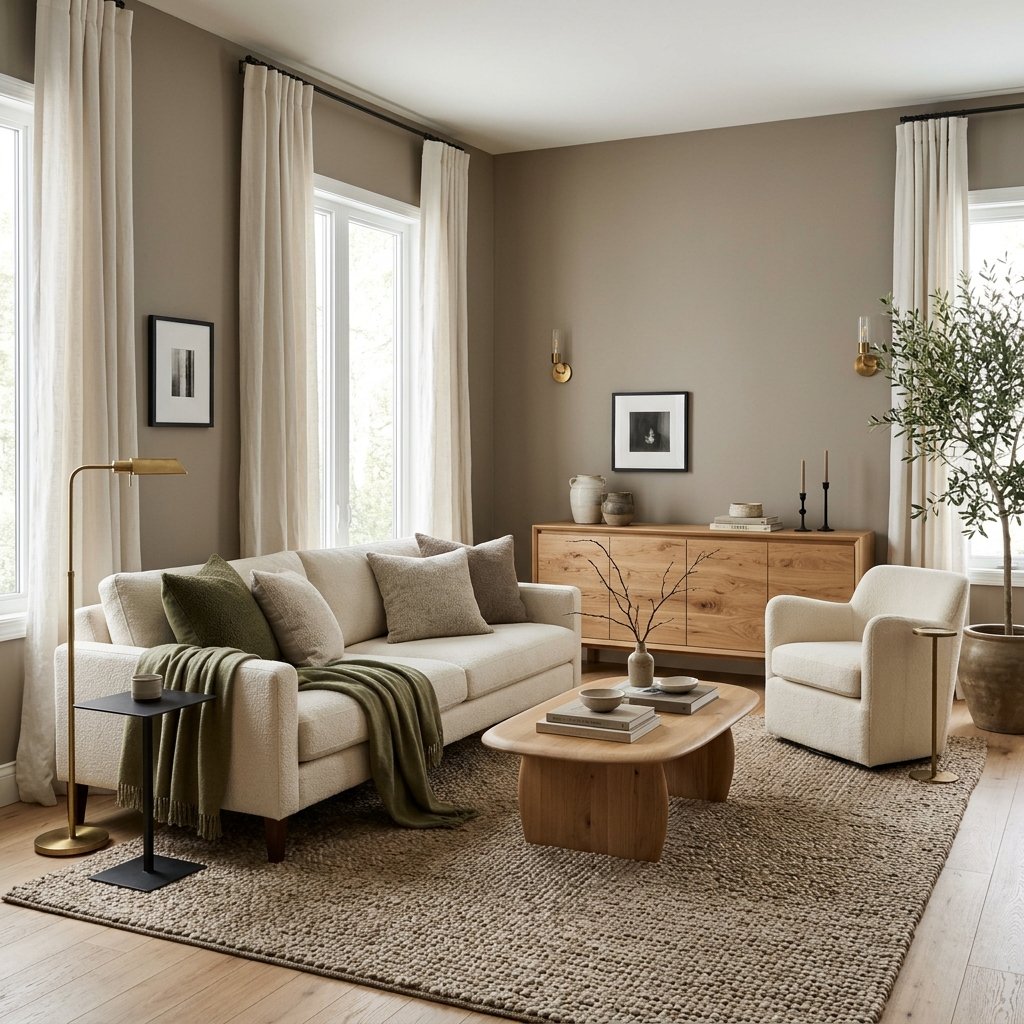
Mushroom Paint Colors for Living Rooms
Mushroom is particularly well suited to living rooms because it works with so many furniture materials.
Try mushroom walls with:
- Cream sofa
- Leather chair
- Walnut table
- Oak furniture
- Linen curtains
- Vintage rug
The color provides more warmth than conventional gray without forcing the room into a strong beige palette.

Mushroom Paint Colors for Bedrooms
Bedrooms can handle slightly deeper mushroom colors because the extra depth can make the room feel cozy.
Try:
Mushroom walls + cream bed + walnut nightstands + oatmeal bedding
or:
Deep mushroom walls + warm white bedding + brass lighting
Keep the bedding lighter if you want contrast.
For a cocooning effect, layer several related taupe and brown tones instead.
Mushroom Kitchen Cabinets
Mushroom is an excellent alternative to white, gray, or beige kitchen cabinets.
It can provide enough color to feel intentional without dominating the room.
Mushroom cabinets pair beautifully with:
- Creamy white countertops
- Warm stone
- White oak
- Walnut
- Brass
- Black
- Warm white walls
The exact undertones become especially important in a kitchen because countertops and backsplashes are large fixed surfaces.
Always compare the cabinet color directly with those materials.
Mushroom Bathroom Vanities
A mushroom-colored vanity can add warmth to a bathroom dominated by pale tile and stone.
Try combining it with:
- Warm white walls
- Cream stone
- Marble-look surfaces
- Brass
- Polished nickel
- Natural wood
If the bathroom has very cool gray tile, sample carefully.
A warm taupe vanity may emphasize the temperature difference between the finishes.
Mushroom Built-Ins
Built-ins are an excellent place to use a deeper mushroom shade.
The color creates contrast without the intensity of black or charcoal.
Try mushroom cabinetry with:
- Warm white walls
- Wood shelves
- Brass picture lights
- Books
- Neutral ceramics
This works especially well in living rooms, offices, libraries, and fireplace walls.
Mushroom Paint With White Trim
White trim can create beautiful contrast with mushroom walls.
But the type of white matters.
A warm mushroom color may coordinate more naturally with:
- Warm white
- Soft white
- Creamy white
A very blue-white trim can make the wall color appear warmer or browner by comparison.
Sample the two colors together rather than choosing them independently.
Mushroom Paint With Cream
Cream and mushroom are natural partners.
Cream provides lighter contrast while preserving the warmth of the overall palette.
Try:
Mushroom walls + cream curtains
Mushroom cabinets + creamy countertop
Mushroom built-ins + warm white walls
The result can feel sophisticated without relying on strong color.
Mushroom Paint With Natural Wood
Wood is one of the easiest materials to pair with mushroom.
Try:
- White oak
- Natural oak
- Walnut
- Medium brown wood
- Dark wood
The earthy character of mushroom paint connects naturally with wood grain.
If both the paint and wood are very warm, add a little contrast through black, cream, or muted green.
Mushroom Paint With Black
Black adds definition to mushroom interiors.
Use it sparingly through:
- Picture frames
- Curtain rods
- Lighting
- Hardware
- Furniture legs
This can prevent a room filled with beige, taupe, and brown from becoming visually muddy.
Mushroom Paint With Brass
Brass emphasizes the warmth of mushroom colors.
Aged or antique-style brass can work particularly well with earthy taupe walls or cabinetry.
Try it through:
- Cabinet hardware
- Lamps
- Picture lights
- Curtain rods
- Mirrors
You don’t need much.
A few repeated metal details are usually enough.
Mushroom Paint With Green
Muted green and mushroom can create a sophisticated nature-inspired palette.
Try:
- Olive
- Sage
- Moss
- Deep forest green
For example:
Mushroom walls + olive chair + cream sofa + walnut
This feels colorful without being bright.
Mushroom Paint With Blue
Blue can provide cooler contrast.
Muted navy, dusty blue, and blue-gray can all be interesting partners.
A blue accent may also keep a very warm mushroom room from feeling too beige.
Test the colors together because some taupes reveal stronger pink or violet undertones beside blue.
Mushroom Paint in North-Facing Rooms
Cooler northern light can make a mushroom paint color appear:
- Grayer
- More muted
- Slightly cooler
- Sometimes deeper
A warmer mushroom may balance that light nicely.
But don’t automatically choose the warmest sample.
Test it throughout the day.
Mushroom Paint in South-Facing Rooms
Warm, abundant light may emphasize the beige or brown side of a mushroom color.
A shade that looks balanced in cooler light may become noticeably warmer.
If your room receives strong warm sunlight, compare several samples with different undertones.
Mushroom Paint in East-Facing Rooms
East-facing rooms usually receive warmer direct light in the morning and cooler or more subdued light later.
A mushroom neutral may therefore look warmer at breakfast and grayer in the afternoon.
Check it during both periods.
Mushroom Paint in West-Facing Rooms
West-facing rooms can become much warmer later in the day.
Expect taupe and beige qualities to become more noticeable in strong afternoon or evening light.
A sample you love in the morning may look quite different at sunset.

Mushroom vs. Greige
Greige combines gray and beige.
Mushroom often occupies similar territory but generally feels earthier and can include more taupe or brown.
Think:
Greige = gray + beige
Mushroom = beige + gray + taupe/brown
These aren’t strict technical definitions, though.
Paint color categories overlap.
Mushroom vs. Taupe
Taupe often has a stronger gray-brown character.
Mushroom can be taupe-like but may also lean beige or putty.
In practice, many colors could reasonably be described by both names.
Mushroom vs. Beige
Traditional beige often has more obvious yellow or golden warmth.
Mushroom typically feels more muted because gray or taupe softens that warmth.
If beige makes your home look too yellow but gray feels too cold, mushroom is a useful middle ground to explore.
How to Make Mushroom Paint Look Modern
Mushroom doesn’t have to feel traditional.
Pair it with:
- Simple furniture
- Natural wood
- Cream textiles
- Black accents
- Sculptural lighting
- Minimal window treatments
- Large artwork
Avoid filling the room with too many similar brown accessories.
Contrast keeps the palette fresh.
How to Keep Mushroom Paint From Looking Muddy
Complex neutrals can become muddy when every surface is the same medium-value brown-gray.
Create separation.
Use:
- Light cream
- Dark wood
- Black
- Green
- Brass
- Natural texture
Vary both color and value.
A room with mushroom walls, mushroom sofa, mushroom rug, mushroom curtains, and mushroom furniture may lack definition.
How to Sample Mushroom Paint Colors
This step is especially important with taupes and complex neutrals.
Paint large sample boards or use large removable samples when available.
Then move them around the room.
Check the color:
- Beside flooring
- Behind furniture
- Near countertops
- Against trim
- In morning light
- In afternoon light
- At night with lamps on
Don’t judge the color from a small chip held in the middle of the room.
Common Mistakes With Mushroom Paint Colors
Choosing by the Name
A color called “taupe,” “stone,” or “mushroom” isn’t guaranteed to look the way you expect.
Ignoring Pink or Violet Undertones
Some taupes can reveal these undertones beside other materials.
Ignoring Green Undertones
Complex neutrals may shift depending on surrounding colors.
Using the Wrong White
A cool white can exaggerate the warmth of mushroom paint.
Matching Everything
Use contrast rather than turning every surface taupe.
Ignoring Lighting
Mushroom colors are highly responsive to light.
Skipping Samples
Never select a complex neutral from an online photograph alone.
A Simple Mushroom Color Palette
If you’re building an entire room around mushroom paint, try one of these formulas.
Warm and Natural
Mushroom + cream + walnut + aged brass
Organic Modern
Light mushroom + white oak + warm white + olive
Moody
Deep mushroom + cream + dark wood + black
Soft and Traditional
Taupe mushroom + warm white + muted blue + brass
Minimal
Pale mushroom + cream + natural oak + black accents
Keep the palette relatively restrained and let texture create additional interest.
FAQ About Mushroom Paint Colors
What color is mushroom paint?
Mushroom is generally an earthy neutral combining elements of beige, taupe, gray, and brown. Exact undertones vary significantly by paint color.
Is mushroom paint warm or cool?
Most mushroom colors feel neutral to warm because they contain beige, brown, or taupe, although grayer versions can appear cooler.
Is mushroom paint still a neutral?
Yes. Mushroom colors can function as neutrals even though they have more depth and complexity than white or pale gray.
What colors go with mushroom paint?
Cream, warm white, natural wood, walnut, black, brass, olive, sage, navy, and dusty blue can all pair beautifully with mushroom.
Does mushroom paint go with gray?
It can. Look for a gray that shares compatible undertones rather than combining a very cool blue-gray with a strongly warm brown-beige without testing them together.
What Sherwin-Williams colors have a mushroom look?
Colors worth sampling include Accessible Beige, Balanced Beige, Tony Taupe, Shiitake, Loggia, and Mega Greige.
What Benjamin Moore colors have a mushroom look?
Pale Oak, Edgecomb Gray, Pashmina, Stone Hearth, Smokey Taupe, and Ashley Gray are among the colors worth exploring for mushroom-inspired palettes.
Is mushroom a good kitchen cabinet color?
Yes. Mushroom can provide more warmth than gray and more depth than white while still functioning as a neutral.
What white goes with mushroom paint?
Soft or warm whites often coordinate naturally, but the correct white depends on the specific mushroom shade and your fixed finishes. Sample them together.
Can mushroom paint look pink?
Some taupe and greige colors can reveal pink or violet undertones under certain lighting conditions or beside particular finishes. Sampling is the best way to catch an unwanted undertone.
Final Thoughts
The best mushroom paint colors sit comfortably between familiar neutral categories.
They’re not quite beige.
They’re not simply gray.
And they’re usually more earthy and substantial than pale greige.
That complexity makes mushroom an excellent option when you want a warm, sophisticated neutral for walls, kitchen cabinets, bathroom vanities, built-ins, bedrooms, or living rooms.
For something light, explore colors such as Accessible Beige, Pale Oak, or Edgecomb Gray.
For more depth, compare Balanced Beige, Shiitake, Pashmina, Stone Hearth, or Smokey Taupe.
And if you want a richer mushroom look, move toward deeper taupes such as Tony Taupe or Ashley Gray.
But don’t choose from the name or online photograph alone.
Mushroom colors can shift dramatically with lighting and surrounding materials.
Sample several candidates directly beside your floors, countertops, furniture, trim, and other permanent finishes.
When you find the right undertone, mushroom paint can give a room exactly what many neutral interiors are missing: warmth, depth, and character without sacrificing the flexibility of a neutral palette.