

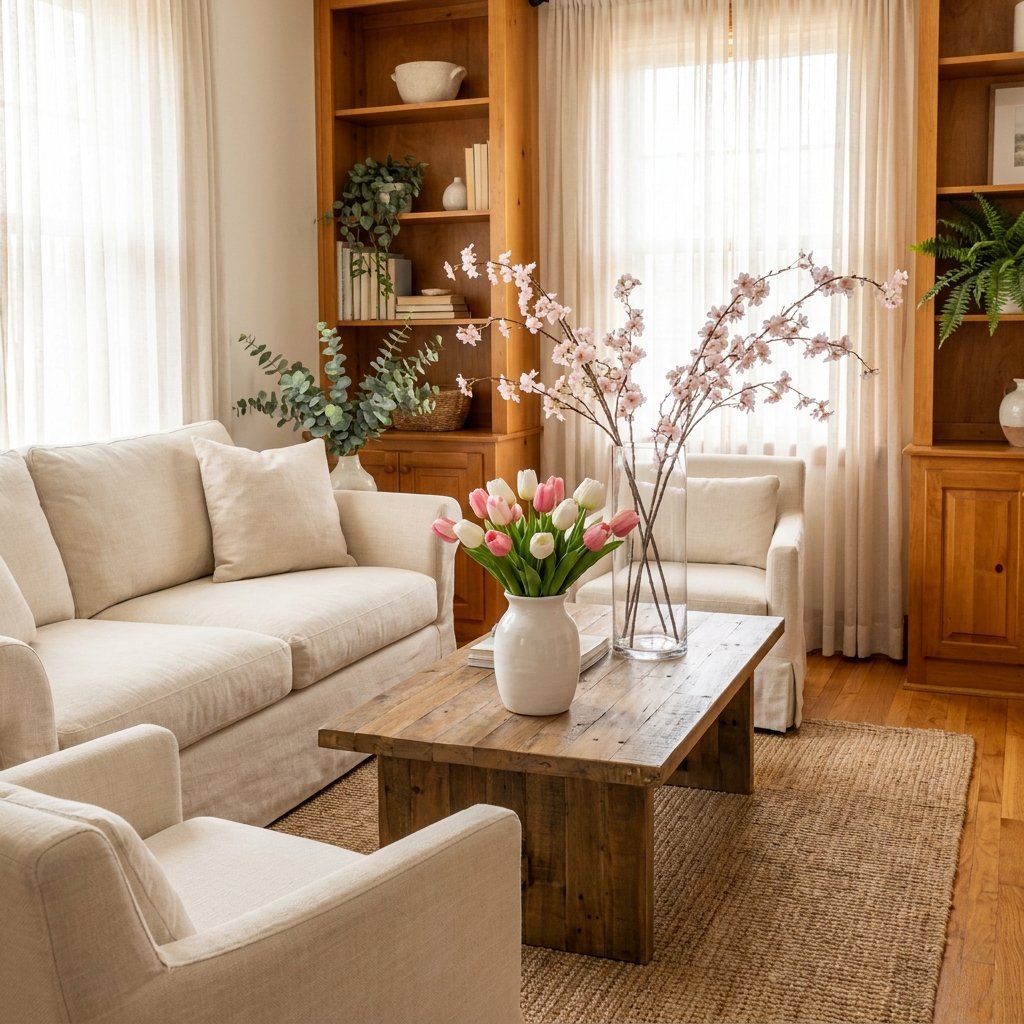
Spring is one of the easiest seasons to decorate with flowers.
Fresh blooms are beautiful, but they are not always practical. They need regular water, they wilt quickly, and buying new bouquets every week can get expensive.
That is where high-quality faux flowers can be useful.
The best fake flowers for spring are not necessarily the most colorful or elaborate. The most convincing arrangements usually use realistic shapes, natural-looking stems, slightly varied petals, and colors that feel soft rather than overly bright.
You can also make inexpensive faux flowers look much more believable by arranging them loosely, mixing different stem lengths, and using containers that hide the artificial stems.
From tulips and peonies to cherry blossoms and delicate wildflowers, these spring faux flower ideas can help you decorate entryways, dining tables, kitchen counters, mantels, and more.
1. Faux Tulips
Tulips are one of the easiest faux flowers to use for spring.
Their simple shape makes them work with many decorating styles.
Try:
- White tulips
- Soft pink tulips
- Pale yellow tulips
- Blush tulips
- Cream tulips
For the most natural look, avoid arranging every stem at exactly the same height.
Let a few stems lean outward slightly.
Tulips naturally have a relaxed shape, so an arrangement that looks too stiff can immediately appear artificial.
Where to Use Them
Faux tulips are especially pretty on:
- Kitchen islands
- Nightstands
- Entry tables
- Coffee tables
- Dining tables
A small bunch can be enough to add a spring touch without overwhelming the room.
2. Faux Peonies
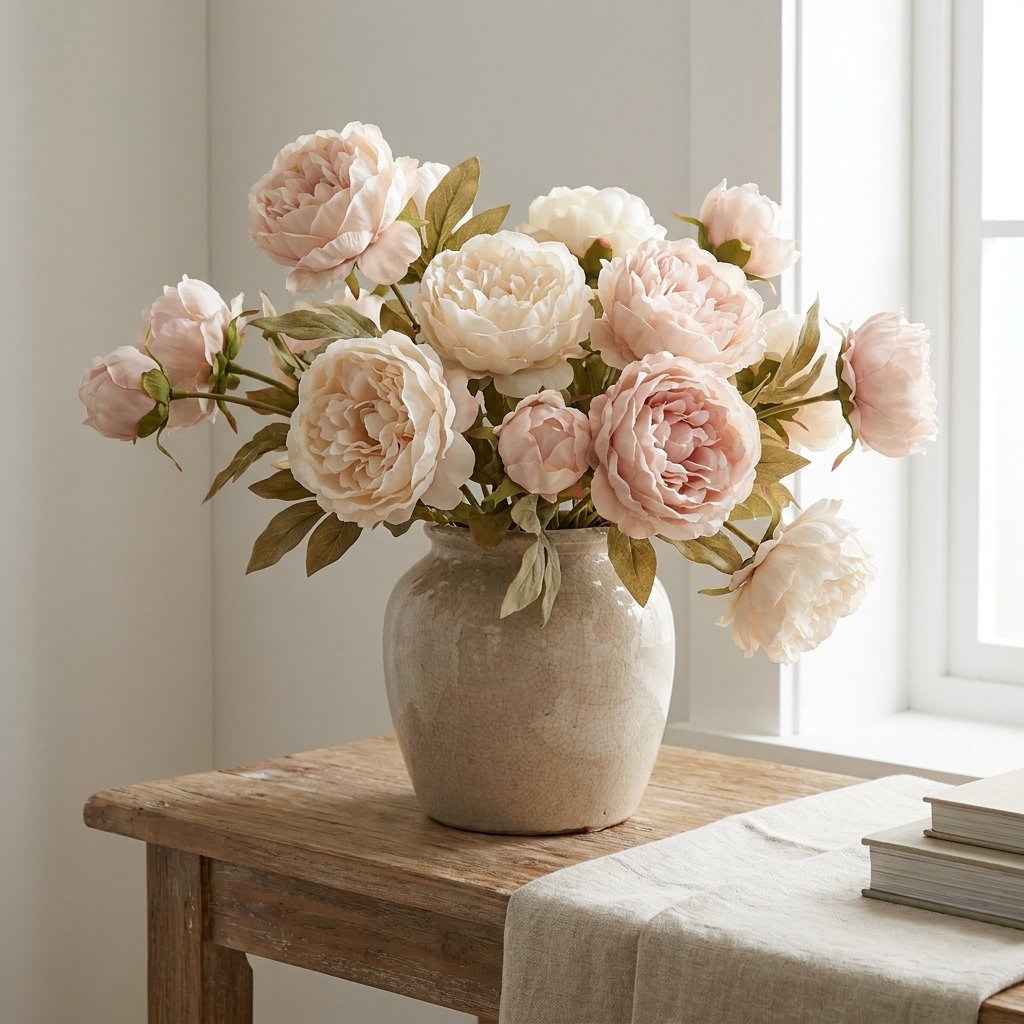
Peonies create a fuller, softer arrangement.
They are useful when you want spring flowers that feel a little more romantic or traditional.
Good colors include:
- Cream
- Blush
- Pale pink
- Soft coral
- Muted white
Look for blooms with slightly irregular petals rather than perfectly symmetrical flowers.
Real flowers have variation, and faux versions tend to look more convincing when they do too.
3. Faux Cherry Blossom Branches
Cherry blossom branches are perfect when you want a taller spring arrangement.
They work particularly well in:
- Entryways
- Dining rooms
- Living rooms
- Large kitchen islands
Place them in a tall ceramic or glass vase and allow the branches to spread naturally.
You often need fewer stems than you think.
A handful of long branches can look more elegant than an overfilled vase.
4. Faux Hydrangeas
Hydrangeas are ideal for creating volume.
Because each flower head is large, only a few stems may be needed to fill a vase.
Spring-friendly colors include:
- White
- Pale blue
- Soft green
- Blush
- Cream
Hydrangeas work beautifully in traditional, coastal, farmhouse, and cottage-style interiors.
Use them in an opaque vase if the artificial stems look noticeably synthetic.
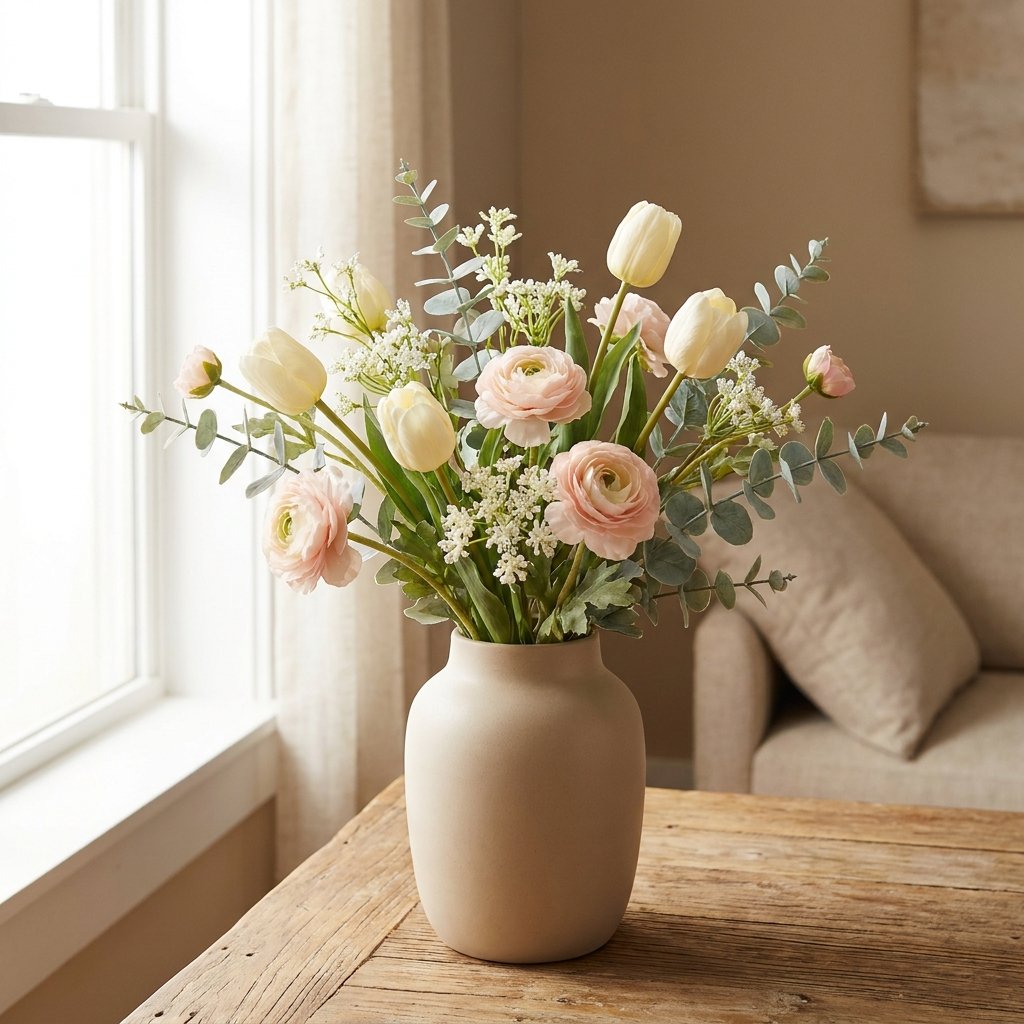
5. Faux Ranunculus
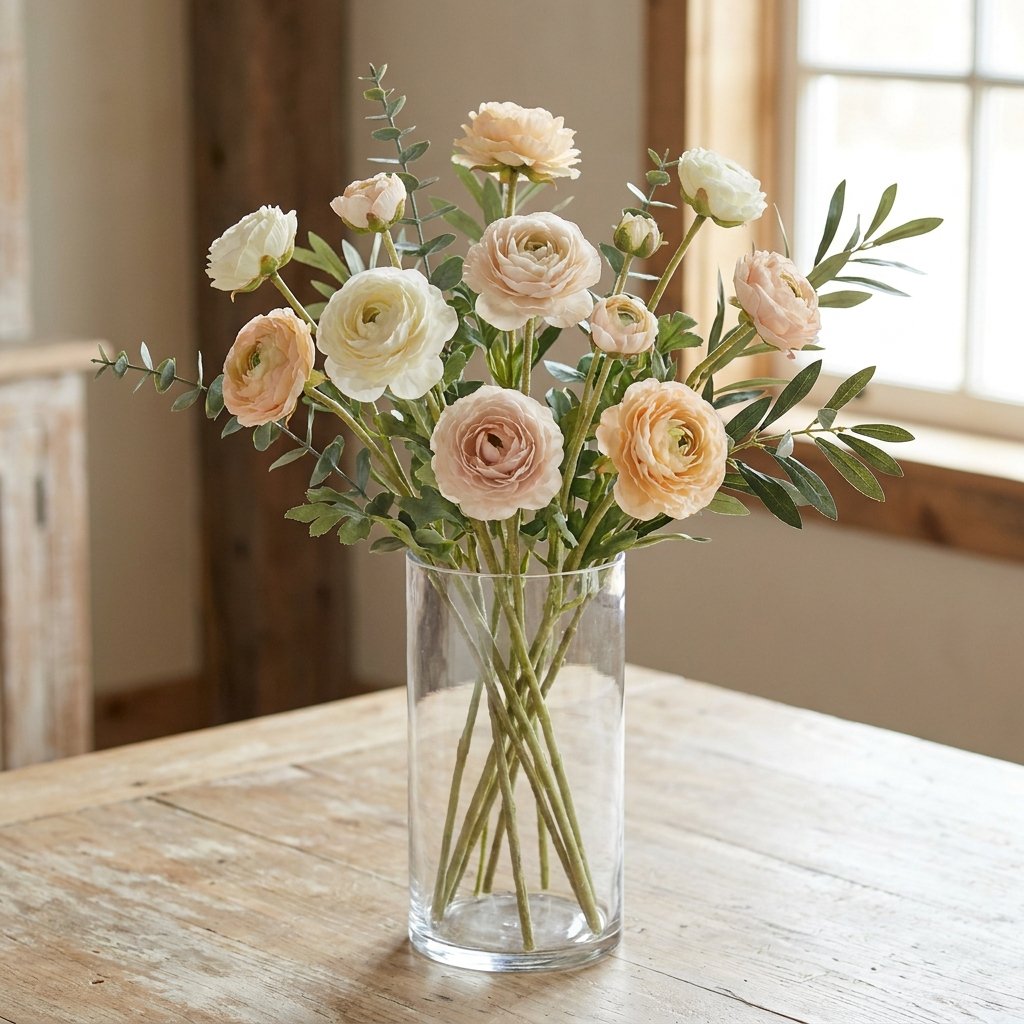
Ranunculus flowers have layered petals and a delicate garden look.
They are a good choice if you want something softer than tulips but less dramatic than large peonies.
Try mixing faux ranunculus with:
- Small greenery
- Tiny white blossoms
- Tulips
- Wildflower-style stems
They look especially pretty in smaller arrangements.
6. Faux Daffodils
Daffodils instantly feel like spring.
Their yellow color can add warmth to a neutral home without requiring lots of seasonal decorations.
A simple bunch works well in:
- Pitcher
- Crock
- Glass vase
- Ceramic jug
For a more understated look, use pale yellow or cream-toned daffodils rather than very bright versions.
7. Faux Lilac Stems
Lilacs add beautiful texture and a slightly romantic feeling.
Look for:
- Soft lavender
- White
- Dusty purple
Their clustered blooms can make an arrangement feel full while still looking airy.
Use lilacs by themselves or mix them with leafy branches.
A loose arrangement often looks more natural than a tightly packed bouquet.
8. Faux Dogwood Branches
Dogwood-style branches offer height without the fullness of cherry blossoms.
They can work beautifully in minimalist or neutral rooms.
White faux dogwood blooms look especially fresh in:
- Tall white vase
- Clear glass vessel
- Rustic pottery
The branching shape adds movement and helps fill vertical space.
9. Faux Magnolia Branches
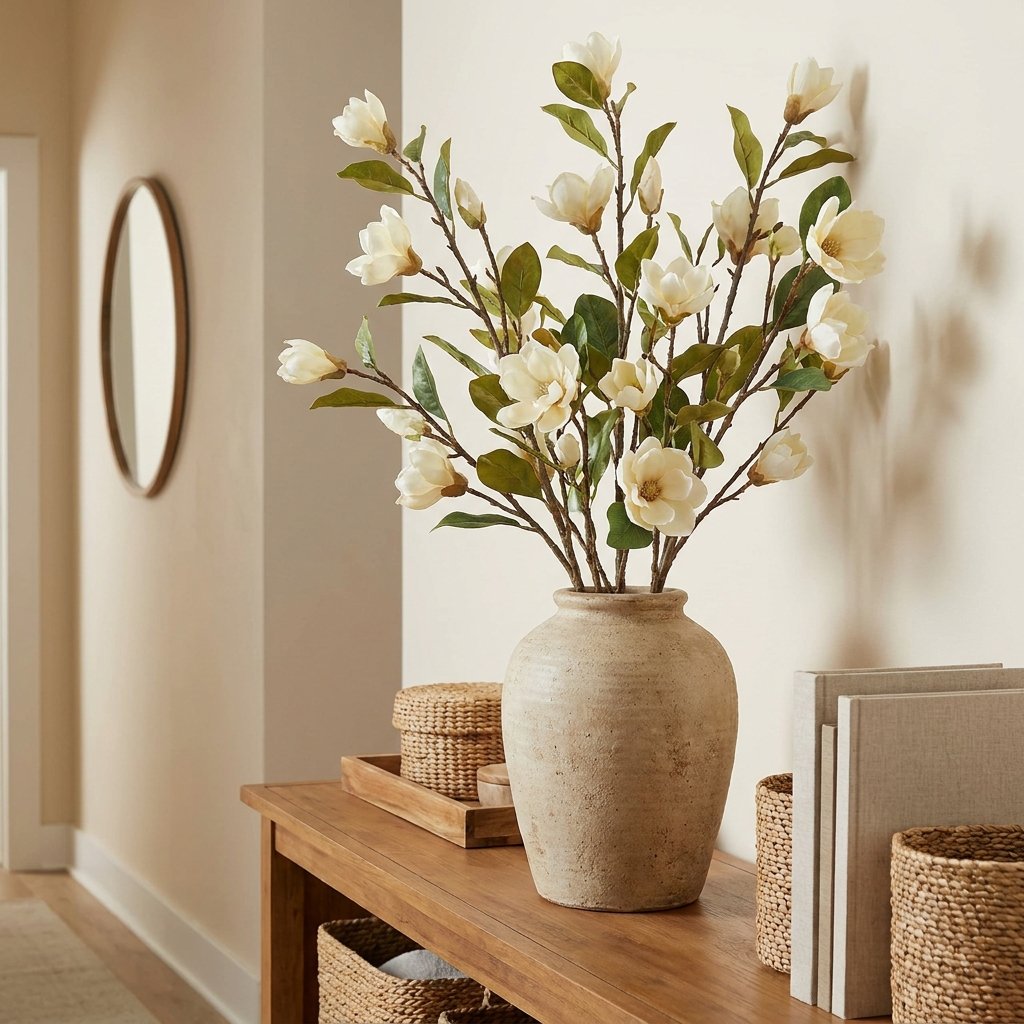
Magnolia blossoms are larger and more sculptural than many spring flowers.
Their creamy petals pair especially well with warm neutral interiors.
Try them in rooms with:
- Natural wood
- Linen
- Brass
- Woven textures
- Warm white walls
Because the blooms are substantial, keep the arrangement relatively simple.
10. Faux Sweet Peas
Sweet peas have a light, delicate appearance that works beautifully for spring.
They are especially good if you prefer:
- Cottage decor
- Traditional interiors
- Romantic styling
- English garden-inspired arrangements
Choose soft colors such as:
- White
- Lavender
- Pale blush
- Dusty pink
Arrange them loosely rather than trying to create a perfectly rounded bouquet.
11. Faux Wildflowers
Wildflower-style faux stems can make a room feel more relaxed and casual.
Look for mixed stems containing:
- Small blossoms
- Fine greenery
- Tiny leaves
- Different flower heights
They work especially well in rustic pottery or clear vintage-style bottles.
Avoid arrangements with too many different bright colors.
Limiting the palette often makes faux wildflowers look more sophisticated.
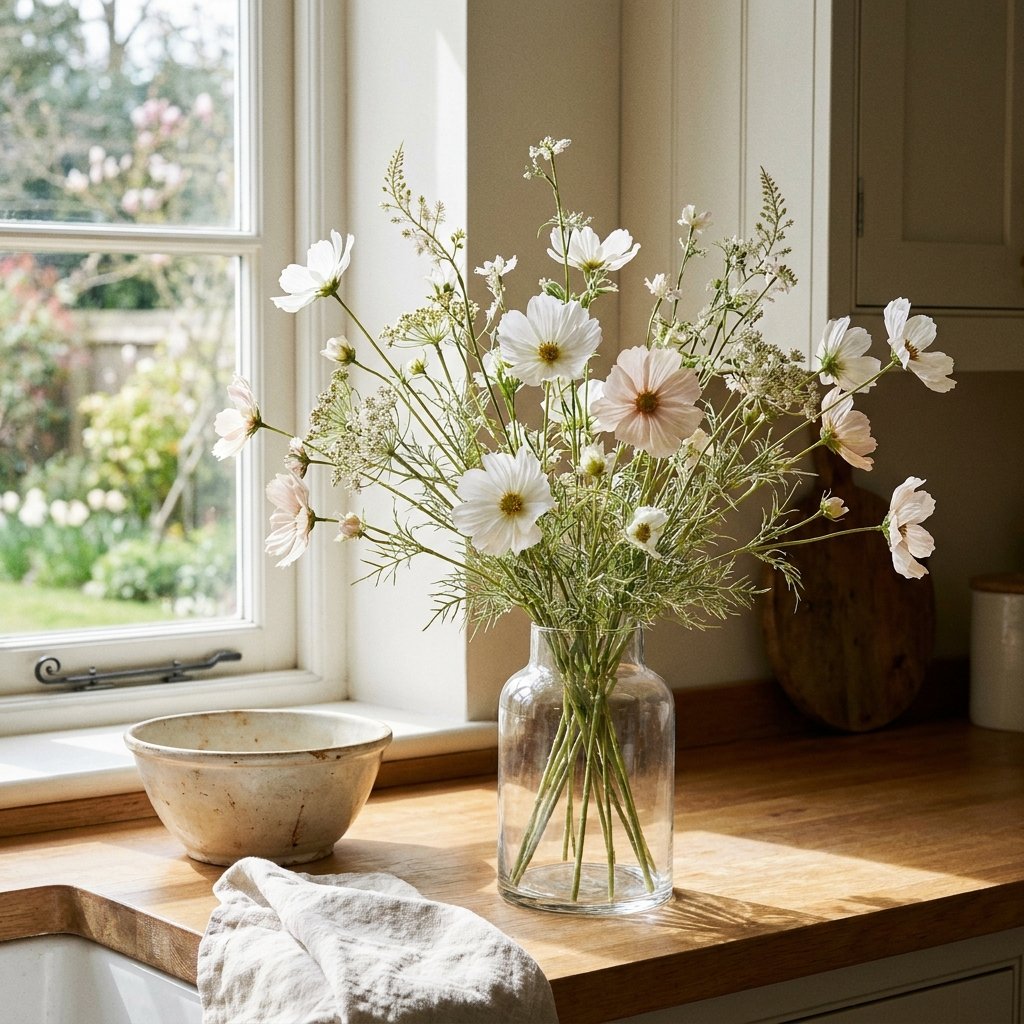
12. Faux Cosmos
Cosmos flowers have a simple, open shape that feels airy and informal.
They can be beautiful in rooms where a heavy floral arrangement would feel too formal.
Use several stems at different heights.
White, blush, or muted pink cosmos look particularly fresh for spring.
13. Faux Anemones
Anemones add a little contrast because of their dark centers.
They work well with:
- White petals
- Blush petals
- Soft purple petals
Use them sparingly as an accent in mixed arrangements.
A few anemones combined with tulips or greenery can add visual interest without making the arrangement too busy.
14. Faux Greenery With Small Blossoms
You do not always need a vase filled with large flowers.
Branches with small spring blossoms can look especially realistic.
Try:
- Leafy branches
- Tiny white blossoms
- Budding stems
- Soft green foliage
These are good choices for homes with a more natural or minimalist decorating style.
15. Mixed Faux Spring Bouquets
If you prefer a fuller arrangement, create your own mixed bouquet.
Try combining three types of stems rather than using every flower you like.
For example:
- Tulips
- Ranunculus
- Greenery
Or:
- Peonies
- Wildflowers
- Leafy branches
Keeping the palette and flower selection limited creates a more cohesive arrangement.
How to Choose Fake Flowers That Look Real
Not all faux flowers look convincing.
The most realistic options usually share a few characteristics.
Look for Natural Color Variation
Real flowers rarely have perfectly uniform color.
Look for petals with subtle shading or variation.
Avoid overly neon colors unless the real flower naturally has that intensity.
Check the Petal Texture
Matte or lightly textured petals often look more realistic than very shiny ones.
If the fabric has an obvious plastic sheen, the flower may look artificial from across the room.
Look at the Leaves
Leaves can give away a faux arrangement quickly.
Choose stems with leaves that have:
- Natural veining
- Varied green tones
- Flexible shapes
Avoid extremely glossy foliage when possible.
Examine the Stem
A realistic flower head attached to an obviously plastic stem can ruin the illusion.
Choose stems with flexible wire interiors or natural-looking coverings when possible.
How to Make Fake Flowers Look More Expensive
You do not necessarily need luxury stems.
Good styling can dramatically improve inexpensive faux flowers.
Bend the Stems
Perfectly straight stems often look unnatural.
Gently shape them so they curve and spread slightly.
Vary the Heights
Cut or bend stems so the arrangement does not form one perfectly even line.
Use Fewer Flowers
Overstuffed arrangements can look artificial.
Sometimes three beautiful branches look better than fifteen crowded ones.
Mix Flowers With Greenery
Adding leaves or simple branches creates depth.
Use an Opaque Vase
If the stems look artificial, hide them.
Ceramic, pottery, metal, or colored glass works well.
Avoid Perfect Symmetry
Real flowers naturally lean and overlap.
Allow the arrangement to feel a little relaxed.
Best Fake Flowers for a Spring Mantel
Mantels often look best with either one central arrangement or a few asymmetrical pieces.
Try:
- Cherry blossoms
- Magnolia
- Dogwood
- Tulips
For a simple mantel, use one vase with flowering branches and balance it with artwork or a mirror.
Avoid placing too many small spring decorations around the flowers.
The blooms can provide enough seasonal interest on their own.
Best Fake Flowers for a Dining Table
Dining table arrangements should usually be low enough for people to see across the table.
Good choices include:
- Tulips
- Peonies
- Ranunculus
- Short wildflowers
A low bowl or small ceramic vase works well.
For longer tables, consider several small arrangements instead of one very large centerpiece.
Best Fake Flowers for a Kitchen
Spring flowers can make a kitchen feel fresh without adding much clutter.
Good options include:
- Tulips
- Daffodils
- Small blossom branches
- Ranunculus
Keep arrangements away from active cooking surfaces.
A simple vase near the sink or on an island can add plenty of color.
Best Fake Flowers for an Entryway
Entryways can handle taller arrangements because they usually do not need to preserve conversation sightlines.
Try:
- Cherry blossom branches
- Dogwood branches
- Magnolia branches
- Tall greenery with blossoms
Use a substantial vase so the scale feels appropriate for the console table.
Best Fake Flowers for a Coffee Table
Keep the arrangement lower and smaller.
Good choices include:
- Short tulips
- Peonies
- Ranunculus
- Small wildflowers
The arrangement should not block the view between seating areas.
A few stems in a compact vase are often enough.
Fake Flowers for Neutral Spring Decor
If your home is mostly neutral, you do not need bright florals.
Try:
- Cream
- White
- Pale blush
- Soft green
- Dusty lavender
Pair these colors with:
- Natural wood
- Warm white pottery
- Glass
- Stone
- Woven textures
This creates a subtle seasonal update without changing the entire room.
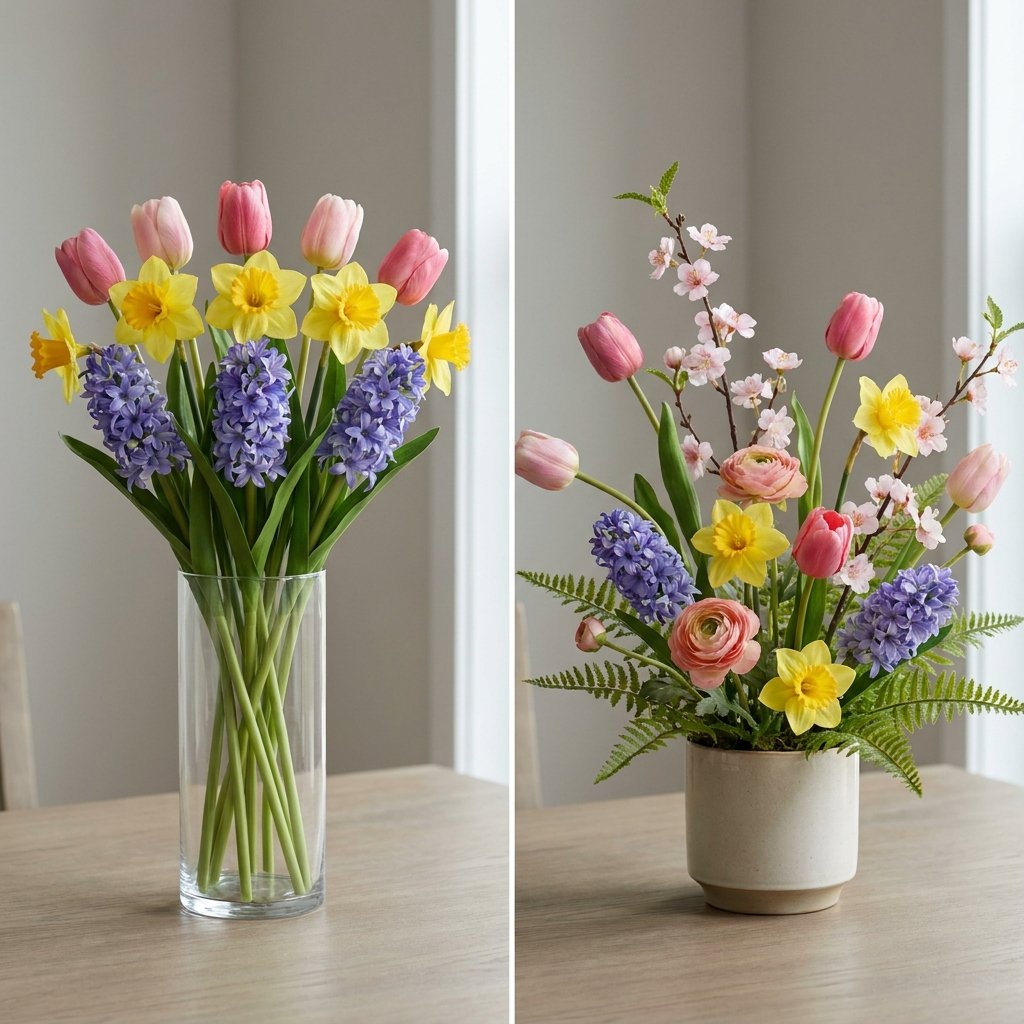
Colorful Faux Spring Flowers
If you prefer more color, choose a limited palette.
For example:
Pink + White
Tulips, peonies, and cherry blossoms.
Yellow + White
Daffodils and tiny white flowers.
Blue + Green
Hydrangeas and leafy stems.
Lavender + Cream
Lilacs and ranunculus.
Using two or three main colors helps the arrangement feel intentional rather than overly busy.
How Many Faux Flower Stems Do You Need?
There is no universal number.
It depends on:
- Vase width
- Stem size
- Flower fullness
- Arrangement style
A large hydrangea head takes up much more visual space than one delicate tulip.
Start with fewer stems.
Arrange them loosely, then add more only where needed.
Can You Mix Real and Fake Flowers?
Yes.
Mixing real greenery or a few fresh flowers with faux stems can make an arrangement feel more natural.
You can also combine faux flowers with:
- Fresh branches
- Dried stems
- Real greenery
Just remember that anything placed in water needs to be appropriate for that use.
Some artificial stems may not be designed for prolonged water exposure.
How to Clean Fake Flowers
Dust can quickly make artificial flowers look less realistic.
For regular maintenance:
- Gently dust petals and leaves.
- Use a soft microfiber cloth where appropriate.
- Follow manufacturer cleaning instructions.
- Avoid aggressive scrubbing that could damage fabric petals.
Keep faux flowers away from excessive moisture unless they are specifically designed for it.
How to Store Faux Flowers Between Seasons
Good storage can help faux flowers last longer.
Before storing:
- Remove dust.
- Allow everything to dry completely.
- Arrange stems loosely rather than crushing them together.
Store them somewhere clean and dry.
Use a container large enough to prevent delicate petals from being flattened.
Common Fake Flower Decorating Mistakes
Using Too Many Different Flowers
A limited selection usually looks more realistic.
Choosing Extremely Bright Colors
Very saturated artificial colors can look less natural.
Leaving Every Stem Straight
Shape them slightly.
Cutting Every Flower to the Same Height
Varying heights creates movement.
Overfilling the Vase
Negative space helps the arrangement breathe.
Ignoring Scale
Tall branches need a substantial vase, while small flowers need a smaller container.
Displaying Dusty Flowers
Dust immediately makes artificial greenery and flowers look tired.
Using Flowers Everywhere
One or two beautiful arrangements often have more impact than a faux bouquet on every surface.
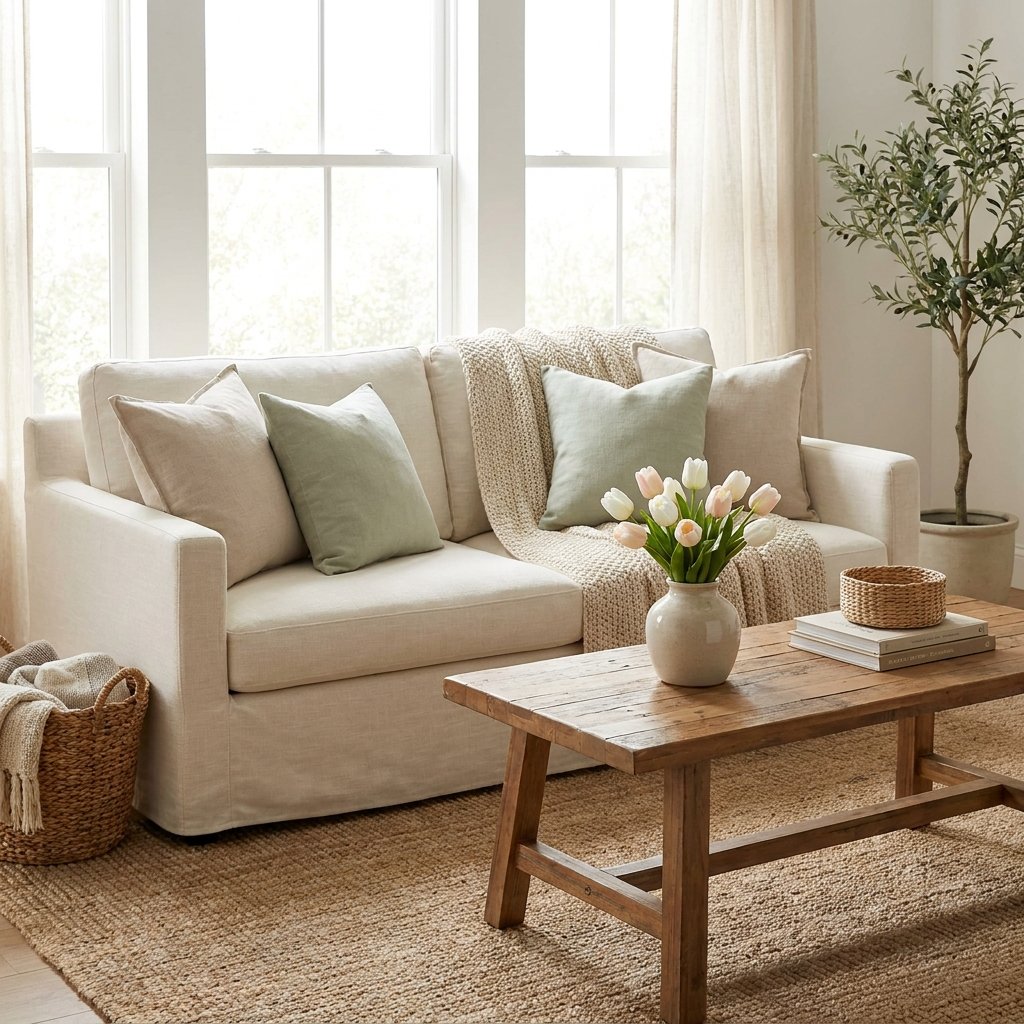
Simple Spring Decorating Ideas With Fake Flowers
Faux flowers work best when they are part of the room rather than the entire spring decorating theme.
Pair them with:
- Light throw pillows
- Woven baskets
- Ceramic bowls
- Simple greenery
- Linen textiles
- Warm wood accents
You do not need signs, themed accessories, or lots of pastel decorations to make a room feel like spring.
One realistic arrangement can be enough.
Fake Flower Safety and Practical Tips
Artificial flowers are low maintenance, but a few practical considerations still matter.
- Keep arrangements away from open flames and hot surfaces.
- Do not place tall, top-heavy vases where they can easily be knocked over.
- Keep small decorative pieces away from babies and young children.
- Check whether materials are suitable before placing faux stems outdoors.
- Keep arrangements away from cooking areas where grease and heat may build up.
- Protect delicate furniture surfaces from rough or wire-ended stems.
- Secure tall arrangements in homes with active pets.
- Follow manufacturer cleaning and care instructions.
FAQ About the Best Fake Flowers for Spring
What fake flowers look the most realistic?
Tulips, peonies, cherry blossoms, ranunculus, hydrangeas, and simple flowering branches can all look very realistic when the petals, leaves, colors, and stems are well made.
What are the best fake flowers for spring decorating?
Tulips, daffodils, peonies, cherry blossoms, lilacs, ranunculus, dogwood, and hydrangeas are all classic spring choices.
How do you make cheap fake flowers look expensive?
Bend the stems, vary the heights, remove overly artificial leaves if necessary, use fewer stems, and display them in a substantial vase.
Are fake flowers still stylish?
Yes. Artificial flowers can work beautifully when they are realistic, simply arranged, and used in moderation.
What color faux flowers are easiest to decorate with?
White, cream, blush, pale green, soft pink, and muted lavender are especially versatile.
Should fake flowers match the room?
They do not need to match exactly, but choosing colors that relate to your room’s existing palette creates a more cohesive look.
What is the best vase for faux flowers?
Opaque ceramic and pottery vases are useful for hiding artificial stems, while glass can work well when the stems themselves look realistic.
How often should you replace fake flowers?
There is no set timeline. Replace them when the petals become damaged, faded, difficult to clean, or no longer look convincing.
Final Thoughts
The best fake flowers for spring are the ones that bring a little seasonal freshness to your home without looking overly artificial or overstyled.
Tulips are a simple choice for kitchens and coffee tables. Peonies and ranunculus create softer arrangements, while cherry blossom, dogwood, and magnolia branches provide height and drama.
Whatever flowers you choose, styling makes a big difference.
Use fewer stems, vary their heights, gently bend them into natural shapes, and choose a vase that suits the scale of the arrangement.
You also do not need spring flowers in every room.
A beautiful vase of tulips on the kitchen island, flowering branches in the entryway, or one loose arrangement on the dining table can be enough to make your home feel lighter and fresher for the season.