


A bathroom mirror is practical, but it is also one of the largest decorative elements around the vanity.
The right mirror can make a small bathroom feel brighter, balance a large vanity, soften a room filled with hard surfaces, and connect the faucet, lighting, hardware, and cabinetry into one cohesive design.
The challenge is choosing the right one.
Should you use one large mirror or two smaller mirrors? Should the frame match the faucet? Is a round mirror practical? How wide should the mirror be compared with the vanity? And what do you do when the sink, sconces, windows, or outlets make the wall difficult to work with?
Instead of choosing a mirror in isolation, look at the entire vanity wall.
Consider the vanity, sink placement, ceiling height, backsplash, lighting, storage, and the amount of reflection you actually need.
These 21 bathroom mirror ideas will help you find a style that looks beautiful while still making sense for everyday use.
Start With the Vanity, Not the Mirror
Before shopping for a bathroom mirror, measure the entire vanity wall.
Record:
- Vanity width
- Countertop width
- Sink location
- Faucet height
- Backsplash height
- Ceiling height
- Light fixture locations
- Outlet and switch locations
- Nearby windows
- Wall edges
Then decide what needs to happen around the mirror.
For example, wall sconces beside the mirror require horizontal space.
A light above the mirror affects its maximum height.
A tall backsplash may push the mirror higher.
Planning everything together is much easier than buying the mirror first and trying to make everything else fit around it.
1. Choose a Large Rectangular Bathroom Mirror
A simple rectangular mirror is one of the most versatile choices.
It works with almost every bathroom style, including:
- Traditional
- Transitional
- Modern
- Farmhouse
- Coastal
A large rectangle also provides plenty of usable reflection.
For a timeless look, choose a simple frame and let the vanity, tile, or lighting provide the decorative detail.

2. Try a Round Bathroom Mirror
A round mirror can soften a bathroom filled with rectangular elements.
Think about how many straight lines are already present:
- Vanity
- Counter
- Tile
- Shower
- Cabinetry
Adding a circle introduces contrast.
Round mirrors work particularly well above single vanities.
Just make sure the diameter provides enough usable mirror area for your needs.
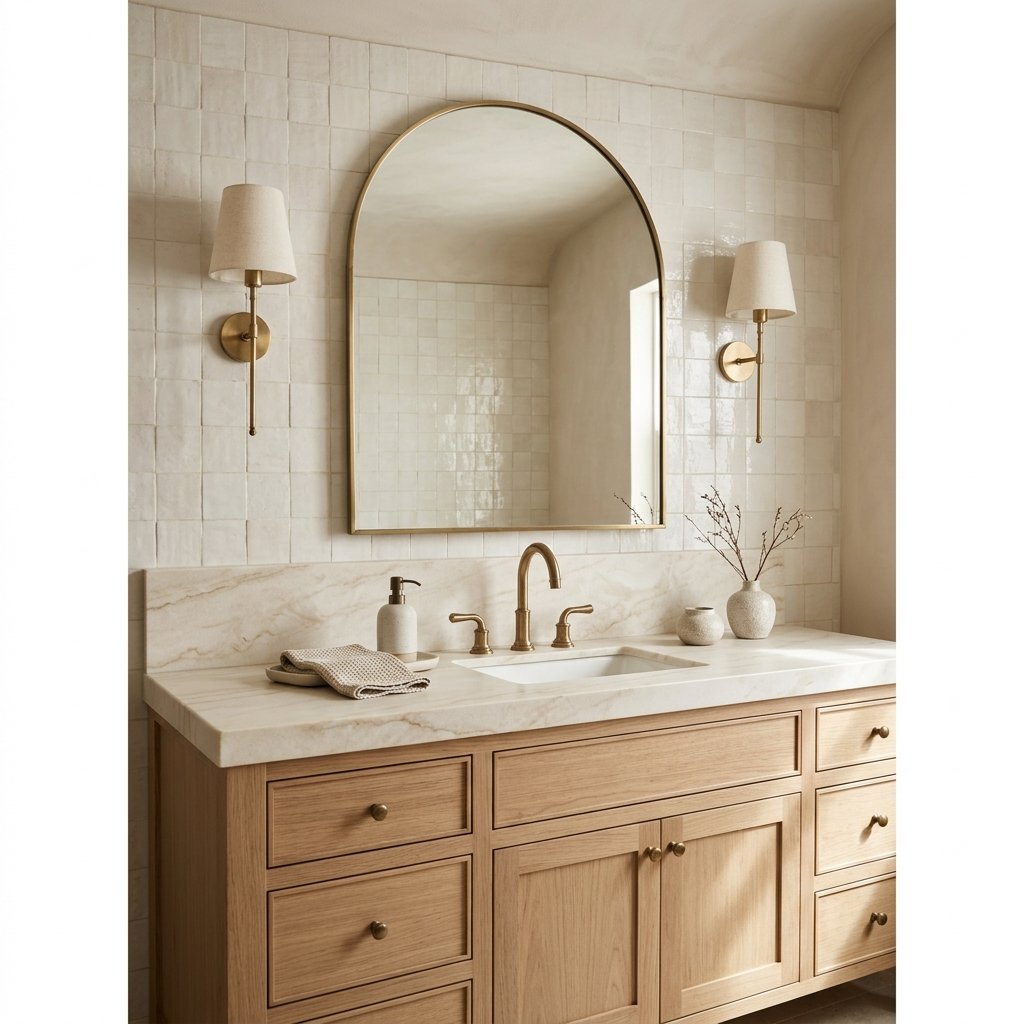
3. Use an Arched Bathroom Mirror
An arched mirror combines the practicality of a rectangular mirror with a softer top.
It can add subtle architectural character without becoming overly decorative.
Arched mirrors look beautiful with:
- Wood vanities
- Painted vanities
- Marble
- Warm metal finishes
- Classic sconces
Repeat the arch somewhere else only if it feels natural. You don’t need an entire room of curved shapes.
4. Choose a Pill-Shaped Mirror
A pill or capsule-shaped mirror has rounded ends and a clean contemporary feel.
It works especially well in a narrow bathroom because its vertical shape can emphasize ceiling height.
Pair it with simple sconces and a streamlined vanity.
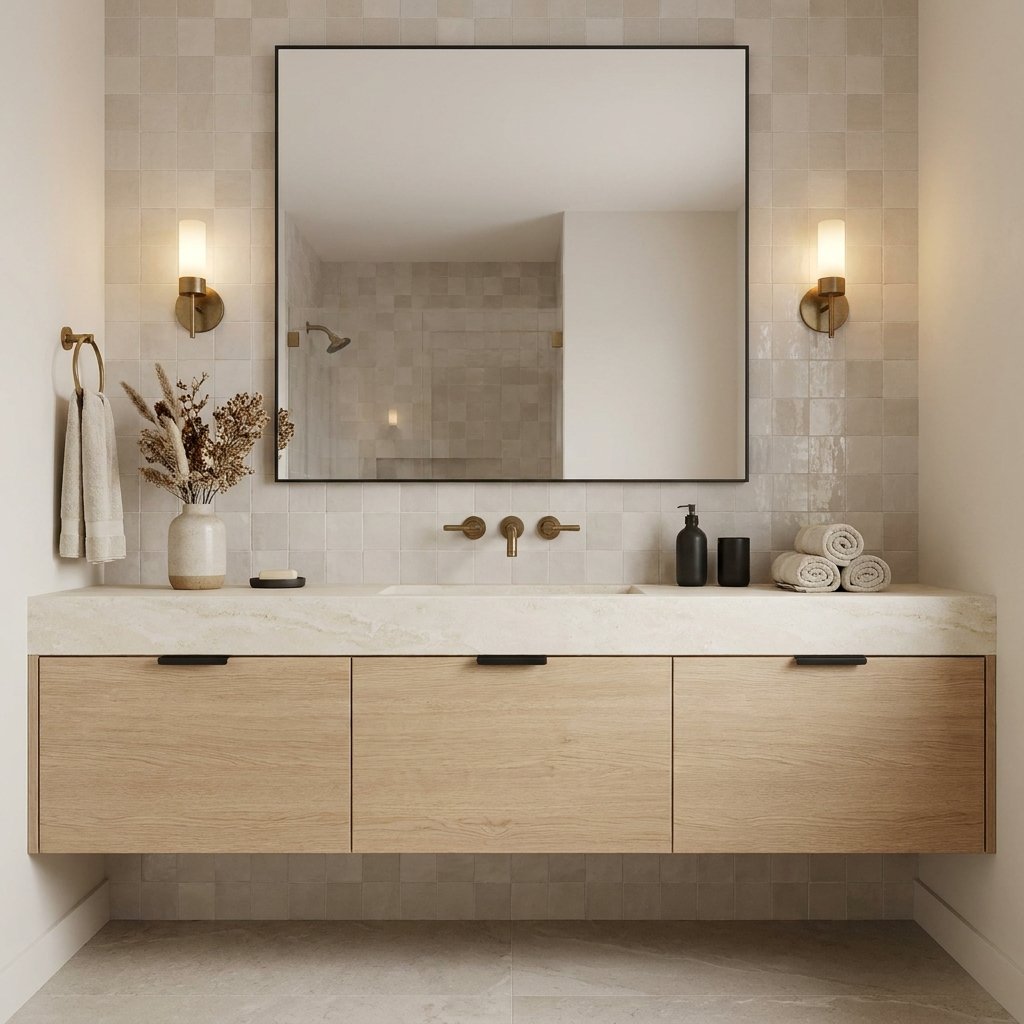
5. Add a Black-Framed Mirror
A black frame adds definition.
It can work particularly well when the bathroom already contains black through:
- Faucet
- Shower frame
- Hardware
- Lighting
But you don’t need every metal finish to match.
A black mirror can also provide contrast in a bathroom with brass fixtures or a warm wood vanity.
6. Use an Aged-Brass Mirror
Warm metal can make a bathroom feel softer and more collected.
A thin aged-brass frame works beautifully with:
- Cream
- Taupe
- Green
- Natural wood
- Marble
- Warm white
If your faucet is polished nickel or black, you can still use brass.
Mixing metals works best when each finish appears intentionally rather than accidentally.
7. Try a Wood-Framed Bathroom Mirror
A wood frame adds warmth to a room dominated by tile, stone, glass, and porcelain.
You don’t have to match the vanity exactly.
For example:
Medium oak vanity + slightly darker wood mirror
can feel more collected than trying to find two almost-identical wood finishes.
Make sure the frame material and finish are appropriate for a bathroom environment and the moisture conditions of the space.
8. Go Frameless
A frameless mirror can create a quiet, streamlined look.
It is particularly useful when the bathroom already has a lot happening visually.
For example:
- Patterned tile
- Strong stone
- Detailed vanity
- Decorative lighting
A simple frameless mirror allows those materials to remain the focus.
Pay attention to edge treatment and professional installation.
9. Use One Large Mirror Over a Double Vanity
A single large mirror can visually widen a bathroom.
It also provides plenty of reflection and can make a double vanity feel unified.
This approach works well when you want a clean, continuous look.
You can place sconces:
- Above the mirror
- Beside it where space allows
- In other appropriately planned positions
Lighting and electrical placement should be coordinated before mirror installation.
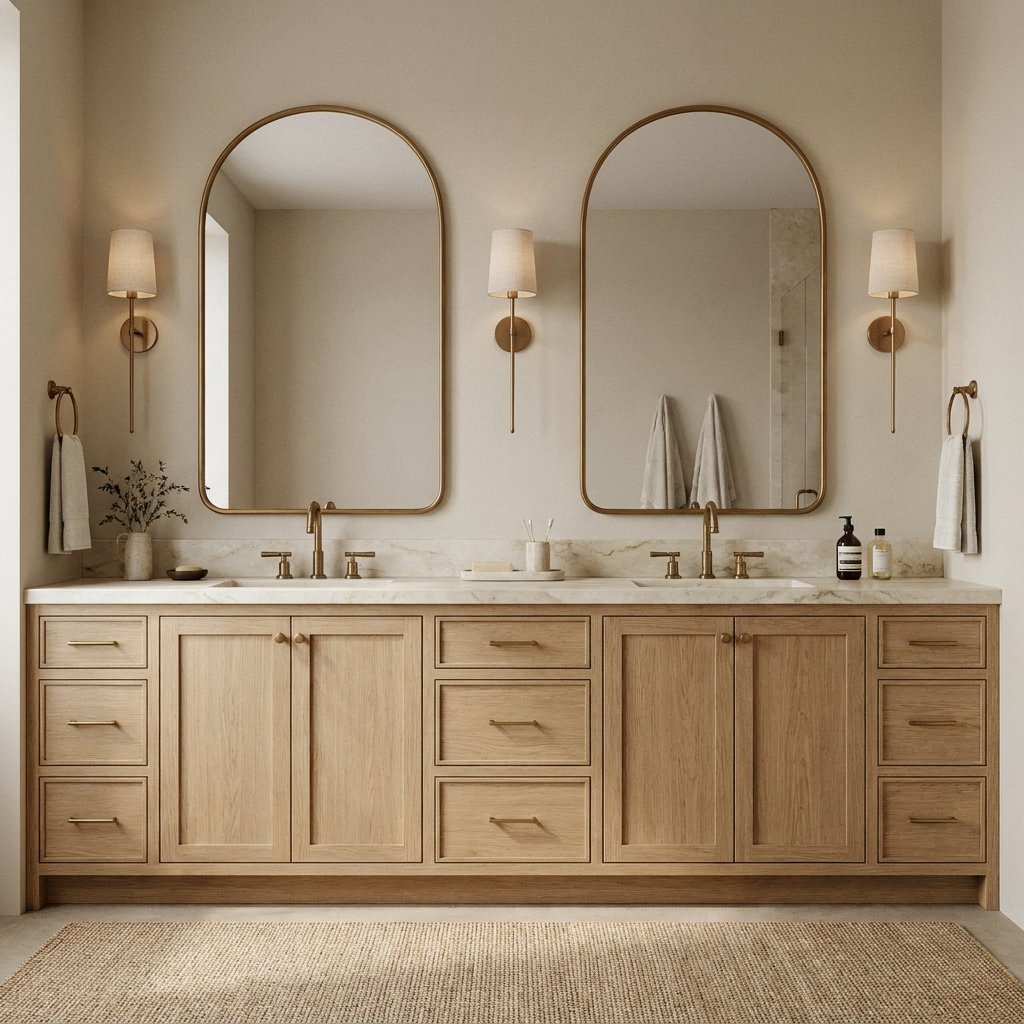
10. Use Two Mirrors Over a Double Vanity
Two mirrors create more separation between individual sink areas.
This arrangement can also give you space for a center sconce.
For example:
Sconce + mirror + sconce + mirror + sconce
can create a beautifully balanced vanity wall when dimensions allow.
The mirrors don’t need to be tiny.
Give them enough width to feel proportional to the sinks and vanity.
11. Use Matching Round Mirrors Over a Double Vanity
Two round mirrors can soften a long double vanity.
This works particularly well when the vanity itself has strong straight lines.
Leave enough visual breathing room between the circles.
If the mirrors are too small, the wall may feel under-scaled.
12. Add a Medicine Cabinet Mirror
A mirrored medicine cabinet can solve two problems at once.
You get:
- Mirror
- Hidden storage
This can be especially useful in:
- Small bathrooms
- Powder rooms
- Bathrooms with limited drawers
Recessed medicine cabinets may require modifications inside the wall, so check for plumbing, wiring, framing, and other obstructions before cutting.
13. Use a Surface-Mounted Medicine Cabinet
If recessing into the wall isn’t practical, consider a surface-mounted mirrored cabinet.
Look for a simple profile that relates to the vanity.
The cabinet will project farther from the wall than a standard mirror, so check how it interacts with faucets, lighting, doors, and nearby walls.
14. Choose a Vintage-Inspired Mirror
A vintage or vintage-inspired mirror can keep a bathroom from feeling too new.
Look for:
- Aged brass
- Dark wood
- Subtle carved details
- Interesting shape
One vintage-style piece is often enough.
Pair it with simpler fixtures so the bathroom doesn’t become overly themed.
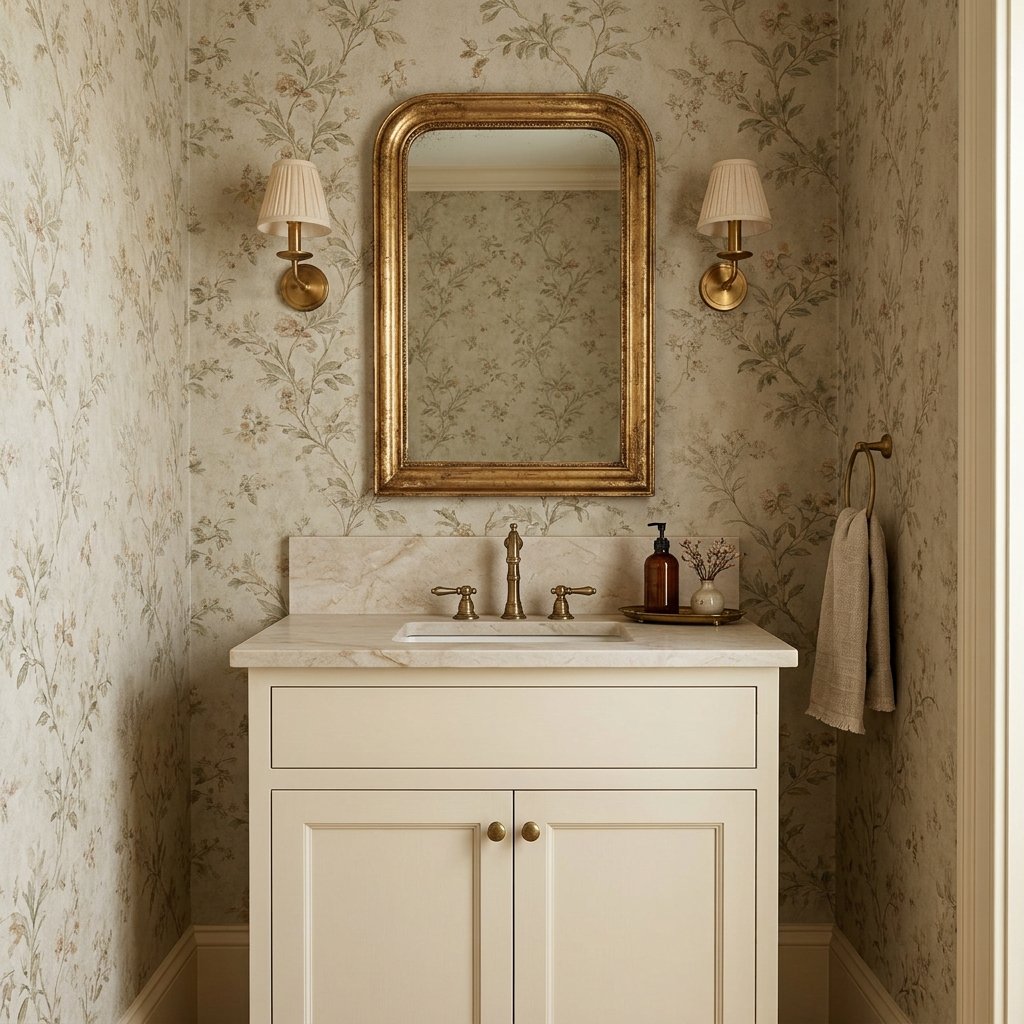
15. Use an Ornate Mirror in a Simple Bathroom
A decorative mirror can become the focal point in a bathroom with restrained finishes.
For example:
Simple white vanity + quiet wall color + ornate gold mirror
The contrast creates personality.
If the vanity, tile, wallpaper, and lighting are already highly decorative, a simpler mirror may work better.
16. Add a Mirror Over a Floating Vanity
A floating vanity already creates a clean contemporary look.
Continue that simplicity with:
- Frameless mirror
- Thin metal frame
- Rounded rectangle
- Pill-shaped mirror
Consider the entire vertical composition from the floor to the ceiling.
A floating vanity can make the room feel taller, so avoid choosing a mirror that’s disproportionately short.
17. Extend the Mirror Toward the Ceiling
A tall mirror can make a bathroom feel larger and more dramatic.
This is especially effective in bathrooms with:
- High ceilings
- Narrow vanities
- Limited natural light
The reflection can visually increase the amount of light in the room.
Check the placement of lighting, vents, trim, and other wall elements before finalizing the height.
18. Create a Wall-to-Wall Mirror
A large wall-to-wall mirror can make a compact bathroom feel much bigger.
This approach is particularly useful over a long vanity.
It also provides uninterrupted reflection.
The look can be modern and minimal, or you can add architectural detailing around it where appropriate.
Large mirrors are heavy and should be professionally handled and mounted when necessary.
19. Add a Mirror With Integrated Lighting
Some bathroom mirrors include built-in lighting.
This can create a streamlined appearance, particularly in contemporary bathrooms.
Before choosing one, consider:
- Light quality
- Brightness
- Color rendering
- Electrical requirements
- Controls
- Installation location
- Bathroom suitability
Integrated mirror lighting may still benefit from additional room lighting.
Electrical work should comply with applicable requirements and manufacturer instructions.
20. Layer a Mirror Over Tile
Continuing tile behind the vanity mirror can create a beautiful finished wall.
Try:
- Handmade-look tile
- Subway tile
- Small square tile
- Stone
Then mount the mirror over it.
Planning is important because drilling and mounting through tile requires the correct approach for the tile, substrate, fastener, and mirror weight.
21. Use a Mirror as the Statement Piece
Sometimes the mirror should be the star.
If the vanity and tile are simple, consider a mirror with:
- Strong arch
- Interesting frame
- Unusual silhouette
- Substantial scale
Then keep everything else quieter.
A statement mirror has more impact when it isn’t competing with five other statement elements.

Bathroom Mirror Ideas for a Small Bathroom
In a small bathroom, a larger mirror can be surprisingly effective.
It can:
- Reflect light
- Expand sightlines
- Reduce visual fragmentation
Instead of choosing a tiny mirror because the room is small, consider using most of the available vanity-wall width.
Keep the frame relatively simple.
Bathroom Mirror Ideas for a Powder Room
A powder room is a great place to use a more decorative mirror.
Because you generally need less grooming storage and reflection than in a primary bathroom, you can experiment with:
- Vintage frames
- Arches
- Round mirrors
- Ornate mirrors
Wallpaper and a beautiful mirror can make a small powder room feel intentional.
Bathroom Mirror Ideas for a Primary Bathroom
Function becomes more important in a primary bathroom.
Make sure the mirror provides enough reflection for everyday routines.
For a double vanity, consider:
- One large mirror
- Two substantial mirrors
- Mirrored medicine cabinets
Choose based on storage, lighting, and sink placement rather than appearance alone.
Bathroom Mirror Ideas for a Guest Bathroom
A guest bathroom can stay relatively simple.
Try:
- Rounded rectangle
- Thin black frame
- Warm brass frame
- Wood frame
Coordinate the mirror with the vanity and lighting rather than trying to match every finish.
Bathroom Mirror Ideas With a Wood Vanity
Wood vanities pair beautifully with:
- Black mirrors
- Brass mirrors
- Frameless mirrors
- Wood mirrors
For contrast, try a thin metal frame.
For a softer organic look, use wood—but choose enough tonal variation that the frame doesn’t look like an unsuccessful attempt to match the vanity exactly.
Bathroom Mirror Ideas With a White Vanity
A white vanity gives you plenty of flexibility.
Try:
- Brass
- Black
- Wood
- Polished metal
- Frameless
Wood can add warmth.
Black adds contrast.
Brass can make the room feel softer and more traditional.
Bathroom Mirror Ideas With a Green Vanity
Green cabinetry pairs beautifully with warm finishes.
Try:
Muted green vanity + aged-brass mirror
or:
Deep green vanity + warm wood mirror
Black can create a more dramatic combination.
Keep the wall color and tile quieter if both the vanity and mirror have strong personalities.
Bathroom Mirror Ideas With a Blue Vanity
A blue vanity can work with:
- Brass
- Chrome
- Polished nickel
- Wood
- Black
Think about the undertone of the blue.
A dusty blue can look beautiful with warmer metals, while a deep navy can create striking contrast with brass or polished finishes.
Bathroom Mirror and Sconce Ideas
Mirror and lighting placement should be planned together.
Common arrangements include:
Sconces on Both Sides
Provides balanced lighting and frames the mirror.
Sconce Above
Useful when wall width is limited.
Three Sconces With Two Mirrors
Beautiful over a large double vanity.
Integrated Mirror Lighting
Creates a streamlined contemporary look.
Don’t finalize mirror dimensions until you know where the electrical boxes and fixtures need to be.
Bathroom electrical work and fixture placement should comply with applicable requirements and manufacturer instructions.

How Big Should a Bathroom Mirror Be?
There isn’t one universal mirror size.
The correct dimensions depend on:
- Vanity width
- Sink position
- Faucet
- Lighting
- Ceiling height
- Wall space
- Desired style
In many designs, the mirror is somewhat narrower than the vanity, but that’s not a rule.
A large frameless mirror might span almost the entire vanity.
Two mirrors might align more closely with individual sinks.
Use painter’s tape to outline possible dimensions directly on the wall before buying.
This is one of the easiest ways to judge scale.
Should a Bathroom Mirror Be Wider Than the Sink?
It can be.
The mirror doesn’t need to match the sink width.
Instead, relate it to the vanity and overall wall composition.
A mirror only slightly wider than a small sink may look undersized over a substantial vanity.
Should the Mirror Match the Vanity Width?
Not necessarily.
A mirror slightly narrower than the vanity can create a balanced look.
But a large wall-to-wall mirror can also work.
Focus on proportion rather than a strict formula.
How High Should a Bathroom Mirror Be?
There isn’t one perfect height for every household.
The mirror needs to provide comfortable reflection for the people using it while fitting above:
- Countertop
- Backsplash
- Faucet
and below:
- Lighting
- Ceiling details
Test the proposed placement before drilling.
For households with users of significantly different heights, make sure the usable reflective area works for everyone.
Round vs. Rectangular Bathroom Mirror
Both can work.
Choose Round If:
You want to soften straight lines or create a decorative focal point.
Choose Rectangular If:
You want maximum reflection and a versatile shape.
Choose Arched If:
You want a little softness while retaining useful vertical mirror area.
The architecture of the vanity wall should guide the choice.
Framed vs. Frameless Bathroom Mirror
A frame adds:
- Color
- Texture
- Definition
A frameless mirror feels:
- Cleaner
- Lighter
- More minimal
If the room already contains many finishes, frameless may be the quieter choice.
If the bathroom feels plain, a frame can add needed contrast.
Should Bathroom Mirrors Match the Faucet?
No.
The mirror frame can match the faucet, but it doesn’t have to.
For example:
Brass mirror + polished nickel faucet
can work if both finishes appear intentionally elsewhere.
Or:
Black mirror + brass faucet
can create attractive contrast.
Aim for repetition rather than perfect matching.
How to Mix Metals Around a Bathroom Mirror
Use a simple strategy.
Choose one dominant metal and one supporting finish.
For example:
Aged brass sconces + brass hardware + polished nickel faucet
or:
Black mirror + black shower frame + brass lighting
Repeating each finish makes the mix feel deliberate.
How to Make a Bathroom Mirror Look Expensive
Scale makes a major difference.
A substantial mirror with a simple, well-proportioned frame often looks more polished than a tiny decorative mirror.
Also consider:
- Good lighting
- Clean mounting
- Appropriate frame finish
- Balanced spacing
- Quality-looking materials
Avoid surrounding the mirror with too many small decorative elements.
Budget-Friendly Bathroom Mirror Ideas
You don’t necessarily need a specialty bathroom mirror.
Depending on the room and product, you may find suitable options among:
- Simple framed mirrors
- Vintage mirrors
- Basic frameless mirrors
Whatever you choose, make sure the mirror and frame materials are appropriate for the bathroom environment and that it can be mounted safely.
A secondhand mirror can be a beautiful option if the frame and backing are in good condition.
How to Make a Builder-Grade Bathroom Mirror Look Better
If you already have a large frameless mirror, you may not need to replace it.
Possible updates include:
- Improving the lighting
- Updating the vanity
- Painting the wall
- Changing surrounding hardware
- Adding an appropriate frame system
If adding a frame to an existing mirror, make sure it doesn’t interfere with clips, outlets, lighting, or the mirror’s secure mounting.
Bathroom Mirror Installation and Safety
Mirrors can be heavy, and bathrooms add moisture, tile, plumbing, and electrical considerations.
Before installation:
- Confirm the mirror weight.
- Identify the wall construction.
- Use mounting hardware suitable for the wall and load.
- Follow the mirror manufacturer’s instructions.
- Check for plumbing and electrical lines before drilling.
- Use appropriate methods when drilling through tile.
- Coordinate hardwired illuminated mirrors with qualified electrical work where required.
- Make sure the mirror is secure, particularly in homes with children.
Large or unusually heavy mirrors may be better handled by professional installers.
Common Bathroom Mirror Mistakes
Choosing a Mirror That’s Too Small
A tiny mirror can make the entire vanity look under-scaled.
Buying the Mirror Before Planning Lighting
Design them together.
Matching Every Metal Finish
Coordination is more important than exact matching.
Ignoring the Faucet Height
Check clearances.
Forgetting the Backsplash
It affects mirror placement.
Hanging the Mirror Too High
Make sure it works for the people using it.
Choosing Style Over Reflection
A bathroom mirror still needs to be practical.
Ignoring Moisture
Choose appropriate materials.
Drilling Without Checking the Wall
Plumbing, wiring, tile, and framing all matter.
Using Two Tiny Mirrors Over a Large Vanity
Scale them to the overall composition.
A Simple Bathroom Mirror Selection Formula
Use this process before buying.
Step 1: Measure the Vanity Wall
Record the available width and height.
Step 2: Mark the Sink Locations
Especially important for double vanities.
Step 3: Decide on Lighting
Side sconces, overhead lighting, or integrated lighting?
Step 4: Choose One or Two Mirrors
Base this on function and wall composition.
Step 5: Choose the Shape
Rectangle, round, arch, pill, or another simple shape.
Step 6: Choose the Frame
Metal, wood, or frameless.
Step 7: Check the Faucet and Backsplash
Make sure everything fits.
Step 8: Tape the Mirror Size on the Wall
Look at it from the doorway.
Step 9: Check Reflection Height
Make sure it works for actual users.
Step 10: Plan Secure Installation
Use the appropriate mounting method.
FAQ About Bathroom Mirrors
What shape bathroom mirror is best?
Rectangular mirrors provide plenty of usable reflection and suit almost any bathroom. Round and arched mirrors are useful when you want to soften a vanity filled with straight lines.
How big should a bathroom mirror be?
The size depends on the vanity, sink placement, lighting, backsplash, ceiling, and wall dimensions. Use painter’s tape to test different sizes before purchasing.
Should a bathroom mirror be the same width as the vanity?
It doesn’t have to be. A somewhat narrower mirror can look balanced, while a large frameless mirror may span most of the vanity wall.
Should I use one or two mirrors over a double vanity?
Both can work. One large mirror creates a continuous look, while two mirrors define individual sink areas and may create room for additional sconces.
Are round bathroom mirrors still a good choice?
Yes. A simple round mirror can be a timeless way to introduce curves into a bathroom dominated by rectangular cabinetry and tile.
Should bathroom mirrors match the faucets?
No. Matching can create a coordinated look, but thoughtfully mixed metal finishes can work beautifully too.
What mirror looks good with a wood vanity?
Black, brass, wood, and frameless mirrors can all work. Choose based on the bathroom’s lighting, hardware, tile, and overall style.
How can I make a small bathroom look bigger with a mirror?
Use a generously sized mirror to reflect more light and extend sightlines. A simple frame or frameless design can keep the wall visually open.
Are medicine cabinet mirrors a good idea?
They can be extremely practical when storage is limited. Recessed versions require checking the wall cavity for framing, plumbing, and electrical obstacles.
Can I hang a heavy mirror on bathroom tile?
Potentially, but the mounting method must be appropriate for the mirror weight, tile, substrate, and wall construction. Follow manufacturer instructions and use professional installation when necessary.
Final Thoughts
Choosing the right bathroom mirror is less about following a strict design rule and more about creating balance.
Start with the vanity.
Look at its width, sink placement, faucet, backsplash, and available wall space.
Then consider the lighting.
Once those pieces are established, choose a mirror shape and scale that complete the composition.
A round mirror can soften a small vanity.
An arch can add subtle character.
Two mirrors can organize a double vanity.
And one oversized mirror can make a small bathroom feel dramatically larger.
Don’t worry about matching every finish perfectly.
Instead, create relationships between the mirror, lighting, hardware, cabinetry, and other materials.
And above all, make sure the mirror works for everyday life.
The most beautiful bathroom mirror is one that looks appropriately scaled, provides useful reflection, works with the lighting, and feels like it was always meant to be part of the room.

