


Side tables may be small, but they can solve some surprisingly big living room decorating problems.
The right table gives you somewhere to set a drink, adds a convenient spot for a lamp, fills an awkward space beside the sofa, and helps connect larger pieces of furniture visually.
It can also introduce a material your room is missing.
A wood side table can warm up a neutral living room. A black table can add contrast. Glass can keep a small room feeling visually open, while an antique or vintage table can add character to a room filled with newer furniture.
The challenge is finding the right balance between function, size, and style.
A side table that’s too small can look insignificant beside a large sofa. One that’s too tall may be uncomfortable to use. And even a perfectly chosen table can quickly become cluttered when it’s covered with too many decorative accessories.
If you’re looking for side table ideas for your living room, these practical decorating ideas will help you choose, place, and style end tables that make your room more useful and more finished.
What Is the Difference Between a Side Table and an End Table?
The terms side table and end table are often used interchangeably.
An end table usually refers specifically to a table placed at the end of a sofa or beside a chair.
A side table is a broader term that can include small tables used beside seating or in other areas of a room.
For decorating purposes, the distinction isn’t particularly important.
What matters more is choosing a table that fits the furniture, space, and way you actually use the room.
1. Choose a Simple Wood Side Table
Wood is one of the easiest materials to incorporate into a living room.
If your room contains a lot of upholstered furniture, painted surfaces, or cool colors, wood can add warmth and texture.
Consider:
- Light oak
- Medium brown wood
- Walnut
- Dark stained wood
Don’t worry about matching the coffee table perfectly.
In fact, a room can look more interesting when the wood pieces coordinate without being identical.
A medium brown side table beside a cream sofa is a simple combination that can work in traditional, transitional, organic modern, and casual living rooms.
2. Use a Round Side Table
A round table can soften a living room filled with rectangular furniture.
Think about how many straight lines are already in the room:
- Sofa
- Rug
- Coffee table
- Windows
- Media console
Adding a circular table introduces a different shape.
Round tables are also useful in tighter spaces because they eliminate sharp corners.

3. Try a Pedestal Side Table
A pedestal table uses one central support rather than four legs.
This can make a small table feel less visually busy.
Pedestal tables work particularly well:
- Between two chairs
- Beside an accent chair
- In a small living room
- Near a window
A sculptural pedestal base can also become a decorative element without requiring much additional styling.
4. Add a Vintage Side Table
Not every piece of living room furniture needs to be new.
A vintage or antique-style side table can add character to a room filled with contemporary furniture.
Look for:
- Small wood tables
- Pedestal tables
- Occasional tables
- Accent tables
- Small chests
Check secondhand pieces carefully for stability, structural damage, odors, pests, and finishes that may require special care.
If a vintage piece is valuable or has an unknown coating, investigate before sanding or refinishing it.
5. Use a Small Chest Instead of a Side Table
A small chest can work beautifully beside a sofa.
It gives you a larger surface than many conventional end tables and may provide storage as well.
Use it for:
- Remotes
- Chargers
- Games
- Extra coasters
- Small electronics
This is especially useful if your living room lacks built-in storage.
A small chest can also make a room feel more collected because it resembles furniture rather than a standard matching end table.
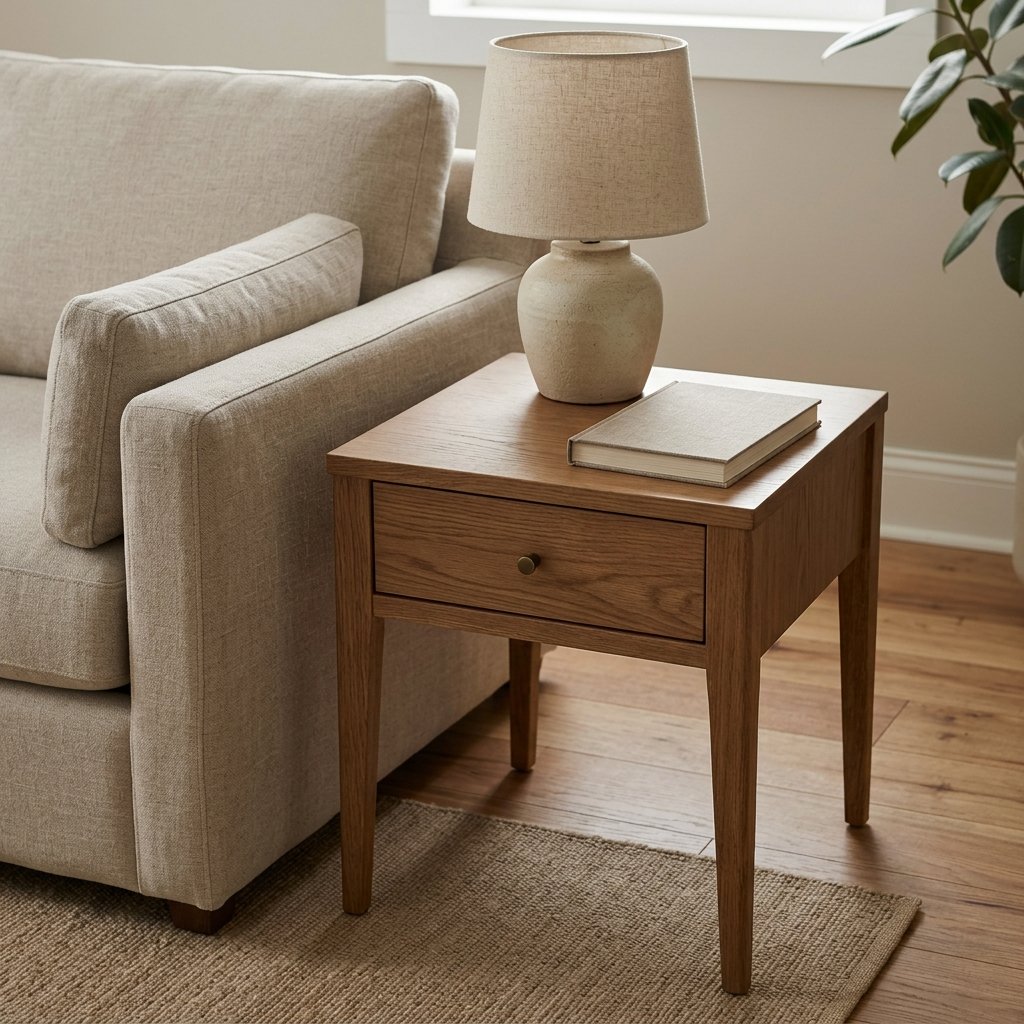
6. Choose a Side Table With Drawers
If clutter tends to collect beside the sofa, choose a table with a drawer.
You can hide:
- Remote controls
- Charging cables
- Reading glasses
- Pens
- Small everyday items
This makes it much easier to keep the tabletop simple.
7. Try a Side Table With a Lower Shelf
A lower shelf gives you another surface without increasing the table’s footprint.
Use it for:
- Books
- Small basket
- Decorative box
Avoid filling both the tabletop and lower shelf completely.
Leave some open space so the table doesn’t become visually heavy.
8. Use Nesting Side Tables
Nesting tables are useful when you occasionally need additional surface space.
Keep them together most of the time.
Then pull out the smaller table when you need somewhere for:
- Drinks
- Snacks
- Guests
- A laptop
They can be particularly useful in apartments and smaller living rooms where permanent extra tables would take up too much space.
9. Add a C-Shaped Side Table
A C-shaped table can slide partially beneath a sofa or chair, depending on the furniture’s construction and clearance.
This makes it useful for:
- Laptop
- Coffee
- Book
- Small plate
It’s a particularly practical choice if you don’t have room for a traditional end table.
Make sure the base slides safely under your furniture without damaging upholstery, flooring, or moving parts.
10. Use a Drink Table in a Tiny Space
Sometimes you don’t have room for a full-size side table.
That’s where a drink table can be useful.
These narrow tables provide just enough surface for a glass, mug, or small decorative object.
Place one:
- Between two chairs
- Beside a reading chair
- At the end of a sofa
- Near a window seat
A small table can still feel substantial if its height and material work with the surrounding furniture.

11. Try a Stone Side Table
Stone can add weight and texture to a living room.
Consider the look of:
- Marble
- Travertine
- Limestone-style finishes
- Other natural or engineered stone
A stone side table can be particularly effective in a room with lots of soft textiles.
The contrast between hard stone and soft upholstery creates visual interest.
Remember that genuine stone can be heavy and may require specific care. Follow the manufacturer’s recommendations for cleaning, sealing, placement, and moving.
12. Add a Black Side Table for Contrast
If your living room is mostly cream, beige, white, or pale wood, a black side table can provide definition.
You don’t need much black.
A small table can repeat other dark elements such as:
- Window frames
- Lighting
- Picture frames
- Fireplace surround
Repeating black in a few places helps it feel intentional.
13. Use a Glass Side Table in a Small Living Room
Glass can be useful when you need function without adding much visual weight.
A glass-topped side table allows the eye to see through it, which can help a small room feel less crowded.
It works especially well beside:
- Large sofa
- Oversized chair
- Dark furniture
If your household includes young children or active pets, consider the table’s construction, stability, edge design, and the type of safety glass used before choosing it.
14. Try a Metal Side Table
Metal introduces a different texture from wood and upholstery.
Consider:
- Aged brass
- Bronze
- Blackened metal
- Polished nickel
A metal table doesn’t have to match every other metal finish in the room.
For example, an aged brass table can work with black lighting and polished nickel details when the finishes are repeated thoughtfully.
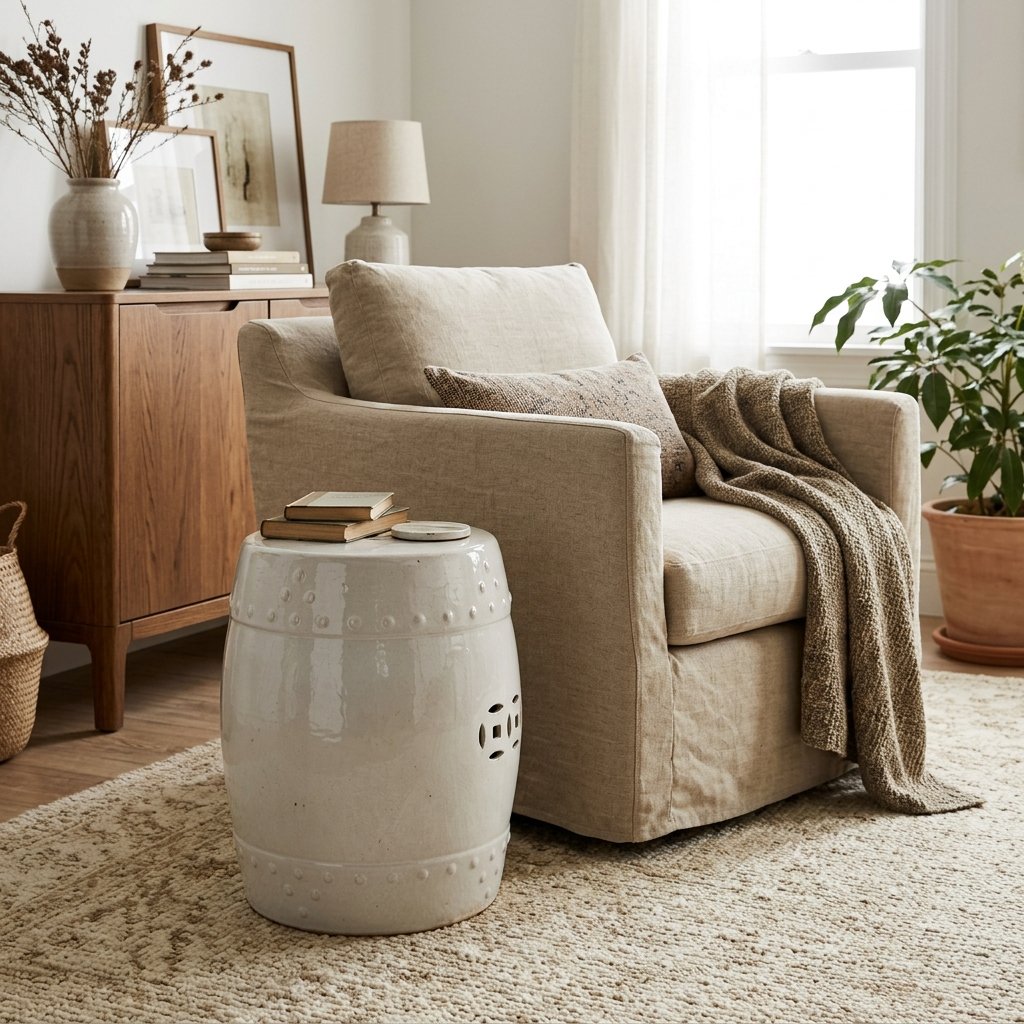
15. Use a Garden Stool as a Side Table
A ceramic garden stool can work indoors as a small occasional table.
It’s especially useful when you want:
- Color
- Pattern
- Glossy texture
- Sculptural shape
Use it beside a chair or sofa.
Just make sure the specific piece is designed and stable enough for your intended use rather than assuming every decorative stool is suitable as a tabletop.
16. Place One Table Between Two Chairs
You don’t necessarily need a table beside every seat.
One table between two chairs can serve both.
This is a great arrangement for:
- Conversation area
- Reading corner
- Bay window
- Fireplace seating
A round table often works particularly well because both chairs can access it comfortably.
Add one lamp if the area needs additional lighting.
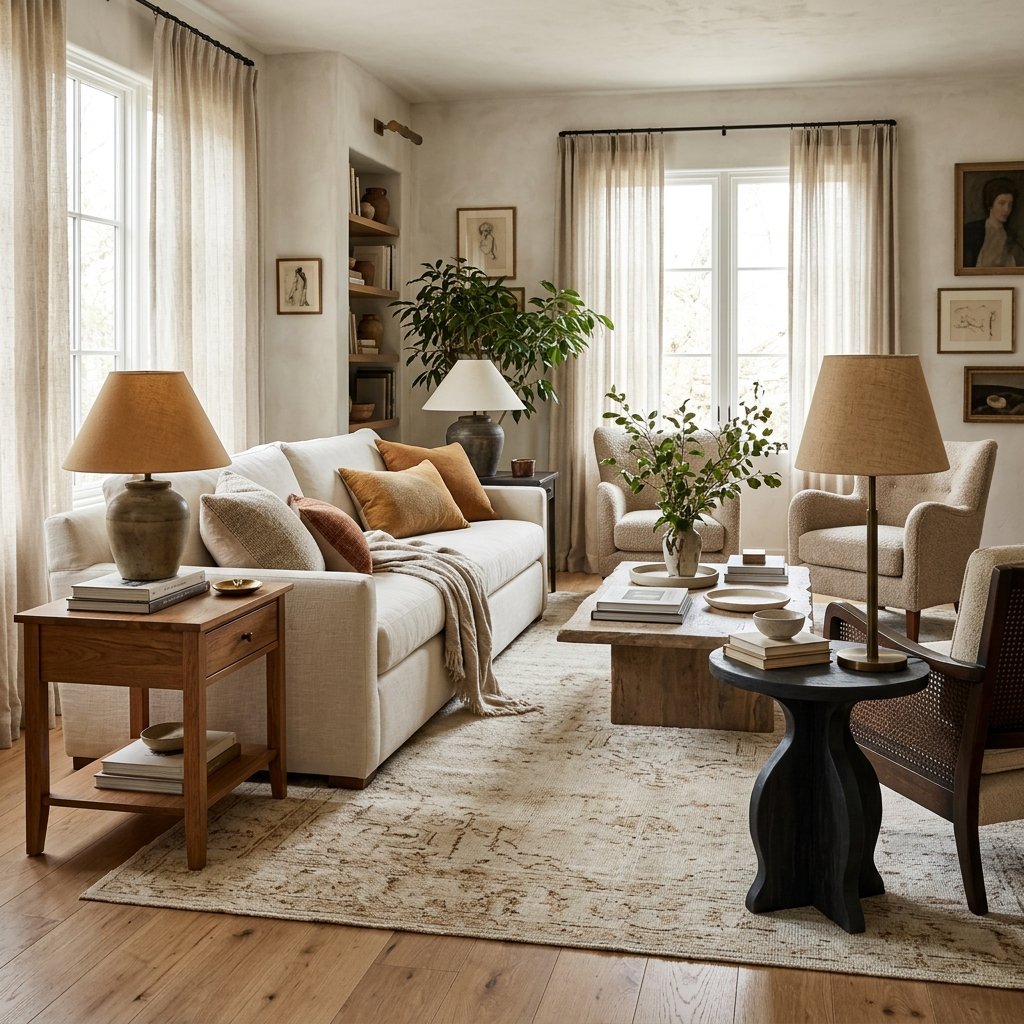
17. Use Mismatched Side Tables
Your side tables don’t have to match.
In fact, mismatched tables can make a living room feel more collected.
You might use:
Wood table on one side + small brass table on the other
or:
Vintage chest + round pedestal table
The tables should relate in some way through:
- Color
- Material
- Scale
- Style
They don’t need to be identical.
18. Skip a Matching Furniture Set
Buying a coffee table, console, and two end tables from the same collection can certainly create consistency, but it can also make a living room feel more like a showroom.
Try mixing materials instead.
For example:
Wood coffee table + stone side table + metal drink table
or:
Glass coffee table + vintage wood end table
Variation creates layers.
19. Use a Side Table as a Reading Station
Turn an empty corner into a practical reading area.
You’ll need:
- Comfortable chair
- Side table
- Lamp
Then add only the essentials.
A book and coaster may be enough.
If the chair is used regularly for reading, prioritize table height and lamp placement over decorative styling.
20. Put a Side Table Beside a Sectional
Sectionals can make side-table placement tricky.
Consider placing a table:
- At the open end
- Beside one arm
- Behind an accessible corner
- Near an adjacent chair
If there isn’t enough room for a standard table, use a drink table or appropriately designed C-shaped table.
Don’t force a large end table into a walkway simply because the sofa feels like it “needs” one.
21. Leave the Side Table Bare
Not every surface needs to be decorated.
If the table itself is beautiful—or you regularly use it for drinks—leave it mostly empty.
You might add just one lamp.
Or nothing at all.
Empty space can make a living room feel calmer and more sophisticated.

How Tall Should a Living Room Side Table Be?
Comfort should guide the height.
Ideally, the tabletop should be convenient to reach from the seat beside it.
A table that’s dramatically higher than the sofa arm can feel awkward.
One that’s far below the seat may be difficult to use.
Instead of relying only on a generic measurement, measure your actual sofa or chair.
Compare the:
- Seat height
- Arm height
- Available space
Then check the dimensions of the table before buying.
How Wide Should a Side Table Be?
The width depends on the available space and what you need to place on it.
If the table only needs to hold a drink, a narrow drink table may be enough.
If it needs to support a lamp, books, and everyday items, choose a larger surface.
Always leave comfortable walking clearance around the furniture.
Use painter’s tape on the floor to mark the proposed table footprint before ordering.
This makes it much easier to understand the real scale.
How Many Side Tables Should a Living Room Have?
There isn’t a rule.
Some living rooms need two or three.
Others may need only one.
Think about where people actually sit.
Ideally, frequently used seats should have reasonable access to a surface for a drink or other small items.
That might mean:
- End table beside sofa
- Table between two chairs
- Coffee table accessible from other seats
Don’t add furniture simply to make the room symmetrical.
Should Side Tables Match the Coffee Table?
No.
They can match, but they don’t have to.
A room can feel much more layered when the tables coordinate rather than duplicate each other.
If your coffee table is wood, try:
- Stone side table
- Black side table
- Metal table
- Different wood tone
If your coffee table is glass, a wood side table can add warmth.
Look for a common thread rather than an exact match.
Should Both Living Room Side Tables Match?
Again, no.
Matching end tables can create a formal, symmetrical look.
Mismatched tables can create a relaxed, collected look.
Both approaches can work.
If you choose mismatched tables, keep their visual weight reasonably balanced.
A massive chest on one side of the sofa and a tiny drink table on the other may feel lopsided unless the rest of the arrangement balances them.
How to Mix Wood Side Tables
You don’t need one wood finish throughout the living room.
Mixing wood tones can make a room feel more natural.
Try combining:
- Light oak
- Medium brown
- Walnut
- Dark wood
The key is repetition.
If the side table is walnut, repeat a similar warm brown somewhere else through a frame, chair leg, bowl, or other small detail.
How to Style a Living Room Side Table
Start with function.
What does the table need to do?
If you need a lamp, add that first.
Then consider one or two additional items.
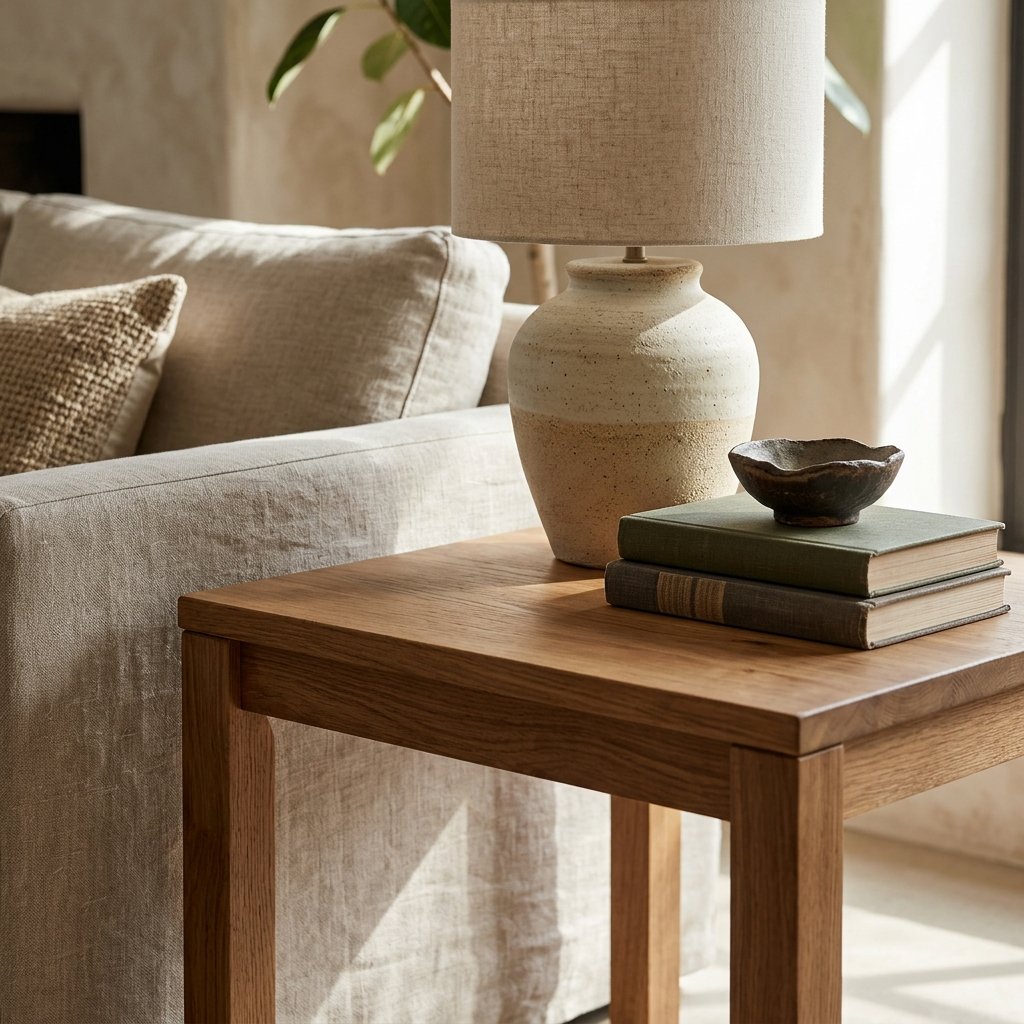
A simple formula is:
Lamp
Provides height and function.
Books
Add a horizontal layer.
Small Object
A bowl, box, or decorative piece adds personality.
You don’t need all three.
Sometimes a lamp alone is enough.
What to Put on a Side Table Without a Lamp
If you don’t need a lamp, try:
- Small vase
- Plant
- Stack of books
- Decorative bowl
- Framed photo
- Sculptural object
Choose one main item and build around it.
Avoid covering the entire surface.
What to Put on a Side Table With a Lamp
Let the lamp be the largest object.
Then add something much smaller.
For example:
Lamp + two books + small bowl
or:
Lamp + framed photo
or simply:
Lamp
Leaving space around the lamp helps the table remain functional.
How Big Should a Side Table Lamp Be?
The lamp should relate to both the table and surrounding furniture.
A tiny lamp on a substantial table may look undersized.
An oversized lamp on a narrow table can feel unstable and leave no usable surface.
Check the lamp’s:
- Base width
- Overall height
- Shade width
- Weight
Make sure the base fits securely on the tabletop.
Use bulbs that meet the lamp manufacturer’s specifications.
How to Decorate a Small Side Table
Small tables require restraint.
Try:
Small lamp + coaster
or:
Small vase + book
That’s enough.
Don’t shrink five different decorative accessories to fit the table.
A few appropriately scaled objects look better.
Side Table Ideas for a Small Living Room
When space is limited, prioritize tables that provide function without blocking circulation.
Consider:
- Round pedestal table
- Drink table
- Nesting tables
- C-shaped table
- Glass table
Measure the room carefully.
A table that appears tiny online may still block a walkway in a small living room.
Side Table Ideas for a Large Living Room
Large rooms can support more substantial pieces.
Try:
- Small chest
- Wide wood end table
- Stone pedestal table
- Large round table between chairs
Avoid automatically filling a large room with lots of small tables.
Larger pieces can create better visual balance.
Side Table Ideas for a Neutral Living Room
If your living room is mostly cream and beige, use the side table to introduce contrast.
Try:
- Medium wood
- Dark wood
- Black
- Bronze
- Stone
Texture becomes especially important in a neutral room.
Side Table Ideas for a Modern Living Room
For a modern look, consider:
- Sculptural pedestal table
- Stone
- Glass
- Black metal
- Simple wood
Choose a strong shape and keep the styling minimal.
Side Table Ideas for a Traditional Living Room
Traditional rooms can handle more detailed furniture.
Consider:
- Vintage wood table
- Small chest
- Turned-leg table
- Brass table
- Dark wood pedestal table
Mixing one antique or vintage-inspired piece with newer furniture can keep the room from looking like a matching set.
Side Table Ideas for an Organic Modern Living Room
Organic modern rooms benefit from natural materials and simple shapes.
Try:
- Light oak
- Travertine-style stone
- Dark wood
- Ceramic
- Sculptural forms
Keep the tabletop relatively uncluttered.
Side Table Ideas on a Budget
Side tables are one category where secondhand shopping can be especially useful.
Look at:
- Thrift stores
- Estate sales
- Flea markets
- Local secondhand marketplaces
Don’t search only for “end table.”
Try searching for:
- Occasional table
- Bedside table
- Small chest
- Pedestal table
- Accent table
A piece doesn’t need to have originally been sold as living room furniture to work beside your sofa.
How to Make a Cheap Side Table Look Better
Sometimes the problem isn’t the table.
It’s everything around it.
Try:
- Remove excess accessories.
- Add a properly scaled lamp.
- Place the table closer to the sofa.
- Repeat its material elsewhere.
- Add one small stack of books.
- Hide cords.
- Clean or repair the finish appropriately.
If the table truly needs refinishing, use products compatible with the existing material and finish and follow all manufacturer instructions for preparation, ventilation, application, drying, and curing.
Common Side Table Decorating Mistakes
Choosing a Table That’s Too Small
A tiny table can look lost beside a substantial sofa.
Choosing the Wrong Height
Make sure it’s comfortable to reach.
Buying Matching Tables Automatically
Matching isn’t required.
Covering the Entire Table With Decor
Leave room for everyday use.
Using an Undersized Lamp
The lamp needs to relate to both the table and sofa.
Ignoring Walkways
Don’t squeeze a table into an important circulation path.
Mixing Too Many Materials
Variation is good, but the room still needs a common thread.
Forgetting Storage
If clutter always collects beside the sofa, choose a table with a drawer or shelf.
A Simple Side Table Styling Formula
If you’re unsure what to put on an end table, start here.
Functional Piece
Lamp
Horizontal Layer
One or two books
Small Accent
Bowl, box, or decorative object
Then stop.
You don’t need to fill every empty corner.
For a more minimal version:
Lamp + book
Or:
Vase + coaster
Simple styling often looks the most polished.
FAQ About Side Table Ideas for Your Living Room
Do living room side tables need to match?
No. Matching tables create symmetry, while mismatched side tables can make a room feel more collected. If you mix tables, look for some connection through scale, color, material, or style.
Should side tables match the coffee table?
They don’t have to. Mixing wood, stone, glass, and metal can create a more layered living room.
How tall should a side table be next to a sofa?
Choose a height that’s comfortable to reach from the sofa. Compare the table dimensions with your actual sofa’s seat and arm height rather than relying solely on a standard measurement.
What should I put on a living room side table?
A lamp, books, small bowl, vase, framed photo, plant, or decorative object can work. Keep enough empty space for the table to remain useful.
What can I use instead of an end table?
Try a small chest, garden stool, pedestal table, nesting table, drink table, or another stable piece designed to safely support the items you intend to place on it.
What side table works in a small living room?
Round pedestal tables, drink tables, nesting tables, glass tables, and C-shaped tables can provide useful surface space without visually overwhelming a small room.
Can I put one side table between two chairs?
Yes. A table between two chairs can serve both seats and create a natural conversation area.
Are round or square side tables better?
Neither is universally better. Round tables soften rooms with many straight lines and can work well in tight spaces. Square or rectangular tables can provide more usable surface area and may align naturally with sofas.
How do you make a side table look expensive?
Choose a table with good proportions, avoid overdecorating it, use a substantial lamp when appropriate, and coordinate its material with other elements in the room.
Final Thoughts
The best side table ideas for your living room combine style with function.
Start by thinking about what the table actually needs to do.
Does it need to hold a lamp?
Provide storage?
Give you somewhere to set a drink?
Fit into a tiny space beside a sectional?
Once you know its purpose, choose a table with the right scale and height.
Then consider what the room needs visually.
Wood can add warmth.
Black can create contrast.
Glass can reduce visual weight.
Stone can add texture.
Vintage furniture can bring character.
And a small metal drink table can provide function where a conventional end table simply won’t fit.
Most importantly, don’t feel obligated to buy a matching set.
Some of the most interesting living rooms combine different materials, wood tones, shapes, and furniture styles.
Choose side tables that relate to the room without duplicating everything already in it.
Then keep the styling simple.
A lamp, a couple of books, and one small decorative object may be all you need to make a side table feel finished while leaving enough space to actually use it.