

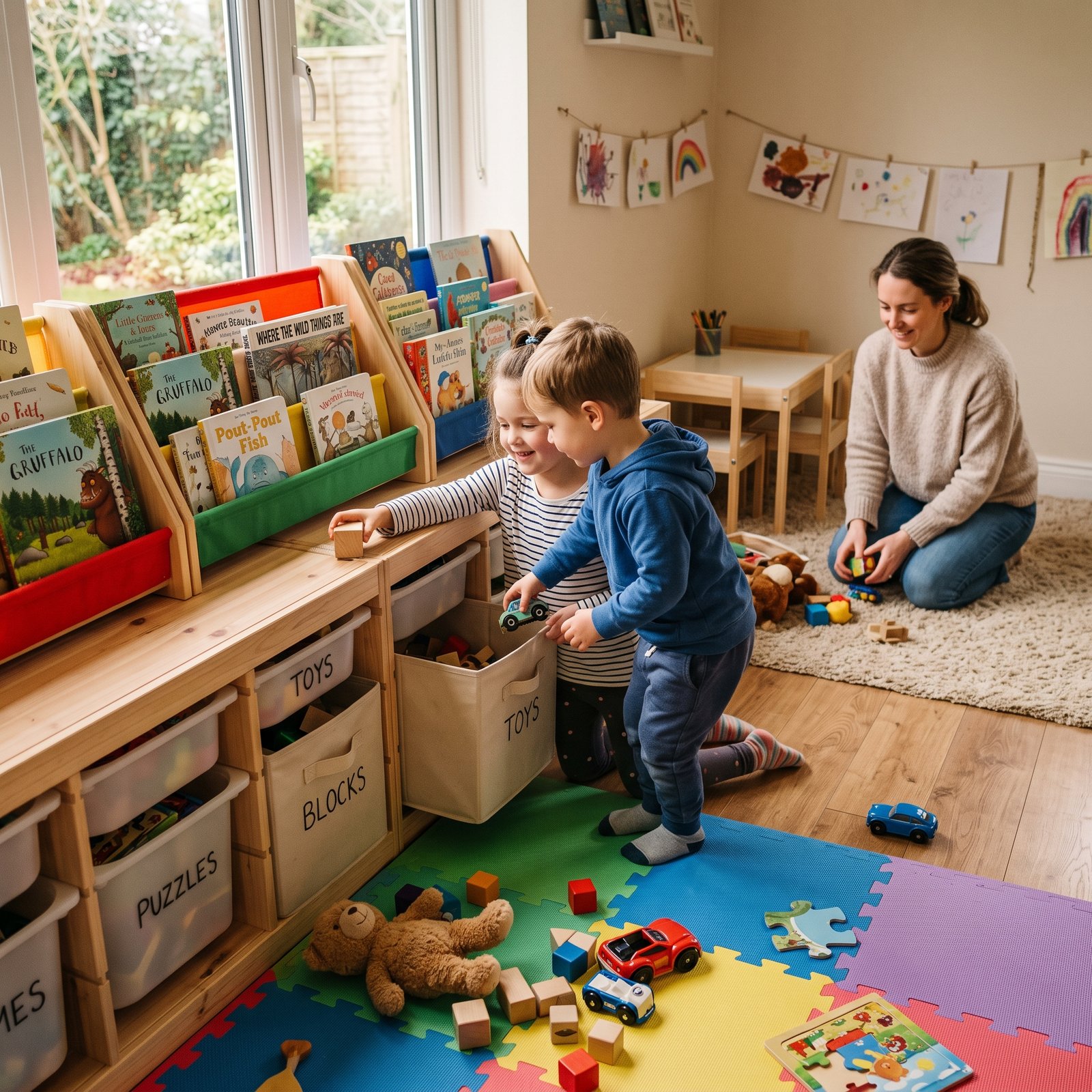
Good playroom organization is not about creating a perfectly styled room where every toy is hidden. It is about making toys easy for kids to find, easy to play with, and—most importantly—easy to put away.
Playrooms can become cluttered incredibly quickly. Building blocks migrate across the floor, art supplies lose their lids, stuffed animals pile up, and tiny toy pieces somehow end up everywhere. Adding more storage containers does not necessarily solve the problem if children cannot understand or use the system.
A better approach is to simplify what is in the room, divide toys into clear categories, use storage that fits those categories, and keep frequently used items within appropriate reach.
Whether you have a dedicated playroom, a small play corner, or a shared family space, these practical ideas can help you create an organized room that still feels fun and welcoming.
1. Declutter the Toys Before Organizing
Before buying bins or installing shelves, reduce what needs to be stored.
Go through the room and gather similar toys together.
You may discover:
- Duplicate toys
- Broken toys
- Games with missing pieces
- Outgrown toys
- Dried-out art supplies
- Toys that are rarely used
Decide what to keep, donate, recycle, repair, or discard as appropriate.
Be especially careful with broken toys that have sharp edges, damaged batteries, loose magnets, or small pieces that could present hazards.
The fewer toys competing for space, the easier the room will be for children to use and maintain.
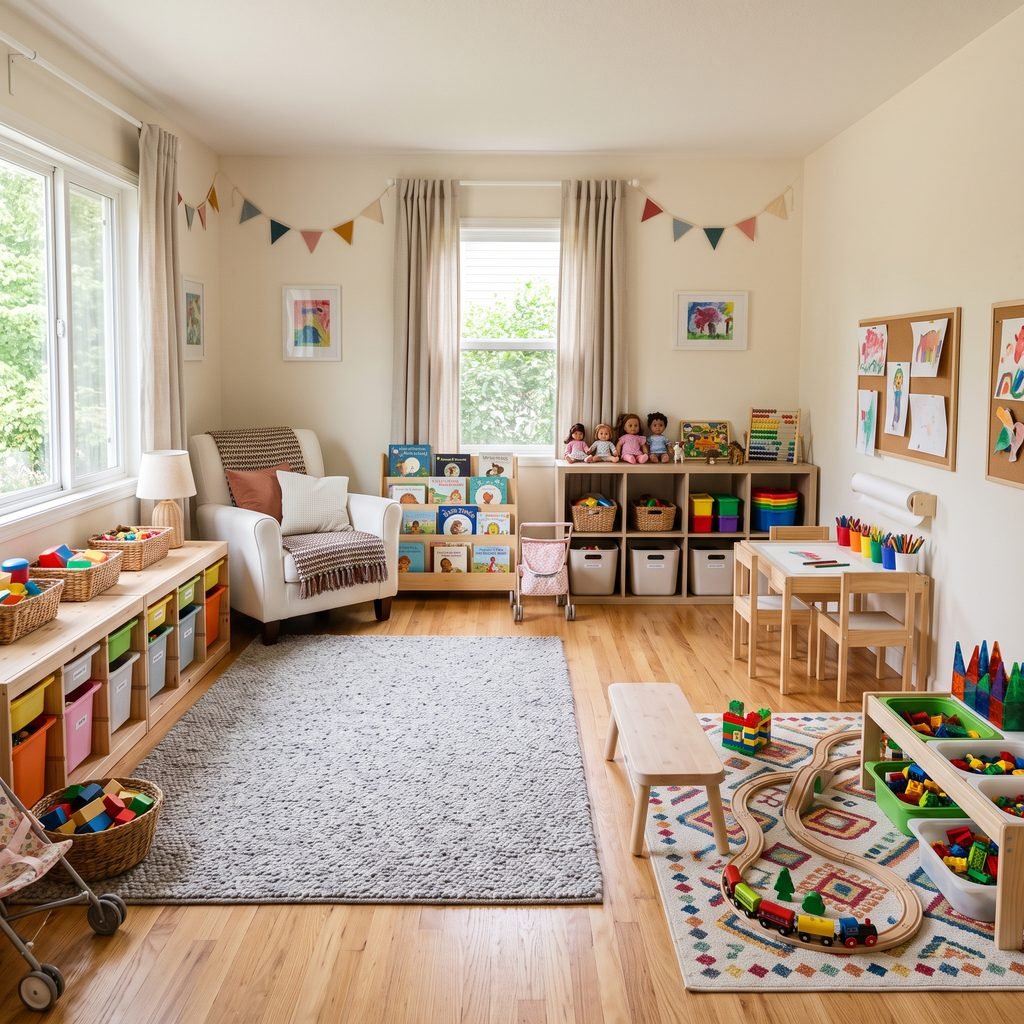
2. Create Simple Playroom Zones
Divide the room according to activities.
Depending on your children’s interests, you might create a:
- Building zone
- Reading corner
- Art area
- Pretend-play area
- Puzzle and game zone
- Stuffed-animal area
You do not need a large room to do this.
A zone might simply be one basket and a section of floor.
For example, place building toys in bins beside an open rug. Keep books beside a comfortable reading chair. Store art supplies near the table where crafts happen.
Keeping related items near where they are used makes cleanup more intuitive.
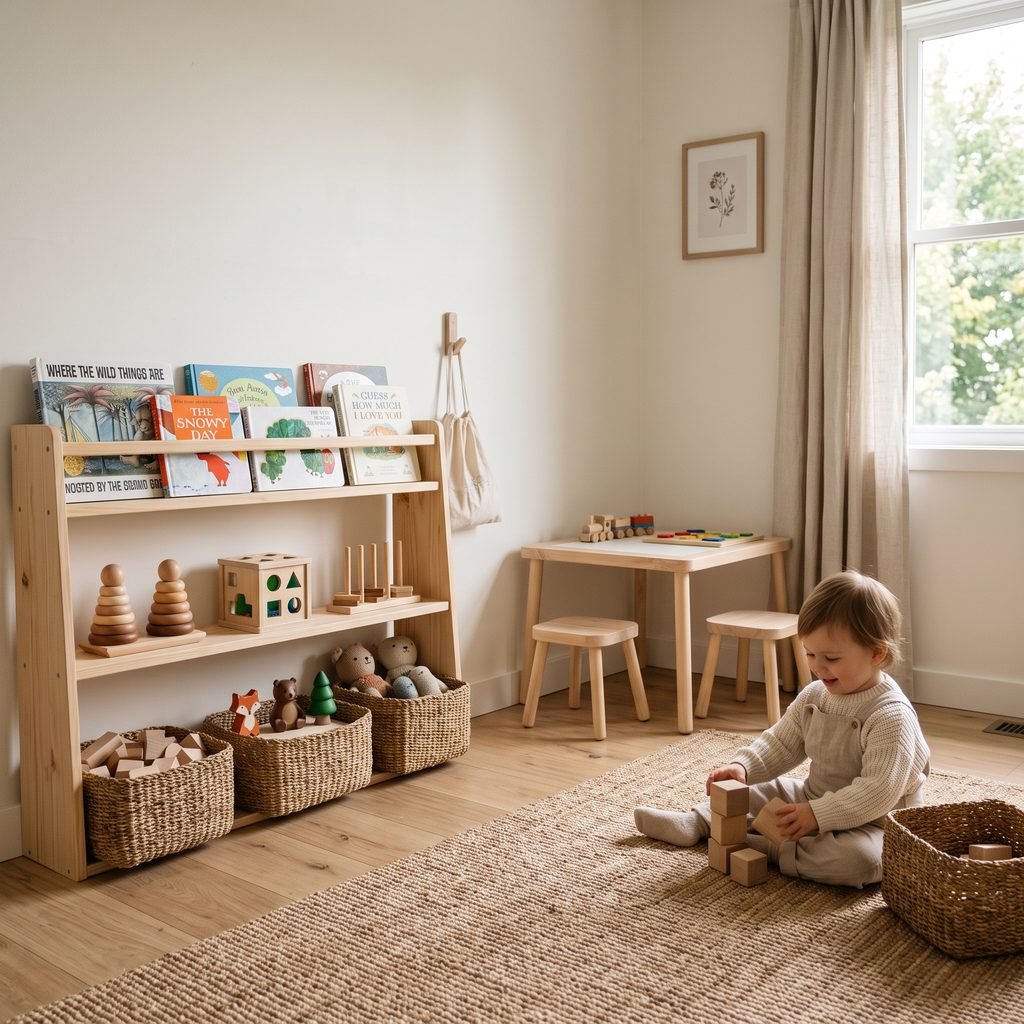
3. Use Low Storage Kids Can Reach
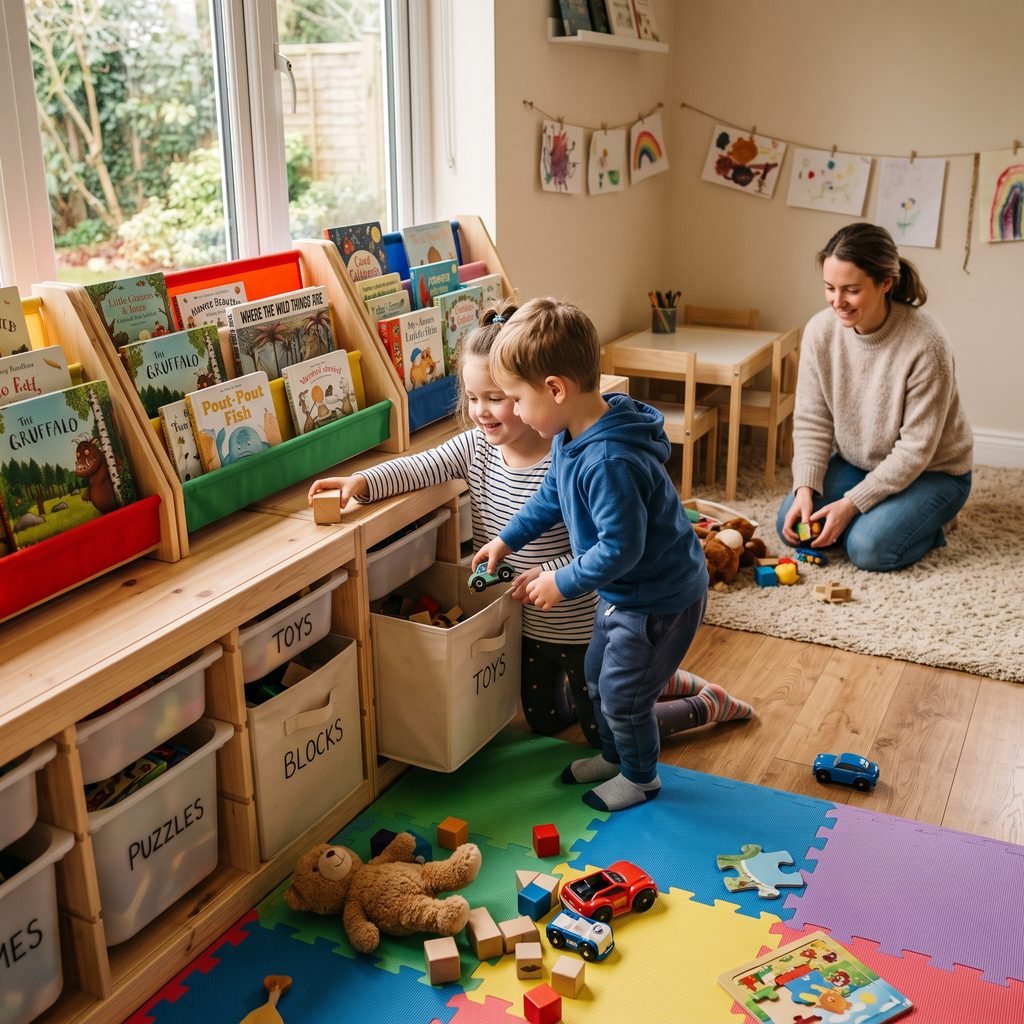
If you want children to participate in cleanup, everyday storage needs to be accessible.
Low shelves work well for:
- Bins
- Baskets
- Books
- Puzzles
- Building toys
Children can see their choices and return toys without needing an adult to reach a high cabinet.
However, accessible storage should only contain age-appropriate items.
Keep supplies requiring adult supervision—such as certain art materials, batteries, tools, or small pieces for older children—securely stored away from younger children.
Tall shelving and freestanding furniture should be properly anchored where appropriate to reduce tip-over risk.
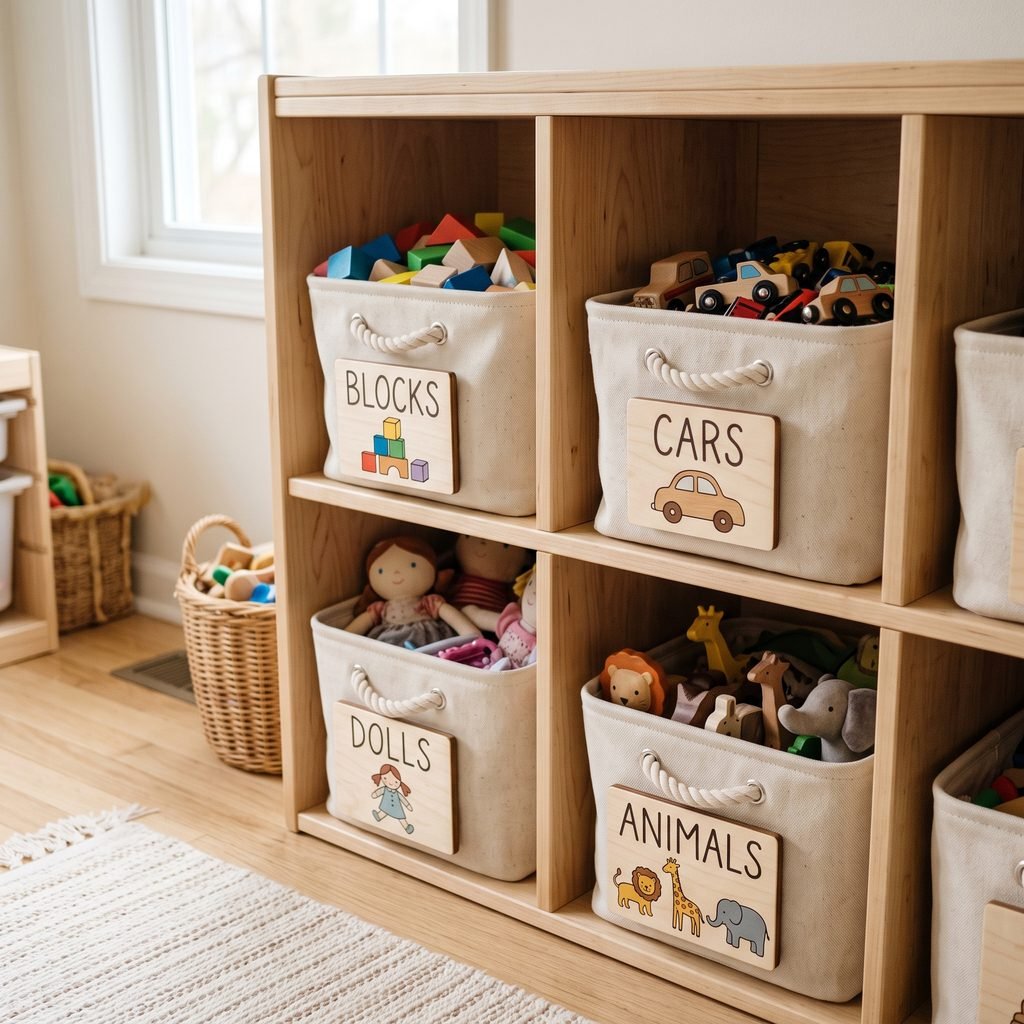
4. Use Bins for Broad Toy Categories
One of the easiest ways to make playroom organization too complicated is to create dozens of tiny categories.
Keep categories broad.
For example:
- Cars
- Blocks
- Dolls
- Animals
- Dress-up
- Trains
A child is much more likely to put a toy car into a bin labeled “Cars” than sort it by color, size, or type.
Choose bins large enough for the category but not so large that children have to dump everything out to find one toy.
Open-top bins are especially convenient for frequently used toys.
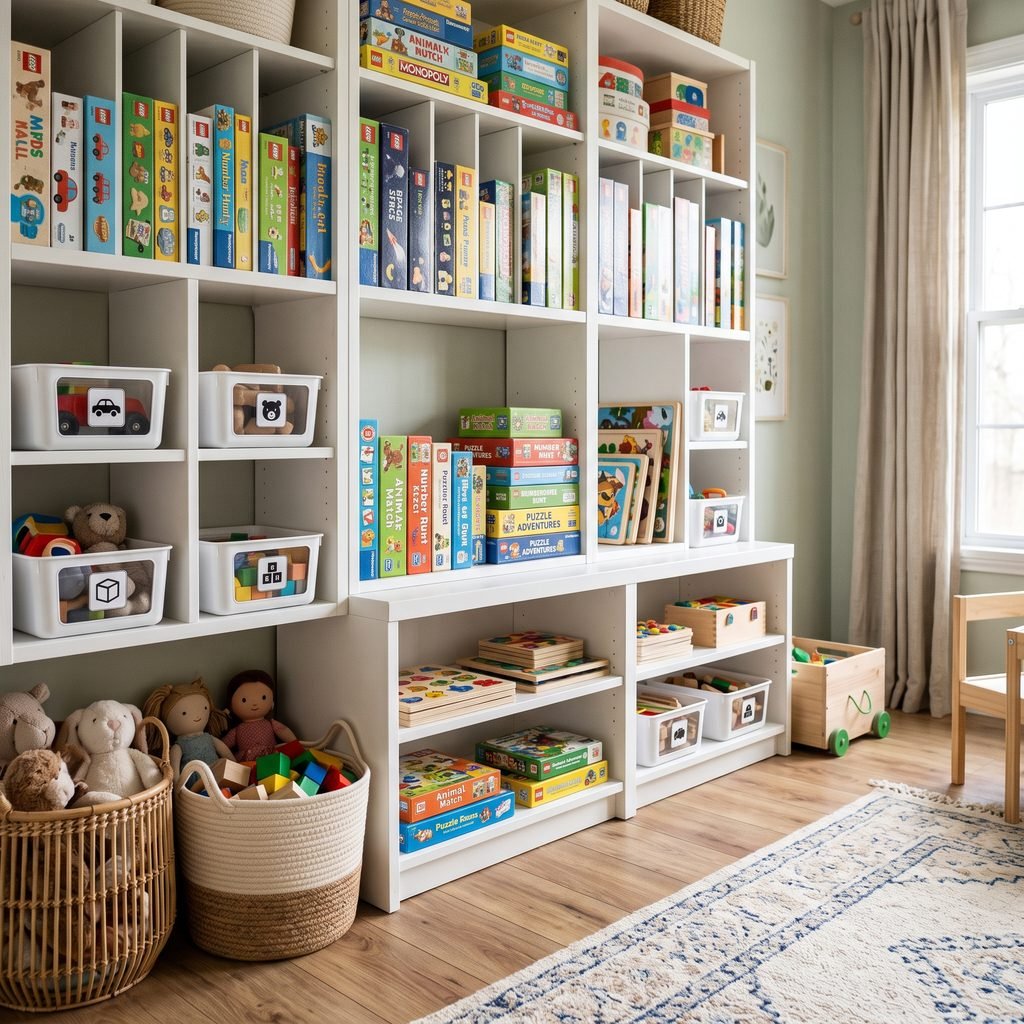
5. Add Picture Labels for Younger Kids
Labels can help children understand where things belong.
For younger kids who cannot read yet, use picture labels.
A block bin could have a simple image of blocks.
The basket for toy animals could have an animal picture.
Older children can use written labels.
You can also combine pictures and words so the system grows with them.
Keep labels simple and consistent.
The goal is to make cleanup easier, not turn the room into a complicated filing system.
6. Give Books Their Own Zone
Books are easier to use when children can see and reach them.
Depending on the room, try:
- Low bookcase
- Front-facing book ledges
- Book basket
- Small rotating selection
Front-facing storage can be particularly useful for younger children because book covers are easier to recognize than spines.
Do not overcrowd the shelves.
If you have a large book collection, keep some stored elsewhere and rotate them periodically.
Create a reading corner nearby with a small chair, floor cushion, or comfortable rug.
Secure wall-mounted ledges and shelving properly, and avoid placing heavy objects above areas where children regularly sit or play.
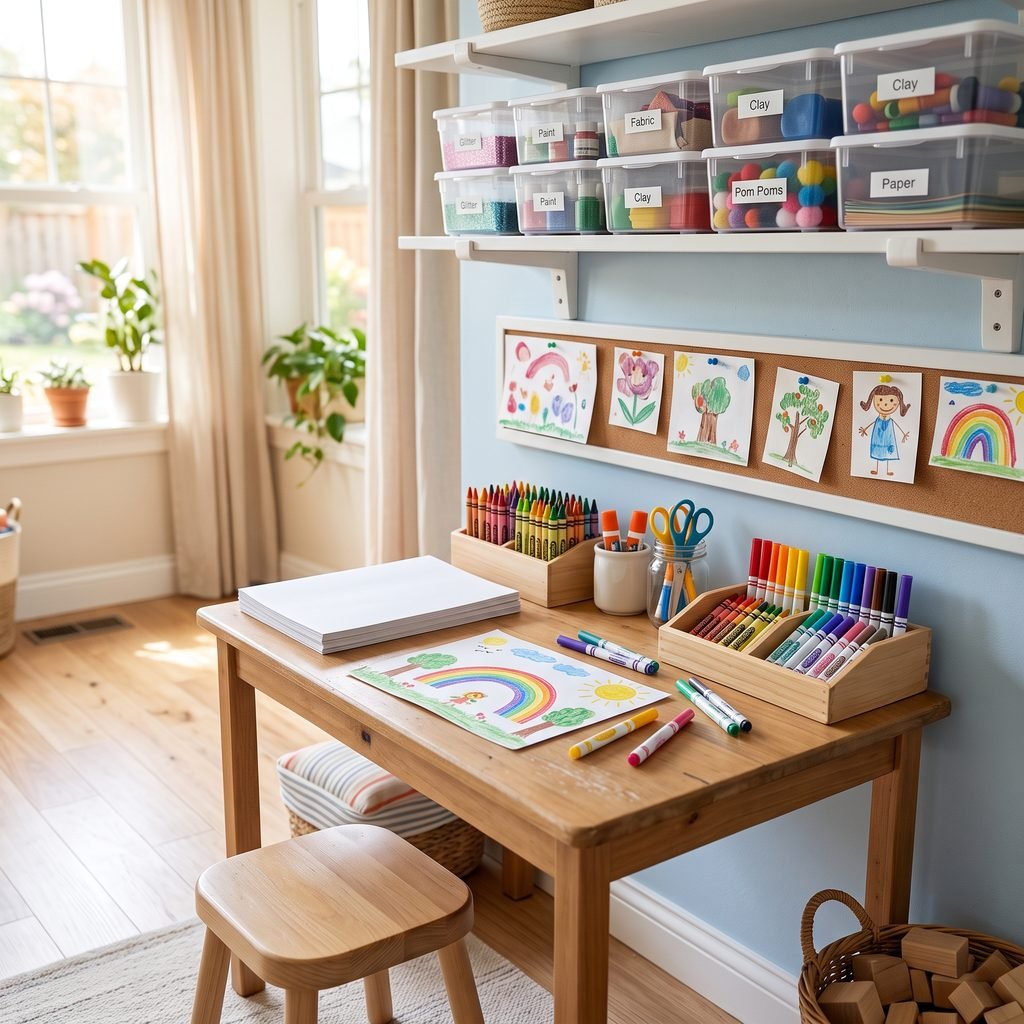
7. Create an Art Supply Station
Art supplies can become messy quickly, so keep them together.
Use drawers, bins, cups, or a small rolling cart for age-appropriate supplies such as:
- Crayons
- Washable markers
- Colored pencils
- Paper
- Stickers
- Coloring books
Keep messy or supervised supplies separate.
Paints, certain glues, scissors, small craft pieces, and other materials may need adult-controlled storage depending on the child’s age and the product.
Follow product age recommendations and safety instructions.
If you use a rolling cart, make sure it is stable and positioned where it will not become a climbing or tipping hazard.
8. Use Clear Containers for Tiny Pieces
Some toys work better in clear storage.
This can include:
- Building pieces
- Puzzle pieces
- Craft supplies
- Small figurines
Being able to see the contents reduces rummaging.
However, small toys require extra care in homes with babies or toddlers.
Anything that may present a choking hazard should be stored securely out of reach of younger children.
Avoid containers that can trap or pinch small fingers, and choose storage appropriate for the child’s age.
9. Create a Stuffed Animal Storage System
Stuffed animals can consume a surprising amount of space.
Instead of lining every surface with them, designate one storage location.
Options include:
- Large floor basket
- Soft-sided bin
- Low cubby
- Suitable wall-mounted storage
Avoid putting heavy storage directly above beds, reading spots, or active play areas.
Also avoid storage designs that could create entrapment, strangulation, or climbing hazards.
If the collection no longer fits comfortably into the designated storage, it may be time to choose some favorites and reduce the number.
10. Store Puzzles and Games Vertically
Boxes take up less space when stored vertically like books—provided their contents stay securely inside.
You can use:
- Shelf dividers
- Magazine-style holders
- Simple shelving
For puzzle boxes that open easily, use an appropriate band or storage pouch to keep pieces together.
Place heavier games on lower shelves.
Games with small pieces should be stored based on the ages of children who can access the room.
11. Add a Dress-Up Station
If your kids enjoy pretend play, give costumes their own area.
A simple dress-up station might include:
- Low hanging rail
- Wall hooks
- Basket for accessories
- Small mirror
Keep the collection manageable.
If every costume is crammed together, children are likely to pull everything out.
Use secure hooks with smooth edges and install them appropriately.
Avoid long cords, necklaces, or accessories that could create strangulation hazards for young children.
Mount mirrors securely and consider shatter-resistant options where appropriate.
12. Make Use of Wall Space
When floor space is limited, the walls can provide useful storage.
Try:
- Book ledges
- Peg rails
- Shallow shelves
- Art display area
But use wall storage thoughtfully in children’s rooms.
Secure everything properly to suitable wall structure, follow hardware weight ratings, and avoid placing heavy objects above active play areas.
Wall storage should help keep the floor open rather than create another crowded display.
13. Create a Home for Large Toys
Large toys are often the hardest items to organize because they do not fit inside standard bins.
Examples include:
- Dollhouses
- Toy kitchens
- Large trucks
- Ride-on toys
- Playsets
Instead of trying to hide them, designate a parking spot.
A toy kitchen might stay against one wall.
Large trucks could line up underneath a low shelf.
A dollhouse could sit on a sturdy low table.
Giving large toys a permanent location prevents them from floating around the room.
14. Rotate Toys Instead of Storing Everything at Once
Toy rotation can be extremely helpful when the playroom feels overloaded.
Keep a manageable selection available and store the rest in a secure location.
After a period of time, swap some toys.
This can:
- Reduce clutter
- Make cleanup faster
- Free shelf space
- Renew interest in older toys
You do not need a complicated rotation schedule.
Simply switch things when the room starts feeling overcrowded or when children seem ready for something different.
Store rotated toys in clearly labeled containers so you know what is inside.
15. Add a Simple Cleanup Basket
Keep one empty or mostly empty basket available for quick cleanup.
If a toy belongs in another room, place it in the basket temporarily.
At the end of the day, carry the basket through the house and return everything to its proper location.
This is especially helpful in shared living spaces.
The basket prevents you from making ten separate trips while tidying.
Just make sure the temporary basket does not become permanent storage for miscellaneous clutter.
16. Keep the Center of the Room Open
Children need room to play more than they need wall-to-wall furniture.
Whenever possible, place storage around the perimeter.
Leave the center open for:
- Building
- Trains
- Pretend play
- Games
- Floor puzzles
An open floor also makes cleanup easier because stray toys are easier to see.
If you use a rug, choose one that suits the room’s needs and make sure it lies securely without creating an unnecessary trip hazard.
17. Build a Five-Minute Cleanup Routine
The best playroom organization system will eventually become messy.
That is normal.
Instead of expecting the room to remain perfectly arranged, create a quick reset routine.
For example:
- Books go back.
- Blocks go into their bin.
- Stuffed animals go into their basket.
- Art supplies return to the art station.
- Large toys go to their parking spots.
Broad categories make this possible.
A five-minute cleanup is much easier when children do not have to decide among 25 different storage containers.
Playroom Organization Ideas for Small Spaces
You do not need a dedicated playroom to create organized toy storage.
If toys share a living room, bedroom, or family room, prioritize storage that contains clutter without dominating the space.
Try:
- Low bookcase
- Storage bench
- Lidded baskets where age-appropriate
- Under-console baskets
- Compact toy cabinet
Limit how many toys stay in the shared space.
Rotate extras rather than trying to store the entire collection in one room.
A smaller number of carefully chosen toys can make a compact play area more usable.
Playroom Organization With Cube Storage
Cube storage is popular because it can hold both toys and bins.
Use open cubes for:
- Books
- Larger toys
- Frequently used items
Use bins for categories that look messy on open shelves.
Avoid stuffing every cube with a container.
Leaving a few open shelves can make the unit feel less visually heavy.
Choose sturdy furniture, follow the manufacturer’s instructions, respect load limits, and anchor furniture when recommended or appropriate.
Playroom Organization Without a Closet
If your playroom has no closet, concentrate storage along one or two walls.
Combine:
- Low shelving
- Baskets
- Closed cabinets
- Wall-mounted book storage
Closed cabinets are useful for items you do not want constantly visible.
If cabinets contain supplies children should not access independently, use appropriate child-resistant storage.
Keep the rest of the room relatively open.
Playroom Organization on a Budget
An organized playroom does not require an expensive custom storage system.
Start by decluttering.
Then reuse containers you already have.
Possible budget storage includes:
- Existing baskets
- Simple plastic bins
- Sturdy boxes
- Secondhand shelving
- Repurposed bookcases
You can also reorganize furniture from other rooms.
Before buying matching bins, live with the new categories for a while.
You may discover that you need fewer containers than expected.
How to Organize a Playroom by Age
The storage system should change as children grow.
Toddlers
Keep the system extremely simple.
Use broad categories and low, accessible storage only for age-appropriate toys.
Small objects and other hazards should remain securely out of reach.
Preschoolers
Picture labels and open bins work well.
Keep art and pretend-play supplies grouped.
School-Age Kids
Children can manage more specific categories.
Consider dedicated areas for:
- Building sets
- Board games
- Art
- Collections
Mixed-Age Playrooms
Separate toys based on safety as well as interest.
Small pieces intended for older children should not be accessible to babies or toddlers.
How to Organize LEGO and Building Toys
Building toys can be organized as simply or specifically as your family needs.
For younger children or smaller collections, one or two broad bins may be enough.
For larger collections, consider sorting into categories such as:
- General bricks
- Figures
- Wheels
- Specialty pieces
Avoid creating an elaborate color-sorting system unless the children using the toys actually prefer it.
Clear containers can make pieces easier to find.
Small building pieces should always be kept away from children for whom they present a choking hazard.
How to Organize Playroom Art Supplies
Separate everyday materials from supplies that require supervision.
Keep accessible items simple.
For example:
- Paper
- Crayons
- Coloring books
- Age-appropriate washable markers
Keep other materials securely stored as appropriate for the child’s age.
Use shallow containers so supplies are easy to see.
If the art area is near carpet or upholstered furniture, consider adding a washable floor protector or placing messier activities at an easy-to-clean table.
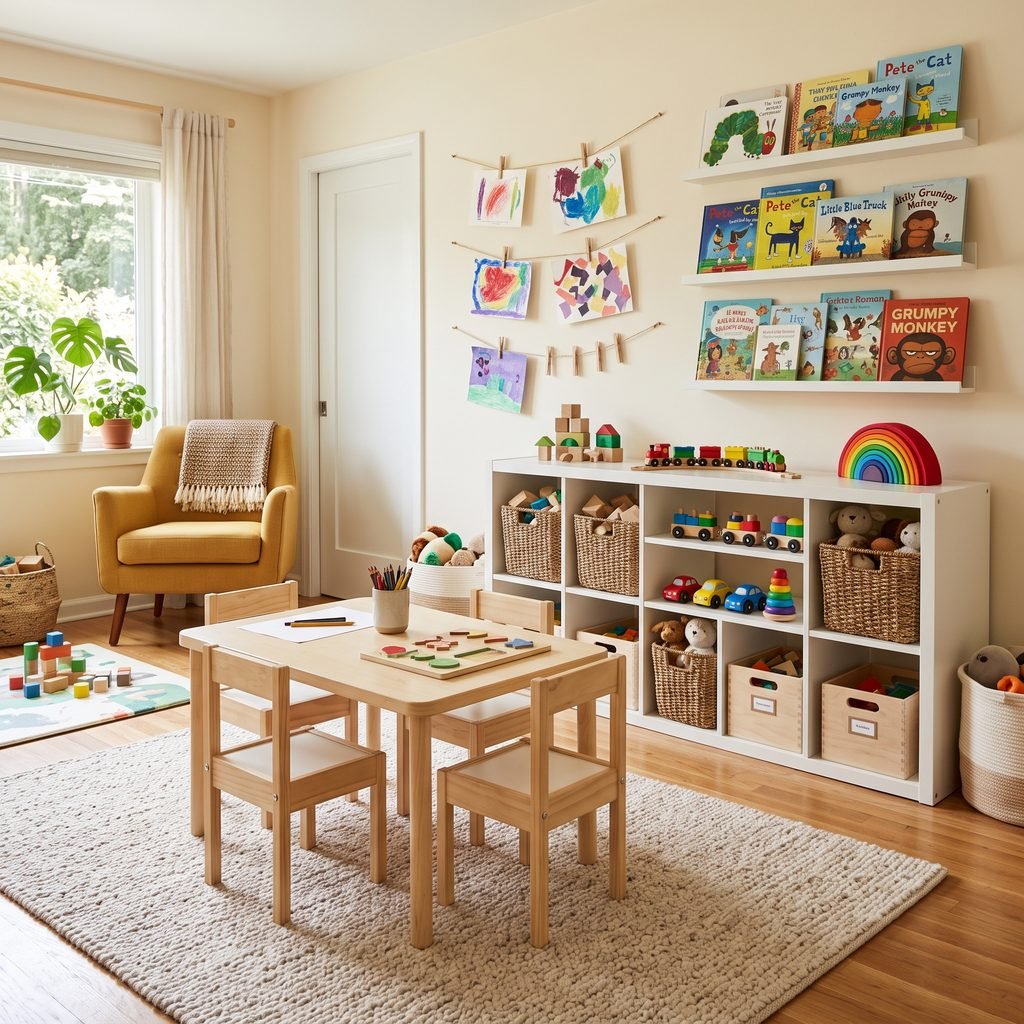
How to Display Kids’ Artwork Without Creating Clutter
Children’s artwork deserves to be enjoyed, but displaying everything at once can overwhelm a room.
Create one designated display area.
You might use:
- Simple frames
- Display rail
- Clips
- Magnetic surface designed for the purpose
Rotate the artwork.
When new pieces go up, older pieces can be saved, photographed, recycled, or shared with family.
This gives important creations more attention instead of covering every wall.
How to Make a Playroom Look Less Cluttered
Organization and visual calm are related, but they are not exactly the same thing.
A room can be technically organized and still look busy.
To make it feel calmer:
Limit Visible Toys
Rotate extras.
Use Repeating Storage
A few similar baskets can visually simplify open shelves.
Keep Walls Selective
Leave some blank space around art and shelves.
Use a Simple Color Palette
Let the toys provide most of the bright color.
Keep the Floor Clear
A visible floor instantly makes a room feel more organized.
Playroom Organization Safety Tips
Safety should be part of the storage plan from the beginning.
Consider these basics:
- Anchor furniture where recommended or appropriate.
- Follow shelving and storage-unit weight limits.
- Store heavy objects low.
- Keep small objects away from children for whom they are a choking hazard.
- Store batteries securely, especially button or coin batteries.
- Keep strong magnets and toys containing accessible magnets away from young children.
- Avoid long cords, loops, or hanging accessories that could create strangulation hazards.
- Keep medications, household cleaners, tools, and other hazardous products outside children’s accessible storage.
- Secure heavy mirrors and wall decor.
- Avoid placing heavy objects above play or reading areas.
- Follow toy manufacturer age recommendations and safety instructions.
- Regularly inspect toys for broken pieces, exposed batteries, sharp edges, or other damage.
Organization should never make a hazardous item more accessible simply because the storage looks attractive.
Common Playroom Organization Mistakes
Buying Storage Before Decluttering
You may end up organizing toys your children no longer use.
Creating Too Many Categories
Simple systems are easier for children to maintain.
Putting Everything in Deep Bins
Children may have to dump out the entire bin to find one toy.
Filling Every Wall
Playrooms need play space as well as storage.
Keeping Too Many Toys Available
Rotation can make the room calmer and toys easier to enjoy.
Storing Everything at Adult Height
Children cannot clean up independently if everyday toys are out of reach.
Ignoring Safety
Storage should reflect the ages and abilities of every child who uses the room.
A Simple Playroom Organization Plan
If the room currently feels overwhelming, tackle it in this order:
- Remove obvious trash and broken toys.
- Group similar toys.
- Declutter what is no longer used.
- Decide on broad categories.
- Create activity zones.
- Assign a bin, basket, shelf, or parking spot to each category.
- Label storage where useful.
- Move hazardous or supervised items out of reach.
- Anchor or secure storage where needed.
- Introduce a quick daily cleanup.
Do not worry about making every container match immediately.
Test the system first.
If children naturally put things back where they belong, the organization is working.
FAQ About Playroom Organization
What is the best way to organize a playroom?
Declutter first, group toys into broad categories, create activity zones, and use accessible storage for age-appropriate everyday toys.
How do you organize a playroom with lots of toys?
Reduce the number of toys available at one time. Keep favorites accessible and rotate part of the collection into secure storage.
How can I organize a playroom cheaply?
Reuse baskets and bins, repurpose existing furniture, declutter before shopping, and create simple categories instead of buying specialized organizers for every toy.
How do I teach kids to keep a playroom organized?
Make the system easy enough for them to use. Low storage, broad categories, picture labels, and a short cleanup routine can help.
Should toys be stored in clear or opaque bins?
Both can work. Clear containers help children see small pieces, while opaque baskets reduce visual clutter. Choose based on the type of toy and the child’s age.
How do you organize toys in a living room?
Keep a smaller selection in attractive baskets, cabinets, or low storage and rotate additional toys rather than trying to fit everything into the shared room.
How often should you declutter a playroom?
There is no required schedule. Declutter when toys no longer fit comfortably, children have outgrown items, or the storage system becomes difficult to maintain.
Final Thoughts
Effective playroom organization should make playing easier, not just make the room look prettier.
Start by reducing clutter.
Then organize what remains into broad categories children can understand. Give books, building toys, art supplies, stuffed animals, dress-up clothes, and larger toys clear homes.
Keep age-appropriate everyday items accessible while securely storing anything that requires adult supervision or could pose a hazard to younger children.
Most importantly, leave room to play.
A playroom does not need every wall covered in storage or every toy hidden inside a matching container.
When children can see what they have, reach what they use, and understand where things go afterward, cleanup becomes much more manageable.
That simple system can turn a constantly cluttered playroom into a functional, welcoming space that is ready for both everyday play and an easy end-of-day reset.