

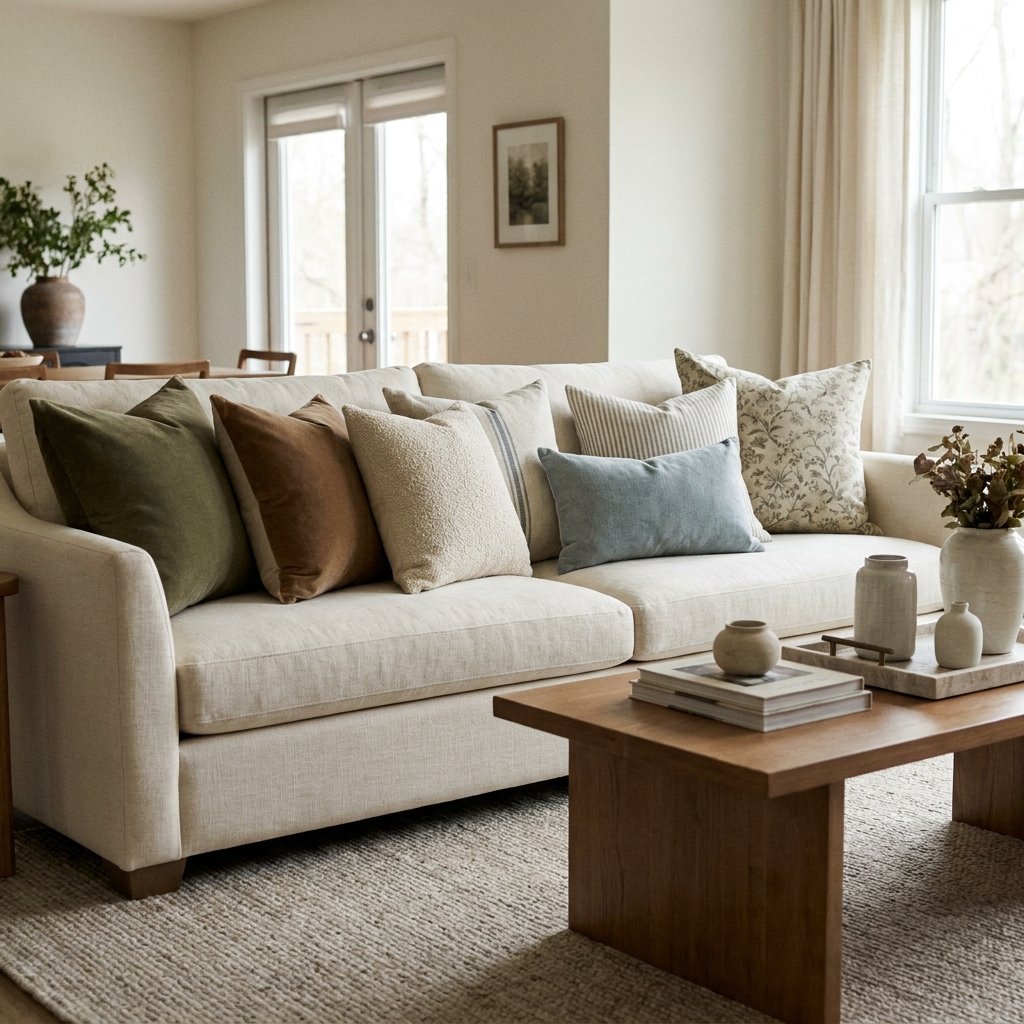
Throw pillows are one of the easiest ways to change the look of a room, but they can also be surprisingly difficult to style.
You find a floral pillow you love. Then you add a stripe. Then another pattern catches your eye. Before long, the sofa has six beautiful pillows that somehow do not look beautiful together.
Learning how to mix and match throw pillows is less about finding a perfectly matched set and more about creating connections between different pillows.
Color, pattern, texture, size, and shape all matter.
The easiest combinations usually include a few repeating colors, patterns at different scales, and enough solid or quiet pillows to give the eye somewhere to rest.
And you do not need a brand-new collection.
Often, keeping several neutral pillows and changing only one or two accent covers is enough to refresh an entire room.
Here are 17 easy ways to mix and match throw pillows on sofas, sectionals, chairs, and beds without making the arrangement feel cluttered or overly coordinated.
1. Start With a Simple Color Palette
Before choosing patterns, decide on color.
Pick two or three main colors that already relate to the room.
For example:
- Cream + olive + brown
- Blue + cream + rust
- Beige + black + camel
- Sage + cream + muted blue
- Burgundy + brown + ivory
Your pillows do not all need to contain every color.
Instead, repeat colors across several pillows.
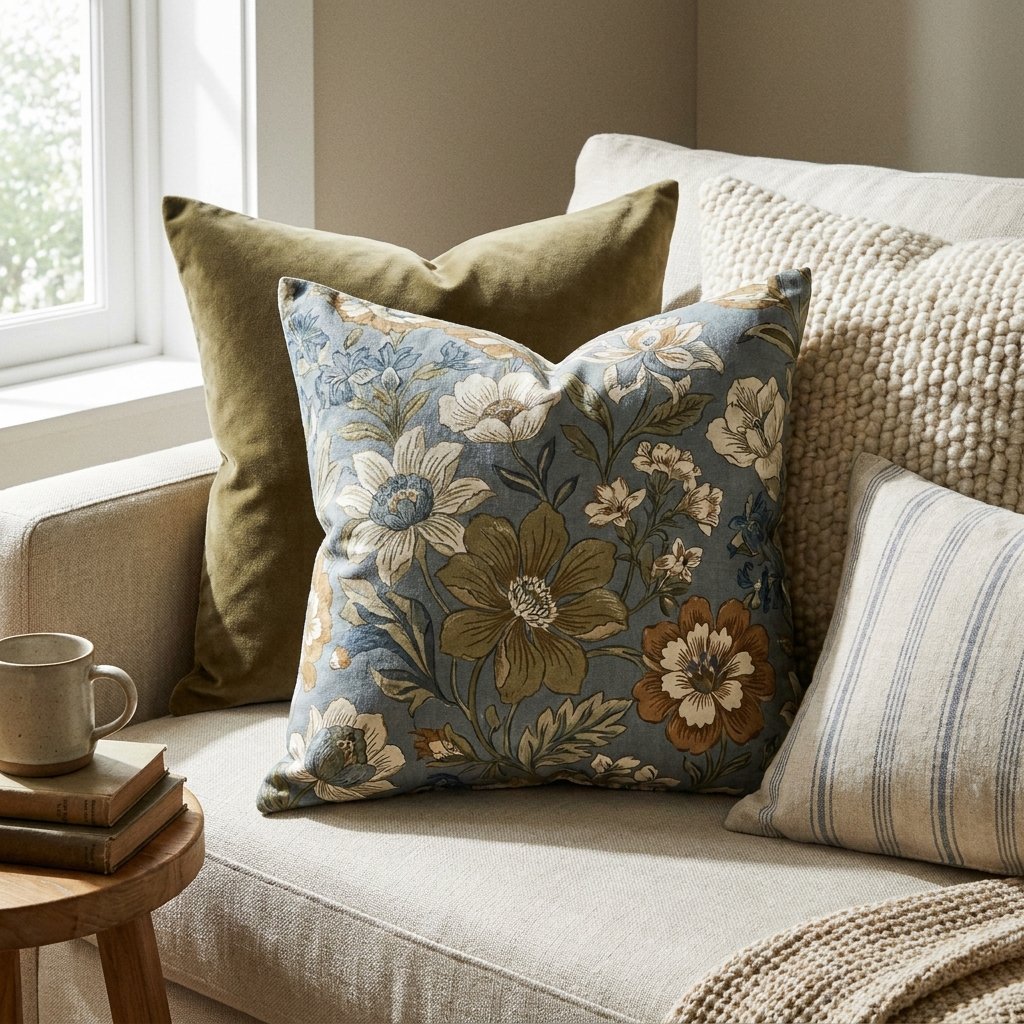
A floral pillow might contain blue and cream. A striped pillow repeats the blue. A solid cream pillow repeats the background.
That repetition is what makes different pillows feel connected.
2. Choose One Pillow as Your Starting Point
If choosing an entire combination feels overwhelming, begin with one pillow you love.
A patterned pillow is particularly useful because it can establish several colors at once.
For example, imagine a floral pillow containing:
- Muted blue
- Olive
- Cream
- Brown
Now choose your remaining pillows from those colors.
You might add a solid olive pillow, cream textured pillow, and subtle blue stripe.
Instead of trying to make four unrelated decisions, you are building the palette from one starting point.
3. Mix Large and Small Patterns
Pattern scale is one of the easiest ways to make mixed pillows work.
If every pattern is small and busy, the arrangement can feel chaotic.
If every pattern is large and bold, they may compete.
Try combining:
- One large-scale pattern
- One smaller-scale pattern
- One solid or textured pillow
For example:
Large floral + narrow stripe + solid velvet.
Each pattern has its own visual role.
4. Add at Least One Solid Pillow
Solids give patterns breathing room.
If your sofa already has floral, plaid, and striped pillows, adding another patterned pillow may make the arrangement feel busier.
A solid pillow can calm everything down.
Choose a solid that repeats a color from one of your patterns.
That way it still feels connected to the arrangement.
Solid does not have to mean boring, either.
A velvet, linen-look, woven, or nubby fabric can add plenty of interest without another print.
5. Mix Textures
Texture is especially important in neutral rooms.
Imagine four beige pillows.
If they are all made from the same smooth fabric, the arrangement may look flat.
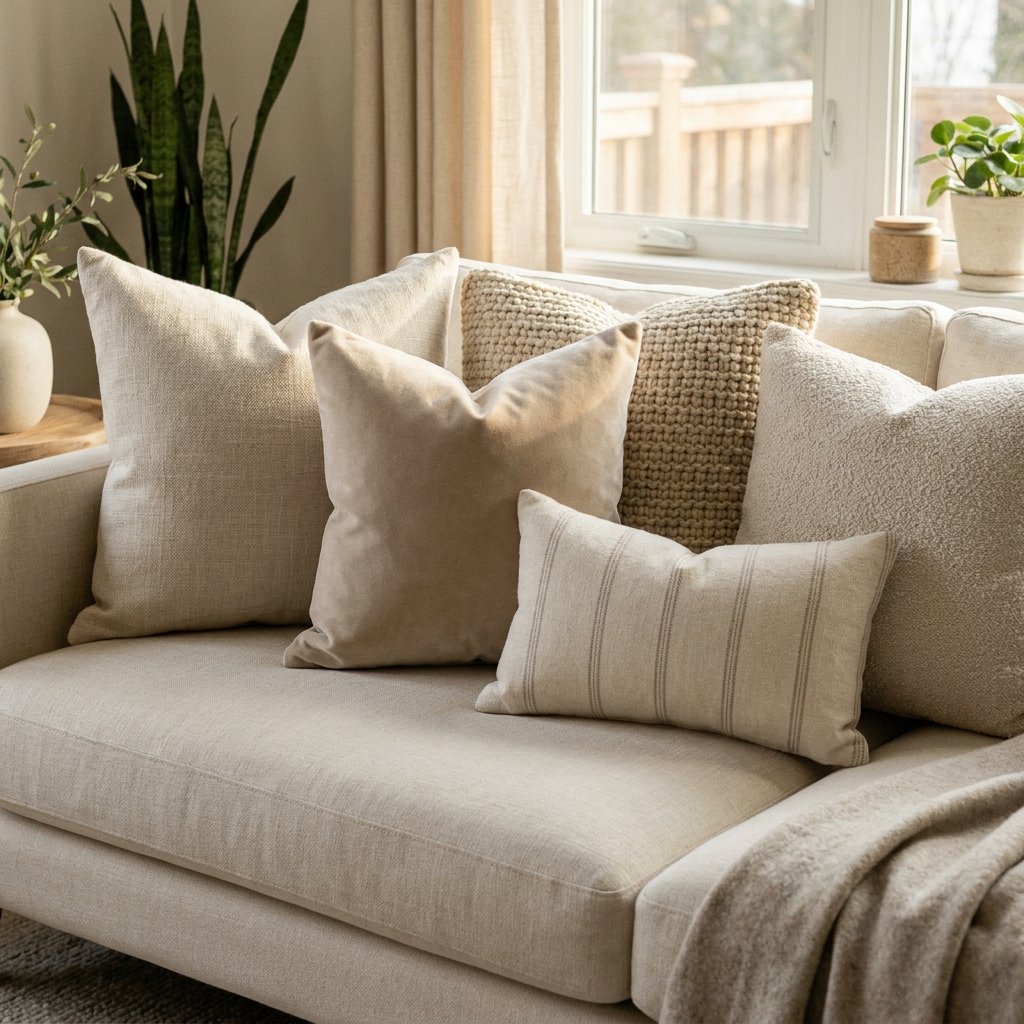
But if you combine:
- Woven linen-look fabric
- Velvet
- Chunky texture
- Subtle boucle-inspired fabric
the same neutral palette suddenly has depth.
This is also a great trick if you are uncomfortable mixing lots of patterns.
6. Vary Pillow Sizes
Using identical pillow sizes can make a sofa feel rigid.
Instead, layer larger pillows behind smaller ones.
A simple arrangement might include:
- Larger square at the back
- Medium square in front
- Smaller lumbar pillow
Exact dimensions are less important than proportion.
Your pillow sizes should make sense for the scale of the sofa or chair and leave enough room for comfortable seating.
7. Add a Lumbar Pillow
A rectangular lumbar pillow is one of the easiest ways to break up a collection of square pillows.
It works especially well:
- In the center of a sofa
- In front of larger pillows
- On an accent chair
- In front of sleeping pillows on a bed
Use a lumbar pillow as the patterned statement or keep it simple and let the square pillows provide the pattern.
Either approach can work.
8. Repeat Colors Without Matching Patterns
Your stripe does not have to match your floral.
The colors can create the connection.
For example:
A blue floral pillow and blue plaid pillow can work together even though the patterns are completely different.
Add a solid blue or cream pillow and the combination becomes even more intentional.
Think coordinated, not matched.
9. Mix Stripes With Florals
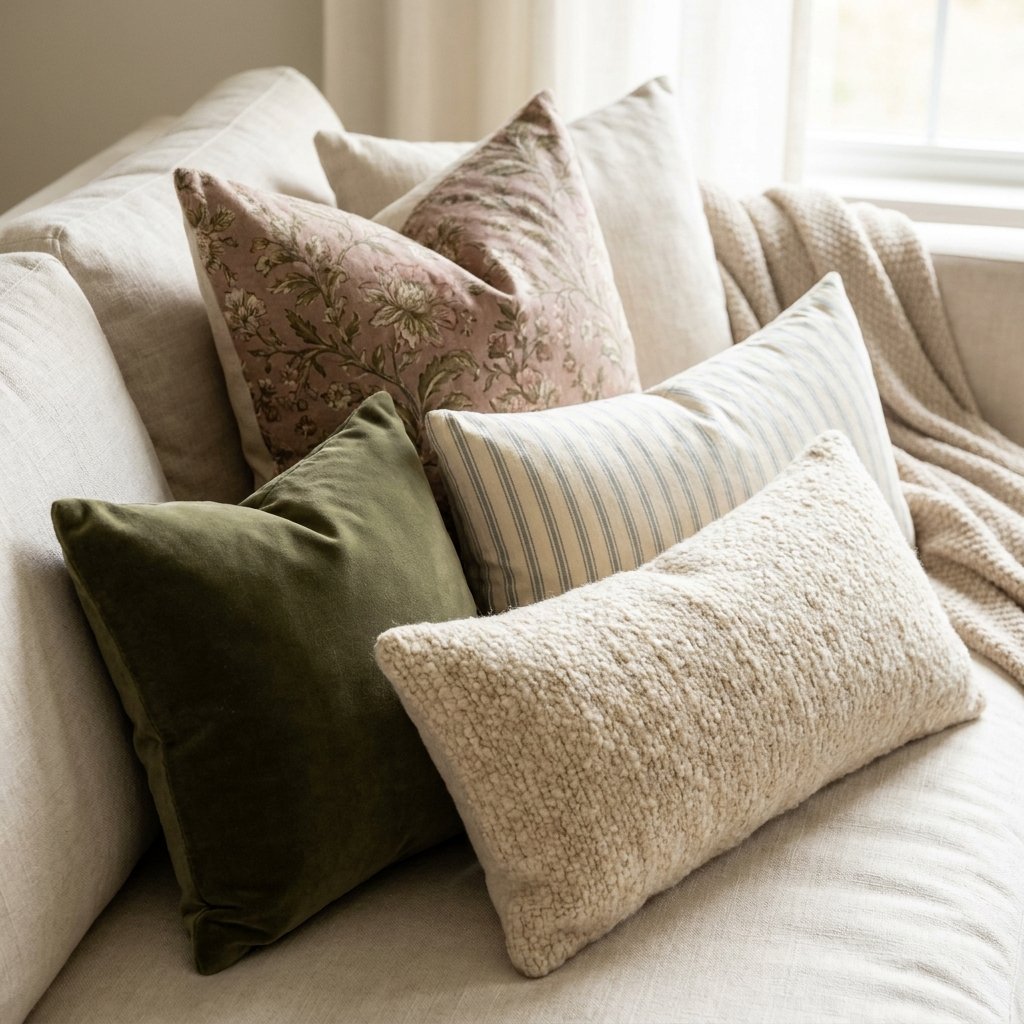
Stripes and florals are a classic pairing because they offer different types of pattern.
Florals are organic and flowing.
Stripes are structured and geometric.
Use one as the stronger pattern and let the other play a supporting role.
For example:
Large muted floral + narrow cream-and-blue stripe + solid olive.
The solid provides the visual pause between them.
10. Mix Geometric and Organic Patterns
The same principle works beyond florals.
Organic patterns might include:
- Botanicals
- Abstract curves
- Leaves
- Loose watercolor-style designs
Geometric patterns might include:
- Stripes
- Checks
- Diamonds
- Grids
Combining the two creates contrast.
Just make sure they share at least one color or relate to the larger room palette.
11. Use Neutrals to Connect Bold Colors
If you love color, neutrals can keep the combination grounded.
Imagine pillows in:
- Rust
- Navy
- Olive
Instead of adding even more color, introduce cream or beige.
The neutral gives the stronger colors space and helps connect them to a neutral sofa or rug.
This is especially helpful in rooms where artwork and accessories already introduce several colors.
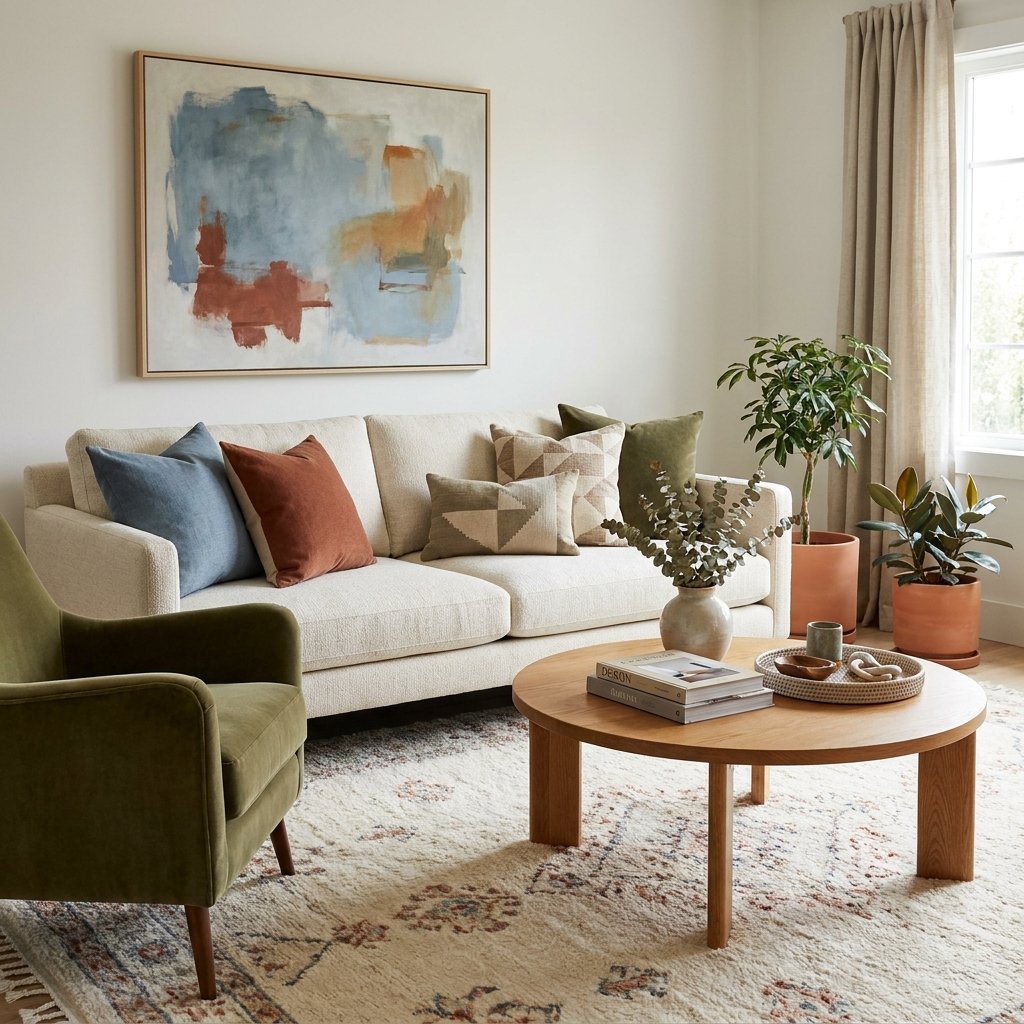
12. Pull Pillow Colors From the Room
Your sofa does not exist separately from everything around it.
Look around the room for colors you can repeat.
Pull from:
- Rug
- Artwork
- Curtains
- Chairs
- Fireplace
- Wood furniture
- Accessories
If your rug contains muted blue, for example, repeat that blue in one pillow.
If your artwork contains rust, use a small rust accent.
These subtle repetitions make the whole room feel connected.
13. Do Not Match Every Pillow
Matching sets can look polished, but they can also make a room feel less collected.
Instead of buying six identical pillows, use a mixture.
For example:
- Two large matching neutral pillows
- One floral
- One stripe
- One solid accent
- One lumbar
The matching pair creates structure.
The other pillows provide personality.
14. Repeat One Pillow for Balance
Mixing and matching does not mean every pillow must be different.
Repeating one style can help anchor a larger arrangement.
On a sectional, for example, you might use the same cream textured pillow at opposite ends.
Then mix different patterned and solid pillows between them.
That repetition makes the arrangement feel intentional without becoming perfectly symmetrical.
15. Let One Pattern Be the Star
If you have a pillow with a beautiful bold pattern, let it lead.
Do not surround it with several equally dominant patterns.
Pair it with:
- Solid color
- Small-scale stripe
- Quiet texture
- Simple lumbar
This gives the statement pillow enough space to be noticed.
16. Use an Odd Number When It Fits the Furniture
Odd-number arrangements can create a relaxed look.
Three pillows can work beautifully on a smaller sofa.
Five may work on a larger sofa.
But this is not a strict rule.
A pair of pillows can look great on a loveseat, while an even arrangement can suit a more formal room.
Furniture size and comfort matter more than following a decorating formula.
17. Stop Before the Sofa Feels Full
The best-looking pillow arrangement is not necessarily the one with the most pillows.
Your sofa still needs to function.
People should be able to sit down without moving a mountain of cushions.
After arranging everything, step back and ask:
Does the sofa look layered?
Or does it look buried?
Removing one pillow can sometimes improve the entire arrangement.
The Easiest Formula for Mixing Throw Pillows
If you want a simple formula, start here:
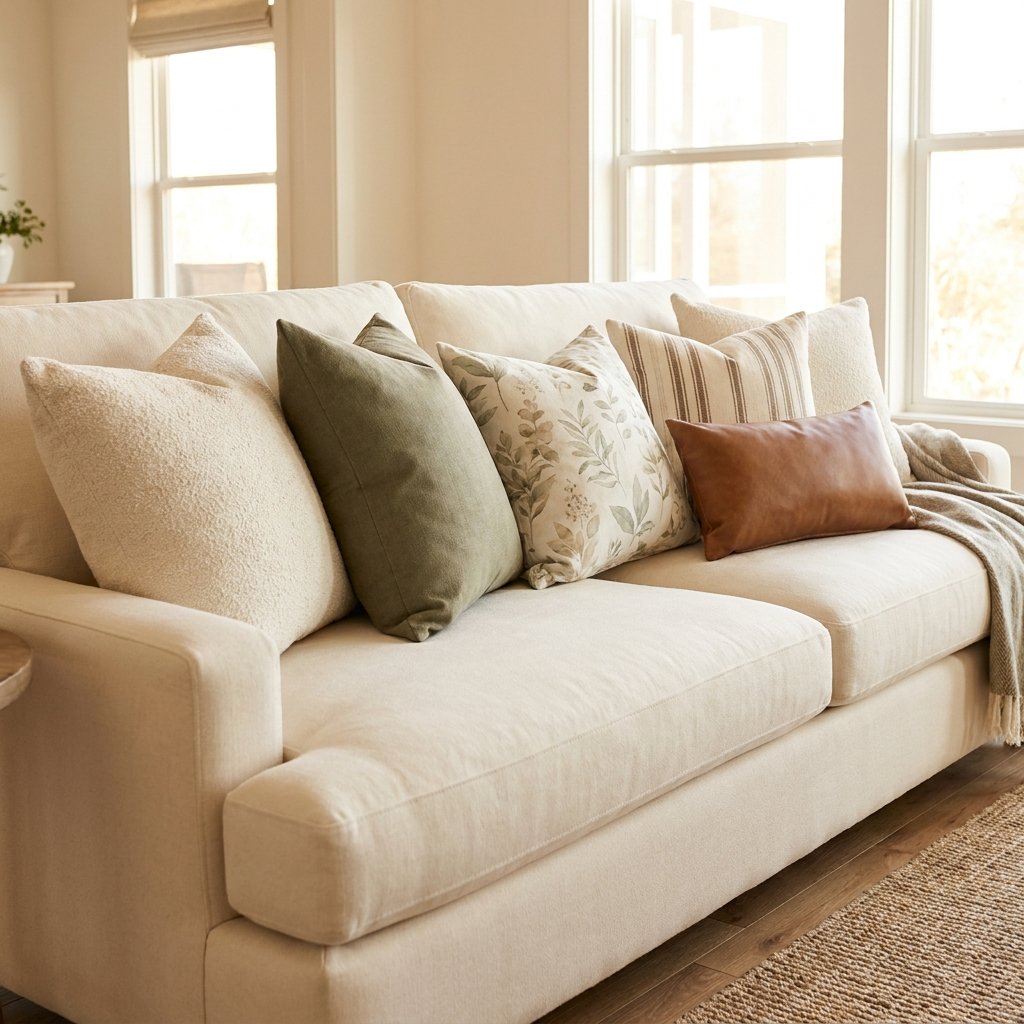
One solid + one stripe + one organic pattern + one texture.
For example:
- Solid olive
- Cream-and-brown stripe
- Muted botanical
- Chunky cream texture
You can use all four on a large sofa or choose three for a smaller one.
Another easy formula is:
One statement pattern + two coordinating solids.
This works particularly well if you prefer simple rooms.
How to Mix and Match Pillows on a Sofa
Start at the outer corners.
Place your larger pillows toward the ends or back.
Layer medium pillows in front or slightly inward.
Then use a lumbar or smaller pillow as an accent.
You do not have to make both sides identical.
An asymmetrical arrangement might include:
Left side: large cream pillow + floral.
Right side: large olive pillow + stripe + small lumbar.
The colors create balance even though the individual pillows differ.
How to Mix and Match Pillows on a Sectional
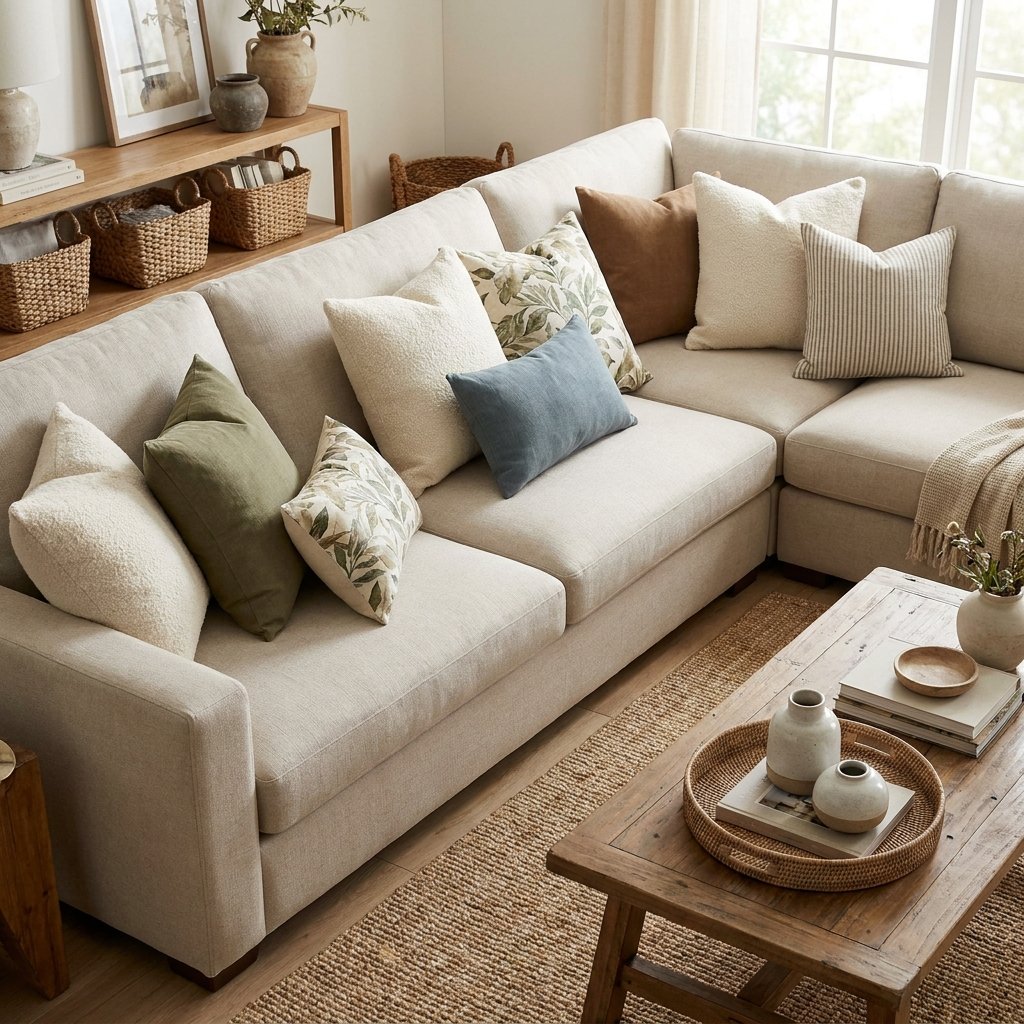
Sectionals provide more space, but that does not mean every corner needs a pile of pillows.
Think in clusters.
You might create:
- Two pillows at one end
- Two or three near the inside corner
- Two at the opposite end
Repeat one pillow style or color across the sectional to visually connect the groups.
Keep the center seating areas relatively open.
How to Mix Pillows on a Bed
Beds already have several layers, so decorative pillows can become excessive quickly.
Start with the pillows you actually sleep on.
Then add decorative layers in front.
A simple arrangement might include:
Sleeping pillows + two larger decorative pillows + one lumbar.
For a more layered look, add another pair between those layers.
Use bedding as your color guide.
If the duvet is patterned, keep more of the pillows solid.
If the bedding is simple, the pillows can carry more pattern.
How to Mix Pillows on a Chair
An accent chair usually needs less.
Often, one pillow is enough.
Choose either:
- Statement pattern
- Strong texture
- Accent color
If the chair itself is patterned, a solid pillow is usually the easiest option.
If the chair is solid, you have more freedom to introduce pattern.
How to Mix Throw Pillows With a Patterned Rug
A patterned rug already creates visual activity.
Your pillows do not need to copy its pattern.
Instead, pull one or two colors from the rug.
If the rug is heavily patterned, keep more pillows solid or subtly textured.
If the rug has a quiet pattern, you can introduce a stronger print on the sofa.
The goal is balance across the whole room rather than matching the rug exactly.
How to Mix Pillows With Patterned Curtains
Use the same approach.
Pull a color from the curtains rather than duplicating the exact print.
Floral curtains, for example, could work with:
- Solid pillow in one flower color
- Simple stripe
- Neutral textured pillow
Repeating the exact floral pattern everywhere can make the room feel overly coordinated.
How to Mix Throw Pillows on a Neutral Sofa
A neutral sofa is essentially a blank canvas.
On a cream, beige, or light gray sofa, you can introduce:
- Blue
- Green
- Rust
- Burgundy
- Brown
- Black
Keep the arrangement connected by repeating colors elsewhere in the room.
If you prefer neutral decor, use texture rather than strong color.
Cream, oatmeal, taupe, camel, and brown can create plenty of depth.
How to Mix Throw Pillows on a Gray Sofa
First consider whether the gray sofa appears warm or cool.
For a warmer look, try:
- Rust
- Camel
- Brown
- Cream
- Olive
For a cooler palette, consider:
- Blue
- Green
- Cream
- Charcoal
If everything feels too gray, introduce warmth through wood, woven materials, and warm textiles elsewhere.
How to Mix Throw Pillows on a Brown Leather Sofa
Leather already provides strong color and texture.
Use pillows to soften it.
Try:
- Cream
- Beige
- Olive
- Muted blue
- Rust
- Plaid
- Botanical patterns
Avoid using only brown pillows that disappear into the sofa.
Lighter textiles create contrast against leather and make the arrangement more inviting.
How to Mix Throw Pillows on a Blue Sofa
A blue sofa can handle both analogous and contrasting colors.
Try combinations such as:
Blue + Cream + Camel
Soft and classic.
Blue + Rust + Cream
Warm and high contrast.
Blue + Olive + Beige
Earthy and relaxed.
Blue + Burgundy + Brown
Rich and traditional.
Use at least one pillow that relates directly to the sofa color to make the combination feel connected.
How to Mix Throw Pillows on a Green Sofa
Green sofas work beautifully with earthy palettes.
Try:
- Cream
- Camel
- Brown
- Rust
- Burgundy
- Muted blue
If the sofa itself is a strong color, you may need fewer colorful pillows.
Use cream and textured neutrals to create balance.
How to Mix Neutral Throw Pillows
Neutral does not mean everything must match.
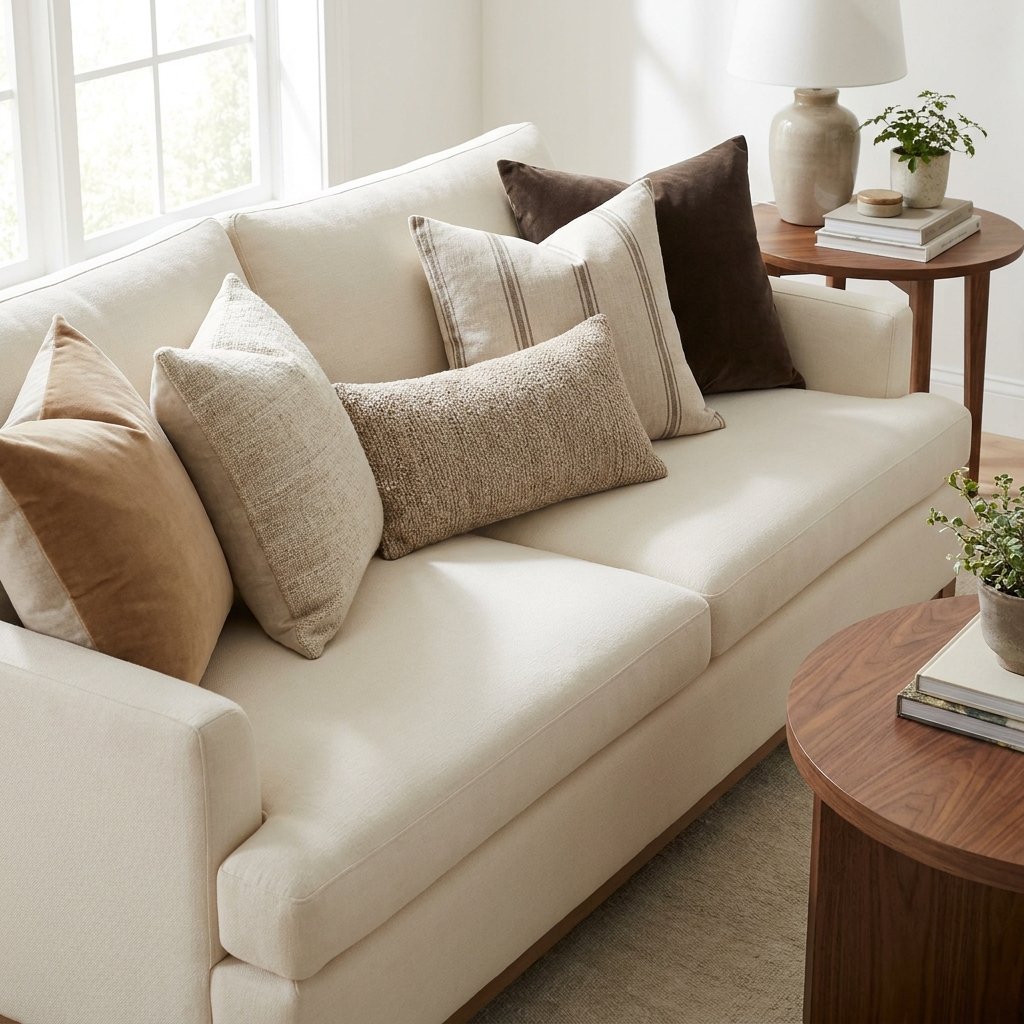
Mix shades such as:
- Warm white
- Oatmeal
- Beige
- Taupe
- Camel
- Brown
Then vary the textures.
Try:
Woven cream + camel velvet + beige stripe + brown lumbar.
The variation in material and pattern keeps the neutral arrangement from feeling flat.
How to Mix Patterns Without Making the Room Look Busy
The easiest strategy is to change the scale.
Imagine three patterned pillows.
Pattern 1: Large
A bold botanical.
Pattern 2: Medium
A loose geometric.
Pattern 3: Small
A narrow stripe.
Because the patterns operate at different scales, they are less likely to compete.
You can then add a solid pillow to give the eye somewhere to rest.
How to Mix Seasonal Throw Pillows
You do not need an entirely separate pillow collection for every season.
Create a foundation of versatile pillows.
For example:
- Cream texture
- Neutral stripe
- Olive solid
- Brown lumbar
Then switch one or two accent covers.
For fall, add rust.
For winter, add burgundy or deeper green.
For spring, introduce softer green or blue.
For summer, use lighter blue or another fresh accent.
This approach reduces both spending and storage.
How to Make Throw Pillows Look More Expensive
The biggest difference usually comes from styling rather than price.
Use a Cohesive Palette
Repeated colors make separate pillows feel intentional.
Mix Materials
Combine smooth, woven, plush, and textured fabrics.
Vary Scale
Mix larger pillows with smaller accents.
Use Fewer Pillows
Do not hide the furniture.
Add a Lumbar
The different shape creates visual interest.
Avoid Buying Only Matching Sets
A collected mix can create more depth.
Coordinate With the Room
The pillows should relate to the rug, artwork, furniture, or curtains.
Common Throw Pillow Mixing Mistakes
Using Too Many Unrelated Colors
Choose a palette first.
Making Every Pillow a Pattern
Add solids and texture for breathing room.
Using Patterns at the Same Scale
Mix large and small patterns.
Buying Everything as a Matching Set
Allow some variation.
Using Only One Texture
Texture creates depth even without pattern.
Ignoring Pillow Size
Layering several sizes looks more natural than a row of identical squares.
Forgetting the Rest of the Room
Pull colors from existing furnishings.
Adding Too Many Pillows
Leave comfortable seating space.
Making Both Sides Perfectly Identical by Default
Symmetry can work, but it is not required.
Replacing Every Pillow Each Season
Keep a versatile foundation and change only a few covers.
A Simple 3-Pillow Combination
For a chair, loveseat, or small sofa arrangement, try:
- Solid color
- Pattern
- Texture
Example:
Olive solid + cream-and-blue floral + oatmeal texture.
A Simple 5-Pillow Combination
For a larger sofa:
- Large cream texture
- Large olive solid
- Medium botanical
- Medium stripe
- Small lumbar
Repeat colors between the pillows so they feel related.
A Simple Neutral Pillow Combination
Try:
- Warm white woven pillow
- Camel velvet
- Beige-and-brown stripe
- Taupe texture
- Chocolate lumbar
There is plenty of variation even though the palette stays neutral.
A Simple Colorful Pillow Combination
Choose one patterned pillow first.
Suppose it contains blue, green, cream, and rust.
Build around it with:
- Solid blue
- Solid green
- Cream texture
- Small rust stripe
The patterned pillow acts as the bridge between all the colors.
Throw Pillow Styling Safety and Practical Tips
Pillows are low-risk decor, but function still matters.
Keep enough seating space for people to sit comfortably.
Avoid piling large floor pillows or cushions where they create trip hazards in walkways.
In children’s spaces, inspect decorative pillows for loose buttons, beads, tassels, or other small embellishments that may not be appropriate for the child’s age.
Keep decorative pillows away from fireplaces, heaters, candles, and other significant heat or flame sources.
Always follow the manufacturer’s care instructions for covers and inserts.
FAQ About Mixing and Matching Throw Pillows
How do you mix and match throw pillows?
Choose a small color palette, combine patterns at different scales, include solids, vary textures and sizes, and repeat colors across several pillows to create connection.
Do throw pillows have to match?
No. Coordinated pillows often look more interesting than identical ones. They simply need a common element such as color, texture, style, or pattern.
How many patterns can you mix on a sofa?
There is no fixed number, but the arrangement usually becomes easier to manage when you combine a limited number of patterns with solids and textures. Varying pattern scale also helps.
Can you mix stripes and florals?
Yes. Their contrasting structures can work beautifully together. Repeat at least one color between them and consider adding a solid pillow.
Should all throw pillows be the same size?
No. Mixing larger squares, medium pillows, and a smaller lumbar can create more depth.
How many throw pillows should be on a sofa?
It depends on the sofa’s size and style. Use enough to make it feel layered without sacrificing comfortable seating.
How do I mix pillows on a neutral couch?
Use the neutral sofa as your foundation, then introduce a small color palette through solids, patterns, and textures. Cream, blue, olive, rust, brown, and black are all possibilities depending on the room.
How do you mix neutral pillows without making them boring?
Vary texture, pattern, shade, and shape. Combine warm white, oatmeal, beige, camel, taupe, and brown in materials such as velvet, woven fabric, and linen-like textures.
Final Thoughts
Learning how to mix and match throw pillows becomes much easier when you stop trying to find a perfectly matching set.
Start with color.
Choose two or three shades that already make sense in the room, or use one patterned pillow as the starting point for your palette.
Then create variety.
Mix large and small patterns. Add a solid pillow for breathing room. Combine different textures. Vary the pillow sizes and introduce a lumbar to break up a row of squares.
Most importantly, look beyond the sofa.
Pull colors from your rug, artwork, curtains, chairs, or other furnishings so the pillows feel connected to the entire room.
You also do not need dozens of pillows or a brand-new collection every season.
A few versatile neutral covers combined with one or two changing accent pillows can create a room that feels collected, comfortable, and easy to update.
The goal is not perfect matching.
It is creating enough repetition for the pillows to belong together—and enough variation to keep the arrangement interesting.