

Kitchen counter stools may seem like a small decorating decision until you start shopping for them.
Suddenly, there are dozens of choices: wood or metal, backless or high-back, upholstered or woven, swivel or stationary, modern or traditional. Then there is the more important question—will the stools actually fit comfortably beneath your kitchen island or counter?
The right kitchen counter stools need to do two jobs well.
They should look like they belong in your kitchen, but they also need to be comfortable and appropriately sized for the counter, available legroom, and everyday use.
Instead of choosing stools based on appearance alone, start with measurements and function. Then use color, wood tone, shape, and texture to connect them to your cabinets, flooring, lighting, and surrounding furniture.
These 17 kitchen counter stool ideas will help you find a style that works for your space while avoiding some of the most common sizing and layout mistakes.
1. Start With the Correct Stool Height
Before thinking about color or style, measure your counter.
Counter-height and bar-height seating are not interchangeable.
Measure from the floor to the underside or seating surface of the counter, then compare that measurement with the stool’s seat height and the manufacturer’s dimensions.
You need enough vertical space between the stool seat and counter for comfortable sitting and leg movement.
Do not shop by the product label alone.
One manufacturer’s interpretation of “counter height” may not be identical to another’s, and countertop thickness, aprons, supports, and overhangs can affect usable space.
Always check actual dimensions.
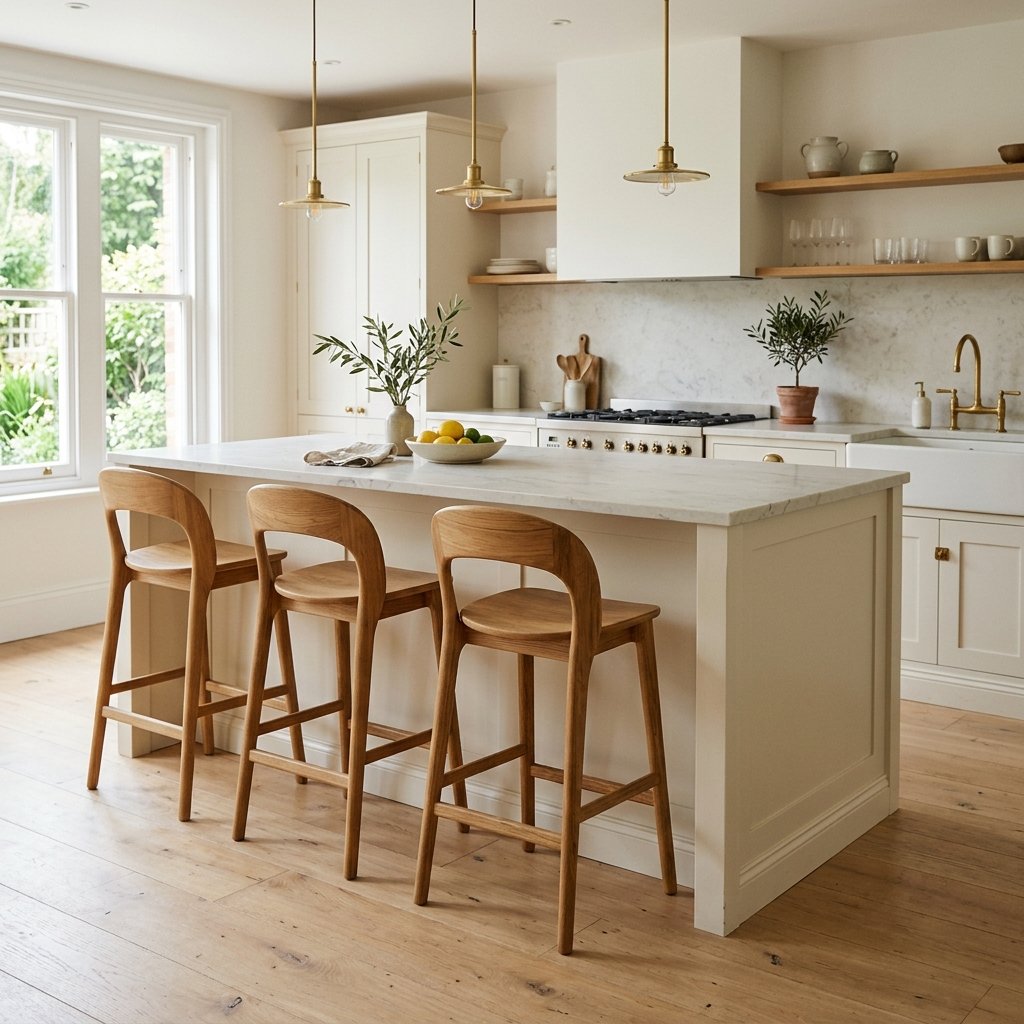
2. Choose Wood Counter Stools for Warmth
Wood stools are an easy way to warm up a kitchen.
They work particularly well in kitchens with lots of painted surfaces.
For example:
White cabinets + white island + wood stools.
The wood prevents the room from feeling too flat or sterile.
You do not have to match the flooring exactly.
In fact, a slightly darker or lighter wood tone can create more depth.
3. Try Black Counter Stools for Contrast
Black stools can visually anchor a light kitchen.
They work especially well with:
- White cabinets
- Cream cabinets
- Light wood cabinets
- Pale stone countertops
- Light flooring
Repeat a small amount of black elsewhere through lighting, cabinet hardware, window frames, or accessories.
That repetition makes the stools feel intentional rather than like isolated dark objects.
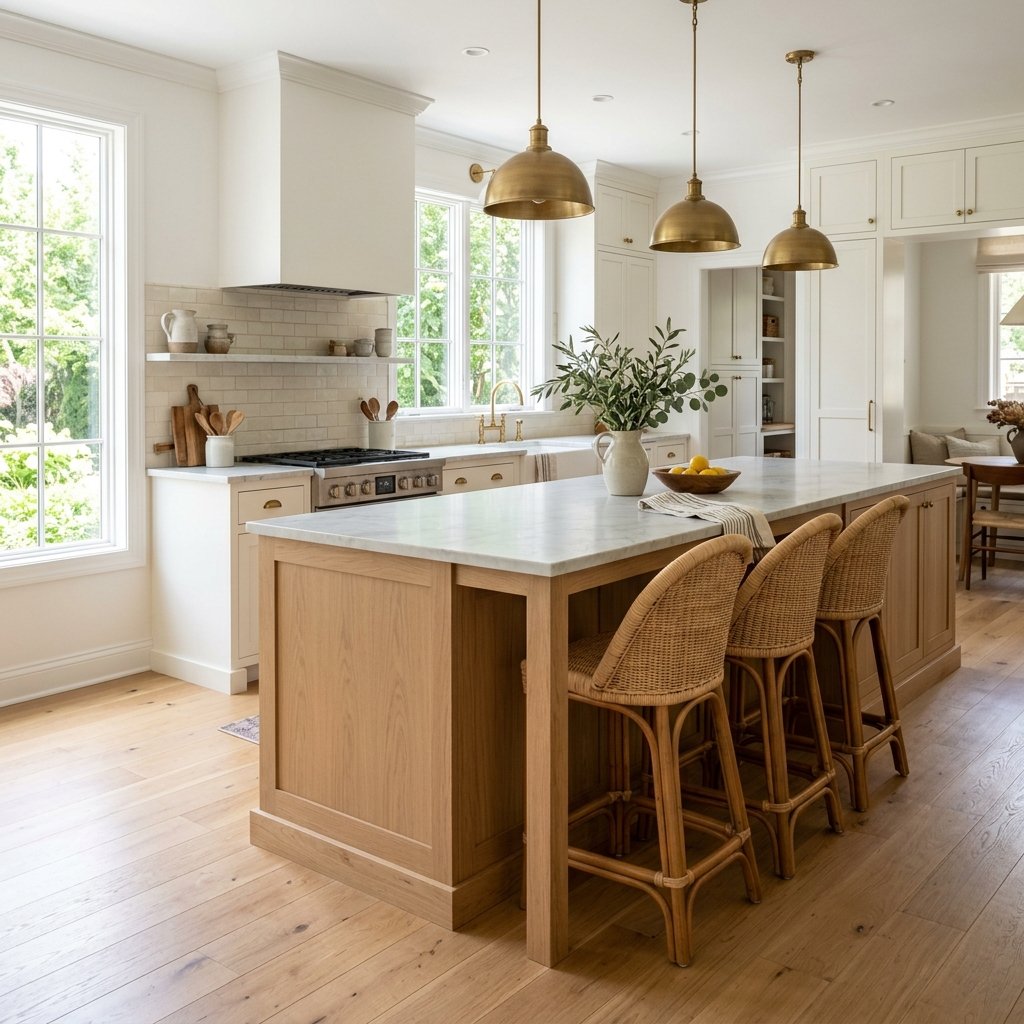
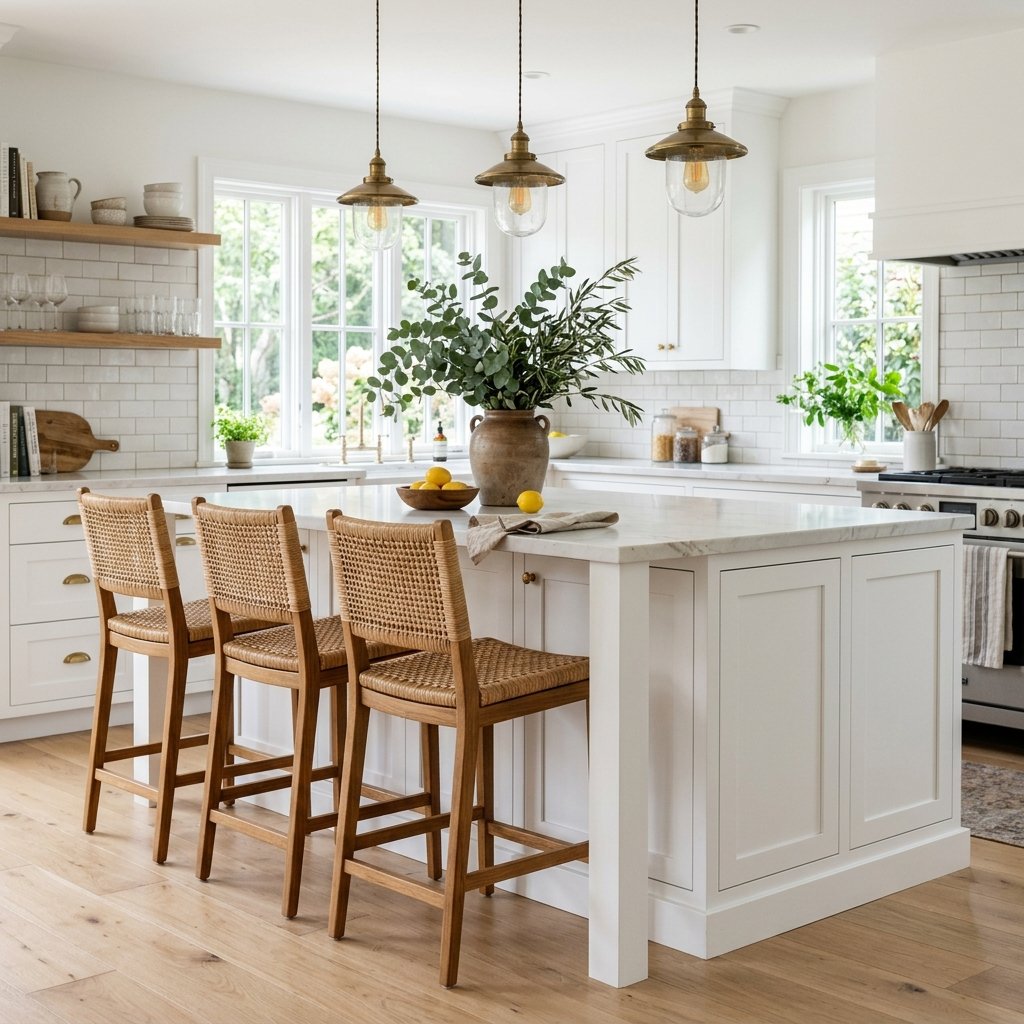
4. Add Woven Counter Stools
Woven materials bring texture to kitchens, which often contain many hard surfaces.
Depending on the design, look for details such as:
- Cane
- Rattan-inspired weaving
- Rush-style seats
- Woven synthetic materials
- Rope-style details
Natural-looking woven stools work particularly well in coastal, organic, farmhouse, transitional, and casual kitchens.
If the stools will be used heavily by children or around frequent spills, consider how easily the specific material can be cleaned.
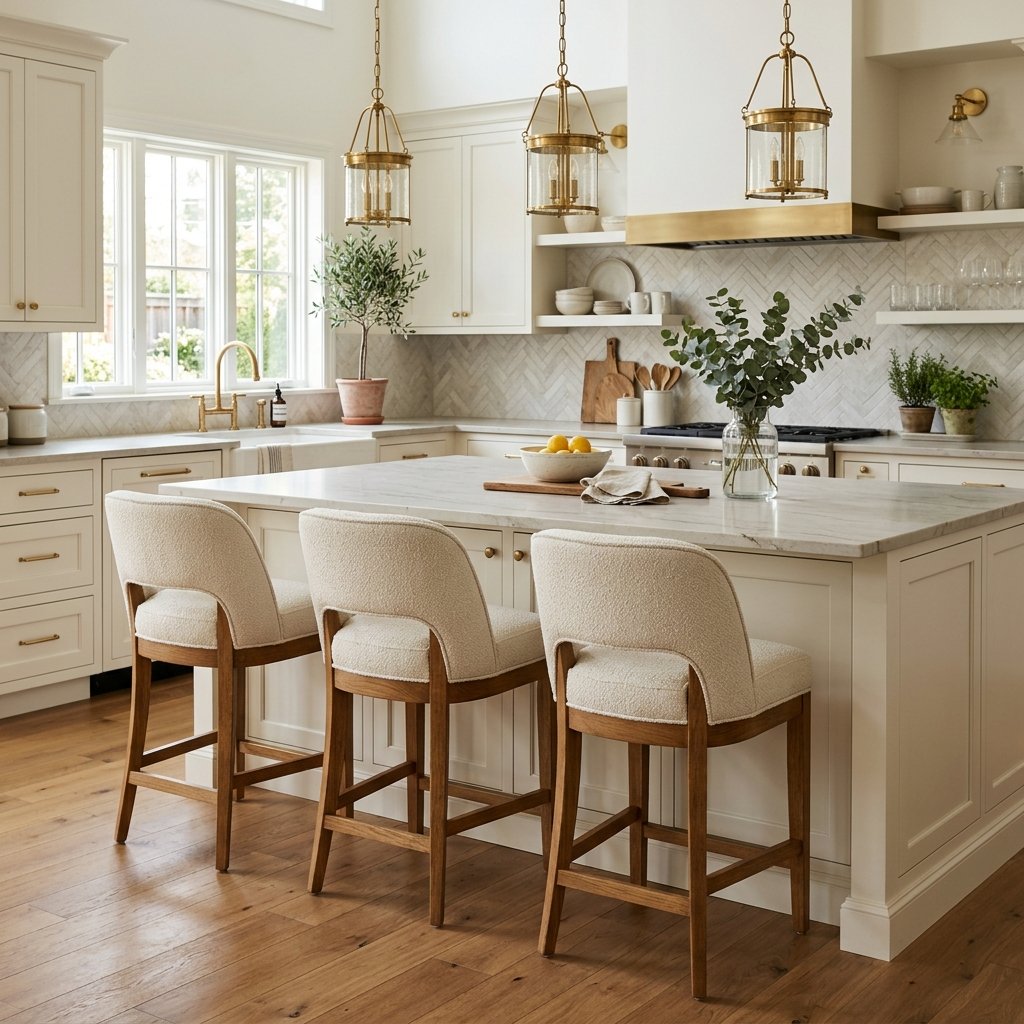
5. Choose Upholstered Stools for Comfort
If your kitchen island doubles as a breakfast table, homework station, or casual workspace, comfort matters.
An upholstered seat can make longer periods of sitting more pleasant.
Consider durability and maintenance before choosing the fabric.
In a busy kitchen, look for materials appropriate for frequent use and follow the manufacturer’s cleaning directions.
A seat that looks beautiful but is difficult to maintain may not be the most practical choice for everyday family life.
6. Use Backless Stools in a Small Kitchen
Backless stools can be useful when visual space is limited.
When they fit fully beneath the counter, they almost disappear from view.
This can make a small kitchen feel less crowded.
They also work well when you want the island itself to remain the visual focus.
The tradeoff is comfort.
If people regularly sit at the counter for long meals or extended conversations, stools with backs may be more supportive.
7. Choose Counter Stools With Backs for Everyday Seating
If your stools are used every day, a back can be worth the extra visual space.
Stools with backs are particularly useful for:
- Family meals
- Homework
- Entertaining
- Working at the island
- Long conversations
Look at the height of the back in relation to the countertop.
A very tall stool back creates a stronger visual statement, while a lower back can provide some support without dominating the island.
8. Try Low-Back Counter Stools
Low-back stools provide a useful middle ground.
They offer more support than completely backless seating while maintaining a relatively open sightline across the kitchen.
This style can work particularly well in open-concept homes where the kitchen island is visible from the living or dining area.
Choose a profile that does not interfere with nearby drawers, walkways, or other seating.
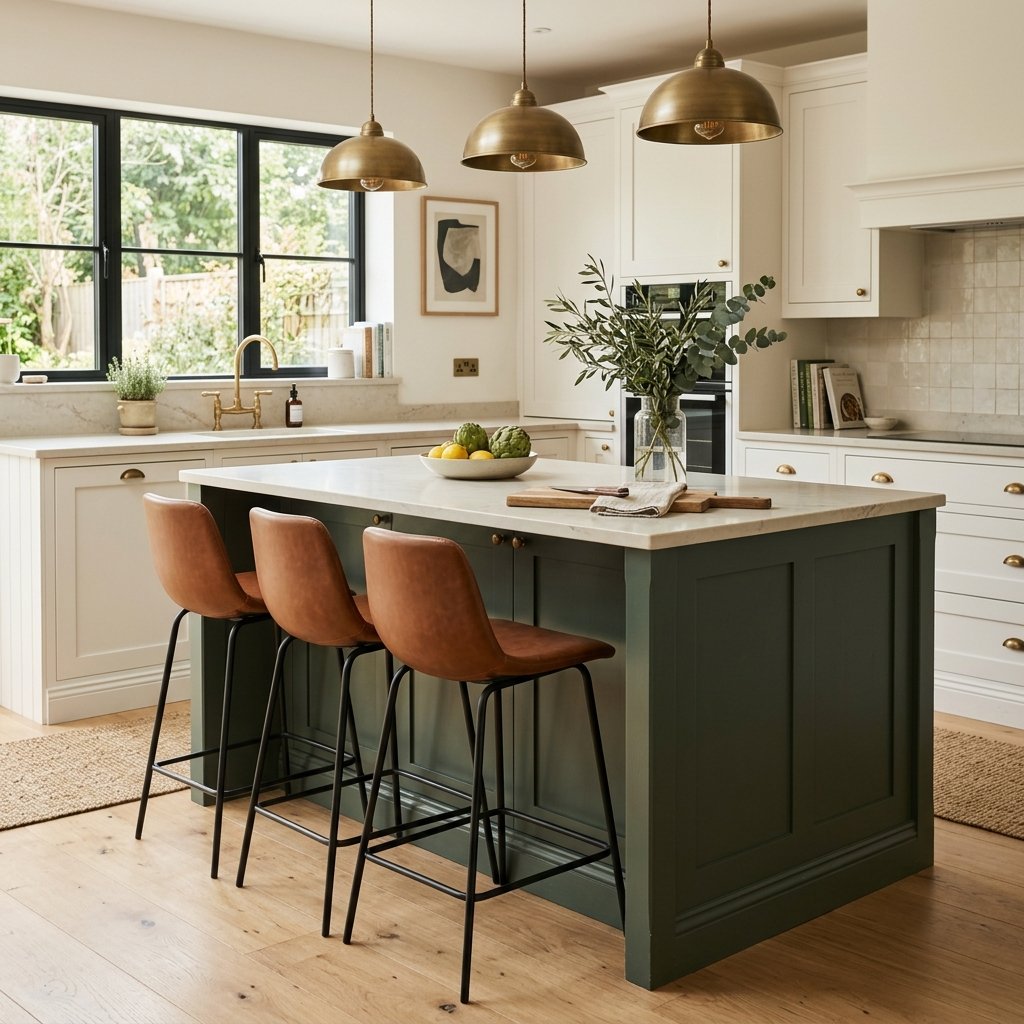
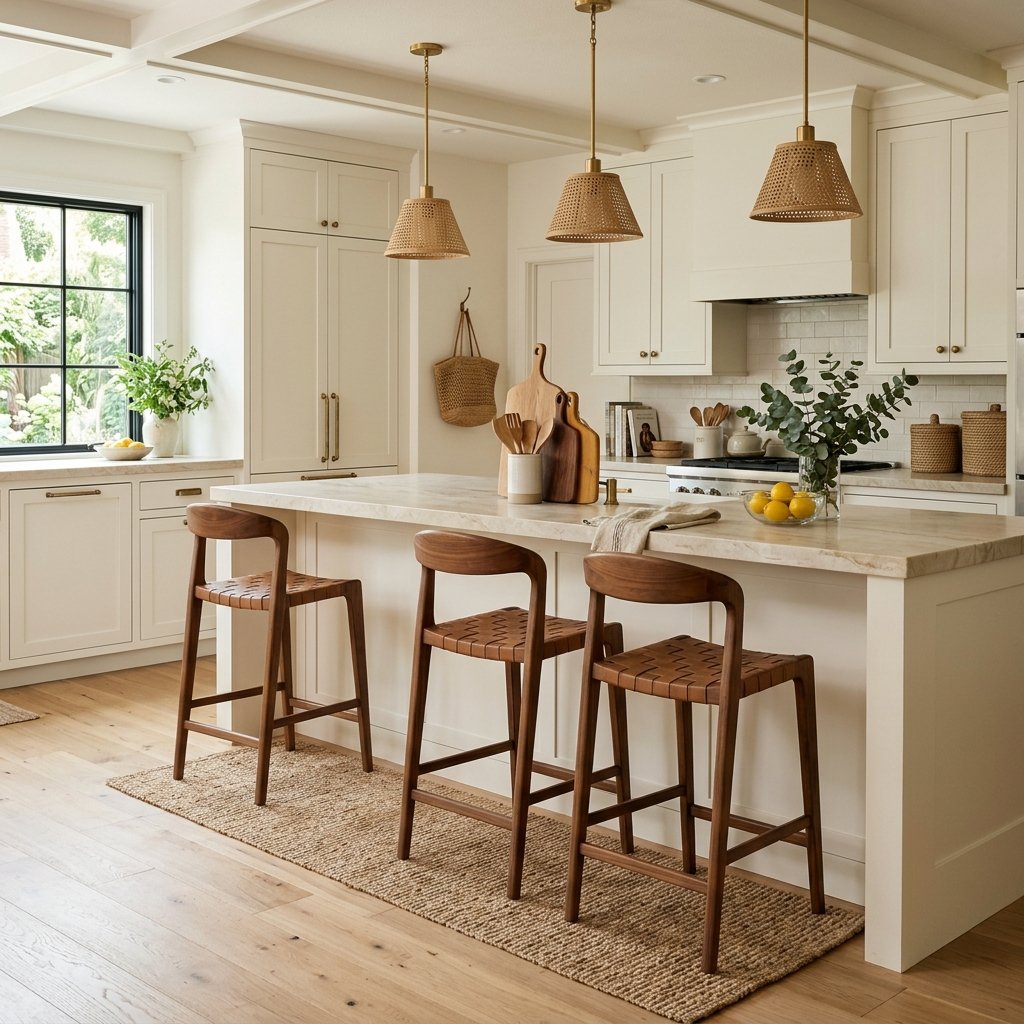
9. Add Leather or Leather-Look Stools
Warm brown seating can add richness to a neutral kitchen.
Cognac, camel, chocolate, or other warm brown upholstery can work beautifully with:
- White
- Cream
- Black
- Green
- Navy
- Natural wood
The material also introduces a different texture from stone, tile, and painted cabinetry.
Check the specific material’s care requirements and durability before buying, particularly for a heavily used kitchen.
10. Choose Swivel Stools for an Open-Concept Kitchen
Swivel stools can make conversation easier when the kitchen opens into a living or dining area.
Someone sitting at the island can turn toward another part of the room without moving the entire stool.
But check the design carefully.
Make sure the swivel mechanism does not cause the seat or back to repeatedly strike the countertop or cabinetry.
Also consider the space needed for safe movement around the stool.
11. Use Metal Stools for a Cleaner Look
Metal frames can make stools feel visually lighter than chunky solid-wood designs.
Black metal works well in modern, industrial, transitional, and farmhouse-inspired kitchens.
Warm metallic finishes can also work depending on the room.
If the kitchen already contains several metals, the stool does not necessarily need to match them exactly.
Instead, aim for finishes that look intentional together.
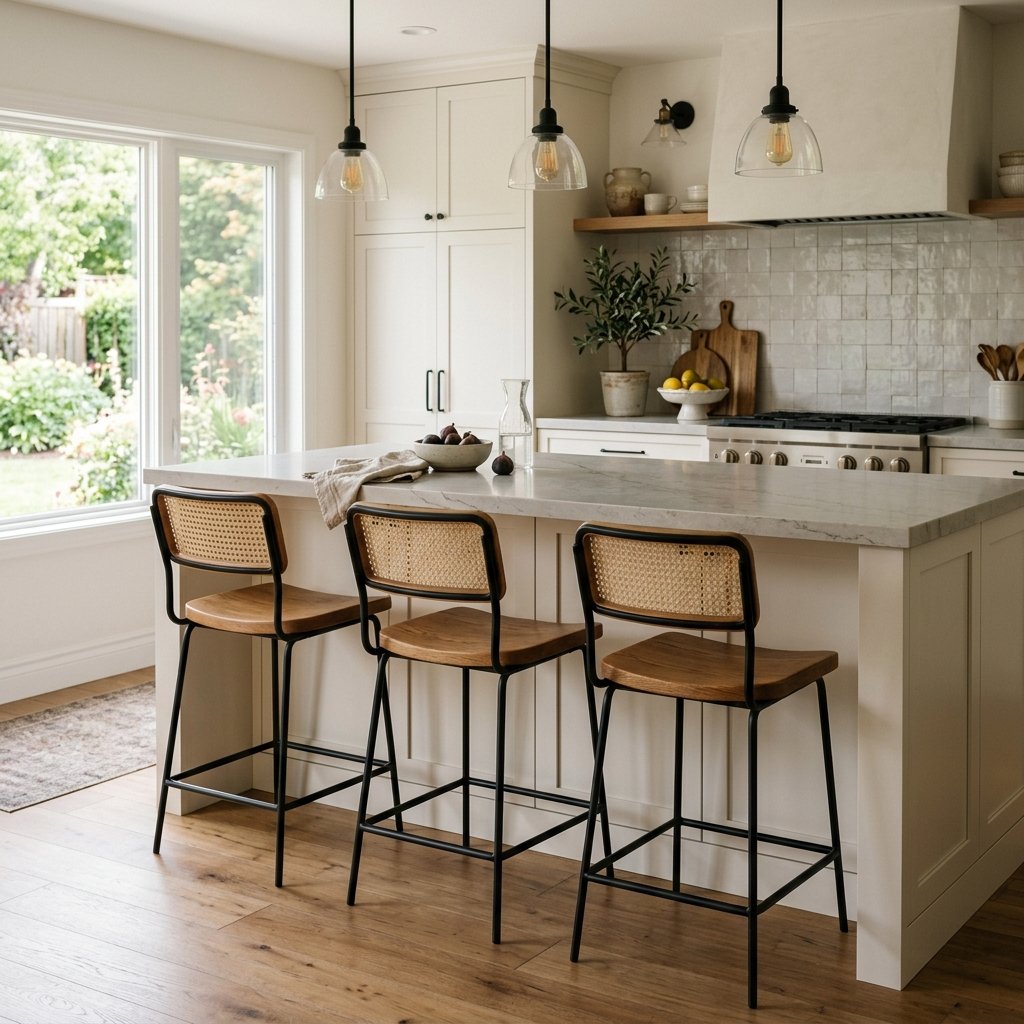
12. Try Mixed-Material Stools
Some of the most versatile kitchen stools combine materials.
For example:
- Wood + upholstery
- Metal + wood
- Wood + cane
- Metal + woven seat
Mixed materials help the stools connect different finishes in the kitchen.
A stool with a black frame and wood seat, for example, could relate to both black pendant lights and wood flooring.
13. Use White or Cream Stools for a Light Look
Light stools can almost disappear into a pale kitchen.
This works well if you want the kitchen to feel:
- Airy
- Quiet
- Coastal
- Minimal
- Soft
To prevent everything from blending together, add texture.
For example, choose a cream stool with woven detailing or a light upholstered seat on a natural wood frame.
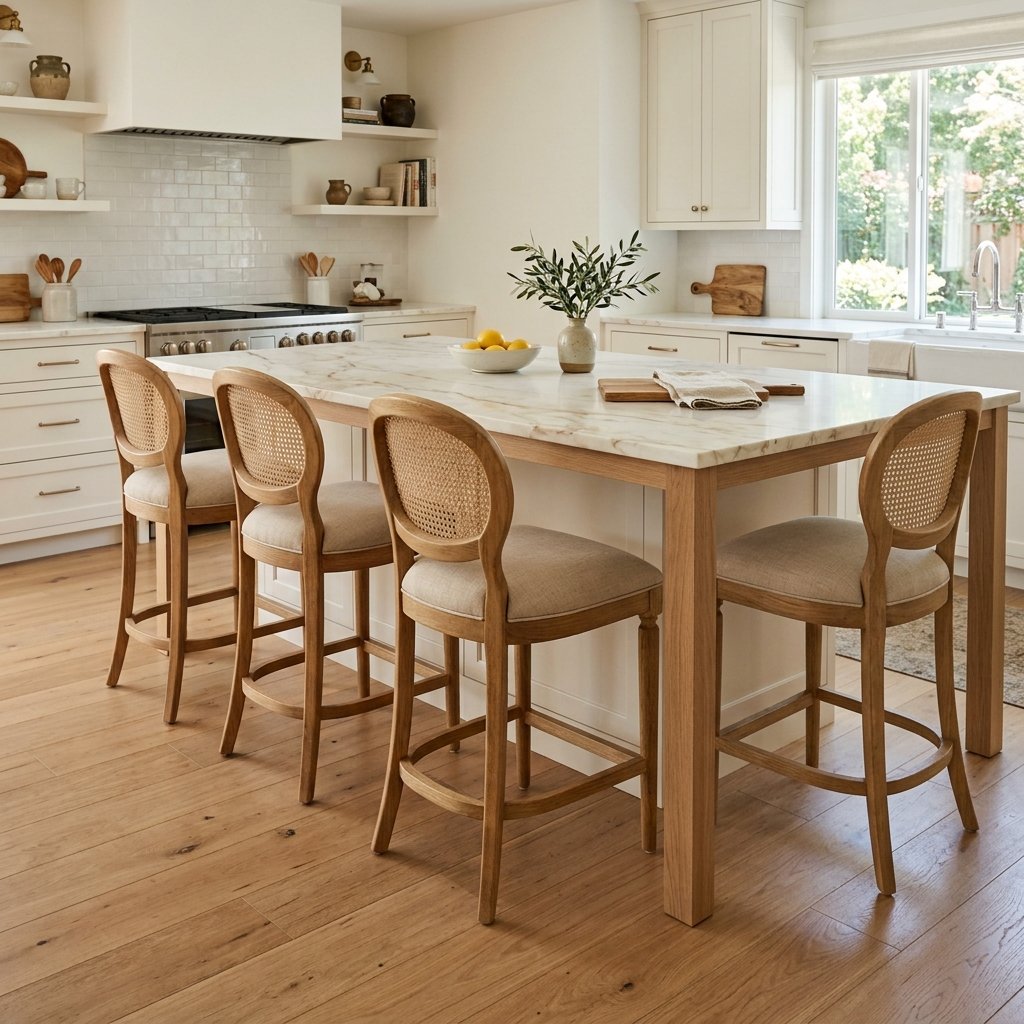
14. Add Color With the Counter Stools
Stools can be a practical place to introduce color without painting the cabinets.
Consider:
- Olive green
- Muted blue
- Navy
- Burgundy
- Soft black
A colored stool works best when the color appears somewhere else in the room, even in a small amount.
That might be artwork, a runner, pottery, or another nearby piece of furniture.
15. Choose Simple Stools for a Statement Island
If the kitchen island already has strong visual features, keep the seating quieter.
For example, an island with:
- Bold paint
- Dramatic stone
- Fluted detailing
- Decorative panels
- Strong wood grain
may not need equally dramatic stools.
Simple wood, black, or neutral upholstered seating lets the island remain the focal point.
16. Choose Statement Stools for a Simple Kitchen
The opposite approach works too.
If your kitchen is mostly simple white cabinetry and quiet countertops, stools can introduce personality.
Look for:
- Interesting curved backs
- Woven details
- Sculptural frames
- Rich wood
- Upholstered seats
Because stools repeat across the island, even a relatively simple design can have a large visual impact.
17. Mix Wood Tones Instead of Matching Them Exactly
One of the biggest decorating concerns is whether counter stools need to match the kitchen floor.
They do not.
Trying to find an exact match can actually make the room look overly coordinated.
Instead, make the difference look intentional.
For example:
Light oak floors + medium walnut-toned stools.
Or:
Medium wood floors + lighter natural stools.
Repeat the stool’s wood tone somewhere else if possible, such as a cutting board, shelf, dining table, or picture frame.
How to Choose the Right Kitchen Counter Stools
Before buying, consider these five things:
- Counter dimensions
- Stool seat height
- Available width
- Comfort
- Style
Measurements should come first.
A beautiful stool that does not fit beneath the counter or leaves people cramped will quickly become frustrating.
Counter Stools vs. Bar Stools
These terms are sometimes used casually, but the products may be designed for different surface heights.
Rather than relying only on the name, compare:
Your actual counter height + the stool’s actual seat height + available legroom.
If your counter has an apron, support structure, thick edge, or other feature beneath it, measure to that obstruction as well.
Always check the manufacturer’s listed dimensions before ordering.
How Many Counter Stools Fit at a Kitchen Island?
There is no single number because islands and stools vary.
Measure the usable seating length of the island.
Then consider:
- Width of each stool
- Space needed between seated people
- Stool arms
- Swivel movement
- Island supports
- Counter overhang
- Adjacent walkways
Do not simply divide the island length by the stool width.
People need enough space to sit down, move their arms, and enter or leave comfortably.
Fewer appropriately spaced stools usually look better and function better than squeezing in one extra seat.
Counter Stools for a Small Kitchen
In a small kitchen, look for stools with less visual bulk.
Good possibilities include:
- Backless stools
- Low-back stools
- Slim metal frames
- Light wood
- Pale upholstery
- Stools that tuck beneath the counter
Avoid buying more stools than you actually need.
Two appropriately scaled stools can make a compact island look much better than three crowded ones.
Counter Stools for a Large Kitchen Island
A large island can handle stools with more visual presence.
You might use:
- Upholstered backs
- Substantial wood frames
- Woven seating
- Dark colors
- Wider seats
However, resist the temptation to fill every available inch.
Comfortable spacing and clear circulation should still guide the layout.
Kitchen Counter Stools With White Cabinets
White cabinets give you plenty of flexibility.
For warmth, try:
- Natural wood
- Woven materials
- Cognac upholstery
- Camel upholstery
For contrast:
- Black
- Charcoal
- Dark wood
For a softer look:
- Cream upholstery
- Light wood
- Pale woven seats
Use the stools to reinforce the overall style of the room.
Counter Stools With a White Kitchen Island
A white island is a perfect backdrop for contrast.
Black stools create definition.
Natural wood adds warmth.
Woven stools introduce texture.
Brown upholstery brings richness.
If you prefer a quieter kitchen, cream or light wood stools can keep everything airy.
Counter Stools With a Wood Kitchen Island
A wood island does not mean you need wood stools.
In fact, contrast may be more interesting.
Try:
- Black metal
- Cream upholstery
- Woven natural material
- Painted stools
If you do choose wood stools, use a noticeably different tone or introduce another material so the island and stools do not visually merge.
Counter Stools With a Black Kitchen Island
A black island can handle several directions.
For contrast:
- Light wood
- Cream upholstery
- Natural woven stools
For a moodier look:
- Black stools
- Dark brown
- Deep wood tones
If you use black-on-black, vary the texture so the pieces remain visually distinct.
Counter Stools With a Green Kitchen Island
Green islands pair beautifully with warm materials.
Try:
- Natural oak
- Medium wood
- Cognac upholstery
- Cream fabric
- Black metal
Muted green and warm brown are particularly effective together because they create an earthy palette.
Counter Stools With Light Wood Floors
You do not need to match light wood floors.
Medium or darker wood stools can add contrast.
Black stools can create definition.
Cream or woven stools can maintain an airy look.
If the floor has a strong warm undertone, compare stool finishes directly against it when possible.
Counter Stools With Dark Wood Floors
Dark floors already create visual weight.
Lighter seating can provide balance.
Consider:
- Natural oak
- Cream upholstery
- Woven tan
- Warm white
- Medium wood
Black stools can still work, but use lighter elements elsewhere so the room does not become visually bottom-heavy.
Counter Stools for a Modern Kitchen
Modern kitchens generally benefit from simpler silhouettes.
Look for:
- Clean lines
- Slim frames
- Low backs
- Minimal upholstery
- Simple wood forms
Black, natural wood, cream, and brown are versatile choices.
A sculptural shape can add interest without requiring pattern.
Counter Stools for a Farmhouse Kitchen
Instead of overly themed farmhouse seating, choose materials that feel warm and practical.
Consider:
- Wood
- Black metal
- Woven seats
- Simple upholstered backs
Natural textures usually create a more timeless result than highly decorative designs.
Counter Stools for a Coastal Kitchen
Coastal kitchens work beautifully with:
- Light wood
- Cane
- Woven textures
- Cream upholstery
- Soft blue accents
Keep the palette light and natural.
You do not need obvious beach motifs to create a coastal feeling.
Counter Stools for a Transitional Kitchen
Transitional kitchens blend traditional warmth with cleaner contemporary lines.
Try:
- Upholstered wood stools
- Simple cane-back stools
- Black frames with neutral seats
- Curved wood backs
Avoid stools that are either extremely ornate or extremely industrial if you want to maintain that middle ground.
Backless vs. Counter Stools With Backs
Choose based on how you use the island.
Backless Stools
Good for:
- Smaller spaces
- Occasional seating
- Tucking completely beneath a counter
- Keeping sightlines open
Stools With Backs
Good for:
- Daily meals
- Longer sitting
- Homework
- Entertaining
A low-back design can provide a compromise between the two.
Should Kitchen Stools Match Dining Chairs?
They can, but they do not have to.
In an open floor plan, identical seating can sometimes make the room feel like a furniture set.
Instead, create a relationship.
For example:
Wood stools + cream dining chairs with wood legs.
Or:
Black stools + wood dining chairs beneath a black light fixture.
Repeat one element without duplicating the entire chair.
Should Counter Stools Match Cabinet Hardware?
Not necessarily.
Black hardware does not require black stools.
Brass hardware does not require brass stool frames.
A room often feels more layered when finishes coordinate rather than match exactly.
Use repetition elsewhere to make the combination feel deliberate.
How to Make Kitchen Counter Stools Look More Expensive
Choose the Correct Scale
Properly proportioned stools immediately make the kitchen feel more considered.
Avoid Crowding
Give each seat visual breathing room.
Repeat a Material
Connect the stool to another finish in the room.
Choose Texture Over Excessive Detail
Wood grain, upholstery, and weaving can provide interest without ornate decoration.
Keep the Palette Cohesive
Stools should relate to the overall kitchen.
Consider the View From Other Rooms
In an open floor plan, stools become part of the living and dining room decor too.
Common Kitchen Counter Stool Mistakes
Buying Before Measuring
Always measure first.
Confusing Counter and Bar Height
Check actual seat dimensions.
Squeezing in Too Many Stools
Prioritize comfort over maximum seating.
Forgetting the Counter Overhang
People need usable knee and leg space.
Ignoring Island Supports
Brackets, panels, and legs can reduce seating space.
Choosing Style Over Comfort
Consider how long people actually sit there.
Matching Every Wood Tone Exactly
Related wood tones can look more natural.
Ignoring Cleaning Requirements
Kitchen seating is exposed to food and spills.
Blocking Walkways
Account for the stool when someone is sitting in it, not just when it is tucked away.
Forgetting Swivel Clearance
Swivel stools require additional consideration around cabinets and nearby surfaces.
Kitchen Counter Stool Safety Tips
Counter stools need to be stable enough for everyday use.
Check the manufacturer’s instructions and weight limits for the specific stool.
Periodically inspect fasteners and tighten them according to manufacturer guidance when necessary.
If children use the stools, choose stable designs appropriate for your household and supervise young children as needed.
Keep stools away from hot cooking surfaces and avoid layouts where seated people interfere with appliance doors, cooking zones, or busy walkways.
If the stool swivels, make sure there is sufficient clearance around it.
Protect flooring with appropriate feet or pads recommended for the flooring and stool materials.
FAQ About Kitchen Counter Stools
How do I choose kitchen counter stools?
Measure the counter first, then compare the counter dimensions with the stool’s actual seat height, width, depth, and overall height. After confirming fit, choose the style, material, and color.
Are counter stools and bar stools the same?
Not necessarily. They may be intended for different surface heights. Check actual dimensions rather than relying only on the product description.
How many counter stools should I put at my island?
It depends on the usable island length, stool width, supports, swivel movement, and space needed between people. Prioritize comfortable seating rather than fitting the maximum possible number.
Should counter stools match kitchen cabinets?
No. Contrasting stools can add warmth, texture, or definition. Natural wood and black stools, for example, can look beautiful with white cabinets.
Should counter stools match the floor?
They do not need to. Mixing complementary wood tones can add depth. Make the difference look intentional rather than trying to achieve a near-but-not-quite match.
Are backless counter stools comfortable?
They can work well for shorter periods of sitting, but stools with backs may be more comfortable if your island is regularly used for meals, homework, or working.
What counter stools look good with a white kitchen?
Natural wood, black, woven, cognac, cream upholstered, and mixed-material stools can all work beautifully with white kitchens.
What stools work with a green kitchen island?
Natural wood, warm brown upholstery, cream fabric, woven materials, and black frames are all useful options to explore.
Final Thoughts
Choosing the right kitchen counter stools starts with function, not color.
Measure the counter, check the usable overhang, consider nearby supports and walkways, and compare those measurements with the actual stool dimensions.
Once the practical details work, focus on style.
Natural wood can warm up white cabinetry. Black creates crisp contrast. Woven materials introduce texture. Upholstery adds comfort. Cognac and brown bring richness, while low-back and backless stools can keep a smaller kitchen feeling open.
And do not worry about matching every finish perfectly.
Your stools do not have to match the floors, cabinets, hardware, dining chairs, and lighting.
Instead, repeat one or two materials or colors so the stools feel connected to the room while still adding another layer.
The best kitchen counter stools should look beautiful when the island is empty—and still be comfortable enough that people actually want to sit in them.