

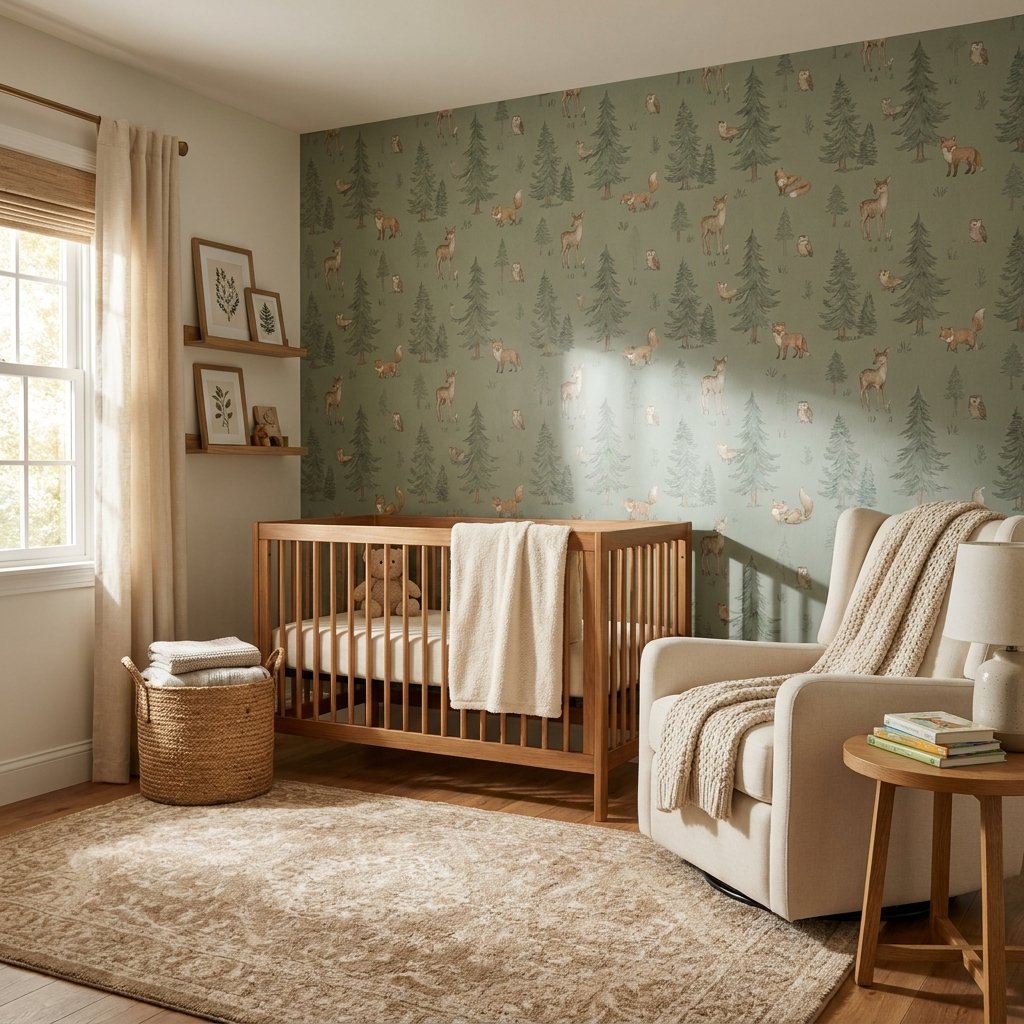
A nursery wallpaper accent wall can completely change a baby’s room without requiring you to wallpaper every surface.
It can create a focal point behind the crib, add color to an otherwise neutral nursery, introduce a sweet pattern, or give a simple room the character it was missing. And because wallpaper comes in everything from delicate florals and woodland scenes to stripes, gingham, botanicals, and subtle geometric patterns, it can work with almost any nursery style.
The key is choosing wallpaper that complements the room rather than overwhelms it.
A beautiful nursery still needs visual breathing room. If the wallpaper is bold, the bedding, rug, curtains, and accessories can be quieter. If the wallpaper is subtle, you have more freedom to introduce color elsewhere.
Placement matters too. The crib wall is a popular choice, but it is not the only option. Wallpaper can also highlight a dresser, reading corner, architectural nook, or another wall that naturally draws the eye.
Here are 17 nursery wallpaper accent wall ideas, plus practical tips for choosing the right pattern, coordinating paint colors, installing wallpaper, and creating a nursery that can grow with your child.
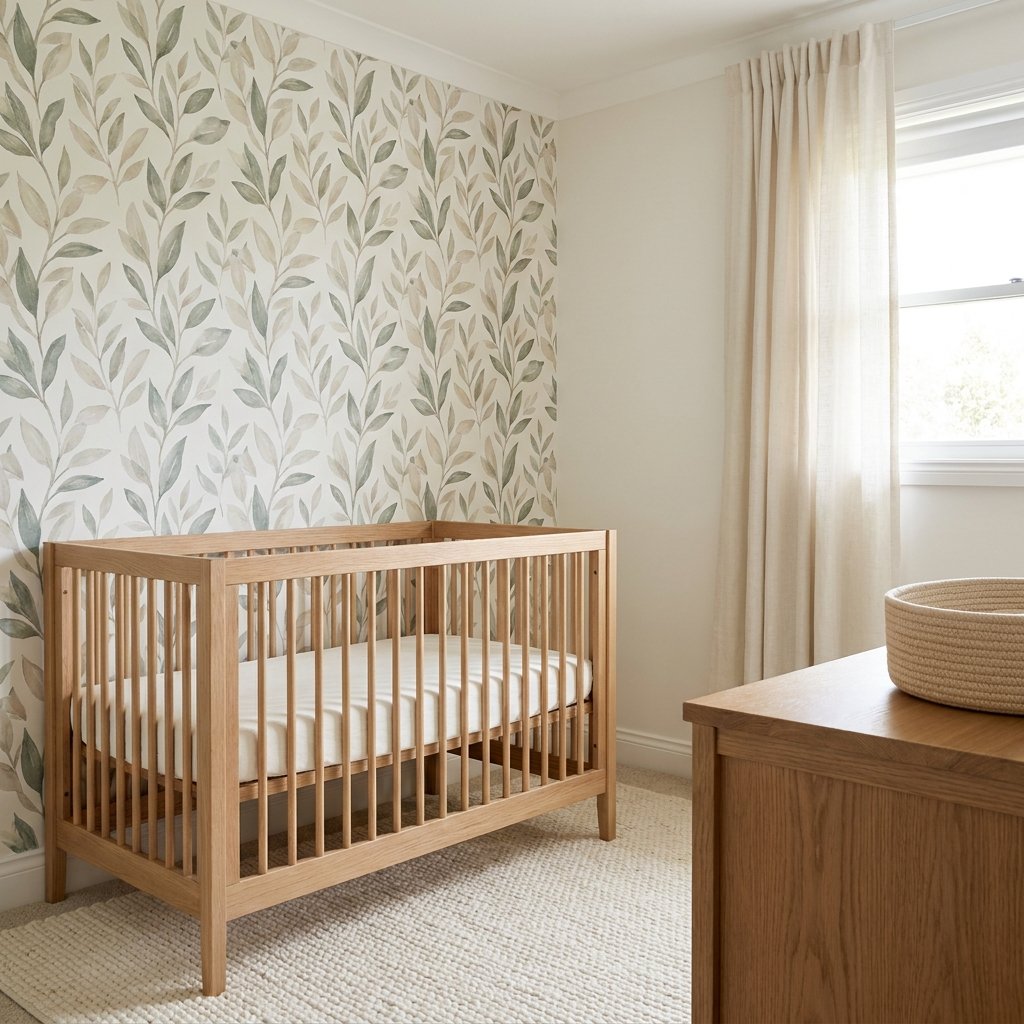
1. Create a Wallpaper Accent Wall Behind the Crib
The wall behind the crib is an obvious place to create a focal point.
Because the crib is usually one of the largest pieces of furniture in the nursery, wallpaper visually frames it and helps establish the room’s design.
You could choose:
- Soft botanical print
- Delicate floral
- Small geometric pattern
- Woodland motif
- Subtle stripe
- Vintage-inspired print
Keep the crib itself relatively simple when the wallpaper is detailed.
A natural wood, white, cream, or painted crib allows the pattern to remain the main feature.
For safety, the crib setup and placement should follow current safe-sleep guidance and the crib manufacturer’s instructions. Avoid hanging loose decor, shelves, heavy objects, cords, or other potentially hazardous items where they could fall into or be reached from the crib.
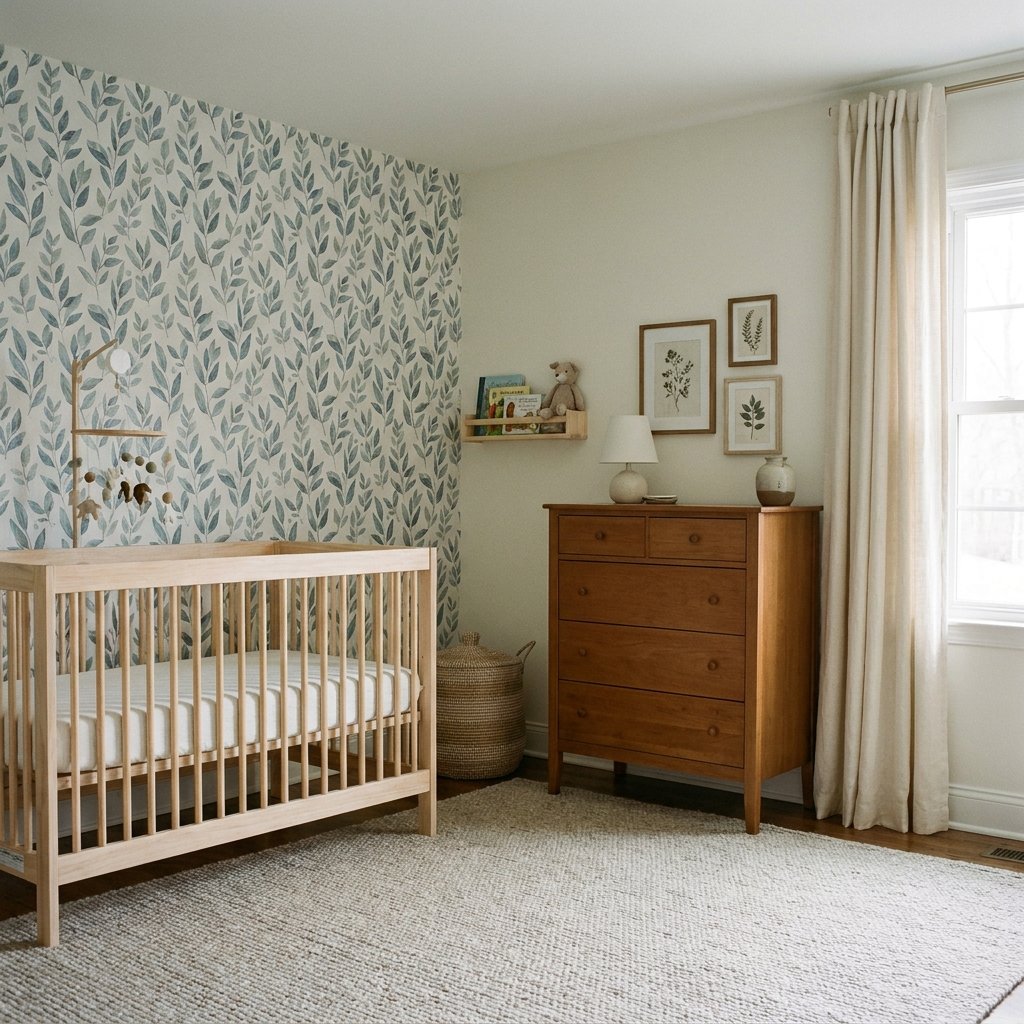
2. Choose Soft Botanical Wallpaper
Botanical wallpaper is particularly versatile because it can feel playful without looking overly baby-specific.
Look for designs featuring:
- Leaves
- Branches
- Wildflowers
- Ferns
- Small vines
- Trees
Muted green, beige, cream, blue, and brown can create a peaceful palette.
Botanical wallpaper also transitions well as the nursery becomes a toddler or child’s bedroom.
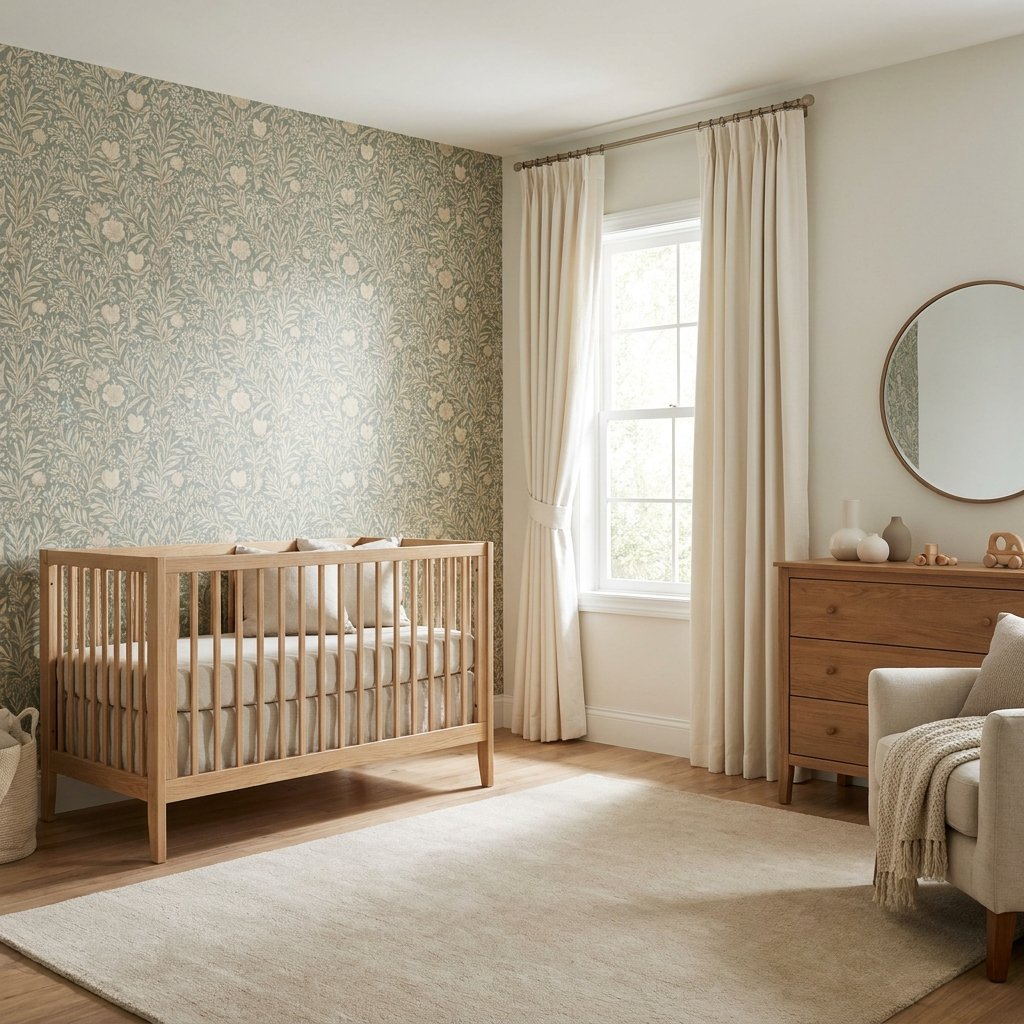
3. Try a Delicate Floral Accent Wall
Floral wallpaper can range from very traditional to surprisingly modern.
For a softer nursery, choose small-scale flowers in muted shades.
For more drama, consider a larger botanical floral.
Colors might include:
- Dusty pink
- Sage
- Cream
- Muted blue
- Lavender
- Warm beige
If the floral contains several colors, use those colors as a guide for the rest of the room.
Pull one shade for the curtains, another for the rug or textiles, and keep the remaining furniture neutral.
4. Use Blue Wallpaper for a Calm Nursery
Blue wallpaper works for far more than traditional baby-boy nurseries.
Dusty blue, denim, blue-gray, and muted navy can all create a calm backdrop.
Try blue wallpaper with:
- Warm white
- Natural wood
- Cream
- Camel
- Sage
If the pattern is darker, balance it with lighter furniture and textiles.
Blue can also transition easily into a big-kid room later.
5. Try Green Nursery Wallpaper
Green is one of the easiest nursery colors to build around.
It works particularly well with botanical, woodland, animal, and nature-inspired patterns.
Pair green wallpaper with:
- Cream
- Warm white
- Natural oak
- Medium wood
- Tan
- Muted blue
For a subtle room, use sage.
For stronger contrast, try olive or a deeper forest tone within the pattern.
6. Add Woodland Wallpaper
Woodland wallpaper can give a nursery a storybook quality without requiring a room full of themed accessories.
Look for patterns with:
- Trees
- Forest animals
- Leaves
- Mountains
- Birds
Keep the remaining decor restrained.
If the wallpaper already contains foxes, deer, trees, and mountains, you probably do not need woodland animals on the rug, curtains, bedding, lamp, and artwork too.
Let the wallpaper establish the theme.
7. Use Animal Wallpaper Without Making It Too Childish
Animal wallpaper can still feel sophisticated.
The secret is often the illustration style and color palette.
A muted animal pattern in cream, brown, olive, or soft blue can work much longer than a highly saturated baby-specific print.
Consider:
- Safari animals
- Birds
- Woodland animals
- Farm animals
- Ocean creatures
Pair the print with simple furniture and solid textiles.
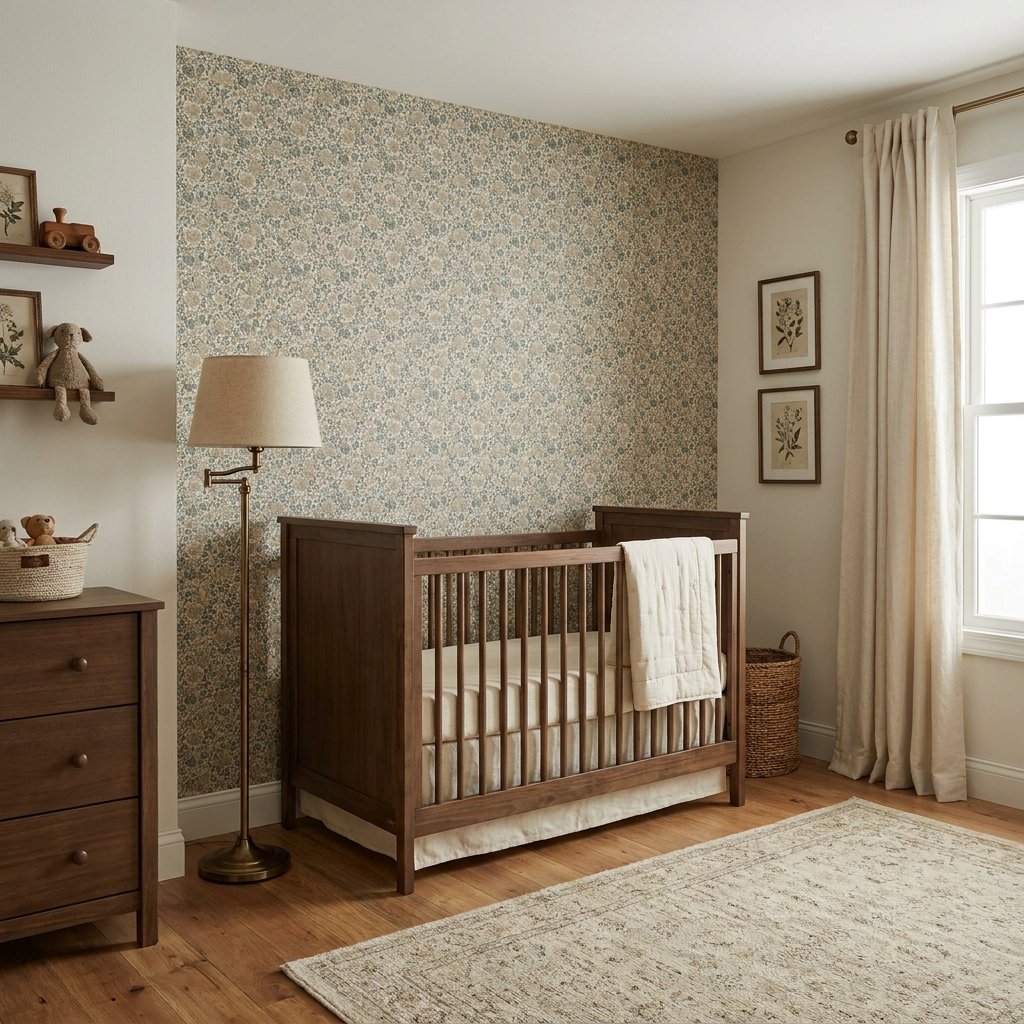
8. Create a Vintage-Inspired Nursery
Wallpaper is an easy way to introduce vintage character.
Look for:
- Tiny florals
- Traditional botanicals
- Small checks
- Toile-inspired designs
- Classic repeating motifs
Pair vintage wallpaper with warm wood furniture, a simple rug, and soft textiles.
You do not need every piece of furniture to be antique.
A modern crib against vintage-inspired wallpaper can create a beautiful balance.
9. Try Gingham or Check Wallpaper
Checks and gingham can create pattern without a complicated illustration.
A small-scale check can work beautifully in:
- Farmhouse nursery
- Traditional nursery
- Cottage nursery
- Neutral nursery
Try beige and cream for a subtle look.
Muted blue and white feels classic.
Soft green and cream can create a fresh, natural palette.
Because the pattern is structured, it pairs well with softer shapes elsewhere in the room.
10. Use Striped Nursery Wallpaper
Stripes are another pattern that can grow with a child.
Vertical stripes can emphasize height, while softer irregular stripes can feel more relaxed.
Consider:
- Blue and cream
- Sage and white
- Beige and ivory
- Dusty pink and cream
If traditional wallpaper feels too permanent, a simple striped treatment may provide the pattern you want without committing to a strong theme.
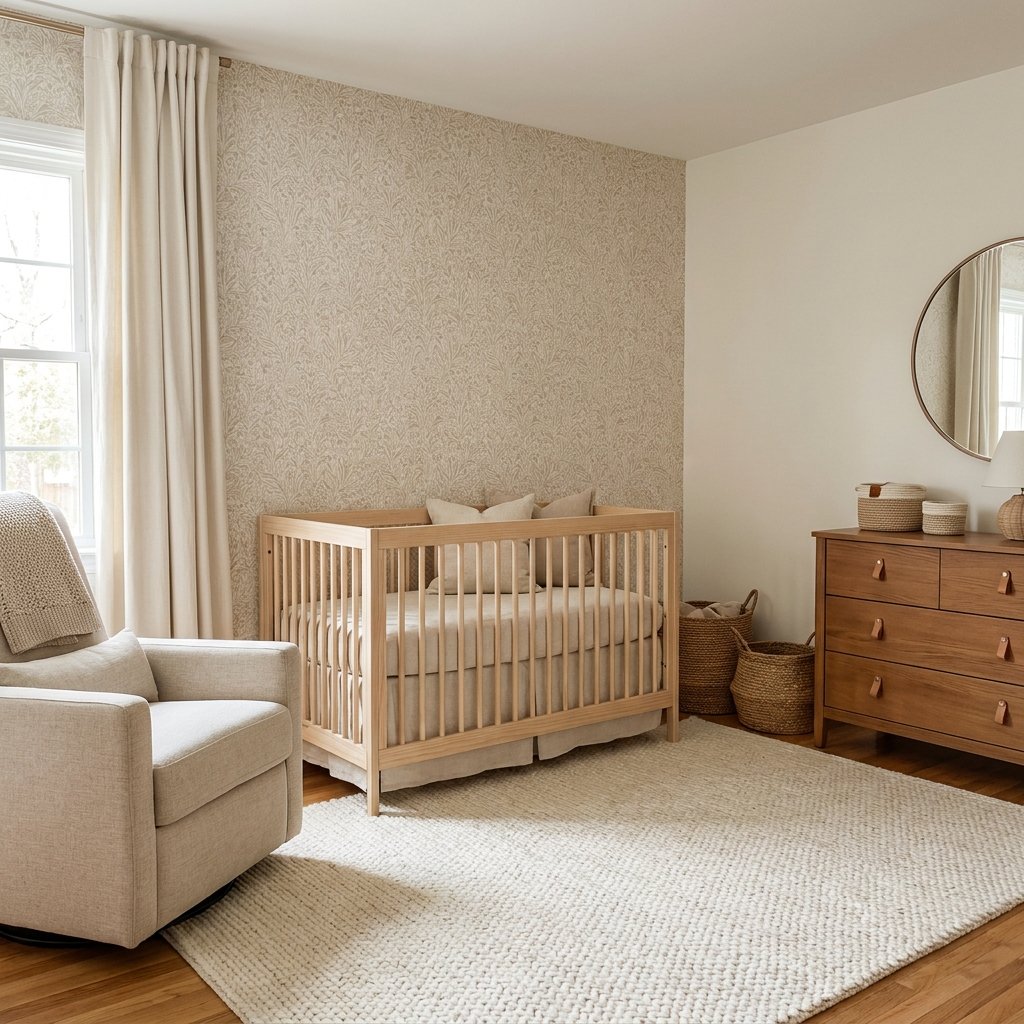
11. Choose Neutral Wallpaper
A wallpaper accent wall does not have to introduce bold color.
Neutral patterns can add depth through line, texture, and repetition.
Try:
- Beige botanicals
- Taupe geometrics
- Cream woodland patterns
- Warm gray stripes
- Brown line drawings
Neutral wallpaper is particularly helpful if you like changing accent colors over time.
You can add blue, green, pink, rust, or another color later without replacing the wall treatment.
12. Try a Large-Scale Wallpaper Pattern
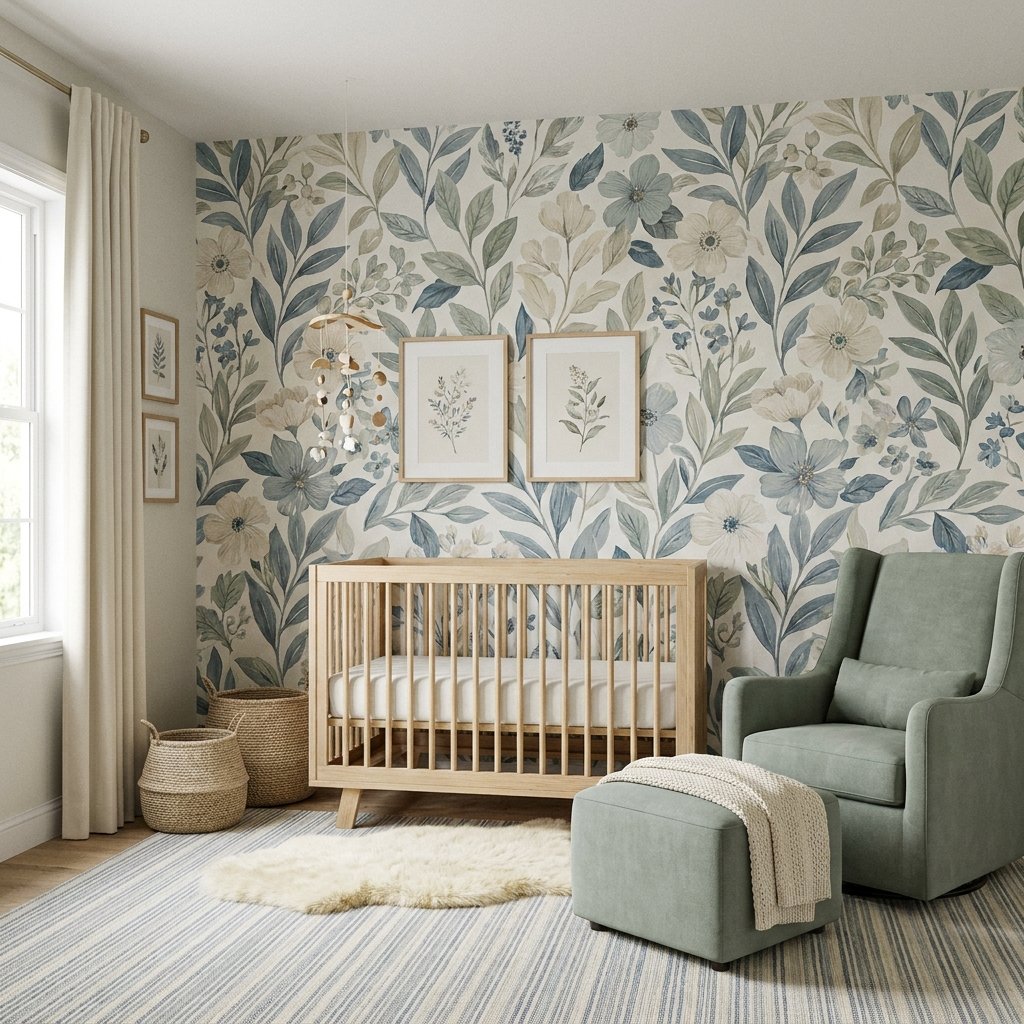
Large-scale patterns can create dramatic impact even in a small nursery.
A larger botanical or floral motif may actually feel less visually busy than hundreds of tiny repeating shapes.
If you choose a large pattern, simplify the rest of the room.
Use:
- Solid curtains
- Simple rug
- Plain crib
- Minimal accessories
Give the wallpaper enough space to be appreciated.
13. Use Small-Scale Wallpaper for Gentle Pattern
Small-scale prints create a different effect.
From across the room, they can almost read as texture.
They are useful when you want a traditional, cottage, or vintage-inspired nursery.
Small patterns work especially well with:
- Simple painted furniture
- Wood crib
- Solid curtains
- Quiet rugs
Avoid adding too many additional small-scale patterns nearby.
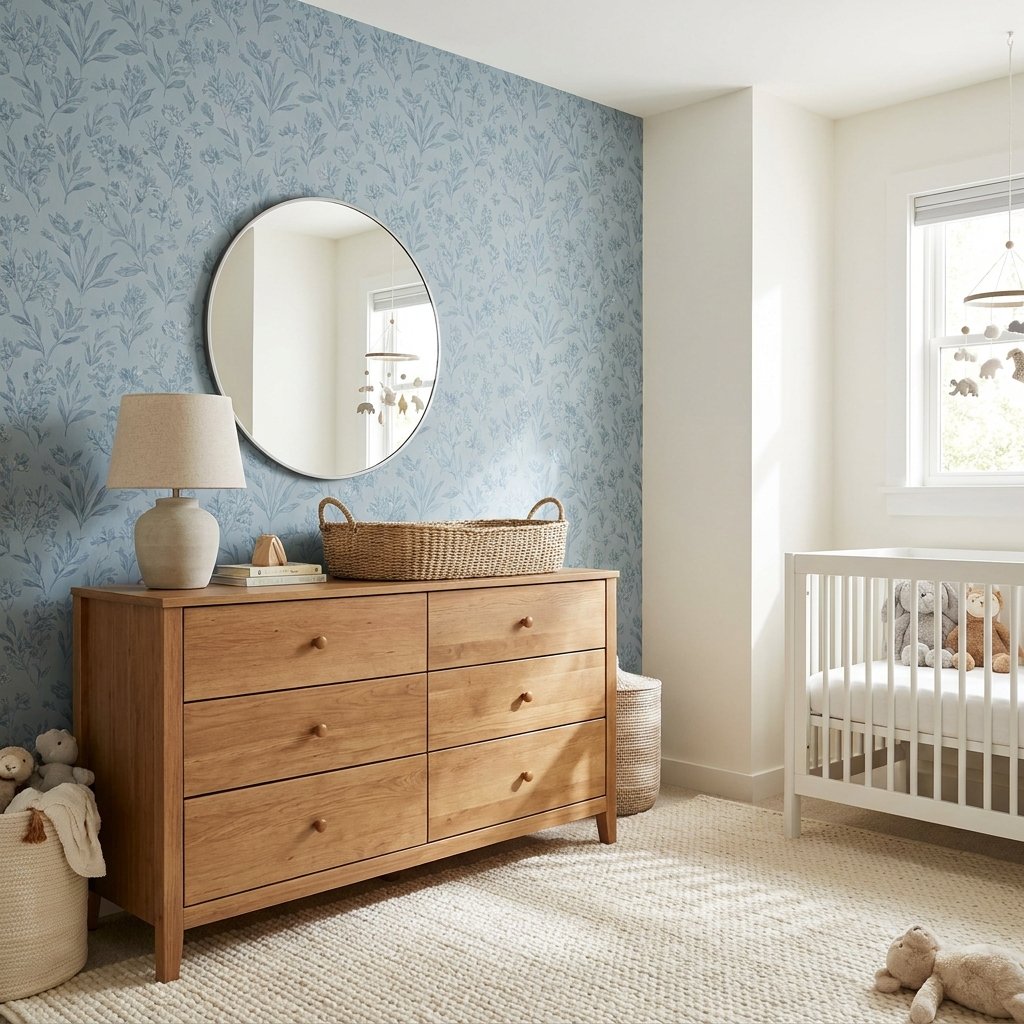
14. Wallpaper the Dresser Wall Instead
The crib wall is not always the best accent wall.
Perhaps it has a window.
Maybe the crib placement will change later.
Or perhaps another wall is more visible when you enter the room.
In that case, wallpaper behind the dresser can work beautifully.
Add a securely mounted mirror or appropriately installed artwork above the dresser if desired, while keeping heavy or breakable items safely positioned and properly secured.
15. Use Wallpaper Above Wall Molding
Instead of wallpapering the entire wall, divide it.
Wallpaper can cover the upper portion while painted molding or paneling fills the lower section.
For example:
Botanical wallpaper above + sage paneling below.
Or:
Floral wallpaper above + warm white molding below.
This creates architectural interest and can help a detailed pattern feel less overwhelming.
Make sure wall treatments are installed securely and do not interfere with outlets, vents, controls, or other functional elements.
16. Coordinate Wallpaper With Painted Walls
The surrounding paint color matters almost as much as the wallpaper.
Instead of automatically choosing bright white, pull a background or secondary color directly from the wallpaper.
If the wallpaper has a warm cream background, a stark cool white on the other three walls may feel disconnected.
You might choose:
- Warm white
- Cream
- Pale beige
- Soft sage
- Muted blue
Bring home samples and compare them directly with the wallpaper in the actual nursery.
17. Choose Wallpaper That Can Grow With the Room
If you want the wallpaper to stay for several years, look beyond obviously infant-specific designs.
Botanicals, stripes, checks, landscapes, subtle animals, and classic florals can often transition naturally into a child’s bedroom.
Imagine the wallpaper without the crib.
Would it still work with a twin bed?
If yes, you probably have a flexible design.
Peel-and-Stick vs. Traditional Nursery Wallpaper
Both can work, but they have different installation requirements.
Peel-and-Stick Wallpaper
This may appeal to renters or anyone wanting a potentially more removable option.
However, removability depends on the specific product, wall surface, paint condition, preparation, age of the finish, and installation.
Do not assume every peel-and-stick wallpaper will remove without affecting paint.
Follow the manufacturer’s wall-preparation and removal instructions.
Traditional Wallpaper
Traditional wallpaper can provide a wide range of patterns and finishes.
Installation may involve paste or a pre-pasted product depending on the wallpaper.
Wall preparation is important, and professional installation may be worthwhile for expensive paper, complicated patterns, difficult walls, or rooms with architectural obstacles.
How to Choose a Nursery Wallpaper Pattern
Start with the overall feeling you want.
Calm and Natural
Botanicals, trees, leaves, soft landscapes.
Traditional
Small florals, stripes, checks.
Playful
Animals, stars, woodland scenes.
Modern
Abstract shapes, simple geometrics, oversized botanicals.
Neutral
Tone-on-tone prints, line drawings, beige patterns.
Then consider scale.
Tape a large wallpaper sample to the wall if possible.
A tiny sample viewed online does not show how the pattern will repeat across an entire nursery.
How to Choose the Best Nursery Accent Wall
Stand at the entrance to the room.
Which wall naturally draws your eye?
That is often a good starting point.
The crib wall works well when it is:
- Visually prominent
- Mostly uninterrupted
- Proportional to the room
But a dresser wall, reading corner, or architectural nook can be equally effective.
Avoid forcing the wallpaper onto a wall simply because nursery photos traditionally place it behind the crib.
How to Coordinate a Crib With Wallpaper
The crib should complement rather than compete with the wallpaper.
Natural Wood Crib
Works beautifully with green, blue, beige, woodland, and botanical prints.
White Crib
Provides clean contrast with darker or more colorful wallpaper.
Dark Wood Crib
Can ground pale floral or vintage-inspired wallpaper.
Painted Crib
Can work beautifully, but coordinate the color carefully with the wallpaper.
Always use the crib according to its manufacturer’s instructions and current safe-sleep guidance rather than altering it cosmetically in ways that could compromise its finish, hardware, or safety.
How to Coordinate Nursery Curtains With Wallpaper
If the wallpaper is strongly patterned, solid curtains are usually the easiest choice.
Pull a quiet color from the wallpaper.
For example:
Green botanical wallpaper + cream curtains.
Blue floral wallpaper + warm white curtains.
Neutral wallpaper + muted blue curtains.
If you want patterned curtains too, vary the scale and make sure the two patterns share colors.
How to Choose a Rug With Wallpaper
Treat the wallpaper as one pattern in the room.
If it is bold, choose a quieter rug.
If the wallpaper is subtle, the rug can introduce more pattern.
A neutral textured rug works with almost anything.
If using a patterned rug, look for colors that repeat the wallpaper palette without duplicating the exact design.
Use an appropriate rug pad or non-slip solution where needed and keep rug edges flat.
How to Mix Patterns in a Nursery
You can absolutely use more than one pattern.
The easiest approach is to vary scale.
For example:
Large floral wallpaper + medium stripe rug + tiny check pillow on a glider where appropriate.
Or:
Small woodland wallpaper + larger geometric rug + solid curtains.
Repeating colors keeps different patterns connected.
Nursery Wallpaper Accent Wall With a White Crib
A white crib creates crisp contrast against almost any wallpaper.
Try:
- Green botanical
- Dusty blue
- Floral
- Woodland
- Beige geometric
If the room starts to feel too cool, introduce warmth with a wood dresser, woven basket, warm rug, or creamy textiles.
Nursery Wallpaper Accent Wall With a Wood Crib
Natural wood works especially well with nature-inspired wallpaper.
Try:
- Sage botanical
- Blue-and-green landscape
- Neutral woodland
- Vintage floral
- Beige stripe
Repeat the wood tone elsewhere through a dresser, frame, or side table so the crib feels connected to the room.
Nursery Wallpaper Accent Wall for a Boy
A boy’s nursery does not need to be limited to blue.
Consider:
- Olive woodland
- Green botanical
- Blue landscape
- Neutral animals
- Brown-and-cream pattern
- Classic stripe
Choose something flexible enough to transition as the room becomes a big boy bedroom.
Nursery Wallpaper Accent Wall for a Girl
Floral wallpaper is a classic option, but there are many others.
Try:
- Botanical
- Soft stripe
- Gingham
- Birds
- Landscape
- Neutral woodland
Muted pink can be beautiful, but green, blue, cream, beige, and lavender can work just as well.
Gender-Neutral Nursery Wallpaper
For a gender-neutral nursery, consider:
- Sage
- Cream
- Beige
- Warm gray
- Muted blue-green
- Brown
Nature-inspired designs are particularly versatile.
Botanicals, woodland patterns, animals, and subtle geometrics can create plenty of personality without relying on a traditional gendered palette.
Small Nursery Wallpaper Ideas
Wallpaper can work beautifully in a small nursery.
Do not automatically assume you need a tiny pattern.
A large, airy botanical can create an impressive focal point without feeling cluttered.
Keep the remaining walls quieter.
Choose furniture with an appropriate scale and avoid filling every wall with additional decor.
How to Make Nursery Wallpaper Look More Expensive
Choose a Pattern With a Cohesive Palette
Too many unrelated colors can make the wall feel busy.
Coordinate the Paint Carefully
Pull the surrounding wall color from the wallpaper.
Keep Other Decor Restrained
Let the wallpaper be the feature.
Use Larger Samples Before Ordering
Scale makes an enormous difference.
Align the Pattern Carefully
Good installation matters.
Finish Edges Cleanly
Corners, ceilings, baseboards, windows, and outlets make installation quality visible.
Avoid Over-Theming
Wallpaper plus a few related details usually looks more polished than repeating the motif everywhere.
Common Nursery Wallpaper Mistakes
Ordering From a Tiny Online Image Alone
View a physical sample when possible.
Ignoring Pattern Scale
A print can look completely different across a full wall.
Forgetting Pattern Repeat
Pattern matching can affect the amount of wallpaper required.
Ordering Exactly the Wall Area
You may need additional material for matching, trimming, mistakes, and future repairs. Follow the manufacturer’s measuring and ordering guidance.
Pairing Busy Wallpaper With Busy Everything Else
Create visual breathing room.
Automatically Choosing Bright White Paint
Match the wallpaper’s undertones.
Assuming Peel-and-Stick Means Damage-Free
Wall surfaces and products vary.
Installing Over a Poorly Prepared Wall
Follow the wallpaper manufacturer’s preparation requirements.
Overdecorating the Crib Wall
Wallpaper may provide all the visual interest you need.
Basic Nursery Wallpaper Installation Tips
Exact installation varies by wallpaper type, so the manufacturer’s instructions should always take priority.
In general:
- Inspect and prepare the wall.
- Repair imperfections as appropriate.
- Clean the surface as directed.
- Allow appropriate drying or paint-curing time.
- Measure the wall carefully.
- Plan where the pattern will begin.
- Check the pattern repeat.
- Establish a straight starting line.
- Install according to the wallpaper type.
- Match subsequent panels carefully.
- Smooth and trim using appropriate tools.
- Finish around outlets and architectural details carefully.
Walls are not always perfectly straight, so relying only on a corner as your starting reference can create problems across the wall.
If you are uncomfortable installing expensive wallpaper or working around complicated architecture, professional installation may be worthwhile.
Nursery Wallpaper Safety Tips
Nursery decorating requires extra attention to anything within a child’s reach.
Follow current crib-placement and safe-sleep guidance and the crib manufacturer’s instructions.
Do not install loose wall decor, shelves, heavy frames, mirrors, cords, or other objects where they could fall into or become accessible from the crib.
Wallpaper should be installed securely according to manufacturer instructions. Repair loose seams or peeling sections rather than allowing material to hang where a child may eventually reach it.
Keep window-covering cords inaccessible and use appropriate child-safe window treatments.
Secure dressers, bookcases, and other furniture that could tip according to manufacturer instructions and current furniture-safety guidance.
Use appropriate ventilation during wallpaper installation, painting, priming, or adhesive use, and follow product safety directions.
Keep electrical outlets, switches, vents, and other functional elements properly accessible.
FAQ About Nursery Wallpaper Accent Walls
Which wall should be the wallpaper accent wall in a nursery?
The crib wall is popular because it naturally creates a focal point, but the dresser wall, reading corner, or another prominent wall can work just as well.
Is wallpaper behind a crib a good idea?
It can create a beautiful focal point when properly installed. Keep additional heavy, loose, or reachable wall decor away from the crib and follow current safe-sleep and crib-placement guidance.
What wallpaper is best for a nursery?
Botanicals, florals, woodland designs, animals, stripes, checks, and subtle geometric patterns can all work. Choose based on the room’s style, color palette, and how long you want the design to last.
Is peel-and-stick wallpaper good for a nursery?
It can be an option, but performance and removability vary by product and wall condition. Follow the manufacturer’s installation, surface-preparation, and removal instructions.
Should I wallpaper all four nursery walls?
You can, but you do not need to. One accent wall provides plenty of impact and can be easier to coordinate with the rest of the room.
What paint color goes with nursery wallpaper?
Pull a background or secondary color from the wallpaper. Warm white, cream, beige, sage, and muted blue are versatile possibilities, depending on the pattern.
Can I mix wallpaper with a patterned rug?
Yes. Vary the pattern scale and repeat colors between the wallpaper and rug so they feel related rather than competing.
How do I choose nursery wallpaper that will grow with my child?
Look for versatile patterns such as botanicals, stripes, checks, landscapes, classic florals, or subtle animals. Imagine the wall with a twin bed instead of a crib before deciding.
Final Thoughts
A nursery wallpaper accent wall is an easy way to give a baby’s room personality without decorating every surface.
Start with the wall that naturally makes sense in the room.
That may be behind the crib, but it could just as easily be behind the dresser or in a reading corner.
Then choose a wallpaper that establishes the mood.
Botanicals and woodland patterns create a natural feeling. Florals can feel soft and timeless. Stripes and checks are classic. Animal prints add playfulness, while neutral patterns provide texture without introducing lots of color.
Once the wallpaper is chosen, let it guide the rest of the nursery.
Pull paint colors from the pattern. Keep curtains quieter if the wall is busy. Choose a rug that complements rather than competes. Use simple furniture to give the wallpaper room to stand out.
And think beyond the nursery stage.
A pattern that looks just as good behind a twin bed as it does behind a crib can help the room transition for years.
With thoughtful pattern, color, placement, and safe installation, one wallpapered wall may be all you need to turn a simple nursery into a warm, memorable room.