

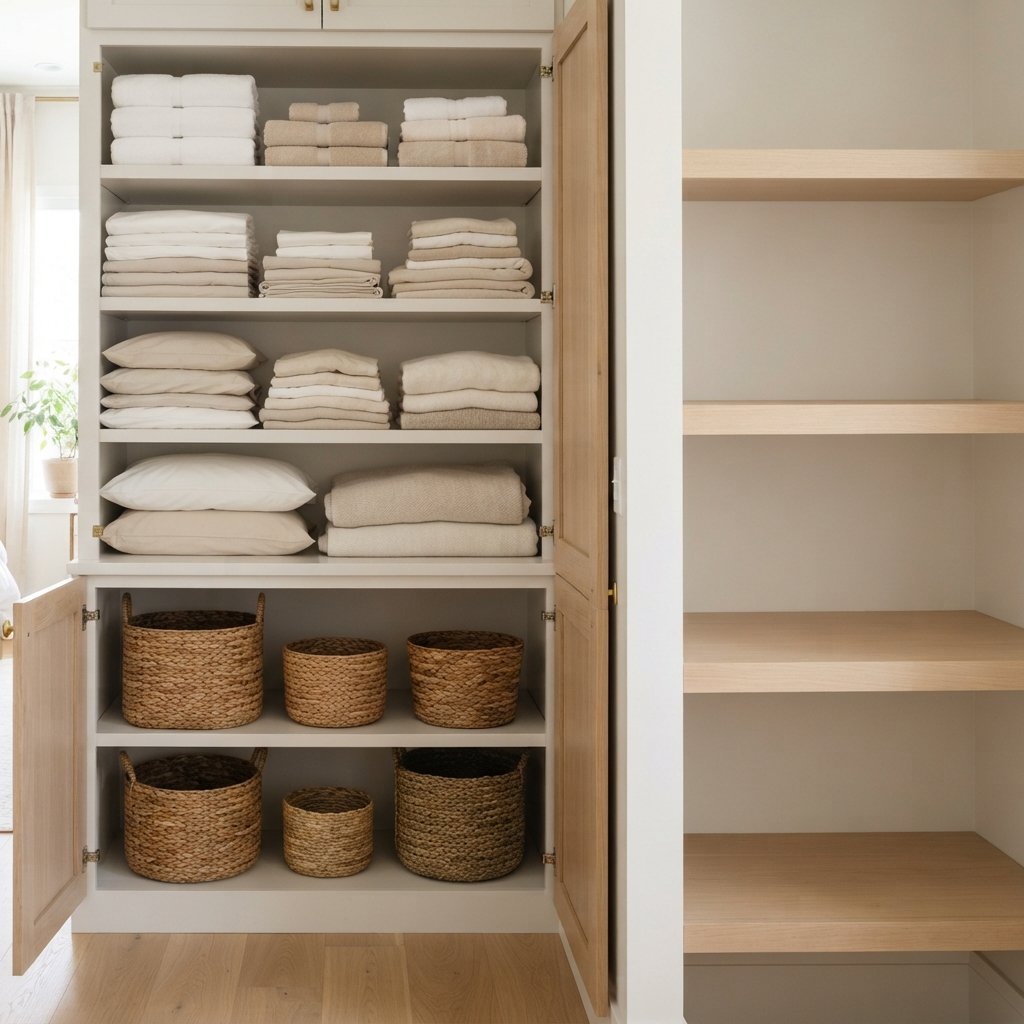
Closets that store household essentials can become messy surprisingly quickly.
Towels get pushed onto shelves. Extra sheets end up in random piles. Cleaning bottles collect on the floor. Brooms fall over whenever the door opens. Before long, finding one washcloth or a fresh set of sheets requires digging through everything else.
Good linen closet and broom closet organization is less about making the closets look perfect and more about making everyday items easy to find, use, and put away.
The best systems are usually simple.
Towels need shelves that are easy to reach. Bedding should be grouped by room or bed size. Cleaning products need safe storage. Brooms, mops, and dusters work better when they have dedicated vertical spaces rather than leaning in a corner.
Whether you have two separate closets, a combined utility closet, or only a narrow cabinet to work with, these ideas can help you make better use of the space you already have.
1. Empty the Closet Before Organizing It
Start by taking everything out.
It may seem easier to move items around while they are still inside, but that often preserves the same clutter in prettier containers.
Emptying the closet lets you see:
- What you own
- What you actually use
- What has expired or deteriorated
- What belongs somewhere else
- How much usable space you really have
Work on one closet at a time if tackling both at once feels overwhelming.
2. Clean the Empty Shelves and Floor
Once everything is out, clean the closet before putting anything back.
Dust shelves, wipe appropriate surfaces, vacuum or sweep the floor, and inspect corners.
This is also a good time to check for:
- Moisture
- Leaks
- Mold or mildew
- Damaged shelving
- Loose hardware
- Pest activity
Do not cover an active moisture problem with baskets and bins.
Address the underlying issue first.
3. Declutter Extra Linens
Linen closets often become storage for every towel and sheet a household has ever owned.
Sort everything by category.
Create groups for:
- Bath towels
- Hand towels
- Washcloths
- Sheets
- Pillowcases
- Blankets
- Guest linens
Then evaluate how much you realistically need.
Worn or damaged textiles may be suitable for cleaning rags, textile recycling where available, or another appropriate use.
4. Create a Shelf for Everyday Towels
Put the towels you use most often in one of the easiest places to reach.
That may include:
- Bath towels
- Hand towels
- Washcloths
Less frequently used guest towels can go higher.
Organizing by frequency of use makes more sense than giving the most accessible shelf to something you reach for twice a year.
5. Fold Towels Consistently
Towels do not need complicated folding techniques.
The goal is simply to create stacks that fit the shelf and stay reasonably neat.
Choose a fold based on:
- Shelf depth
- Shelf width
- Towel size
Consistent folds make stacks easier to manage.
Avoid creating towers so tall that pulling out one towel causes the entire pile to collapse.
6. Organize Bedding by Bed or Room
Sheets are much easier to find when grouped logically.
You could organize them by:
- Bed size
- Bedroom
- Family member
- Type
Choose whichever method makes sense in your household.
For example, you might create separate areas for:
Primary bedroom
Kids’ beds
Guest room
If multiple beds use different mattress sizes, clear identification becomes especially helpful.
7. Keep Sheet Sets Together
One common linen closet problem is separating fitted sheets, flat sheets, and pillowcases.
Keep each set together.
One simple method is to fold the pieces and place them together with their coordinating pillowcase.
Another is to use a labeled basket for each bed or size.
The exact folding method matters much less than being able to find the entire set at once.
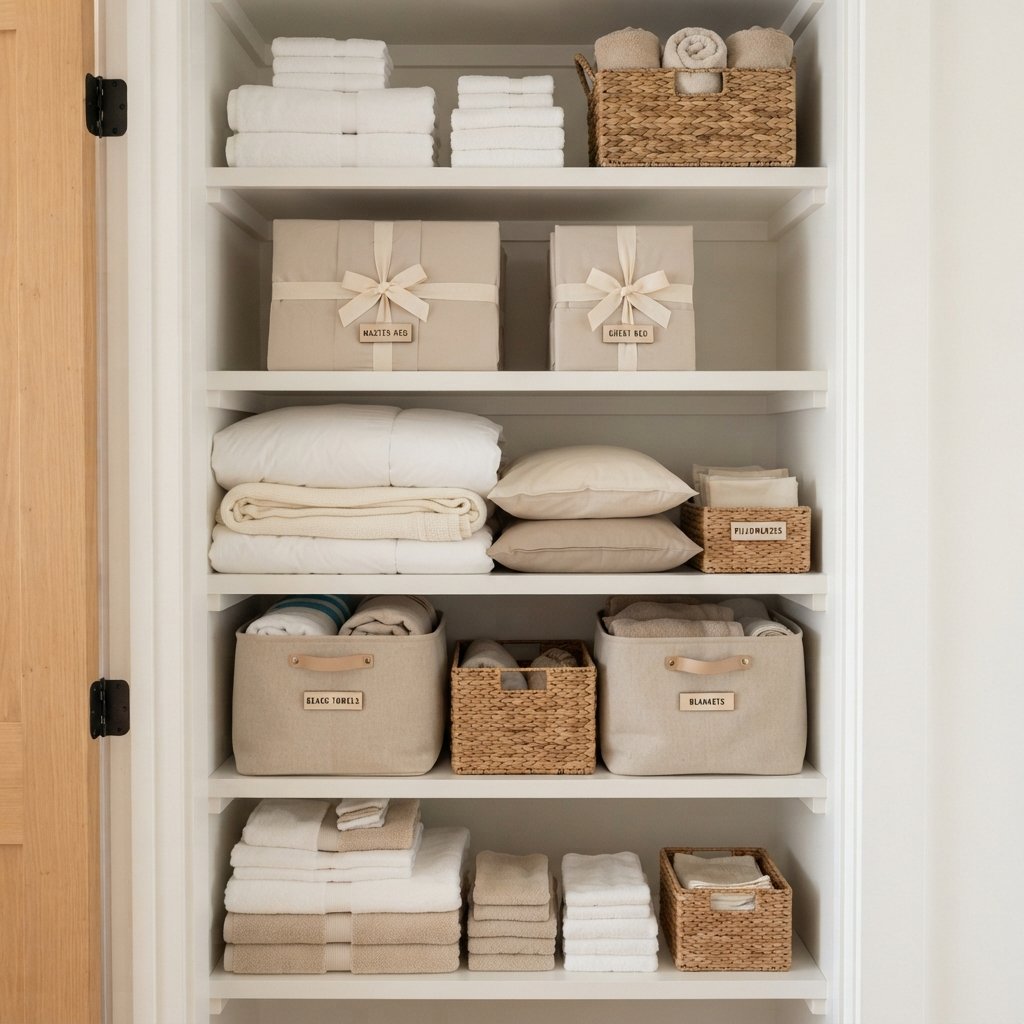
8. Use Baskets for Small Linen Closet Items
Small items can make shelves look messy even when they are technically organized.
Baskets are useful for categories such as:
- Extra pillowcases
- Washcloths
- Guest toiletries
- Cleaning cloths
- Small bathroom supplies
Choose baskets that fit the shelf rather than buying them first and hoping they work.
Measure:
- Width
- Depth
- Height
Also make sure you can remove a basket easily without scraping the shelf above it.
9. Use Clear Bins When Visibility Matters
Not everything needs to go in a decorative basket.
Clear containers are helpful when seeing the contents saves time.
They may work well for:
- Toiletries
- Small cleaning supplies
- Extra soap
- Household refills
Avoid turning the closet into a wall of containers.
Bins should solve specific storage problems, not create additional steps for accessing simple items.
10. Use the Top Shelf for Less-Used Linens
The highest shelf is usually better for things you do not need every day.
Consider storing:
- Extra blankets
- Seasonal bedding
- Guest linens
- Spare pillows where appropriate
Keep heavier items at a manageable height rather than placing them overhead where they may be difficult to retrieve safely.
If you need a step stool, use a stable one designed for the purpose rather than climbing on shelves or nearby furniture.
11. Give Blankets Their Own Zone
Blankets can quickly consume an entire linen closet.
Instead of squeezing them into leftover spaces, designate a specific area.
Fold blankets according to the shelf dimensions and stack only as many as can remain stable.
Bulky seasonal blankets can sometimes be stored elsewhere if the linen closet is small.
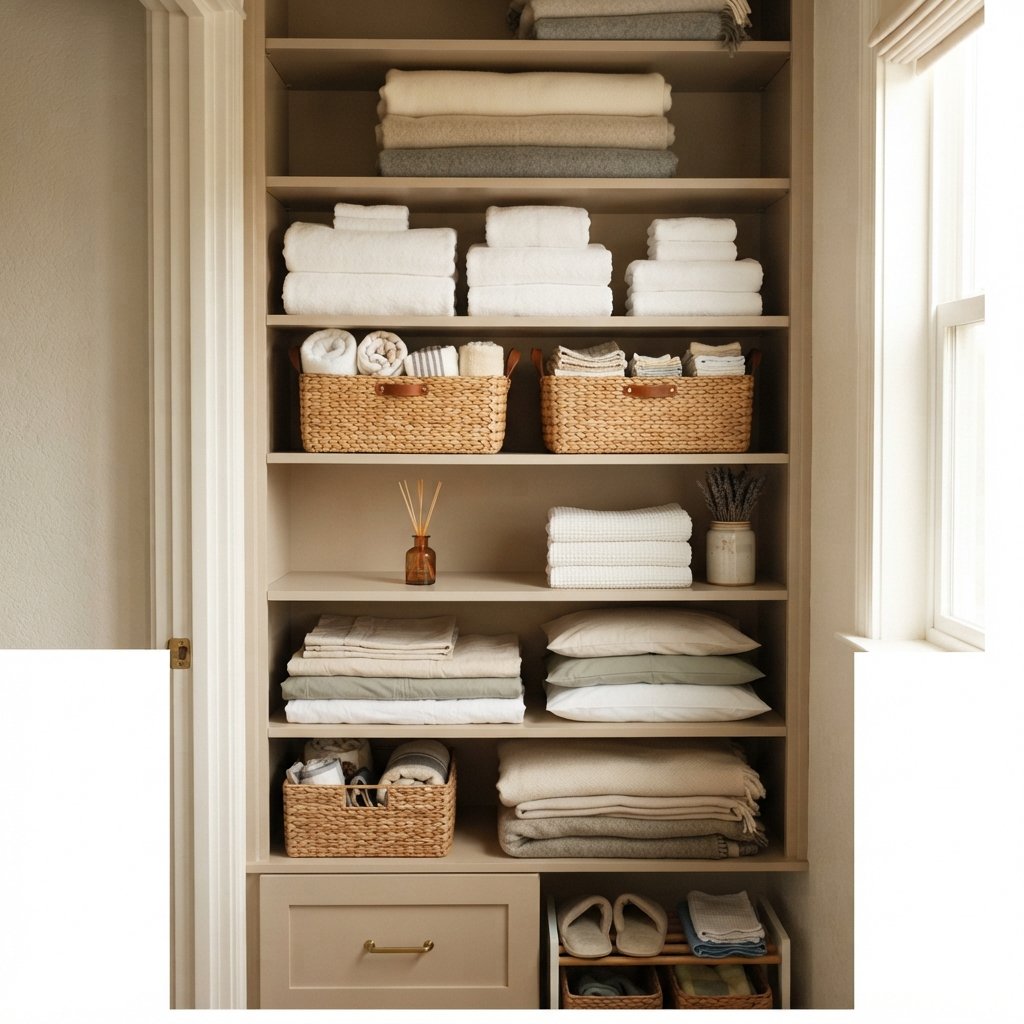
12. Add Labels Only Where They Help
Labels are useful when several people use the closet or when baskets hide their contents.
Useful labels might include:
- Queen Sheets
- Guest Towels
- Washcloths
- Toiletries
- Cleaning Cloths
You do not need to label a visible stack of bath towels “Bath Towels” unless the label genuinely helps your household maintain the system.
Organization should reduce work, not create more of it.
Broom Closet Organization
A broom closet has a different challenge.
Instead of piles of soft linens, you are dealing with tall tools, bottles, cords, attachments, and awkward equipment.
The goal is to use the vertical space while keeping everything secure and accessible.
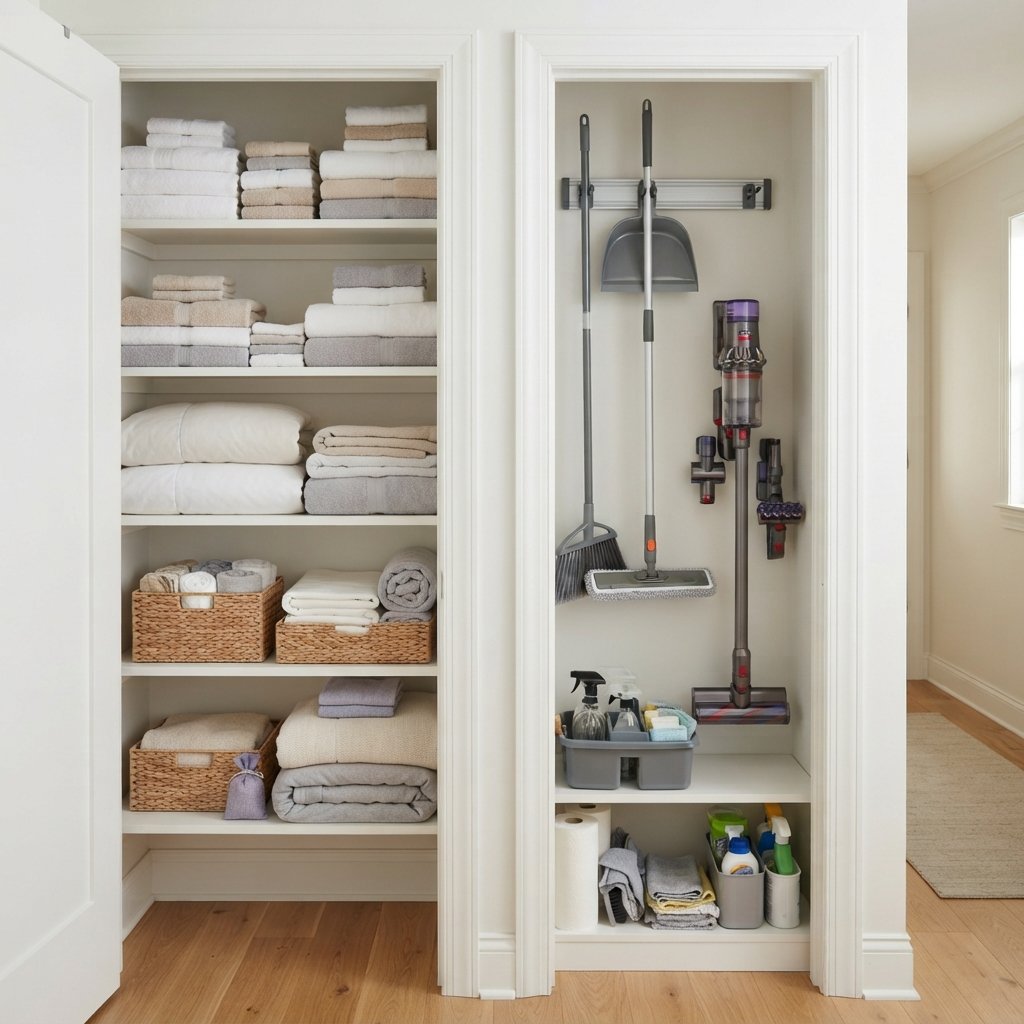
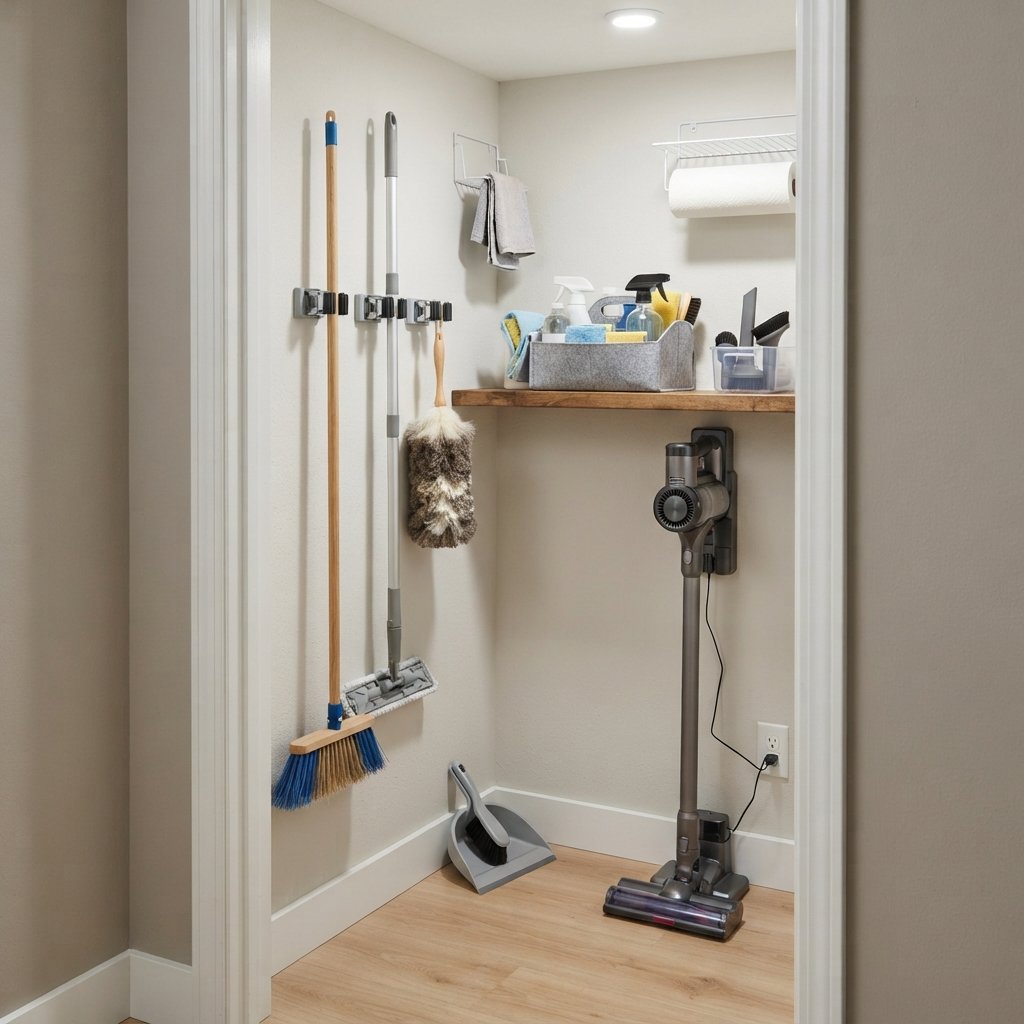
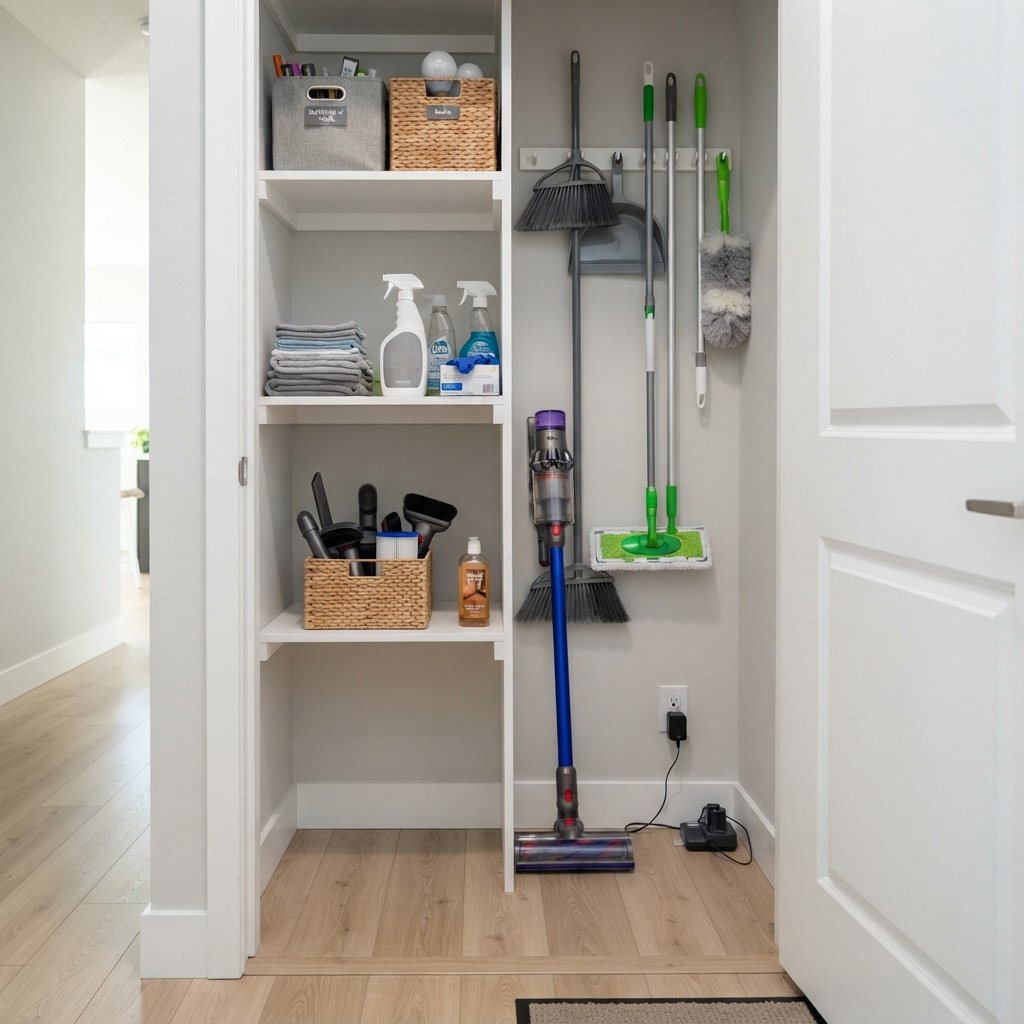
13. Stop Leaning Brooms Against the Wall
Brooms and mops stored loosely in a corner tend to fall over.
A properly installed wall-mounted tool holder can give each item a dedicated position.
Depending on the system, you may be able to store:
- Broom
- Mop
- Duster
- Dustpan
- Floor brush
Install the organizer according to its manufacturer instructions and use suitable fasteners for the wall construction and expected load.
Do not overload lightweight adhesive hooks with heavy cleaning equipment unless they are specifically rated for the application.
14. Create a Parking Spot for the Vacuum
The vacuum should have a specific home.
If you use a cordless vacuum, follow its manufacturer’s instructions for wall mounting, charging, ventilation, battery care, and electrical placement.
If you use an upright or canister vacuum, leave enough floor space that it can be removed without first moving five other items.
Store attachments nearby in a bin, basket, or compatible holder.
15. Use the Back of the Door
The inside of the broom closet door can provide useful storage when the door and hardware can safely support it.
Possible uses include:
- Lightweight dusters
- Cleaning cloths
- Small brushes
- Reusable shopping bags
Make sure door-mounted storage does not prevent the door from closing or interfere with handles, hinges, ventilation, or nearby shelving.
16. Create a Grab-and-Go Cleaning Caddy
A cleaning caddy makes routine cleaning easier.
Instead of carrying individual bottles around the house, keep frequently used products together.
Depending on your household, a caddy might contain:
- Appropriate surface cleaner
- Cleaning cloths
- Scrub brush
- Gloves
Do not combine incompatible chemicals, and never transfer cleaning products into unmarked food or drink containers.
Keep original labels and follow manufacturer safety and storage instructions.
17. Put Backup Cleaning Supplies Together
Extra products can create a lot of visual clutter.
Designate one shelf or bin for backups.
Before buying another bottle, check this area first.
This simple system can help prevent having several partially forgotten replacements of the same product.
18. Use Shelves Above Tall Cleaning Tools
The space above brooms and vacuums can sometimes hold lightweight supplies.
Consider storing:
- Paper products
- Cleaning cloths
- Vacuum attachments
- Empty reusable buckets
Avoid placing heavy liquids high overhead.
Any shelving should be securely installed and appropriate for the expected load.
19. Keep Frequently Used Supplies Accessible
Just like the linen closet, the broom closet should be organized by frequency of use.
The everyday broom should not be trapped behind a carpet cleaner used twice a year.
Keep daily items in front.
Move occasional equipment toward the back, upper shelves, or another appropriate storage area.
20. Keep the Closet Floor as Clear as Possible
A clear floor makes a broom closet easier to clean and use.
Mount what can safely be mounted.
Contain small items.
Give the vacuum a defined footprint.
Avoid placing loose bottles and random cleaning supplies across the floor.
If something leaks, a crowded closet floor makes the problem harder to notice and clean.
21. Create a Quick Reset Routine
Even the most organized closet will eventually become messy without a maintenance habit.
Every few weeks, take a minute to:
- Straighten towels
- Return baskets
- Put tools on holders
- Check supplies
- Remove empty containers
You do not need a major reorganization.
A quick reset prevents small messes from becoming another full closet cleanout.
How to Organize a Small Linen Closet
Small linen closets require more editing, not necessarily more organizers.
Start with the essentials.
Give shelf space to:
- Everyday towels
- Everyday bedding
- Frequently used bathroom supplies
Then use the upper shelves for extras.
If the closet cannot comfortably hold every blanket, pillow, beach towel, bathroom refill, and cleaning product you own, move less relevant categories elsewhere.
A linen closet does not have to store every piece of fabric in the house.
Deep Linen Closet Organization
Deep shelves can be frustrating because items disappear behind one another.
Instead of creating two loose rows, use the depth deliberately.
You might place:
- Everyday items in front
- Backups behind
- Less-used linens toward the rear
Bins can also help because you can pull the entire category forward.
Avoid stacking unrelated items front-to-back where the rear items will be forgotten.
Narrow Linen Closet Organization
In a narrow closet, use shelf width carefully.
Smaller baskets may work better than oversized containers.
Fold towels to fit the shelf rather than forcing a standard fold.
Keep categories limited.
A narrow closet looks more organized when it contains fewer, clearly defined groups.
Linen Closet Organization Without Bins
You absolutely do not need bins.
Open shelves can work beautifully for:
- Towels
- Sheets
- Blankets
Simply create clear stacks and leave a little space between categories.
Use bins only for small items that would otherwise scatter.
This can be both cheaper and easier to maintain.
Linen Closet Organization on a Budget
Before buying organizers, use what you already have.
You may be able to repurpose:
- Baskets
- Small boxes
- Trays
- Clear containers
The biggest improvement usually comes from decluttering and rearranging the shelves—not buying matching baskets.
Once the closet is organized, you can decide whether any specific container would genuinely improve it.
How to Make a Linen Closet Look Nice
You do not need perfectly matching white towels.
Instead, focus on visual order.
Try:
- Consistent folding
- Clear categories
- Similar items together
- Limited stacks
- A few matching baskets
Leave some empty shelf space when possible.
A closet packed edge to edge rarely stays looking organized.
Small Broom Closet Organization
A narrow broom closet is primarily a vertical-storage problem.
Use the walls.
A simple layout might include:
One wall: broom, mop, duster.
Floor: vacuum.
Upper shelf: attachments and lightweight supplies.
Door: lightweight accessories where appropriate.
This is often more useful than trying to install lots of shelves that interfere with tall tools.
Broom Closet Without Shelves
No shelves?
You can still organize it.
Prioritize securely mounted vertical tool storage.
Then add an appropriate wall-mounted basket or other storage only if needed and if the wall can support it.
Avoid turning every wall into storage.
You still need enough room to remove the vacuum and cleaning tools easily.
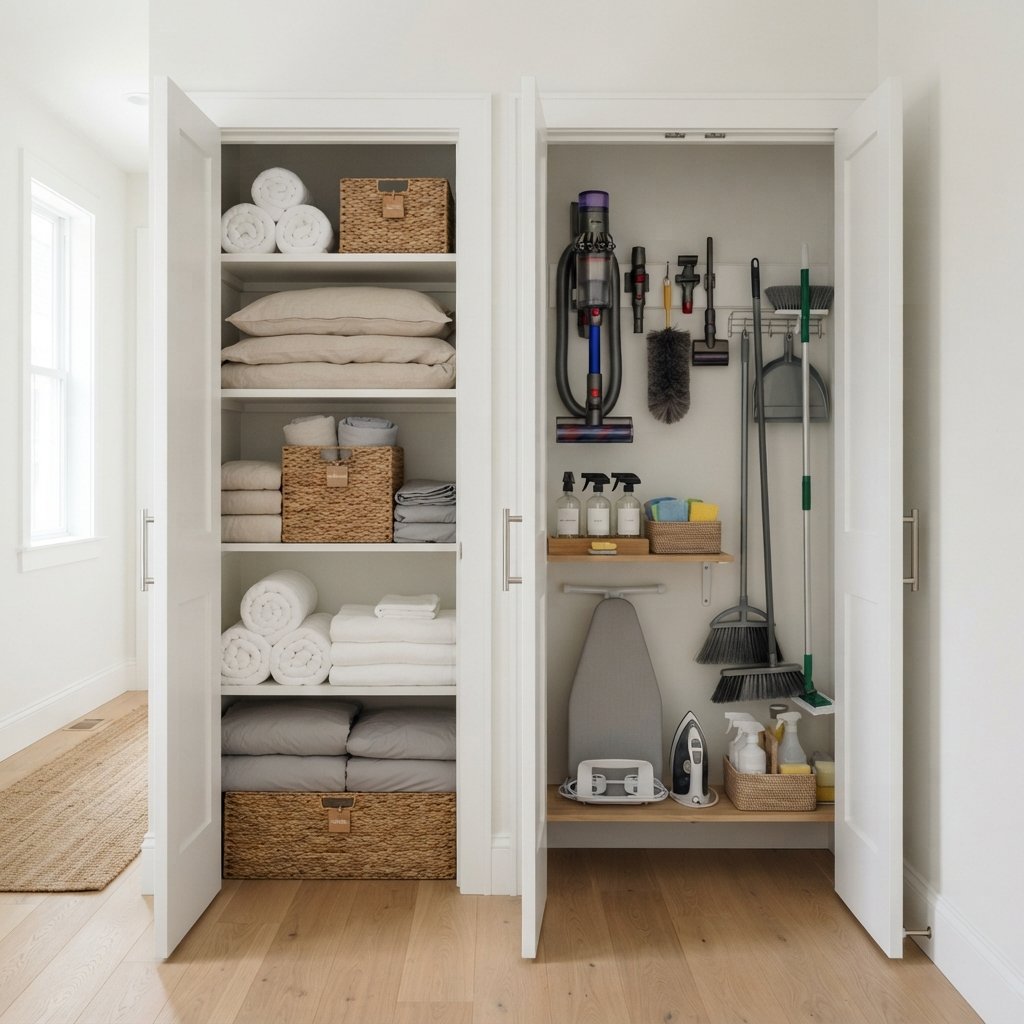
Combined Linen and Broom Closet Organization
Sometimes one closet has to do both jobs.
Divide it into clear zones.
For example:
One Side
Brooms, mop, vacuum.
Other Side
Shelving for towels and linens.
Upper Area
Less frequently used household supplies.
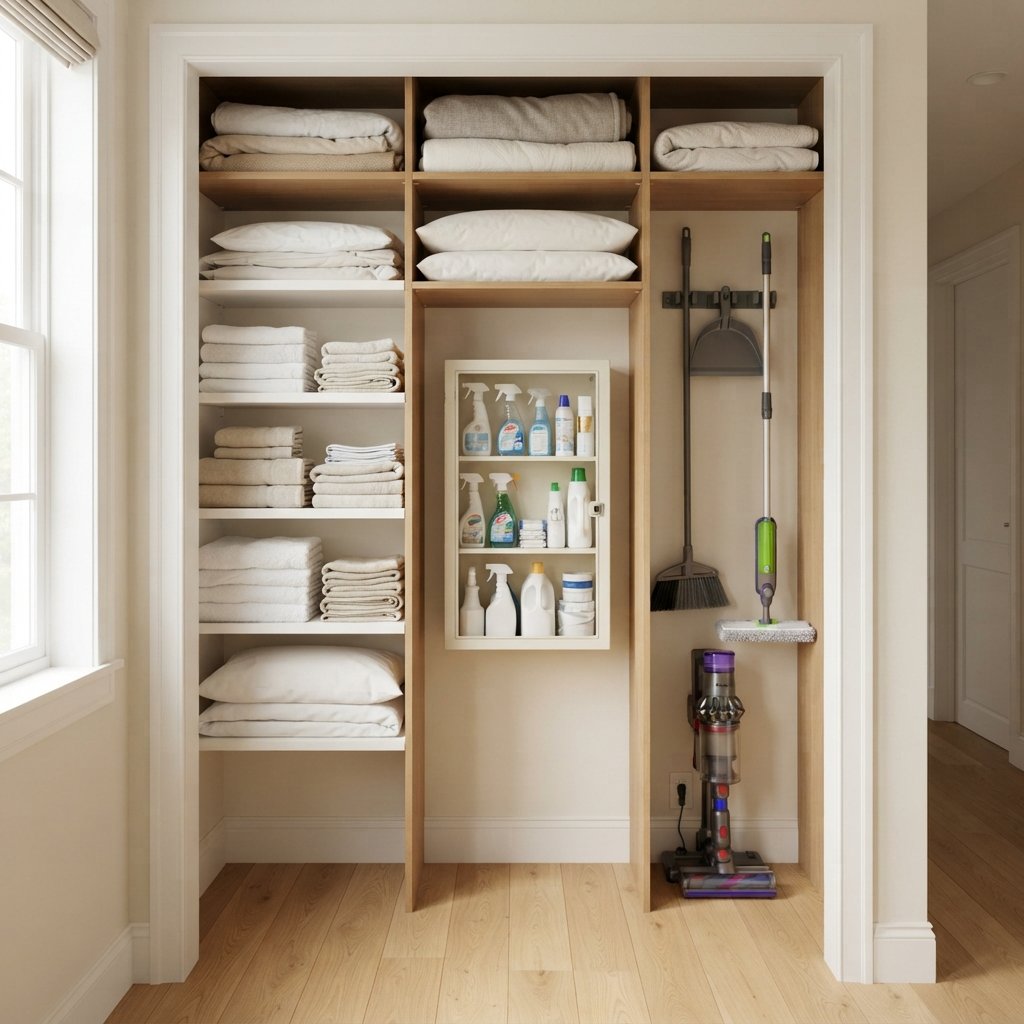
Keep cleaning chemicals separated from linens and stored according to product instructions.
In homes with children or pets, hazardous products may need secured or otherwise inaccessible storage.
How to Organize Cleaning Products Safely
Cleaning-product storage deserves more attention than appearance.
Keep products in their original labeled containers whenever directed.
Do not mix household cleaning chemicals unless the manufacturer specifically instructs you to do so.
Certain combinations can create dangerous reactions or fumes.
Follow product labels for storage conditions and keep hazardous products inaccessible to children and pets.
Do not place leaking containers above towels, bedding, or other household items.
Dispose of unwanted household chemicals according to local requirements rather than automatically pouring them down a drain or placing them in household trash.
What Should Not Go in a Linen Closet?
Avoid treating the linen closet as generic overflow storage.
Items that may need another location include:
- Hazardous cleaning chemicals where they could contaminate linens
- Leaking toiletries
- Damp towels
- Wet cleaning cloths
- Items vulnerable to the closet’s temperature or humidity
- Unrelated household clutter
If storing medications or other sensitive products, follow their specific label storage requirements rather than assuming a humid bathroom-area linen closet is suitable.
How to Keep Towels Smelling Fresh in a Linen Closet
Only store towels when they are fully dry.
A clean closet with reasonable airflow is also important.
Avoid overpacking shelves so tightly that linens are compressed into every available gap.
If towels develop persistent musty odors, investigate the cause rather than covering the smell with fragrance.
Moisture or inadequate drying may be the real issue.
How to Organize Sheets in a Linen Closet
Keep the system simple.
For each sheet set:
- Fold pieces together
- Group by bed size or room
- Place them in a defined section
If different sets look similar, labels can help.
Keep the sets used most frequently on an accessible shelf.
Seasonal or guest bedding can go higher.
How to Organize Towels in a Linen Closet
Separate towels by function.
For example:
- Bath towels
- Hand towels
- Washcloths
- Guest towels
Stack everyday towels where they are easiest to reach.
If shelf depth is limited, experiment with the fold rather than allowing towels to hang over the shelf edge.
How to Make These Closets Look More Expensive
Use Fewer Containers
A closet does not need a basket on every shelf.
Choose Similar Storage Where Visible
A few coordinated baskets can create visual consistency.
Leave Breathing Room
Do not pack every shelf.
Keep Labels Simple
Use them where they improve function.
Repeat Materials
For example, use the same style of woven basket on several linen shelves.
Keep Utility Storage Intentional
Mounted tools look neater than brooms leaning randomly against a wall.
Maintain the System
An inexpensive closet that stays organized looks better than an expensive system overflowing with clutter.
Common Linen Closet Organization Mistakes
Buying Bins Before Measuring
Measure first.
Keeping Too Many Linens
Declutter before organizing.
Making Stacks Too Tall
Shorter stacks are easier to maintain.
Putting Everyday Items Too High
Organize according to frequency.
Overlabeling Everything
Labels should help, not decorate every object.
Filling Every Inch
Leave room to put things away.
Hiding Items in Deep Shelves
Create a deliberate front-and-back system.
Common Broom Closet Organization Mistakes
Leaning Every Tool in a Corner
Use appropriate vertical storage.
Overloading Adhesive Hooks
Check weight ratings and surface compatibility.
Blocking the Vacuum
Keep frequently used equipment accessible.
Putting Heavy Bottles Overhead
Store heavier items lower when practical.
Ignoring Electrical Safety
Cordless vacuums and other equipment should be charged according to manufacturer instructions.
Mixing Chemicals
Keep products in suitable containers and follow their labels.
Making the Closet Too Full
You should be able to remove one tool without unloading everything else.
Closet Organization Safety Tips
Secure shelves, wall-mounted tool holders, and storage systems with hardware appropriate for the wall construction and expected load.
Do not overload shelves or hang heavy tools from fasteners that are not rated for them.
Store cleaning products according to their labels and keep hazardous substances inaccessible to children and pets.
Never mix cleaning chemicals unless specifically directed by the manufacturer.
Keep products in appropriately labeled containers and avoid transferring hazardous cleaners into beverage or food containers.
Store cordless vacuums, batteries, and chargers according to manufacturer instructions, including ventilation and electrical requirements.
Do not block electrical panels, utility equipment, vents, shutoff valves, or other areas that require access.
Keep closet floors and nearby walkways clear to reduce trip hazards.
Address water leaks, persistent moisture, or suspected mold before storing clean linens in the space.
Use a stable step stool when accessing upper shelves rather than climbing on shelving or unstable furniture.
FAQ About Linen Closet and Broom Closet Organization
How do I organize a linen closet with deep shelves?
Keep frequently used items toward the front and use bins or clearly defined backup zones toward the rear so items do not disappear.
Should towels go in baskets?
They can, but they do not have to. Open stacks are often easier for frequently used towels. Baskets are more useful for small or loose items.
What is the best way to organize bed sheets?
Keep complete sets together and group them by bed size or bedroom.
What should go on the top shelf of a linen closet?
Use upper shelves for lightweight, less frequently used items such as guest linens or seasonal bedding.
How do I keep brooms from falling over?
Use a securely installed wall-mounted broom or tool holder appropriate for the wall and the weight of the tools.
Where should cleaning products go in a broom closet?
Store them according to manufacturer instructions in a stable location that is inaccessible to children and pets when necessary. Keep them separate from linens and food-related items.
How do I organize a broom closet without spending much money?
Start by decluttering. Then mount tall tools appropriately, give the vacuum a dedicated space, and use existing baskets or containers for small supplies.
Can a linen closet and broom closet be combined?
Yes, when space is limited. Create separate zones and keep cleaning chemicals safely separated from clean towels and bedding.
Final Thoughts
Good linen closet and broom closet organization does not require a complicated storage system.
Start by getting rid of what does not belong.
In the linen closet, keep everyday towels and bedding accessible. Group sheet sets together. Use baskets for the small things that otherwise become messy, and reserve upper shelves for less frequently used items.
In the broom closet, think vertically.
Secure brooms and mops instead of leaning them against the wall. Give the vacuum a dedicated place. Group frequently used cleaning supplies together and keep backup products contained.
Most importantly, leave some room.
A closet that is completely full is difficult to keep organized no matter how many bins it contains.
Create clear categories, give each category a logical home, and make putting things away as easy as taking them out.
That is the kind of organization that actually lasts.