

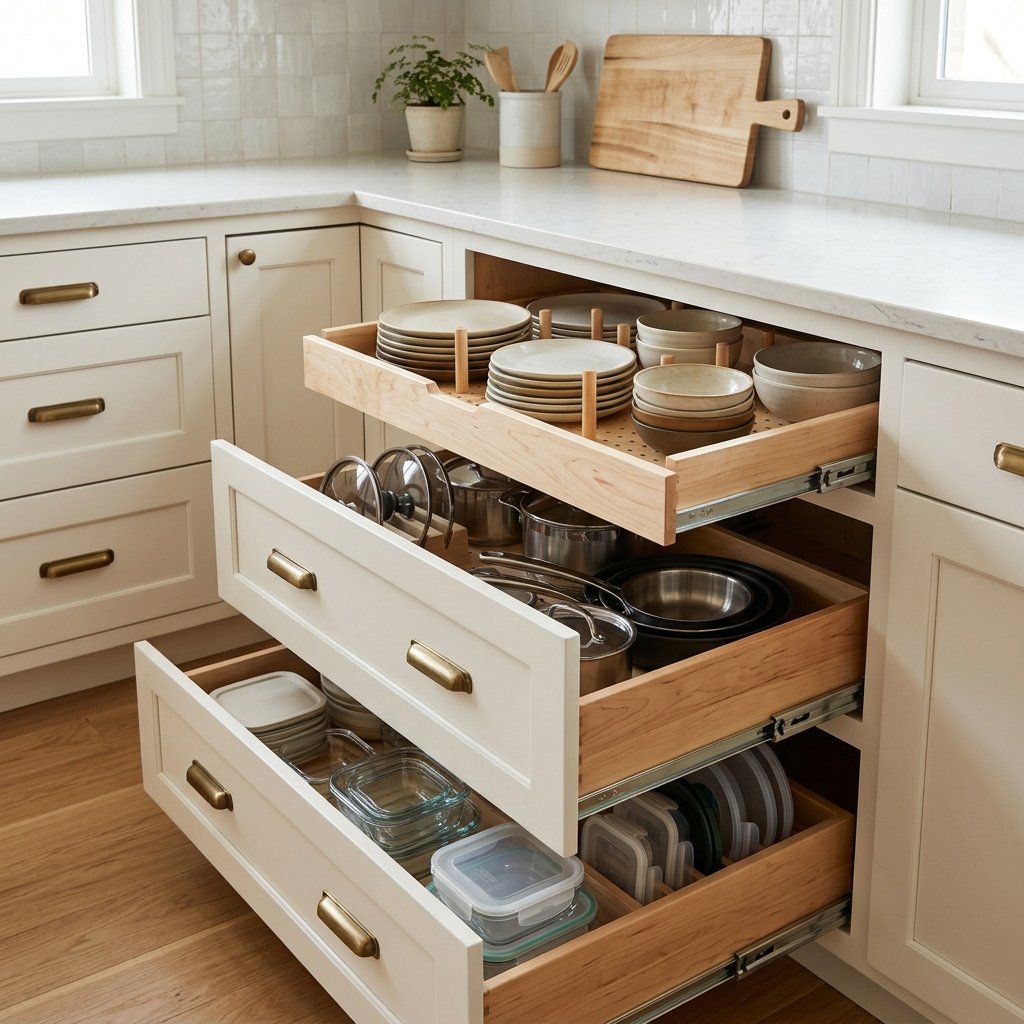
Deep kitchen drawers can hold an impressive amount of stuff—which is exactly why they can become such a mess.
Pots get stacked on top of one another. Lids disappear underneath pans. Food storage containers tumble together. Water bottles roll around, and that extra-deep drawer that seemed like an amazing kitchen feature somehow turns into a place where random kitchen items go to hide.
The secret to learning how to organize deep kitchen drawers is to stop treating them like ordinary shallow drawers.
Deep drawers work best when you take advantage of their height, create clear categories, and use dividers or containers to prevent everything from sliding into one big pile.
You also don’t need to buy dozens of organizers.
Start by deciding what should actually live in each drawer. Then add only the organizers needed to keep those items separated, visible, and easy to reach.
These 17 deep kitchen drawer organization ideas will help you create storage that stays functional long after you’ve finished organizing.
Why Deep Kitchen Drawers Get Messy
Deep drawers have a few challenges that shallow drawers don’t.
Because there’s so much vertical space, it’s tempting to stack everything.
That works until you need the pan at the bottom.
They’re also large enough for unrelated categories to migrate into the same drawer.
Soon you have:
Mixing bowls + cutting boards + colander + baking dishes + random water bottle
all competing for space.
A better approach is to give each deep drawer one main purpose.
Before Organizing: Empty Every Drawer
Don’t try to reorganize around what’s already there.
Take everything out.
Yes, everything.
Wipe out the drawer according to the cabinet material and manufacturer’s care recommendations, then place the contents on a counter or table.
Group similar items together:
- Pots and pans
- Lids
- Baking dishes
- Mixing bowls
- Plates and bowls
- Food storage
- Water bottles
- Lunch containers
- Baking supplies
- Small appliances
Now you can see how much you actually own.
Declutter Before Buying Organizers
Ask:
- Do I use this?
- Do I have duplicates?
- Is anything broken?
- Does every container have a lid?
- Does this belong somewhere else?
There’s no reason to design a beautiful organization system around things you don’t need.
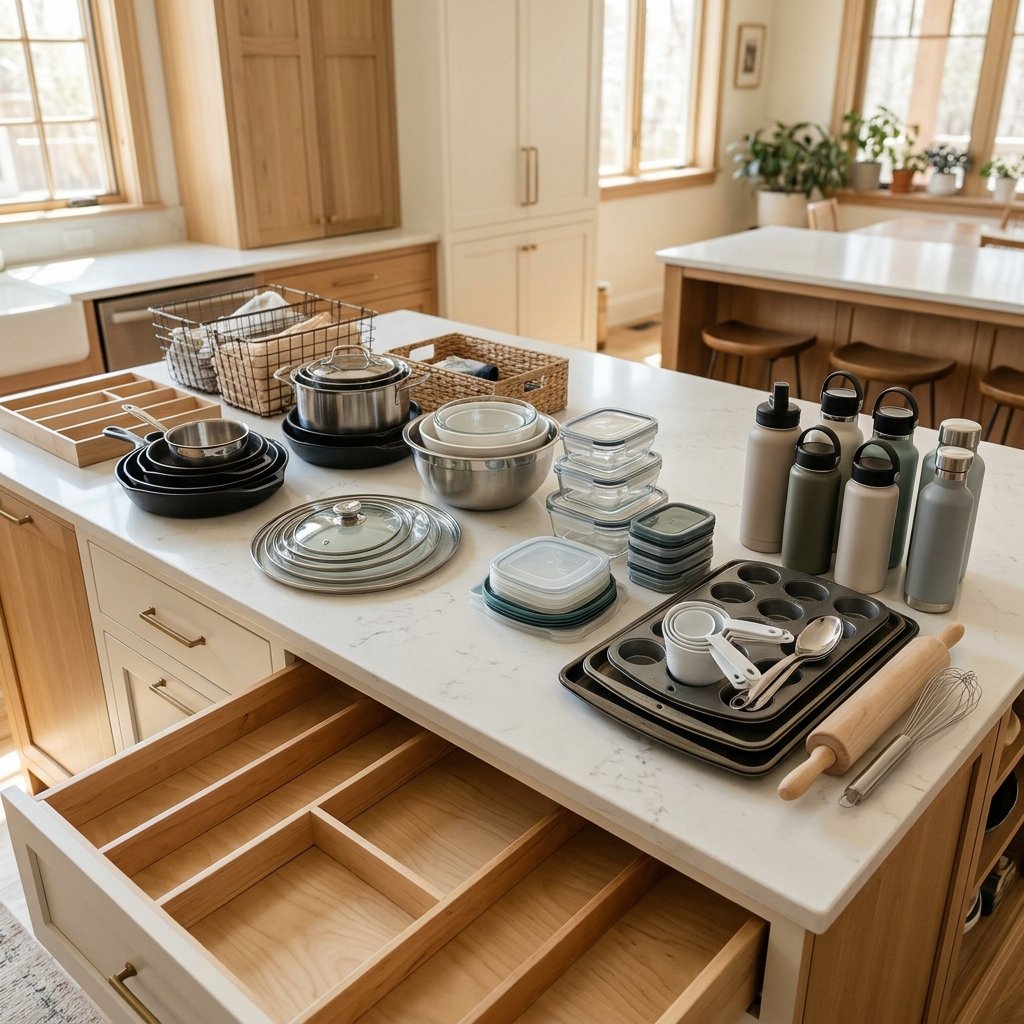
1. Store Pots and Pans in a Deep Drawer
Deep drawers are excellent for cookware because you can see everything from above.
Instead of stacking ten pans together, keep the collection manageable.
Place frequently used pots and pans where they’re easiest to grab.
If stacking is necessary, group similar sizes together.
Use protective separators between finishes when appropriate for the cookware.
Heavy cookware can place significant loads on drawers, so follow your cabinet or drawer manufacturer’s weight limits.
2. Store Pot Lids Vertically
Pot lids are one of the biggest kitchen storage problems.
Instead of laying them in a pile, store them vertically using an appropriate divider or rack.
Arrange them by size:
Small → Medium → Large
This makes it much easier to see the lid you need.
Depending on your drawer configuration, lids may fit:
- Along one side
- Behind the pots
- In their own divided section
Make sure the organizer is stable and doesn’t interfere with the drawer closing.
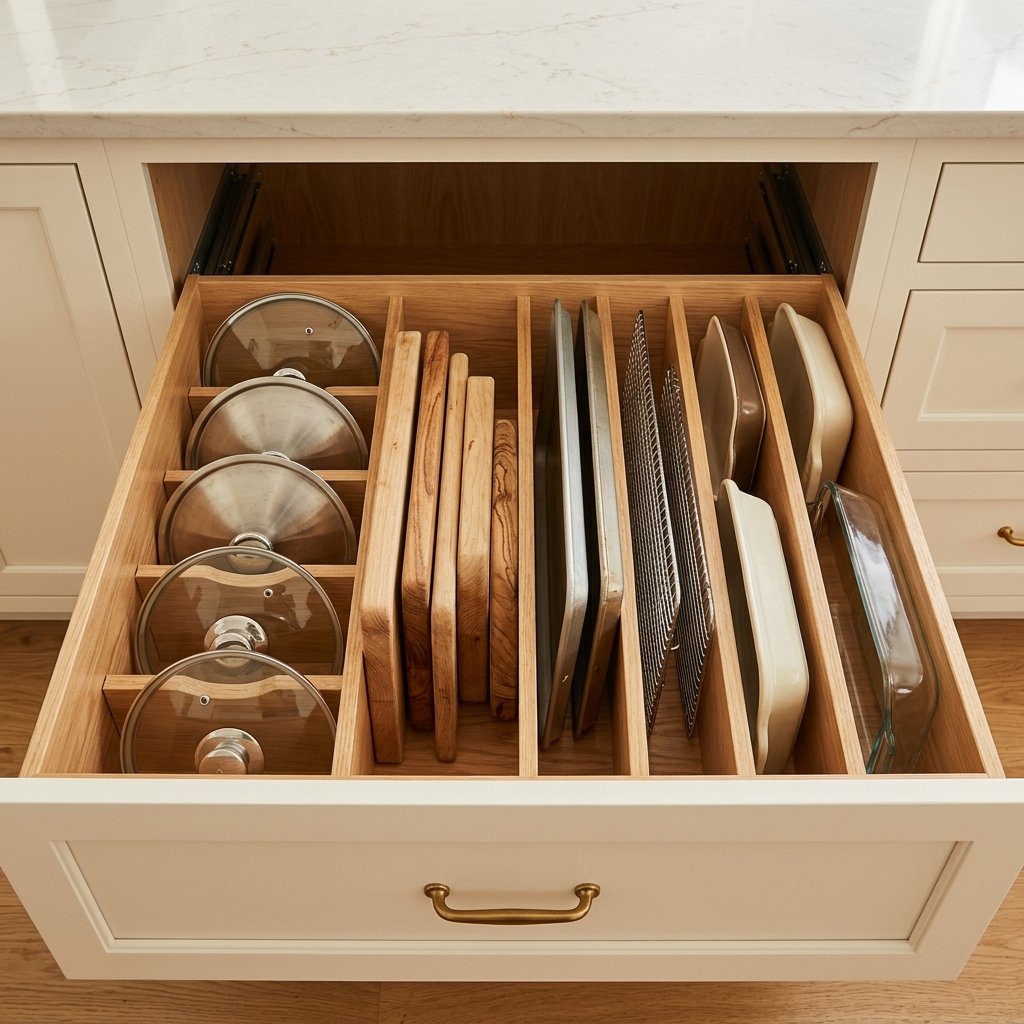
3. Use Adjustable Drawer Dividers
Adjustable dividers can turn one huge drawer into several smaller storage zones.
They’re useful for separating:
- Lids
- Cutting boards
- Baking pans
- Containers
- Kitchen linens
Measure the interior dimensions of the drawer before purchasing anything.
Check both width and height.
A divider designed for a shallow drawer may not provide enough support in a very deep one.
4. Store Dishes in Deep Drawers
If your cabinetry and drawer hardware are designed to support the load, deep drawers can be convenient for everyday dishes.
They eliminate the need to reach into upper cabinets.
Store:
- Dinner plates
- Small plates
- Bowls
Use a suitable peg or divider system when needed to keep stacks from shifting as the drawer opens and closes.
Be particularly careful with heavy ceramic or stoneware dishes.
Confirm the drawer’s load capacity rather than assuming it can support a large collection.
5. Use a Peg System for Plates and Bowls
Peg-style drawer organizers create adjustable sections around stacks of dishes.
You can configure the pegs around:
- Dinner plates
- Salad plates
- Cereal bowls
- Serving bowls
This is especially useful in wide drawers where dishes might otherwise slide.
Choose a system designed for the drawer and expected load.
6. Organize Food Storage Containers
Deep drawers can work extremely well for food storage containers—if you don’t throw everything inside.
First, match every container with its lid.
Get rid of damaged pieces and containers missing their matching parts.
Then choose one of two systems.
Option 1: Nest Containers
Stack similar shapes together and keep lids in a separate vertical section.
Option 2: Store Containers With Lids Attached
This uses more space but eliminates lid matching.
Choose the system you’re more likely to maintain.
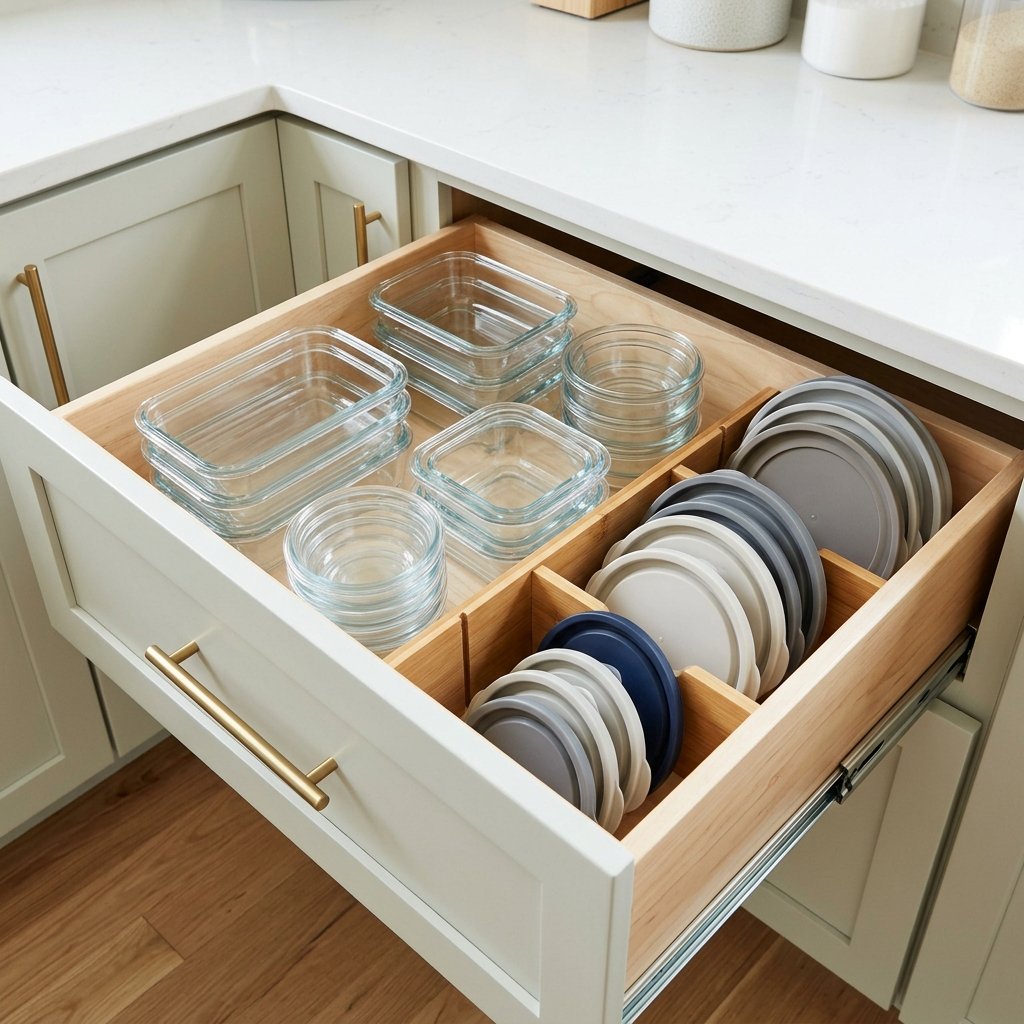
7. Create a Dedicated Lid Section
If you use nesting containers, give lids their own area.
Separate them by:
- Shape
- Size
- Container type
You can use:
- Drawer divider
- Small bin
- Vertical organizer
Avoid creating a complicated system with fifteen categories.
The easiest organization systems are usually the ones people continue using.
8. Organize Water Bottles Vertically
Reusable bottles can easily take over a cabinet.
A deep drawer may be a better solution.
Depending on the bottle and drawer dimensions, store them upright where practical so you can see the collection at once.
If bottles are too tall, another storage area may work better.
Don’t force the drawer closed against bottles or lids.
And if you discover you own far more bottles than the drawer can comfortably hold, declutter before buying a larger organizer.
9. Create a Lunch-Packing Drawer
If you regularly pack lunches, dedicate one deep drawer to the task.
You might store:
- Lunch containers
- Reusable bags
- Small snack containers
- Water bottles
- Appropriate food wraps
Keeping everything together makes morning routines easier.
Keep sharp tools, medications, cleaning products, and other unsafe items separate from areas accessible to young children.
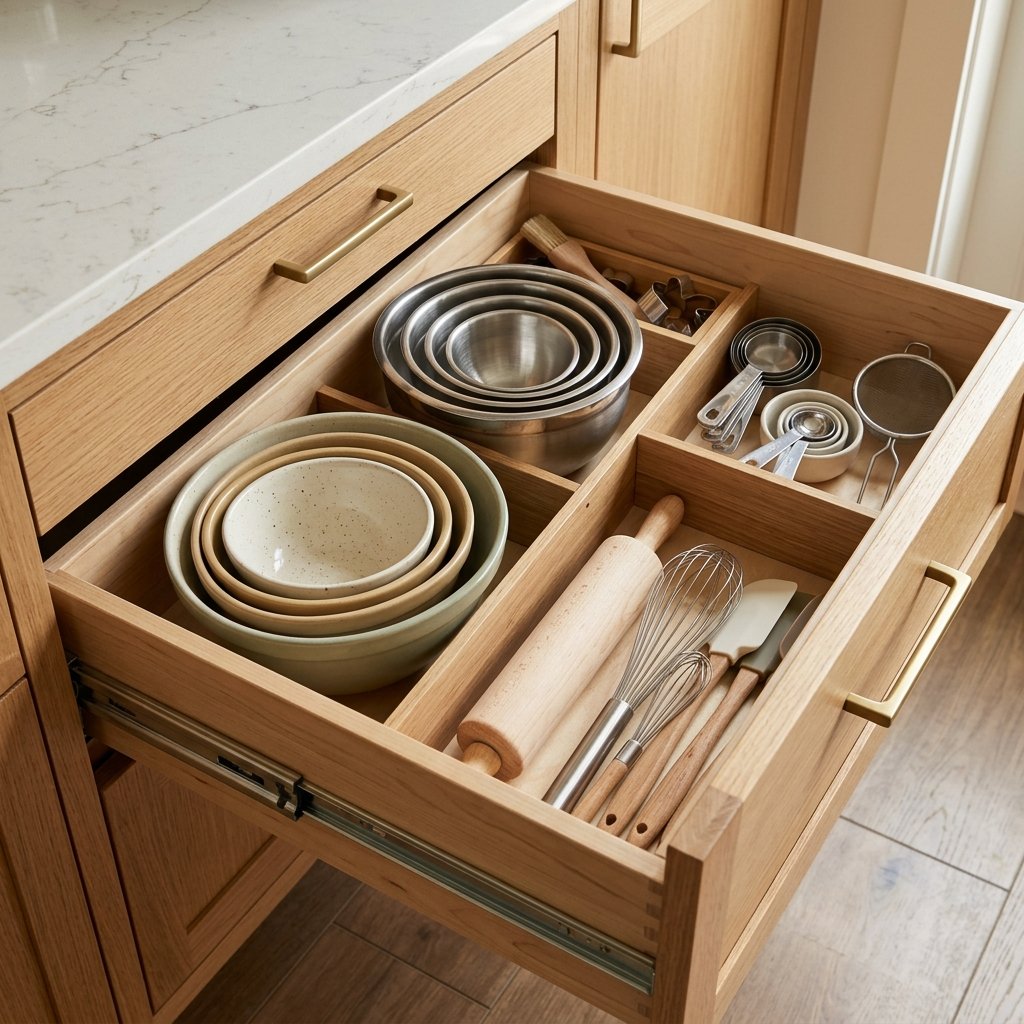
10. Store Mixing Bowls Together
Nesting mixing bowls are practically made for deep drawers.
Stack them by size.
If you have multiple sets, ask whether you really need all of them.
Place frequently used bowls toward the front.
Occasionally used specialty bowls can go farther back.
11. Create a Baking Drawer
If you bake frequently, turn a deep drawer into a baking station.
Depending on what fits safely, store:
- Mixing bowls
- Measuring cups
- Measuring spoons
- Rolling pin
- Parchment paper
- Appropriate baking accessories
Keep food ingredients in suitable storage locations and containers.
Heavy equipment may be better in cabinetry or drawers specifically designed for the load.
12. Store Baking Pans Vertically
Instead of stacking baking sheets and pans, consider storing them on edge.
Vertical storage can work for:
- Baking sheets
- Muffin tins
- Cutting boards
- Cooling racks
- Certain shallow baking dishes
Use sturdy dividers suited to the drawer.
Make sure items can’t tip, bind, or prevent the drawer from closing properly.
13. Organize Cutting Boards Vertically
Cutting boards are much easier to retrieve when you don’t have to lift five others first.
Store them upright in divided sections.
Group by size or material if useful.
Allow boards to dry fully after washing before returning them to enclosed storage.
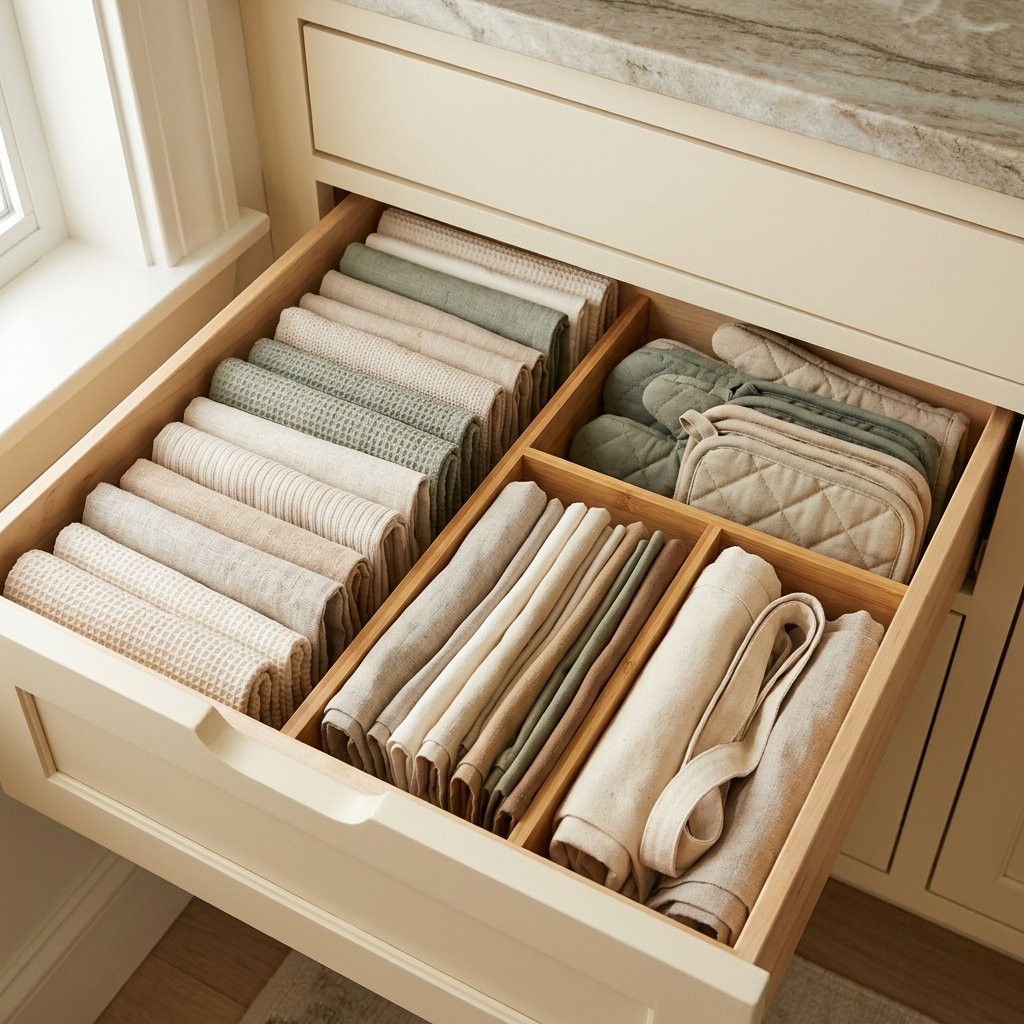
14. Create a Deep Drawer for Kitchen Linens
Not every deep drawer needs hard dividers.
One can be useful for:
- Dish towels
- Cloth napkins
- Aprons
- Oven mitts
- Pot holders
Fold items so you can see them rather than stacking everything in a tall pile.
File-style folding can make individual pieces easier to remove without disturbing the rest.
15. Use Bins Inside Extra-Deep Drawers
Sometimes a drawer is simply too large.
Bins create smaller zones.
Instead of one huge empty space, create sections such as:
Baking | Food Storage | Lunch Supplies
Choose bins that fit comfortably without preventing the drawer from closing.
Measure:
- Interior width
- Interior depth
- Usable height
Don’t assume measurements listed for the cabinet opening are the same as the usable interior drawer dimensions.
16. Use the Front of the Drawer for Everyday Items
Not every part of a deep drawer is equally convenient.
Put the items you use most often toward the front.
Less-used items can go toward the back.
For example:
Front: Everyday skillet
Middle: Saucepan
Back: Large stockpot
This simple change can make the drawer more functional without purchasing anything.
17. Leave Some Empty Space
This may be the most overlooked kitchen organization trick.
Don’t fill every inch.
If an organizer technically fits but makes the drawer difficult to use, it’s not helping.
Leave enough room to:
- Lift items out
- Return them easily
- See what you own
- Add an occasional replacement item
A drawer that is 100 percent full is much harder to keep organized than one with a little breathing room.
How to Organize Extra-Deep Kitchen Drawers
Extra-deep drawers can be particularly challenging because they encourage tall piles.
Think in terms of vertical storage.
Good candidates include:
- Pots
- Deep mixing bowls
- Food storage containers
- Plates
- Water bottles
For flatter items, use dividers to stand them vertically rather than wasting the drawer’s height.
The goal is to make the contents visible from above.
If you can’t see an item without removing several others, reconsider the arrangement.
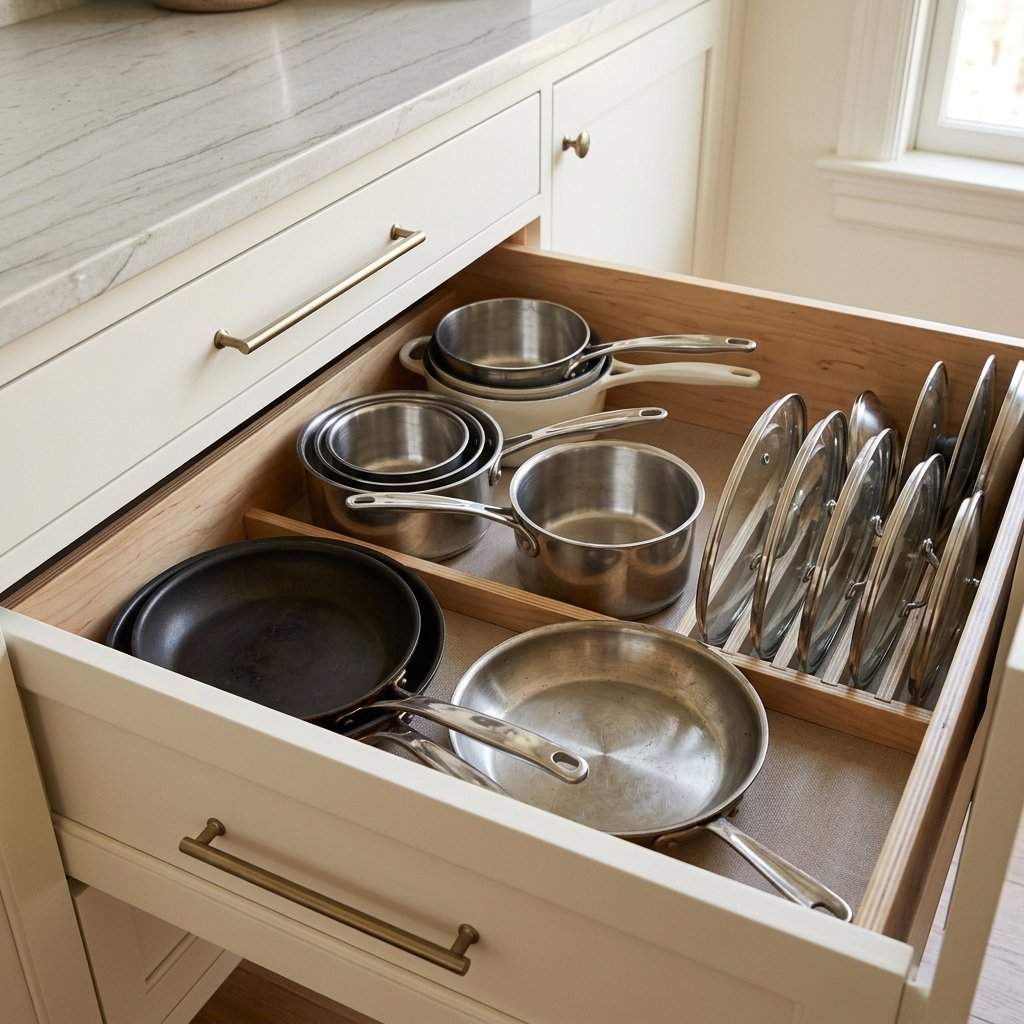
How to Organize Deep Kitchen Drawers for Pots and Pans
Start by putting all your cookware together.
Then identify what you actually use.
A practical arrangement might be:
Front
Everyday skillet and saucepan
Middle
Frequently used larger pots
Side Section
Lids stored vertically
Back
Stockpot or specialty cookware
Keep the heaviest items positioned so the drawer remains stable and operates as intended.
Always respect the drawer system’s load limits.
How to Organize Deep Kitchen Drawers for Dishes
Dish drawers can be extremely convenient, particularly in kitchens where reaching upper cabinets is difficult.
Separate stacks into:
- Dinner plates
- Small plates
- Bowls
Use pegs or dividers if necessary.
Avoid making stacks so tall that they’re unstable or difficult to lift.
And don’t assume a drawer can support heavy dishware simply because the dishes physically fit.
How to Organize Deep Kitchen Drawers for Food Containers
Start with a complete container audit.
Match every lid.
Then discard or repurpose appropriate containers that are:
- Damaged
- Missing lids
- No longer used
Nest similar shapes.
Store lids vertically.
Avoid mixing several unrelated container systems if possible.
The simpler the collection, the easier it is to organize.
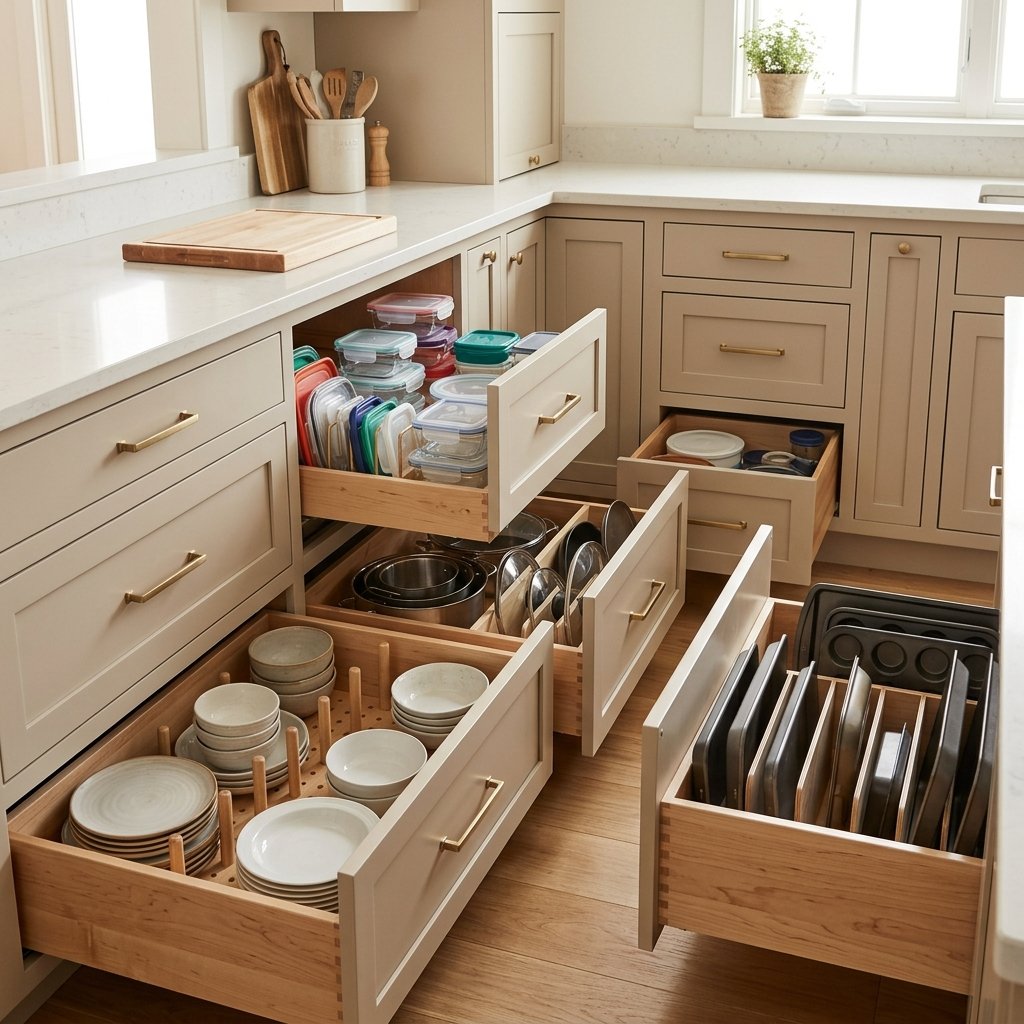
How to Organize Deep Drawers Without Buying Anything
Before ordering organizers, try using the drawer as-is.
You may only need to:
- Remove excess items.
- Group similar things.
- Nest bowls and containers.
- Stand appropriate items vertically.
- Move rarely used items elsewhere.
- Put everyday items at the front.
You can also repurpose suitable containers you already own.
The goal isn’t to create a drawer that looks like an organization catalog.
It’s to make your kitchen easier to use.
How to Measure for Deep Drawer Organizers
Measure the usable interior of the drawer.
Record:
- Width
- Front-to-back depth
- Usable height
Then check for anything that reduces the usable space.
Also consider whether the drawer sides are lower than the drawer front.
Before buying an organizer, verify its external dimensions rather than judging from photographs.
For multiple bins, sketch the drawer and test the arrangement with measurements first.
Should You Use Clear or Opaque Organizers?
Both can work.
Clear Organizers
Make contents easy to see.
Opaque Organizers
Can create a visually calmer appearance.
Function matters more than appearance inside most deep drawers.
Choose organizers that:
- Fit properly
- Are easy to clean
- Suit what you’re storing
- Don’t slide excessively
- Don’t waste unnecessary space
The Best Place for Different Kitchen Items
A useful rule is to store things near where they’re used.
Near the Stove
Pots, pans, and appropriate cooking tools.
Near the Dishwasher
Everyday plates and bowls.
Near Food Prep Space
Cutting boards and mixing bowls.
Near the Refrigerator
Food storage containers or lunch supplies.
Near the Oven
Appropriate baking pans and baking tools.
This reduces unnecessary movement while you’re cooking and unloading dishes.
How to Keep Deep Kitchen Drawers Organized
Creating the system is only half the job.
The real test is whether it stays organized.
Give Everything a Home
Every category needs an obvious place.
Don’t Overfill
When a category outgrows its space, declutter it.
Keep Categories Broad
Simple systems are easier to maintain.
Put Things Back Immediately
Don’t create a temporary pile inside the drawer.
Reassess Occasionally
Kitchen habits change.
If the system isn’t working, adjust it.
Common Deep Kitchen Drawer Organization Mistakes
Buying Organizers Before Decluttering
You’ll end up organizing things you don’t need.
Not Measuring
Even a beautiful organizer is useless if the drawer won’t close.
Over-Complicating the System
You probably don’t need a separate compartment for every single object.
Stacking Everything
Use vertical storage where it improves access.
Ignoring Weight
Cookware and dishes become heavy quickly.
Filling Every Inch
Leave room to remove and return items.
Mixing Too Many Categories
Give each drawer one primary purpose whenever possible.
Storing Items Far From Where They’re Used
Convenience is part of organization.
Deep Kitchen Drawer Safety Tips
Deep drawers can hold heavy items, so use them thoughtfully.
- Follow cabinet and drawer hardware load limits.
- Don’t overload drawers with cast iron, stoneware, appliances, or other heavy items.
- Make sure tall objects don’t interfere with closing.
- Keep knives and other sharp tools in suitable secure storage.
- Store household chemicals separately from food and food-contact items as appropriate.
- Consider child-resistant storage where necessary.
- Use stable dividers and organizers that won’t tip easily.
- Don’t modify drawer hardware or cabinetry without understanding the system.
- Keep frequently used heavy items at a comfortable lifting height when possible.
- Follow cookware and storage-product care instructions.
- Make sure cutting boards and other washed items are dry before placing them in enclosed storage.
A Simple Deep Drawer Organization Plan
If your entire kitchen needs help, don’t organize every drawer at once.
Try this:
Drawer 1: Pots and Pans
Cookware + lids.
Drawer 2: Everyday Dishes
Plates + bowls.
Drawer 3: Food Storage
Containers + lids.
Drawer 4: Baking
Mixing bowls + baking accessories.
Drawer 5: Kitchen Linens
Towels + napkins + oven mitts.
Adjust the categories to match how you actually cook.
FAQ About Organizing Deep Kitchen Drawers
What should you put in deep kitchen drawers?
Deep drawers work particularly well for pots and pans, dishes, mixing bowls, food storage containers, water bottles, baking pans, and kitchen linens.
How do you organize a really deep drawer?
Use the drawer’s height intentionally. Nest bowls and containers, stand appropriate flat items vertically, and use bins, pegs, or dividers to create smaller zones.
How do you organize pots and pans in deep drawers?
Place frequently used cookware toward the front, nest only where necessary, and store lids vertically in a separate section.
How do you organize food storage containers in a deep drawer?
Nest similar containers together and store matching lids vertically in a divided section or bin.
How do you keep things from moving in deep drawers?
Use appropriately fitted bins, dividers, peg systems, or other organizers designed for the drawer and stored items.
Can you store plates in deep kitchen drawers?
Yes, if the drawer system is designed to support the weight. Pegs or dividers can help keep stacks from shifting.
What is the best way to organize deep drawers on a budget?
Declutter first. Nest items, use vertical storage, group similar objects, and repurpose suitable containers you already have before buying organizers.
How do you organize deep drawers without wasting space?
Use the full height where practical, but avoid filling every available inch. The contents should remain visible and easy to remove.
Final Thoughts
Learning how to organize deep kitchen drawers isn’t about filling them with complicated organizers.
It’s about giving the space a clear purpose.
Start by emptying everything.
Declutter what you don’t use.
Group similar items.
Then decide what each drawer should hold based on where it’s located and how you use your kitchen.
Store pot lids, cutting boards, and baking pans vertically when appropriate.
Nest mixing bowls and food containers.
Use adjustable dividers or bins to keep large drawers from becoming one giant storage space.
And leave some room.
The best kitchen drawer isn’t necessarily the one that holds the most stuff.
It’s the one where you can open the drawer, immediately see what you need, take it out, and put it back without moving five other things first.
Create that kind of system, and your deep kitchen drawers will be much easier to keep organized every day.