

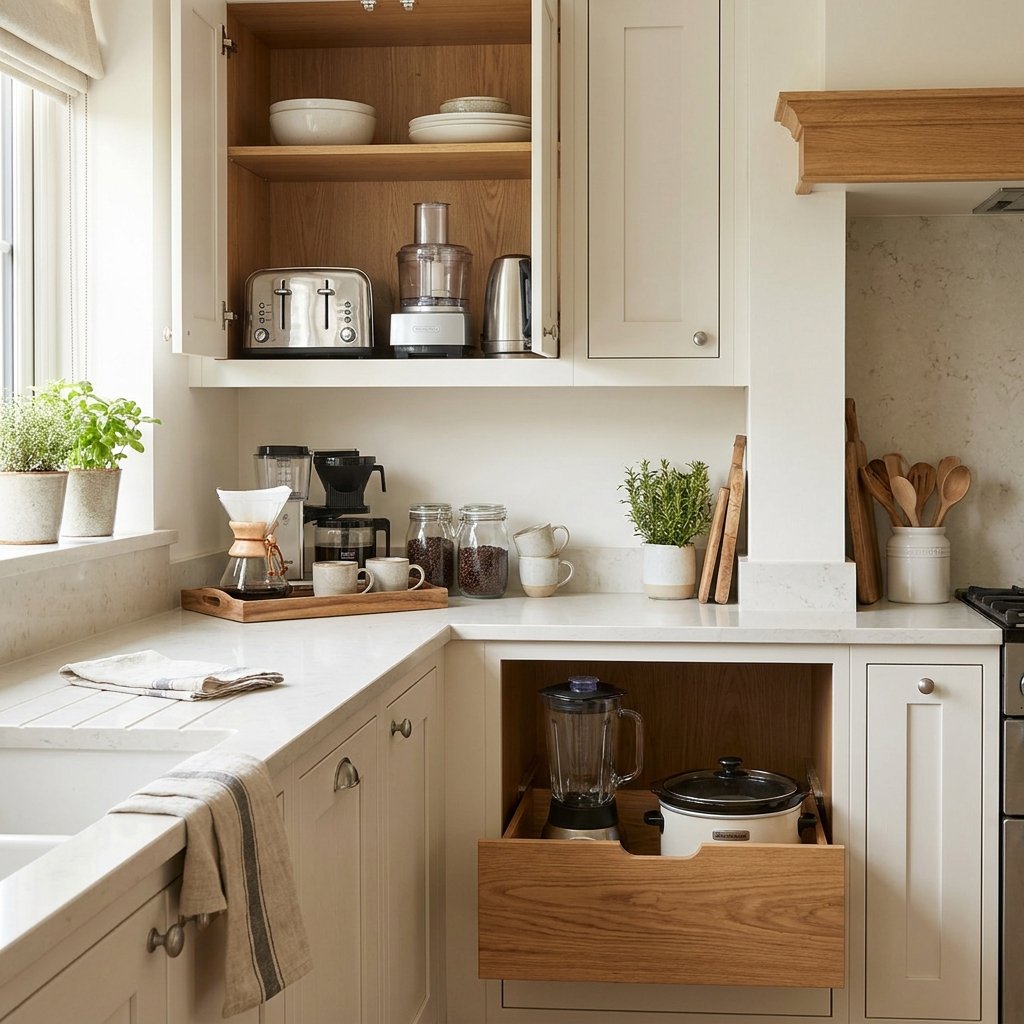
Small kitchen appliances have a way of taking over the countertop.
The coffee maker stays out because you use it every morning. The toaster needs to be accessible. The blender is too tall for one cabinet. The slow cooker is heavy. And somehow the air fryer ends up permanently occupying the exact section of counter where you’d rather prepare dinner.
Good kitchen appliance storage ideas aren’t about hiding absolutely everything.
They’re about deciding which appliances deserve valuable countertop space, storing everything else according to how often it’s used, and making heavy or awkward appliances easier to access safely.
Whether you have a small kitchen with limited cabinetry or a larger kitchen that needs better organization, these 21 ideas can help you find practical homes for coffee makers, mixers, blenders, slow cookers, air fryers, toasters, and other countertop appliances.
Start by Decluttering Your Kitchen Appliances
Before buying organizers or redesigning a cabinet, take inventory.
Pull out your small appliances and group them together.
You might discover you own:
- Two blenders
- Several coffee makers
- An old toaster
- A slow cooker you never use
- A specialty appliance still in its box
Ask yourself:
When did I last use this?
Then divide appliances into three groups.
Everyday
Used daily or several times each week.
Occasional
Used every few weeks or months.
Rarely Used
Holiday or specialty appliances.
Your most accessible storage should go to the first group.
Don’t let an appliance you use twice a year occupy the easiest cabinet in the kitchen.
1. Keep Everyday Appliances on the Counter
Countertop storage isn’t automatically bad.
If you use something every day, leaving it out may be the most practical solution.
Possible everyday appliances include:
- Coffee maker
- Electric kettle
- Toaster
The trick is limiting the number.
Instead of spreading appliances across every countertop, group daily essentials in one intentional area when possible.
Keep required clearances, ventilation, heat safety, and manufacturer instructions in mind.
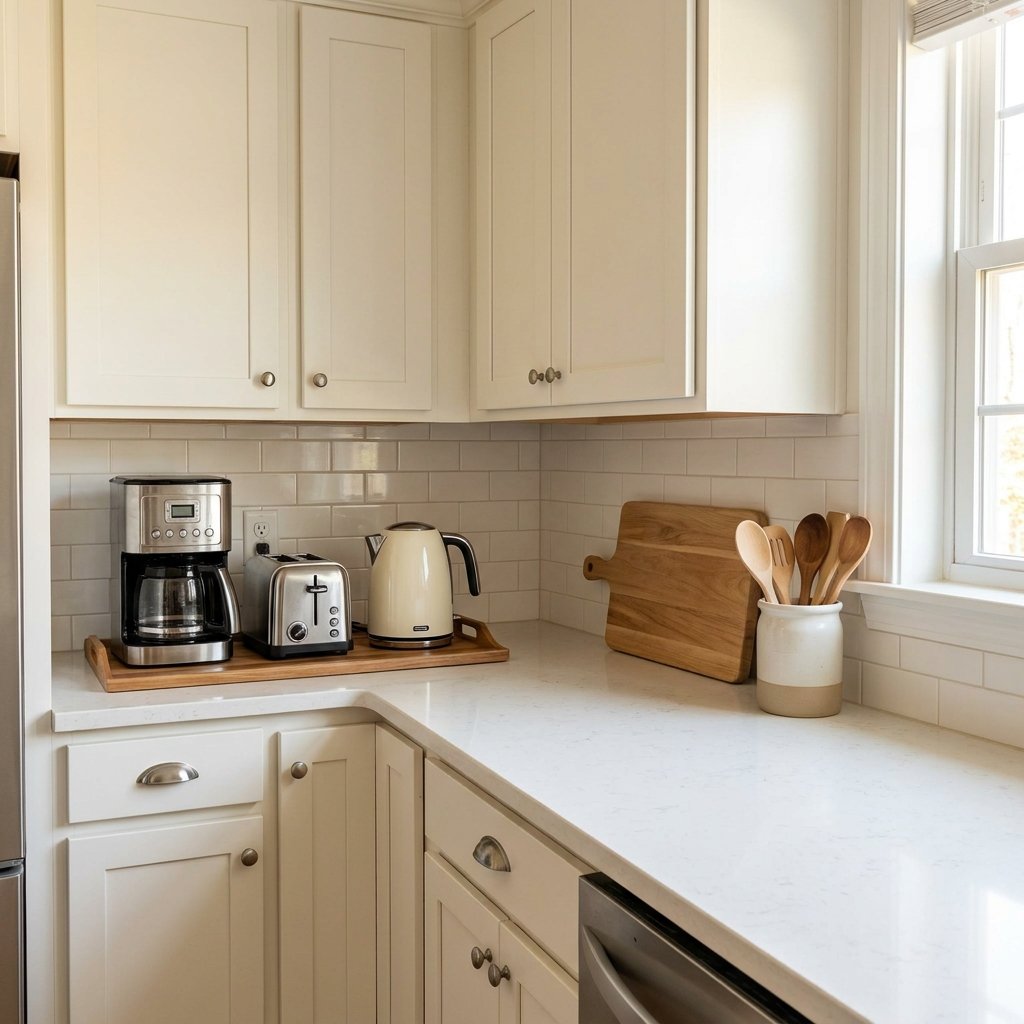
2. Create a Dedicated Coffee Station
If coffee supplies are scattered across several cabinets, bring them together.
Create a station containing the items you actually use, such as:
- Coffee maker
- Mugs
- Coffee
- Filters
- Appropriate accessories
A coffee station can live on a section of countertop, inside appropriately designed cabinetry, or on a separate piece of furniture if the setup is safe and practical.
Keep electrical appliances away from sinks and other water sources as appropriate, and follow the appliance manufacturer’s requirements for placement and ventilation.
3. Use an Appliance Garage
An appliance garage can conceal frequently used appliances while keeping them near the work surface.
It may have:
- Lift-up door
- Retractable door
- Hinged doors
- Pocket-style doors
This can be useful for coffee makers, toasters, or blenders—but only when the cabinetry and appliance setup are designed for that use.
Heat-producing appliances shouldn’t simply be operated inside enclosed cabinets unless the appliance and cabinet system specifically permit it.
When in doubt, pull the appliance out to a safe operating location and follow its instructions.
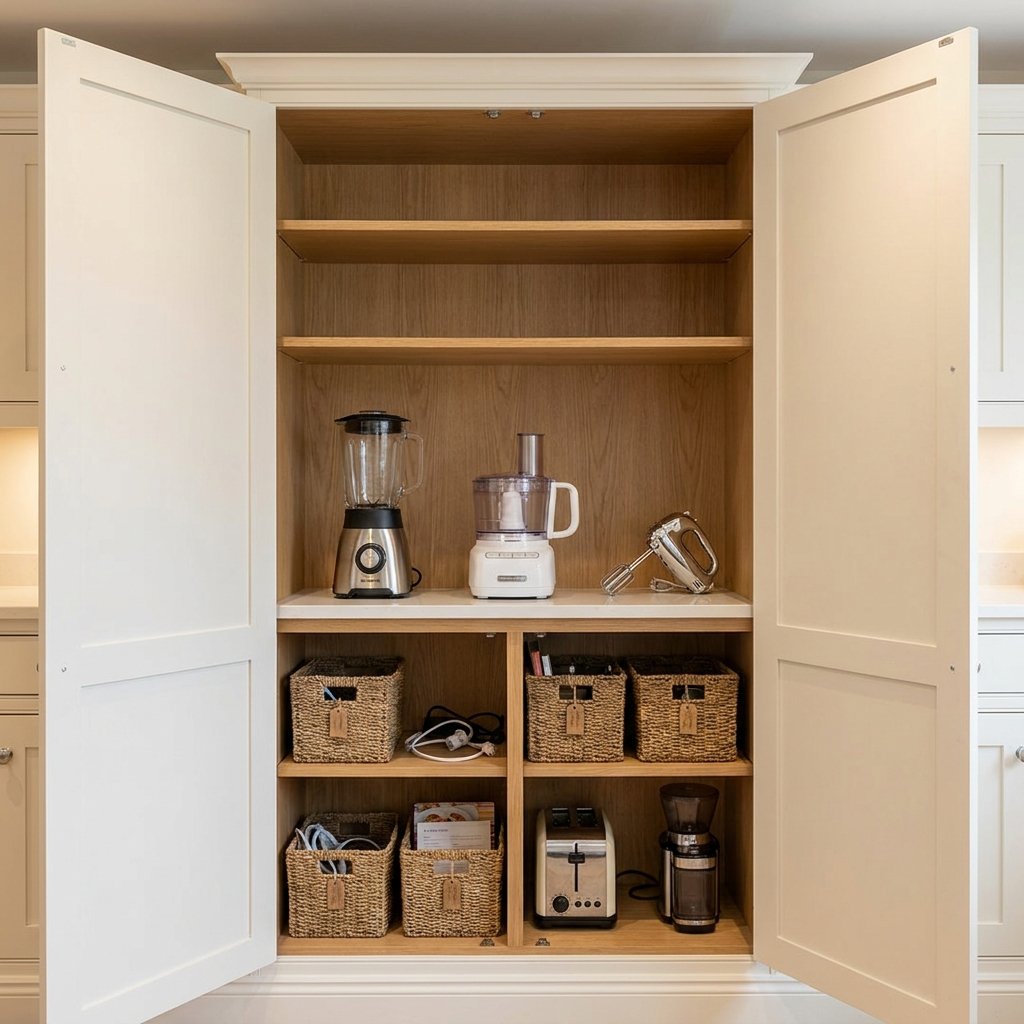
4. Turn a Cabinet Into an Appliance Cabinet
You don’t necessarily need a custom appliance garage.
Dedicate an existing cabinet to small appliances.
Group them by frequency of use.
For example:
Lower shelf: frequently used blender and food processor.
Upper shelf: less-used specialty appliances.
Make sure shelves are designed to support the weight.
Store heavy appliances at a comfortable lifting height when possible rather than high overhead.
5. Use Deep Drawers for Smaller Appliances
Deep drawers can be surprisingly useful for certain appliances.
Depending on their dimensions and weight, you may be able to store:
- Hand mixer
- Immersion blender
- Small food processor
- Compact blender
Drawers let you look down at everything rather than reaching behind items on a shelf.
Before loading a drawer with appliances, confirm its weight capacity.
6. Store Heavy Appliances in Lower Cabinets
Heavy appliances generally shouldn’t live on high shelves.
A slow cooker, large food processor, or other bulky appliance may be safer and easier to retrieve from a lower cabinet.
Place the heaviest appliances where you can lift them without excessive reaching.
Avoid storing very heavy items where they could fall from overhead.
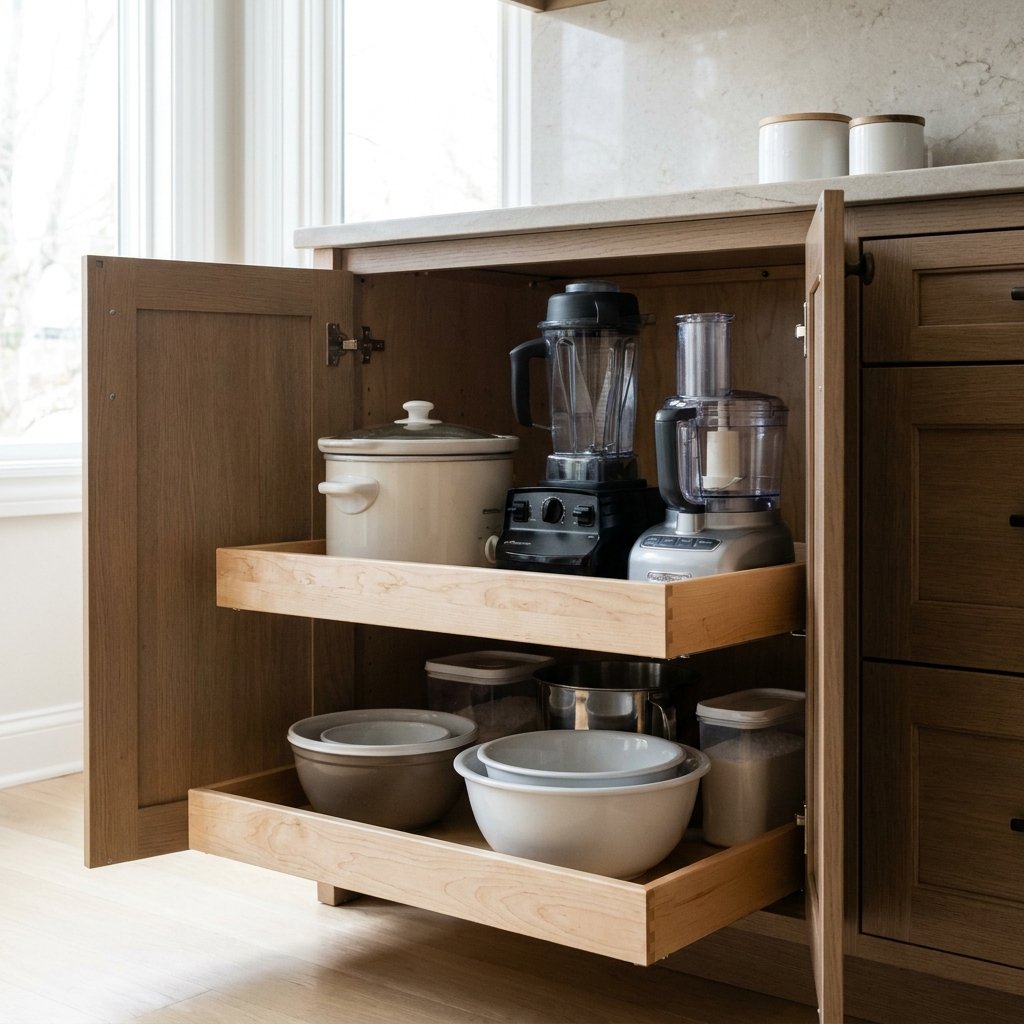
7. Add Pull-Out Shelves
Pull-out shelves can make deep base cabinets much more functional.
Instead of kneeling and reaching behind three appliances, you pull the shelf forward.
They can work well for:
- Slow cookers
- Food processors
- Blenders
- Other appropriately sized appliances
The cabinet, shelf, slides, mounting method, and hardware need to be rated for the expected load.
Don’t assume a retrofit shelf can safely support heavy appliances.
8. Use a Mixer Lift
If you frequently use a heavy stand mixer, a purpose-designed mixer lift may make it easier to access.
The appliance remains in a lower cabinet and rises toward counter height using specialized hardware.
This can reduce the need to repeatedly lift a heavy mixer.
However, mixer lifts require appropriate cabinetry, hardware, clearances, installation, and weight capacity.
Follow the hardware and cabinet manufacturers’ requirements, and consider professional installation if structural cabinet modifications are necessary.
9. Give the Air Fryer a Dedicated Home
Air fryers can be particularly awkward because they’re often bulky and may require clearance around them during operation.
When not in use, consider storing the appliance:
- In a lower cabinet
- In a pantry
- On an appropriate appliance shelf
During operation, place it exactly as directed by the manufacturer, with the required clearances and ventilation.
Don’t operate a heat-producing appliance in a confined cabinet simply to keep it hidden.
10. Store the Toaster Away When You Don’t Use It Daily
If toast isn’t part of your everyday routine, the toaster doesn’t need permanent countertop space.
Store it in an accessible cabinet.
Before putting it away:
- Unplug it.
- Allow it to cool completely.
- Empty crumbs according to the manufacturer’s instructions.
- Keep the cord appropriately arranged.
Avoid storing a hot appliance.
11. Create a Breakfast Cabinet
If mornings involve several small appliances and supplies, create one breakfast zone.
Depending on your household, this might contain:
- Toaster
- Coffee supplies
- Tea
- Mugs
- Appropriate breakfast dishes
Keeping related items together reduces the amount of searching you do during busy mornings.
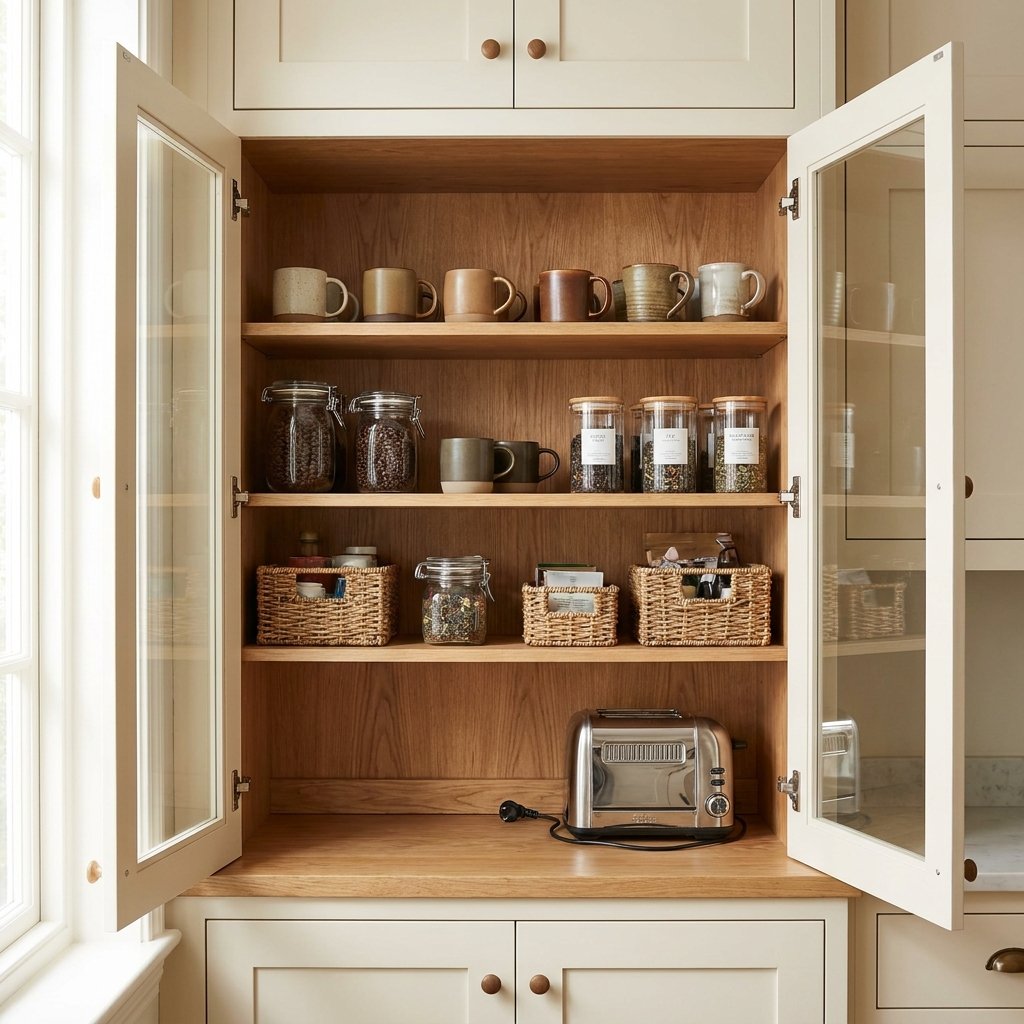
12. Create a Smoothie Station
If you make smoothies regularly, keep the equipment together.
Store the blender near related items such as:
- Reusable cups
- Lids
- Straws
- Appropriate dry ingredients
Refrigerated and frozen ingredients should, of course, remain in suitable cold storage.
The goal is to reduce the number of cabinets you open to complete one routine.
13. Store Appliance Attachments With the Appliance
A stand mixer isn’t very useful if its attachments are in three different places.
Keep attachments close to the appliance when practical.
Use:
- Small bin
- Drawer
- Nearby shelf
- Purpose-designed organizer
Do the same with:
- Food processor blades
- Blender accessories
- Hand mixer attachments
Store blades and sharp attachments safely so hands can’t accidentally contact cutting edges while reaching into a cabinet.
14. Use Bins for Small Appliance Accessories
Small accessories disappear easily.
Use bins to group accessories by appliance.
For example:
Blender Accessories
Mixer Accessories
Food Processor Parts
Labels can be useful when several bins look similar.
Don’t over-divide everything.
One container for each major appliance is often easier to maintain than a complicated system of tiny compartments.
15. Organize Appliance Cords
Loose cords make appliance cabinets look messy and can snag when you remove another item.
If the manufacturer provides a cord-storage feature, use it.
Otherwise, arrange cords carefully without:
- Pinching
- Crushing
- Tightly stressing
- Damaging
Avoid improvised solutions that could damage electrical cords.
Inspect cords periodically and stop using appliances with damaged electrical components until they are appropriately repaired or replaced.
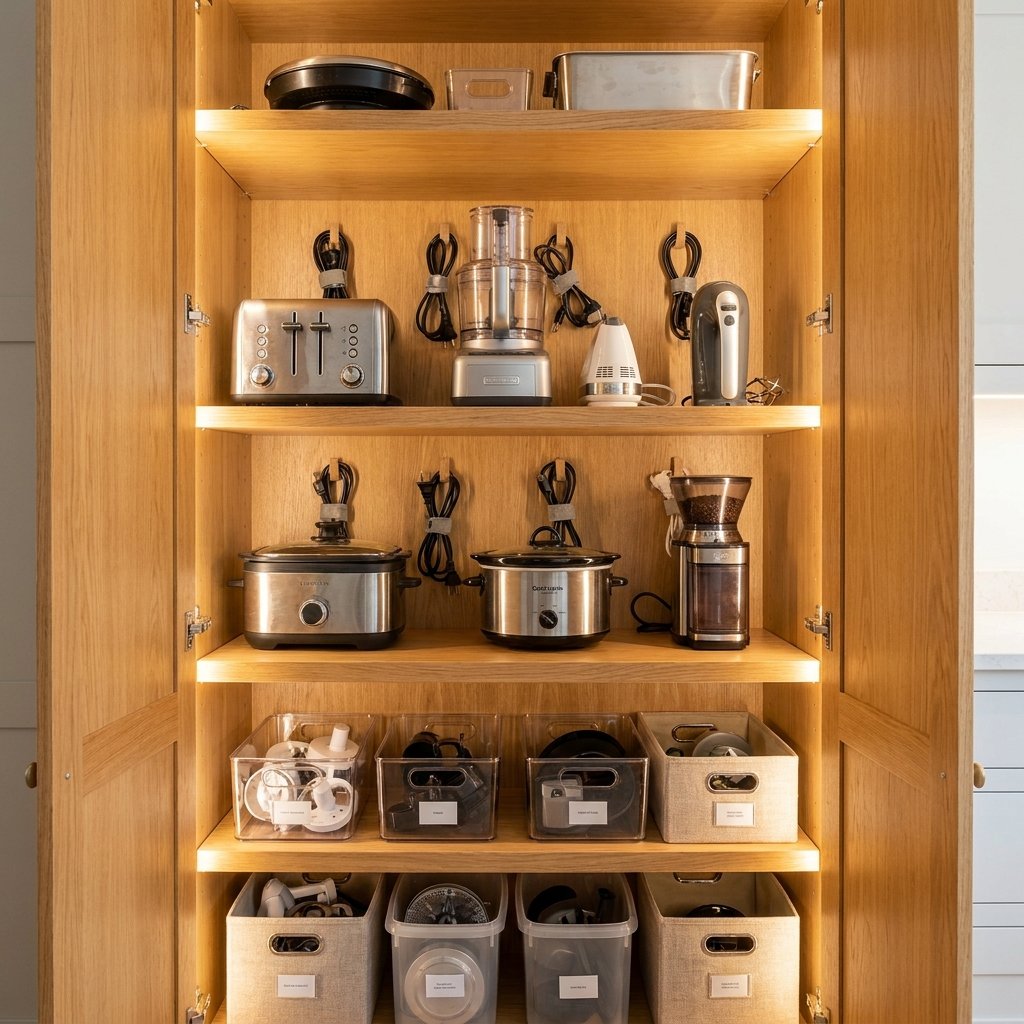
16. Use Pantry Shelves for Occasional Appliances
A pantry can be ideal for appliances you use occasionally.
Consider storing:
- Slow cooker
- Waffle maker
- Specialty blender
- Ice cream maker
- Other infrequently used equipment
Place heavy appliances on sturdy shelves at comfortable lifting heights.
Lightweight items can go higher.
Don’t overload shelving.
17. Use the Bottom of a Pantry for Heavy Appliances
If your pantry has a sturdy lower shelf or suitable floor-level storage area, it can work well for bulky appliances.
The downside is bending.
If lifting from the floor is uncomfortable, use a higher location.
Accessibility matters just as much as maximizing space.
18. Store Rarely Used Appliances Outside the Prime Kitchen Zone
The kitchen’s most convenient cabinets should support everyday cooking.
A specialty appliance used once or twice a year may be better stored in another suitable area.
Possible locations include:
- Secondary pantry
- Utility storage
- Appropriate nearby cabinet
Keep appliances in dry, clean locations that protect them from damage, pests, moisture, and extreme conditions.
Avoid storage locations that aren’t suitable for electrical equipment.
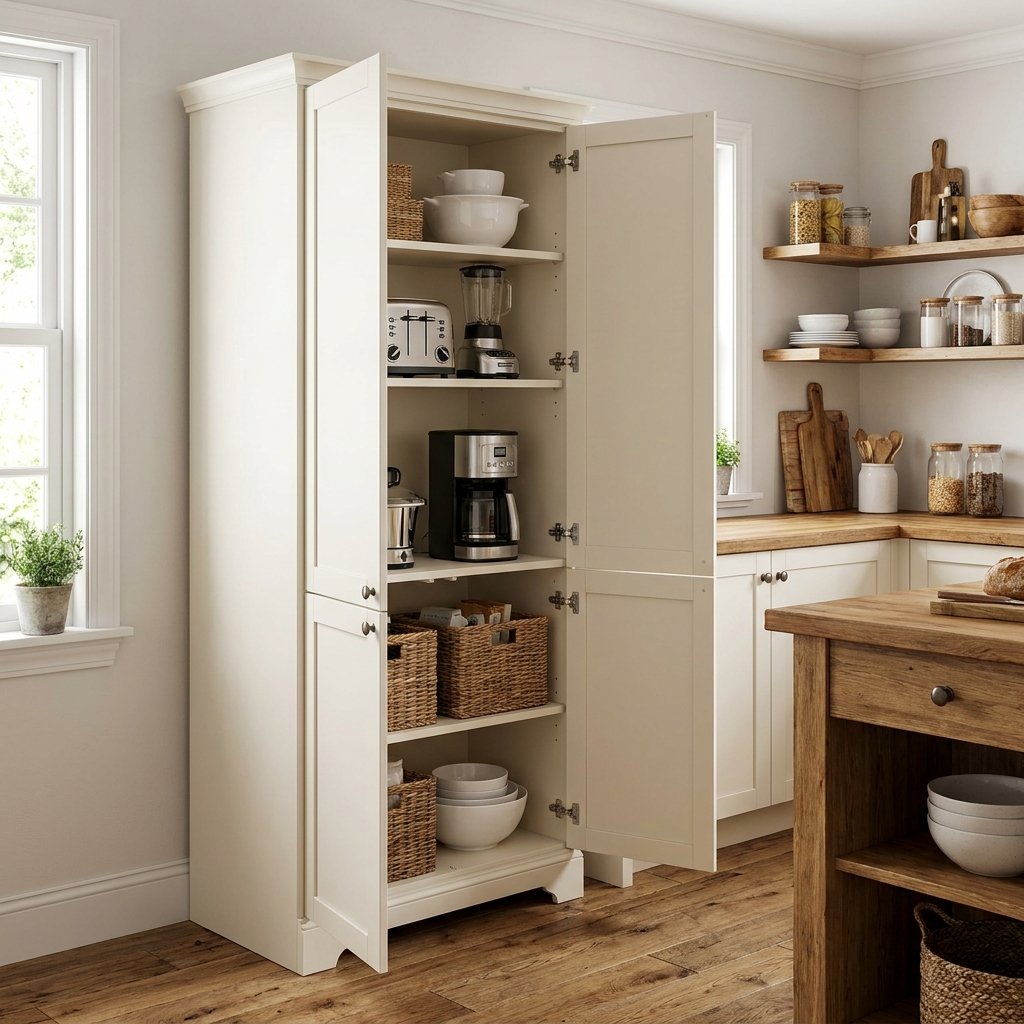
19. Use a Freestanding Cabinet
If your kitchen simply doesn’t have enough cabinetry, adding a freestanding storage piece may solve the problem.
Depending on your space, consider:
- Tall cabinet
- Sideboard
- Hutch
- Pantry cabinet
Use it for appliances and related supplies.
Choose a piece appropriate for the weight and secure tall furniture to the wall where necessary to reduce tipping risk.
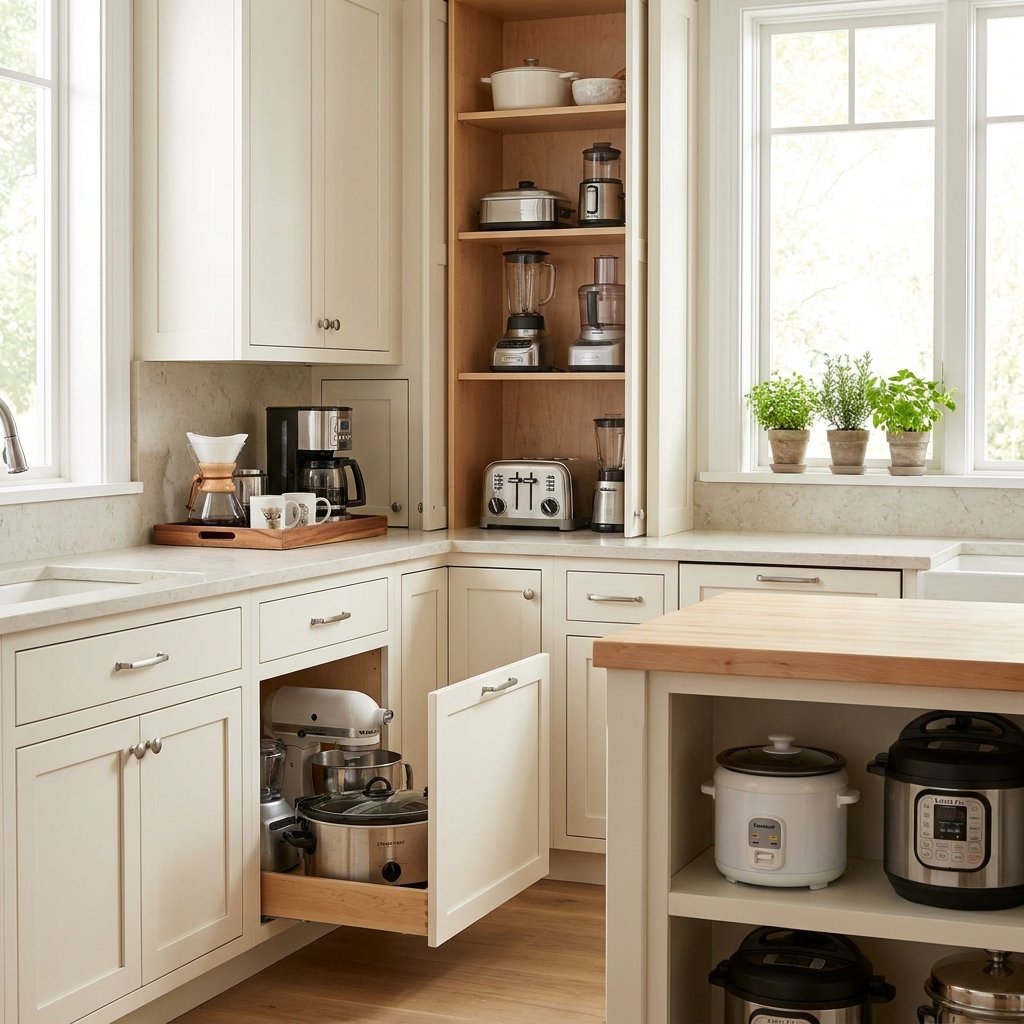
20. Turn an Island Cabinet Into Appliance Storage
A kitchen island can offer excellent storage for appliances that don’t need to stay on the counter.
Consider storing:
- Blender
- Food processor
- Slow cooker
- Baking appliances
Position frequently used appliances on the side that’s easiest to access from your main prep area.
Avoid storing heavy appliances where they create awkward lifting positions.
21. Leave Some Empty Space
The goal isn’t to fit an appliance into every available inch.
Leave enough space to remove items easily.
If retrieving the blender requires moving:
slow cooker → toaster → waffle maker → food processor
you’re probably not going to use the blender very often.
Good storage should make appliances easier to use, not simply hide them.
Kitchen Appliance Storage Ideas for Small Kitchens
Small kitchens require stricter priorities.
Countertop space is valuable, so decide which appliances truly deserve it.
Try this hierarchy:
Daily Appliances
Countertop or highly accessible cabinet.
Weekly Appliances
Easy-to-reach cabinet or deep drawer.
Monthly Appliances
Pantry or less convenient cabinet.
Rarely Used Appliances
Secondary appropriate storage.
If you own several appliances that perform similar functions, consider whether you actually use all of them.
Decluttering can create more usable space than an organizer.
How to Hide Kitchen Appliances
If visual clutter is your main concern, there are several ways to make appliances less noticeable.
Consider:
- Appliance garage
- Dedicated cabinet
- Deep drawer
- Pantry
- Island storage
- Freestanding pantry cabinet
But don’t sacrifice safety for appearance.
Some appliances generate significant heat, steam, or airflow and shouldn’t be operated inside enclosed cabinetry unless specifically permitted by the manufacturer and installation.
Storage and operation are two different things.
Kitchen Appliance Storage Ideas Without a Pantry
No pantry?
Use the cabinetry you already have more intentionally.
Dedicate One Base Cabinet
Store bulky appliances together.
Use Deep Drawers
Great for certain smaller appliances.
Add Pull-Out Shelves
Improve access to deep cabinets.
Use Island Storage
Reserve part of the island for appliances.
Add a Freestanding Cabinet
If floor space allows, this can create an entire appliance zone.
The goal is to consolidate appliances instead of scattering them throughout the kitchen.
How to Store Appliances in Deep Cabinets
Deep cabinets often waste space because appliances disappear in the back.
Pull-out shelves can improve accessibility.
If adding pull-outs isn’t practical, place appliances according to frequency:
Front: Frequently used
Middle: Occasionally used
Back: Rarely used
Avoid stacking heavy appliances on top of one another.
How to Store Heavy Kitchen Appliances
Weight should influence your storage decisions.
Heavy appliances are generally easier to handle when stored:
- Below counter level
- Near waist height where possible
- On sturdy shelving
- Near where they’re used
Avoid high shelves.
When lifting, make sure you have a clear path and stable grip.
If an appliance is too heavy or awkward for you to move safely, choose a storage solution that reduces lifting or get help moving it.
Where Should You Store an Air Fryer?
The best location depends on how frequently you use it.
Daily
An appropriate countertop location may be easiest.
Several Times a Week
An accessible lower cabinet or appliance storage area can work.
Occasionally
Pantry storage may make more sense.
During operation, always follow the air fryer’s manufacturer instructions for surface placement, ventilation, and clearance.
Where Should You Store a Stand Mixer?
Stand mixers can be heavy.
Good options may include:
- Countertop
- Sturdy lower cabinet
- Purpose-designed mixer lift
If you bake frequently, keeping it on the counter may actually be more practical than repeatedly lifting it.
If you rarely bake, lower cabinet storage can free countertop space.
How to Store a Slow Cooker
Slow cookers can be bulky but are usually easy to categorize as weekly or occasional appliances.
Store yours in:
- Lower cabinet
- Pantry
- Pull-out shelf
Keep the lid secured or positioned so it can’t easily fall when the appliance is moved.
Make sure the appliance is completely cool and clean before storing.
How to Store a Blender
If you use your blender every morning, countertop storage may make sense.
Otherwise, store it in a cabinet or deep drawer if the dimensions and weight are appropriate.
Keep blades safely covered or installed/stored according to the manufacturer’s guidance.
How to Organize a Kitchen Appliance Cabinet
Start by emptying the cabinet.
Then sort appliances by frequency.
A practical setup might look like this:
Most Accessible Area
Blender, food processor, or another frequently used appliance.
Lower Sturdy Shelf
Heavy appliances.
Higher Shelf
Lightweight accessories and less-used items.
Small Bin
Attachments and parts.
Avoid putting heavy appliances overhead.
How to Organize Appliance Accessories
Gather every attachment.
Match it to its appliance.
Then remove pieces that no longer belong to anything you own, where appropriate.
Group the remaining accessories into broad categories.
Keep sharp components safely protected.
If you’re storing appliance manuals, you can keep them together in a file or retain digital copies when available.
How to Keep Kitchen Counters Clear
A clear counter doesn’t mean a completely empty counter.
Choose what deserves to stay.
For example:
Coffee maker + small tray + utensil crock
might be all you need.
Move everything else into cabinets.
If you constantly return an appliance to the counter after putting it away, that’s useful information.
It probably deserves a more accessible permanent location.
Common Kitchen Appliance Storage Mistakes
Keeping Every Appliance on the Counter
Prioritize what you actually use.
Storing Heavy Appliances Too High
Make them safer to retrieve.
Hiding Daily Appliances in Inconvenient Places
Storage needs to match frequency of use.
Operating Heat-Producing Appliances Inside Unsuitable Cabinets
Follow manufacturer clearance and ventilation instructions.
Overloading Shelves or Drawers
Know the weight limits.
Tangling Electrical Cords
Store cords carefully.
Separating Appliances From Their Attachments
Keep related parts together.
Buying Organizers Before Measuring
Always measure usable cabinet dimensions.
Filling Every Inch
Leave enough room to remove appliances safely.
Kitchen Appliance Storage Safety Tips
Electrical appliances require more consideration than ordinary dishes or pantry items.
Keep these guidelines in mind:
- Follow the appliance manufacturer’s storage, operation, ventilation, and clearance instructions.
- Unplug portable appliances when appropriate and according to manufacturer guidance.
- Let heat-producing appliances cool completely before storage.
- Don’t operate appliances inside enclosed cabinetry unless the setup and manufacturer specifically permit it.
- Keep appliances away from water sources as appropriate.
- Never use appliances with damaged plugs, cords, or electrical components.
- Don’t pinch cords behind cabinetry or organizers.
- Avoid overloading electrical outlets or power strips.
- Store sharp blades and attachments securely.
- Keep heavy appliances off high shelves where practical.
- Respect cabinet, drawer, pull-out, and shelf weight limits.
- Secure tall freestanding storage furniture appropriately.
- Keep appliances and cords appropriately out of children’s reach where needed.
- Don’t modify cabinetry, electrical wiring, or outlets unless you’re qualified and the work complies with applicable requirements.
- Use appropriate professional help for new electrical circuits, outlet relocation, major cabinetry changes, or other work beyond your skill level.
A Simple Appliance Storage Plan
If you’re overwhelmed, organize your appliances using this simple system:
Zone 1: Countertop
One to three appliances used almost every day.
Zone 2: Easy-Access Cabinet
Appliances used weekly.
Zone 3: Lower Cabinet or Pantry
Heavy or occasional appliances.
Zone 4: Secondary Storage
Rarely used specialty appliances.
Zone 5: Accessories
Bins or drawers near the matching appliance.
This creates a kitchen based on how you actually cook.
FAQ About Kitchen Appliance Storage
Where should small kitchen appliances be stored?
Store appliances according to how often you use them. Daily appliances can stay on the counter, while weekly and occasional appliances can go in accessible cabinets, drawers, pantry shelves, or island storage.
How do I hide appliances in my kitchen?
Consider an appliance garage, dedicated cabinet, deep drawer, pantry, island cabinet, or freestanding storage cabinet.
How do I store appliances in a small kitchen?
Keep only true daily essentials on the countertop, use lower cabinets and deep drawers efficiently, and move rarely used appliances outside the kitchen’s prime storage zones.
Is it okay to store appliances in lower cabinets?
Yes, provided the cabinet and shelving can support the weight. Lower cabinets can be particularly useful for heavy appliances.
Can you put an air fryer in an appliance garage?
It may be possible to store an air fryer there if it fits appropriately. Whether it can safely be operated there depends on the appliance and cabinet design. Follow the air fryer manufacturer’s ventilation and clearance requirements.
How do you store heavy kitchen appliances?
Keep heavy appliances on sturdy lower shelves or appropriate pull-outs and avoid high overhead storage. A purpose-designed lift may help with certain heavy stand mixers.
What should I do with appliances I rarely use?
If you genuinely use them, move them to less valuable storage. If you haven’t used an appliance in years, consider whether keeping it still makes sense.
How do I keep kitchen appliance cords organized?
Use built-in cord storage where provided or arrange cords carefully so they’re not pinched, crushed, tightly stressed, or damaged.
Final Thoughts
The most effective kitchen appliance storage ideas aren’t necessarily the ones that hide every appliance.
They’re the ones that make your kitchen easier to use.
Keep the coffee maker out if you use it every morning.
Store the slow cooker in a lower cabinet if you use it twice a month.
Give the blender an easy-to-reach home if smoothies are part of your routine.
Move the specialty appliance you use twice a year out of your most valuable cabinet.
Start by decluttering, then organize appliances according to frequency, weight, and where you use them.
Use appliance cabinets, deep drawers, pull-out shelves, pantry storage, island cabinets, or a freestanding cabinet where they make sense.
Most importantly, don’t sacrifice safety or convenience just to achieve perfectly empty countertops.
A well-organized kitchen isn’t one where nothing is visible.
It’s one where the things you use are easy to reach—and everything else has a logical place to go.