

A white kitchen is bright, versatile, and easy to decorate—but sometimes all that white can start to feel a little flat.
If your white cabinets, counters, backsplash, and walls are blending together, you don’t necessarily need a major renovation. There are plenty of ways to add color to a white kitchen without replacing perfectly good cabinetry or committing to an expensive remodel.
The easiest approach is to decide how permanent you want the color to be.
Accessories, rugs, stools, artwork, and window treatments can introduce color with very little commitment. Paint, tile, and cabinetry make a stronger statement but require more planning.
You also don’t need five different accent colors. In many white kitchens, one main color combined with warm wood, greenery, and a little contrast is enough to make the entire space feel more inviting.
Here are 21 practical ways to bring color into a white kitchen while keeping it cohesive, functional, and easy to live with.
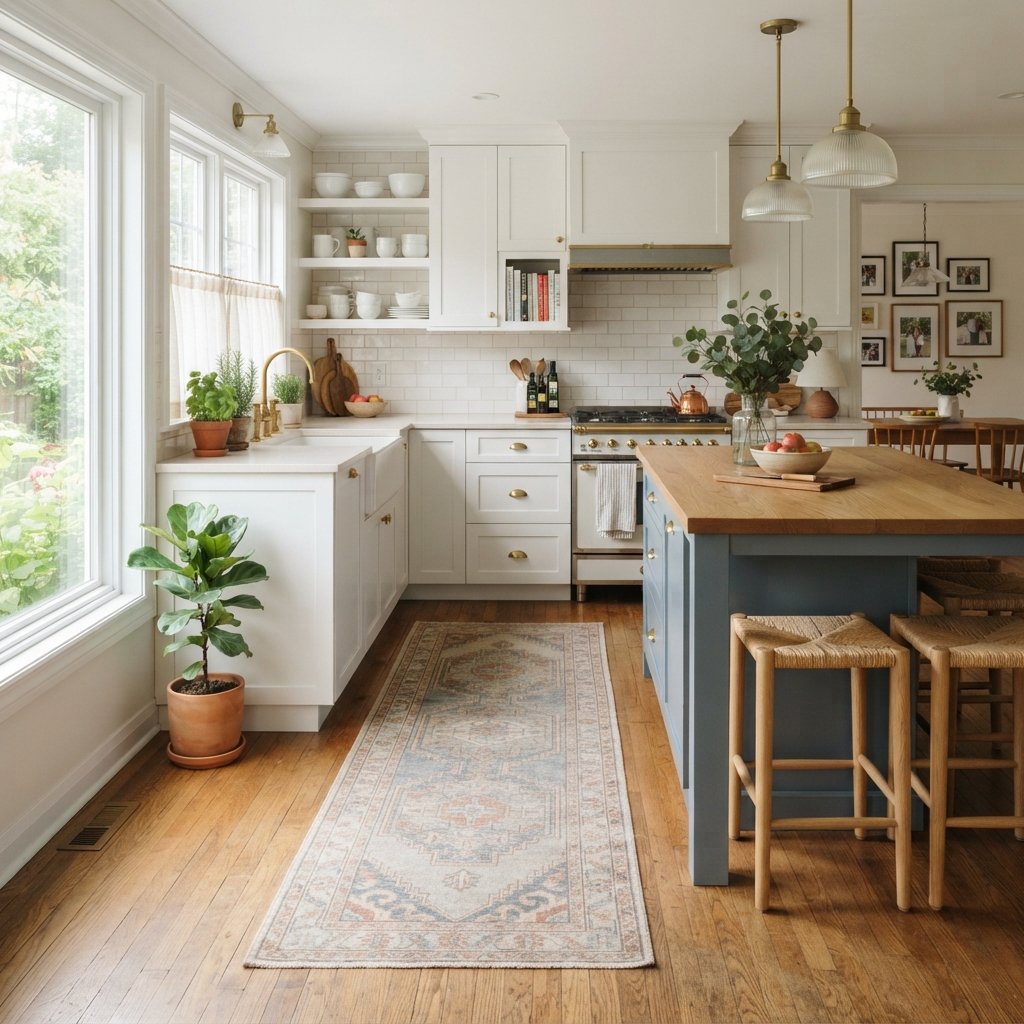
1. Paint the Kitchen Island
If you have an island, painting it is one of the most effective ways to break up a large amount of white.
The island is visually separate from the perimeter cabinets, so it naturally lends itself to a different color.
Consider:
- Muted blue
- Navy
- Sage green
- Olive
- Deep green
- Taupe
- Charcoal
A colorful island can become the focal point while allowing the rest of the cabinetry to remain white.
Before choosing paint, compare samples directly with the countertop, flooring, and cabinet white.
Cabinet painting also requires careful cleaning, preparation, priming where appropriate, and a coating suitable for cabinetry. Follow the product manufacturer’s preparation, application, drying, and curing instructions.
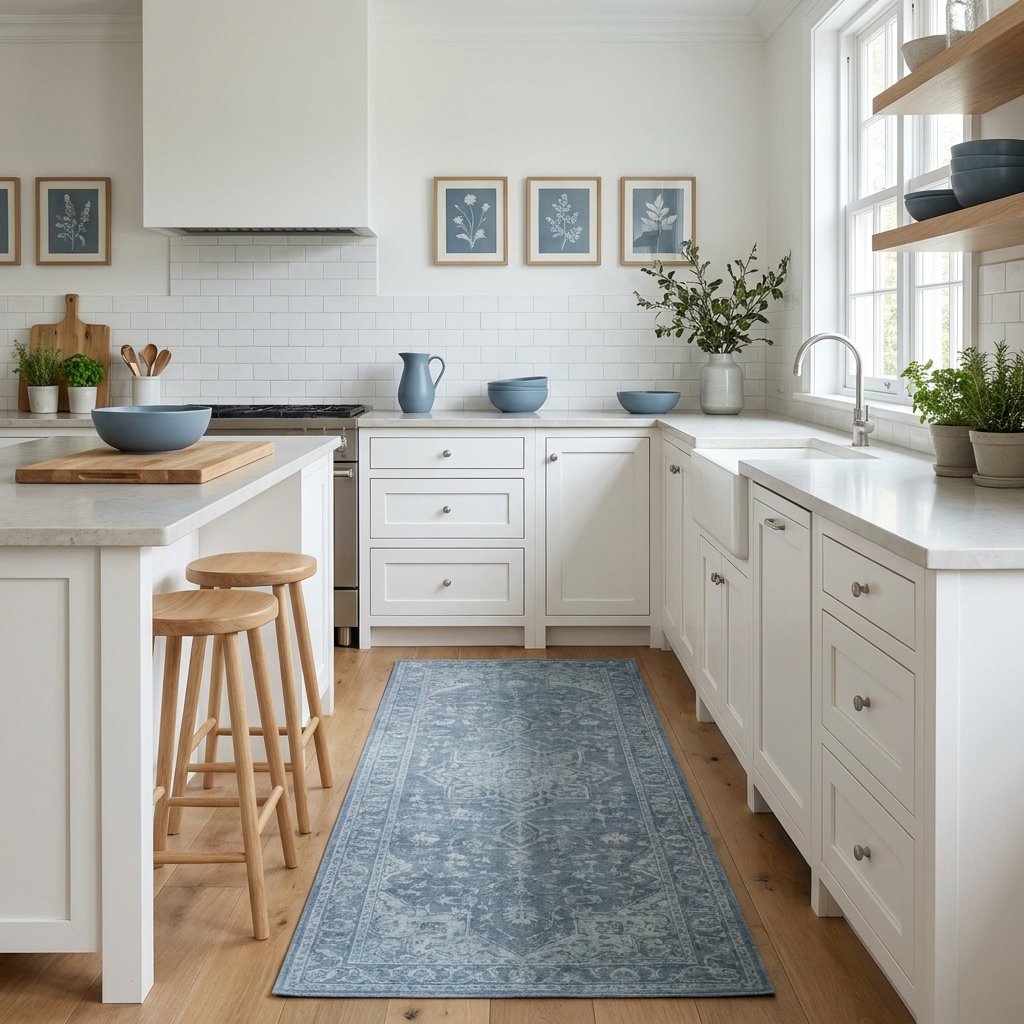
2. Add a Colorful Kitchen Runner
A runner is one of the easiest low-commitment ways to add color.
It can introduce several colors at once and give you a palette to repeat elsewhere.
Try a rug with:
- Blue
- Green
- Rust
- Burgundy
- Muted red
- Gold
A patterned rug can be particularly useful in an otherwise simple kitchen.
For practicality, choose something appropriate for a high-traffic food-preparation area and follow the manufacturer’s cleaning instructions. Use an appropriate rug pad or non-slip solution where needed to reduce movement and tripping hazards.
3. Bring in Natural Wood
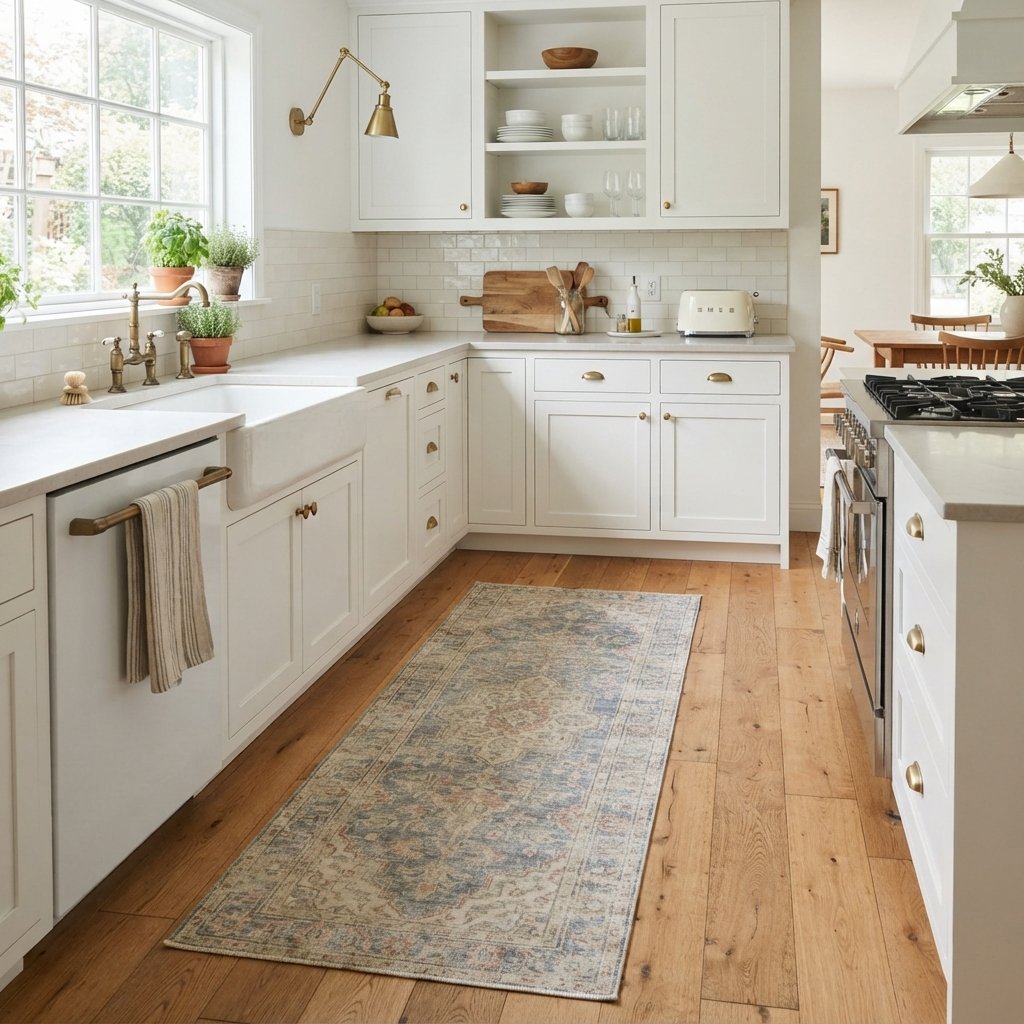
Wood isn’t technically a bright color, but it can completely transform a white kitchen.
It adds warmth and variation that keeps white surfaces from feeling sterile.
Bring wood into the room through:
- Counter stools
- Cutting boards
- Shelves
- Bowls
- Trays
- Furniture
You don’t need every wood element to match exactly.
A few related wood tones can make the kitchen feel more collected and natural.
4. Add Colorful Counter Stools
Counter stools occupy a surprising amount of visual space.
Instead of another white or neutral stool, consider:
- Blue upholstery
- Green-painted frames
- Cognac leather
- Natural woven seats
- Black with warm wood
Stools are particularly useful if you want noticeable color without changing permanent finishes.
Repeat the stool color once or twice elsewhere so it feels intentional.
5. Introduce Green With Plants
Greenery is one of the easiest colors to add to a white kitchen.
Try:
- Small potted herbs
- Trailing plants
- Potted tree
- Branches in a vase
- Realistic faux greenery
Plants also add organic shapes that contrast nicely with straight cabinet lines and hard countertop surfaces.
If you’re using live plants, choose varieties appropriate for the available light and conditions.
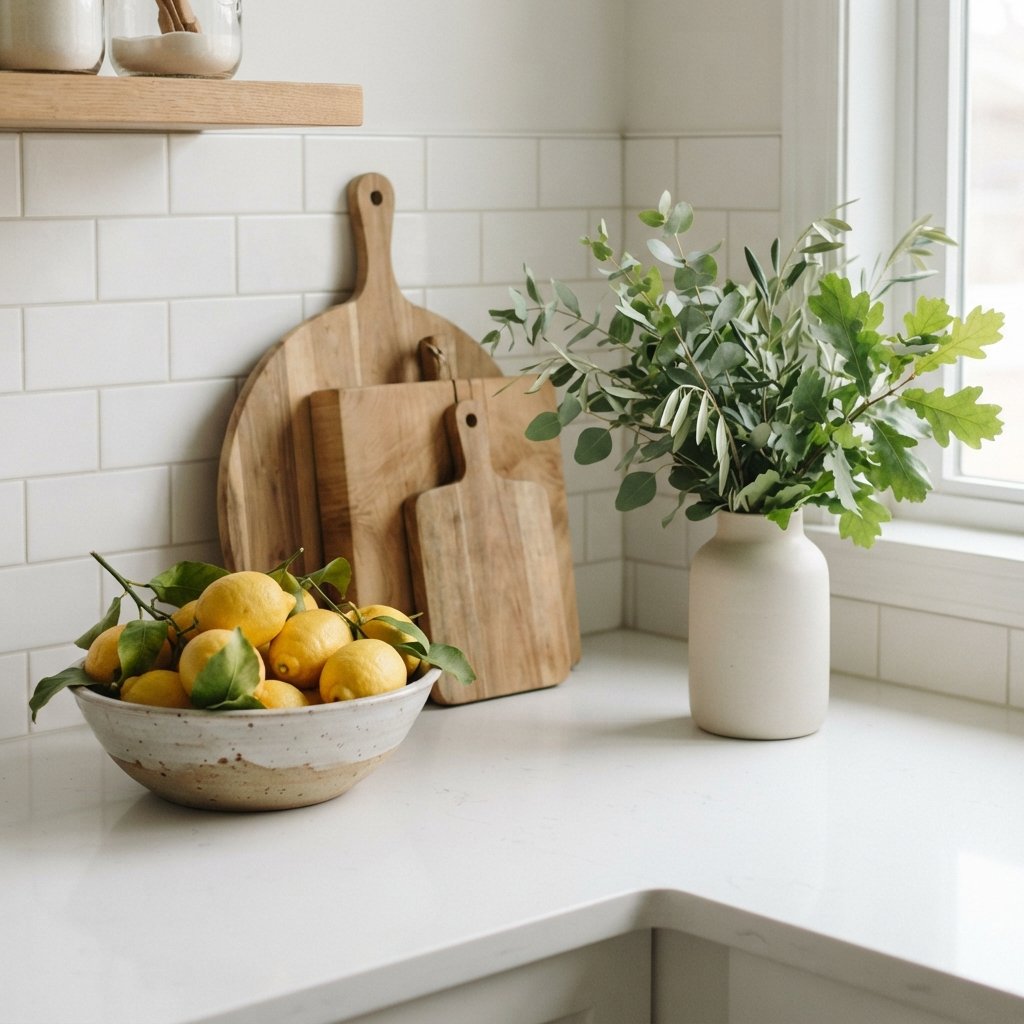
6. Display Colorful Fruit
Sometimes the simplest decorating ideas work.
A bowl of:
- Lemons
- Oranges
- Apples
- Pears
can bring natural color into the kitchen while remaining useful.
Use one attractive bowl rather than scattering several decorative fruit displays around the counters.
7. Add Color Through Artwork
Kitchens are often overlooked when it comes to artwork.
A framed print can introduce exactly the colors the room is missing.
Potential locations include:
- Small blank wall
- Above a coffee station
- Beside a pantry
- Open shelf
- Dining nook
Artwork is especially helpful because you can use it to establish a palette.
For example, a print containing blue, green, and rust can inspire the rug, towels, and accessories throughout the room.
8. Use Colorful Roman Shades
Window treatments can add both color and softness.
Consider a Roman shade in:
- Subtle stripe
- Floral
- Muted blue
- Sage
- Small-scale pattern
A patterned fabric works especially well when the rest of the kitchen has lots of solid white surfaces.
Choose window treatments appropriate for the window location and conditions, particularly around moisture, heat, and cooking areas.
9. Add Color With Café Curtains
Café curtains can introduce fabric without covering the entire window.
They can work especially well in casual kitchens.
Try:
- Blue stripe
- Green check
- Small floral
- Warm neutral pattern
Keep the pattern connected to colors elsewhere in the kitchen.
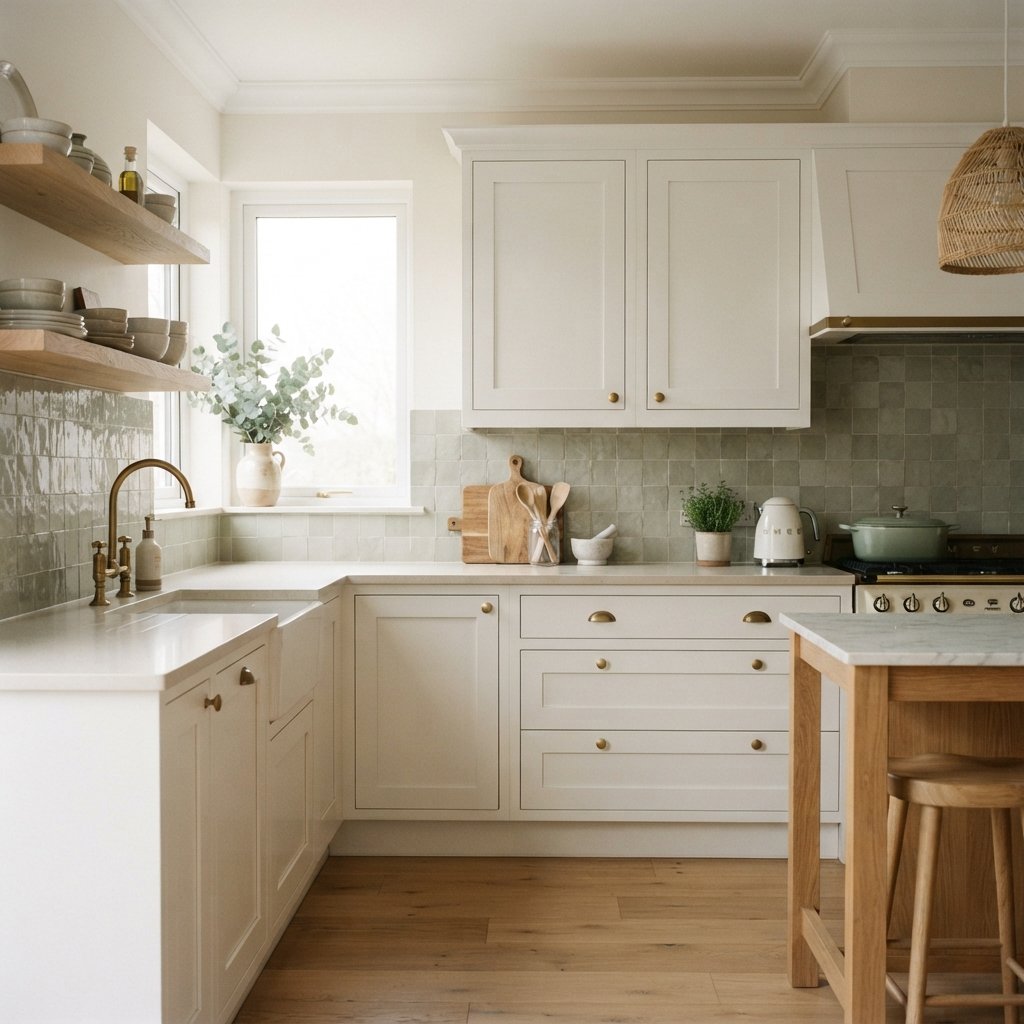
10. Add a Colorful Backsplash
If you’re ready for a more permanent change, the backsplash is an excellent place to introduce color.
Options include:
- Sage green
- Olive
- Dusty blue
- Navy
- Soft beige
- Terracotta
Colorful backsplash tile can completely change the personality of white cabinetry.
Bring physical samples home and compare them vertically against the wall, directly above the countertop.
11. Try a Soft Blue Backsplash
Blue is especially easy to combine with white.
A muted blue backsplash can create a fresh look without feeling overly colorful.
Pair it with:
White cabinets + dusty blue tile + light wood + pale countertops
For additional warmth, bring in woven texture or wood accessories.
12. Use Green for an Earthy Look
Green works naturally in kitchens because it connects beautifully with wood and stone.
Consider:
- Sage
- Olive
- Muted forest green
- Gray-green
You can introduce green through the backsplash, island, stools, artwork, or accessories.
A little green goes a long way against white cabinetry.
13. Paint the Walls
If your cabinets and backsplash are white, painted walls can create an easy layer of color.
Potential directions include:
- Soft blue
- Sage green
- Warm beige
- Pale greige
- Muted clay
The wall color should coordinate with the cabinet white rather than being chosen independently.
Place large paint samples directly beside the cabinetry and countertop.
Check them during the day and under your normal kitchen lighting.
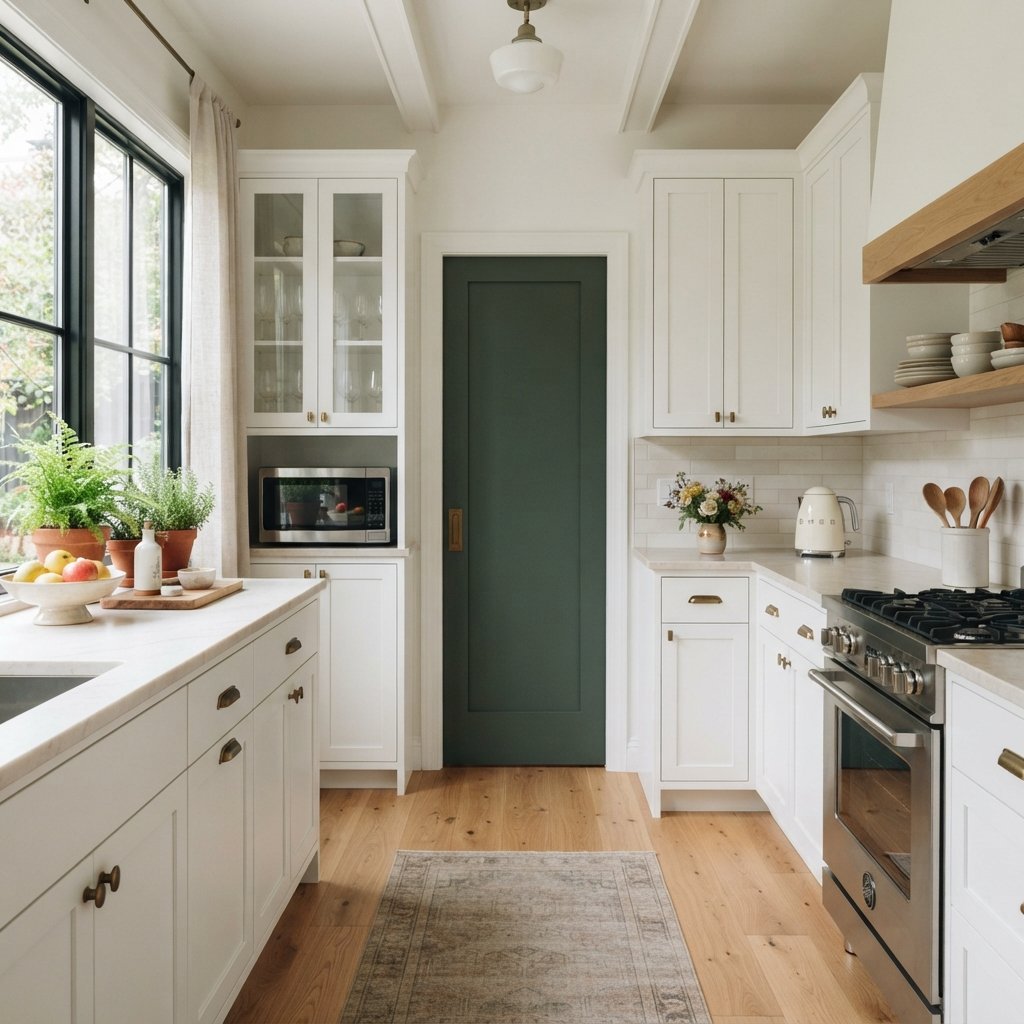
14. Paint a Pantry Door
If you’re not ready to paint cabinets, consider a smaller architectural feature.
A pantry door can become an accent.
Try:
- Deep green
- Dusty blue
- Black
- Warm taupe
This is a good way to introduce a stronger color without overwhelming the room.
15. Use Colorful Dishes
If you have glass-front cabinets or open shelves, dishes can become part of the decor.
Try displaying:
- Blue-and-white ceramics
- Green glassware
- Colored mugs
- Earthy pottery
Don’t buy dishes solely as decoration if you won’t use them.
Functional objects make kitchen styling easier to maintain.
16. Add Color With Cookware
A few attractive pieces of cookware can introduce color without adding clutter.
If you regularly keep a Dutch oven, kettle, or other item visible, its color can become part of the kitchen palette.
Choose one or two intentional pieces rather than filling the counters with appliances and cookware.
17. Change Your Kitchen Towels
Kitchen towels are one of the least expensive ways to experiment with color.
Try:
- Green stripe
- Blue check
- Small floral
- Rust
- Mustard
- Soft red
Because towels are easy to change, they also work well for seasonal color.
Use lighter colors in spring and summer, then introduce deeper tones during fall and winter if you enjoy changing your decor.
18. Bring in Warm Metal Finishes
Metal finishes aren’t the same as colorful paint, but they can add warmth and contrast to a white kitchen.
Depending on the existing style, you might use warm metal through:
- Cabinet hardware
- Lighting
- Faucet
- Decorative objects
Don’t change every metal simply because you want more warmth.
Mixed metals can work when they’re repeated intentionally.
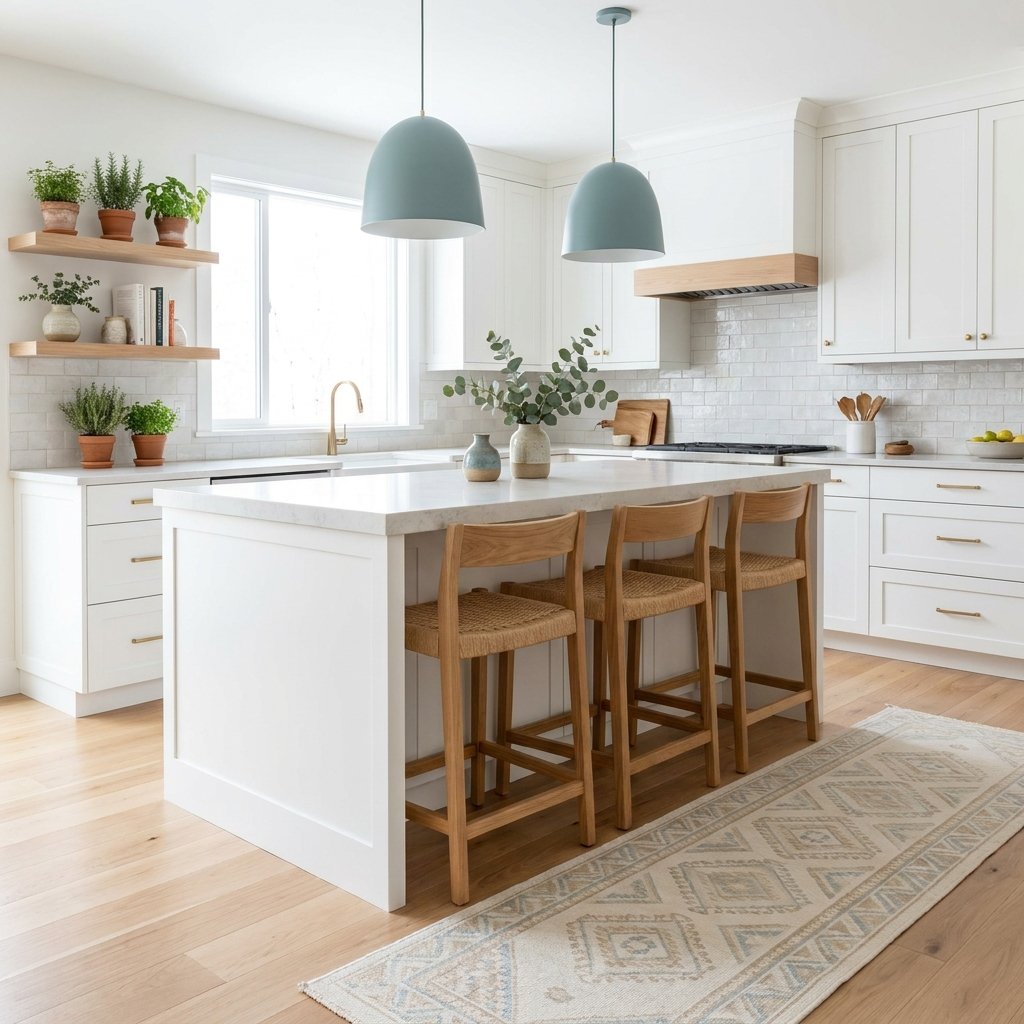
19. Add Color Through Pendant Lighting
Pendant lights provide an opportunity to introduce color or material at eye level.
Options include:
- Dark green shades
- Black
- Aged metal
- Woven shades
- Colored glass
Lighting should be selected primarily for function and appropriate installation, but it can also contribute significantly to the room’s palette.
Electrical fixtures should be installed according to manufacturer instructions and applicable electrical requirements. Use a qualified professional when appropriate.
20. Style Open Shelves With Color
If your kitchen has open shelving, use it to repeat the room’s accent color.
For example:
Blue rug + blue ceramic bowl + blue artwork
or:
Green backsplash + small plant + green pottery
The goal isn’t to fill every shelf with colorful objects.
A few repeated accents are enough.
Mix them with white dishes, wood, glass, and negative space.
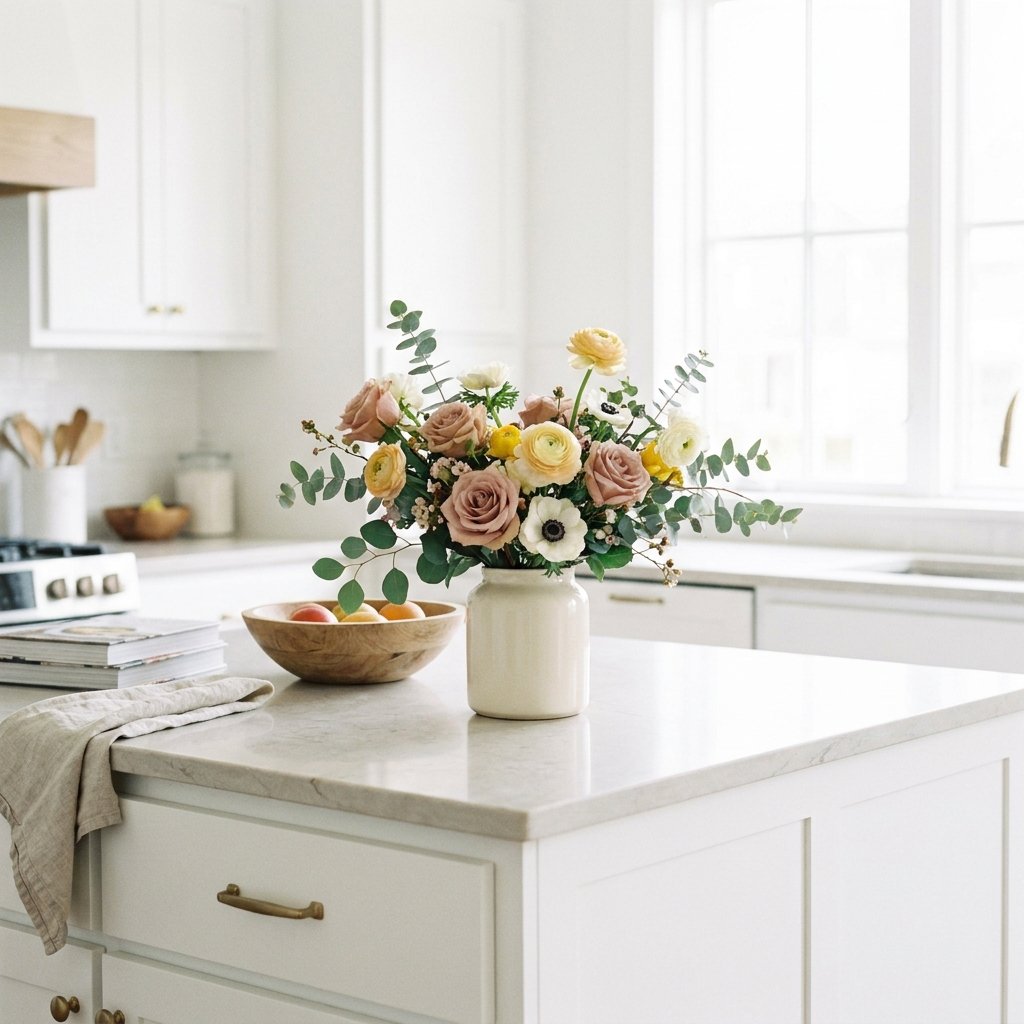
21. Add Color With Flowers and Branches
Flowers are a simple finishing touch.
Use:
- Tulips
- Hydrangea-style blooms
- Wildflower-style arrangements
- Leafy branches
- Seasonal stems
A large arrangement on an island can become a focal point.
If your kitchen is small, use a small vase near a window or in a corner instead.
The Best Colors to Add to a White Kitchen
Almost any color can work with white cabinetry, but the specific white matters.
White cabinets may lean:
- Warm
- Cool
- Creamy
- Gray
- Slightly blue
That influences which accent colors feel most natural.
Blue
Blue creates a fresh, classic combination.
Try dusty blue for softness or navy for stronger contrast.
Green
Green adds an organic feeling.
Sage and olive are particularly easy to combine with wood.
Burgundy
Deep muted red can create a rich accent, especially through rugs and textiles.
Terracotta
Terracotta adds warmth and works nicely with creamier whites and natural wood.
Yellow
A small amount of yellow can make a white kitchen feel cheerful.
Black
Black isn’t colorful, but it creates definition and can make other colors stand out.
How to Add Color Without Making the Kitchen Feel Busy
The easiest strategy is to choose one primary accent color.
For example:
White + blue + wood
Then add a few supporting neutrals.
You could use blue in:
- Runner
- Artwork
- Dish
- Window treatment
The items don’t need to match exactly.
In fact, slight variation usually looks more natural.
How to Choose an Accent Color
Look beyond the cabinets.
Your kitchen probably already contains color through:
- Flooring
- Countertops
- Backsplash
- Adjacent rooms
- Furniture
Use those finishes as your starting point.
If the floors are warm wood and the counters are creamy, sage or dusty blue may create a comfortable palette.
If your countertops contain dramatic gray veining, a muted blue or charcoal accent might relate more naturally.
Don’t choose color in isolation.
How Much Color Should You Add?
There’s no perfect percentage.
Instead, think about visual hierarchy.
The white cabinetry may remain the dominant element.
Your accent color can appear in a few noticeable places.
Wood, metal, and neutrals then support the palette.
If every object becomes colorful, the white cabinets stop providing the calm background that makes the accent color effective.
Adding Color to an All-White Kitchen
If your kitchen has white:
- Cabinets
- Countertops
- Backsplash
- Walls
start with temporary additions before renovating anything.
Try:
- A patterned runner.
- Wood stools.
- Colorful artwork.
- Greenery.
- A window treatment.
Live with those changes.
You may discover that the room simply needed texture and contrast—not a new backsplash.
How to Warm Up a White Kitchen
Sometimes the problem isn’t a lack of color.
It’s a lack of warmth.
In that case, focus on:
- Natural wood
- Woven materials
- Warm metals
- Cream
- Beige
- Brown leather
- Greenery
These additions can transform a stark white kitchen without introducing a strong accent color.
How to Add Color to a White Kitchen Without Painting
If you don’t want to paint anything, focus on movable decor.
Try:
- Runner
- Counter stools
- Artwork
- Window treatment
- Towels
- Plants
- Flowers
- Dishes
- Cookware
This is also a good approach if you’re renting or aren’t ready to commit to permanent changes.
How to Add Color to a Small White Kitchen
In a small kitchen, you don’t need lots of colorful objects.
One strong element can be enough.
Try:
White kitchen + patterned runner
or:
White kitchen + colorful Roman shade
or:
White kitchen + sage backsplash
Limiting the number of accents can make a compact kitchen feel intentional rather than cluttered.
How to Add Color to a Modern White Kitchen
Keep the palette restrained.
Choose one muted accent such as:
- Olive
- Deep blue
- Rust
- Burgundy
Then pair it with wood and black.
A modern kitchen often benefits from fewer, larger color moments instead of many small decorative accessories.
How to Add Color to a Farmhouse White Kitchen
Bring in color through materials that suit the casual style.
Try:
- Vintage-inspired runner
- Blue ceramics
- Green island
- Wood cutting boards
- Natural greenery
Let practical objects contribute to the decor.
How to Add Color to a Coastal White Kitchen
Blue is the obvious direction, but keep it subtle if you want a sophisticated coastal look.
Try:
- Dusty blue
- Blue-gray
- Soft green-blue
Combine it with:
- White
- Light oak
- Woven materials
- Natural greenery
You don’t need obvious beach-themed accessories.
Use the 3-Point Color Trick
If an accent color feels random, repeat it in roughly three areas of the room.
For example:
Blue runner + blue artwork + blue dish
The pieces don’t need to be identical.
The repetition simply helps the eye connect them.
This is especially helpful in a white kitchen because color stands out so easily.
Common Mistakes When Adding Color to a White Kitchen
Adding Too Many Accent Colors
Start with one dominant accent.
Buying Lots of Small Accessories
One colorful rug can make more impact than ten tiny decorative objects.
Ignoring Undertones
The cabinet white, countertop, flooring, and accent color all need to relate.
Forgetting Texture
Sometimes the kitchen needs wood and woven texture more than bright color.
Making Everything Match
Variation creates a more natural look.
Ignoring Adjacent Rooms
Open-plan spaces should feel connected.
Choosing Permanent Color Too Quickly
Try temporary accents before replacing tile or painting cabinetry.
Covering Counters With Decor
Keep work surfaces functional.
A Simple Formula for Adding Color
If you’re unsure where to start, use this combination:
White cabinets + natural wood + one accent color + greenery + small amount of dark contrast
For example:
White + oak + sage + plants + black
or:
White + walnut + dusty blue + greenery + charcoal
or:
White + light wood + burgundy + branches + black
It’s simple, flexible, and easy to adjust over time.
FAQ About Adding Color to a White Kitchen
How can I add color to an all-white kitchen?
Start with a colorful runner, artwork, greenery, window treatments, stools, towels, or flowers. If you want a more permanent change, consider painting the island or installing a colored backsplash.
What colors look good in a white kitchen?
Blue, green, burgundy, terracotta, yellow, black, and warm wood can all complement white cabinetry. The best choice depends on the undertone of the cabinets and the kitchen’s other finishes.
How can I warm up a white kitchen?
Add natural wood, woven materials, warm metals, cream, beige, greenery, and warm-colored textiles.
How do you add color to a white kitchen without painting?
Use rugs, artwork, counter stools, curtains, plants, dishes, cookware, towels, and flowers.
What color should I paint a white kitchen island?
Muted blue, navy, sage, olive, deep green, taupe, and charcoal are all useful options to explore. Compare samples with the cabinet white, flooring, and countertop before deciding.
What color backsplash works with white cabinets?
White cabinets can work with sage, blue, beige, taupe, terracotta, black, charcoal, or other compatible backsplash colors. The countertop should be a major factor in your choice.
How many accent colors should a kitchen have?
There’s no strict rule, but starting with one main accent color is an easy way to keep a white kitchen cohesive. Repeat that color in a few areas and support it with neutrals and natural materials.
How can I add color to a white kitchen on a budget?
Use items that are easy to change, such as towels, a runner, artwork, flowers, plants, and accessories. You can also move colorful items from other rooms before buying anything new.
Final Thoughts
Learning how to add color to a white kitchen doesn’t have to lead to an expensive renovation.
Start small.
Bring in a colorful runner.
Add natural wood.
Place greenery on the counter.
Hang artwork.
Change a window treatment.
Then step back and see what the room still needs.
If you want more impact, move on to a painted island, colorful backsplash, accent door, or statement lighting.
The most important thing is to use color intentionally.
Instead of filling the kitchen with lots of unrelated colorful accessories, choose one main color and repeat it in a few thoughtful places.
Combined with wood, texture, greenery, and the white cabinetry you already have, that small amount of color may be all your kitchen needs to feel warmer, more interesting, and much more like home.