

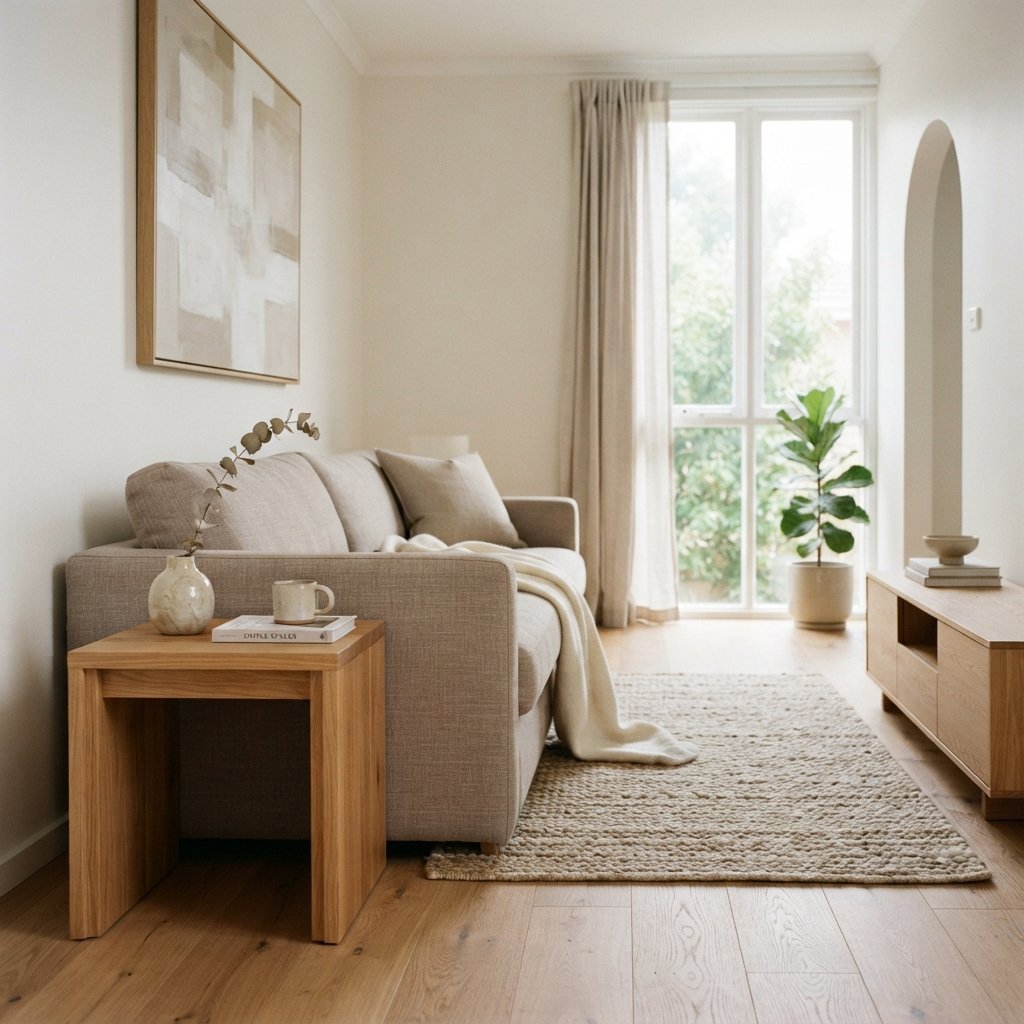
A minimalist living room doesn’t have to be stark, cold, or almost empty.
The most inviting minimalist spaces are simply intentional. They contain enough furniture to be comfortable, enough storage to function well, and enough personality to feel like a home—without being overwhelmed by things that aren’t useful or meaningful.
That’s an important distinction.
Minimalism isn’t about removing every pillow, painting everything white, and living with one lonely chair. It’s about reducing visual clutter and giving the things you love room to stand out.
That might mean choosing one substantial coffee table instead of several small accent pieces. It could mean closed cabinetry instead of overflowing open shelves. Or it might simply mean clearing unnecessary accessories from surfaces and creating a more cohesive color palette.
Whether you’re decorating from scratch or trying to simplify a room that feels busy, these minimalist living room ideas can help you create a space that’s calm, comfortable, practical, and still full of warmth.
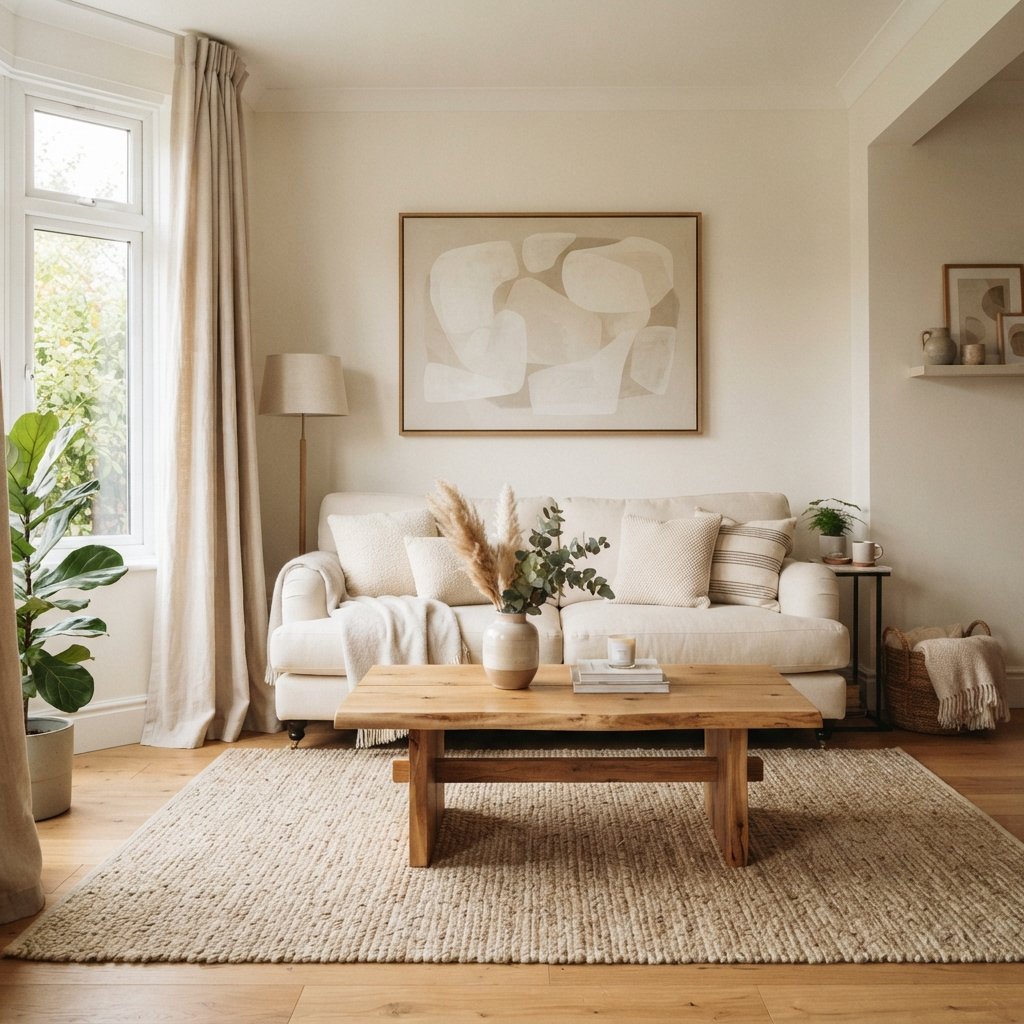
What Is a Minimalist Living Room?
A minimalist living room prioritizes function, simplicity, and intentional design.
Common elements include:
- Uncluttered surfaces
- Simple furniture shapes
- Limited color palette
- Thoughtful storage
- Fewer decorative accessories
- Open visual space
- Natural materials
- Functional layouts
But minimalist doesn’t necessarily mean monochromatic.
A minimalist room can include:
- Color
- Pattern
- Vintage furniture
- Artwork
- Plants
- Books
The difference is usually in how much you use and how intentionally everything is arranged.
1. Start by Removing Visual Clutter
Before buying anything, edit what’s already in the room.
Look at:
- Coffee table
- Side tables
- Media console
- Shelves
- Floor
- Sofa
Remove anything that doesn’t need to be there.
You don’t have to get rid of it permanently.
Move questionable items out of the room temporarily and see how the space feels.
Often, you’ll discover that you don’t need more decor—you need fewer competing pieces.
2. Decide What the Room Needs to Do
Minimalism works best when function comes first.
Ask how your living room is actually used.
Do you:
- Watch television?
- Read?
- Entertain?
- Play games?
- Have young children?
- Work from the sofa?
- Need toy storage?
Your room needs to support those activities.
A minimalist living room that looks beautiful but doesn’t provide enough seating or storage isn’t particularly successful.
3. Choose a Simple Color Palette
Limiting the number of dominant colors can immediately make a room feel calmer.
You might use:
Warm white + beige + natural wood
or:
Cream + taupe + black
or:
Soft gray + warm wood + green
or:
White + olive + brown
This doesn’t mean everything must match.
Instead, repeat a few related colors throughout the room.
4. Use Warm Neutrals Instead of Stark White
White is common in minimalist interiors, but it’s not required.
If you want the room to feel warmer, consider:
- Cream
- Warm white
- Mushroom
- Taupe
- Beige
- Greige
These colors create a soft backdrop while maintaining the quiet visual effect associated with minimalism.
Always sample paint in the actual room because natural and artificial light can significantly affect how a neutral appears.
5. Choose a Comfortable, Simple Sofa
The sofa is usually the largest piece of furniture in the living room.
Choose one that is comfortable first.
For a minimalist look, simple silhouettes often work well.
That could mean:
- Clean arms
- Simple upholstery
- Solid fabric
- Minimal decorative details
But don’t choose a low-profile sofa simply because it photographs well if it’s uncomfortable for your household.
Minimalist design should still support everyday life.
6. Don’t Overload the Sofa With Pillows
You don’t need eight throw pillows to make a sofa cozy.
Try two to four depending on the sofa size.
Use texture rather than lots of competing patterns.
For example:
Cream sofa + two textured beige pillows + one muted green pillow
can provide plenty of interest.
Keep enough room for people to actually sit down without moving a pile of pillows first.
7. Use Texture to Add Warmth
Texture becomes especially important when you’re working with a restrained color palette.
Layer materials such as:
- Linen
- Wool
- Cotton
- Bouclé
- Wood
- Woven fibers
- Stone
A room made entirely from smooth white surfaces can feel sterile.
A room with warm white walls, linen upholstery, a textured rug, and a wood coffee table can feel cozy even with very little decoration.
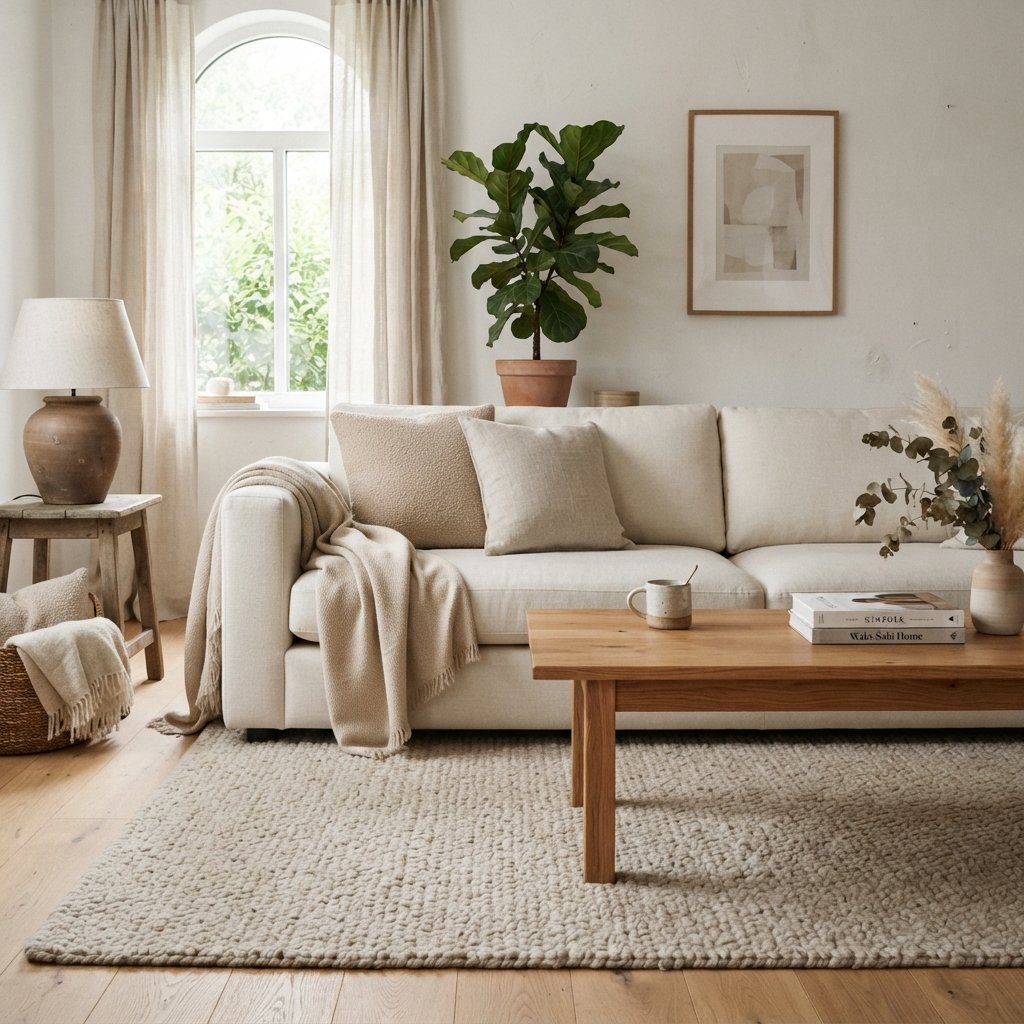
8. Choose One Substantial Coffee Table
A collection of small tables can make a room feel busier.
One appropriately scaled coffee table often creates a calmer visual anchor.
Consider:
- Wood
- Stone
- Glass
- Upholstered ottoman
Choose based on how you use the room.
If you have young children, for example, the shape, material, stability, and edges may matter more than achieving a particular minimalist aesthetic.
9. Keep the Coffee Table Styling Simple
A coffee table doesn’t need seven decorative objects.
Try:
Small stack of books + bowl
or:
Tray + vase
or:
One sculptural object
Leave plenty of empty surface.
You need somewhere to set a drink.
A useful table shouldn’t become a display shelf that can’t be used.
10. Choose Larger Decor Instead of Lots of Small Decor
Many tiny objects create more visual information than one substantial piece.
Instead of filling a console with ten accessories, try:
- One large lamp
- One bowl
- A few books
Instead of covering a wall with many unrelated pieces, you might choose one large artwork.
Larger pieces can create impact while keeping the overall room quieter.
11. Hang One Large Piece of Art
Large-scale artwork can be ideal for minimalist rooms.
It gives the eye somewhere to land without requiring a complicated gallery wall.
Choose something that relates to your color palette but still adds personality.
You might use:
- Abstract painting
- Landscape
- Photography
- Textile art
Mount artwork using hardware appropriate for the wall construction and weight.
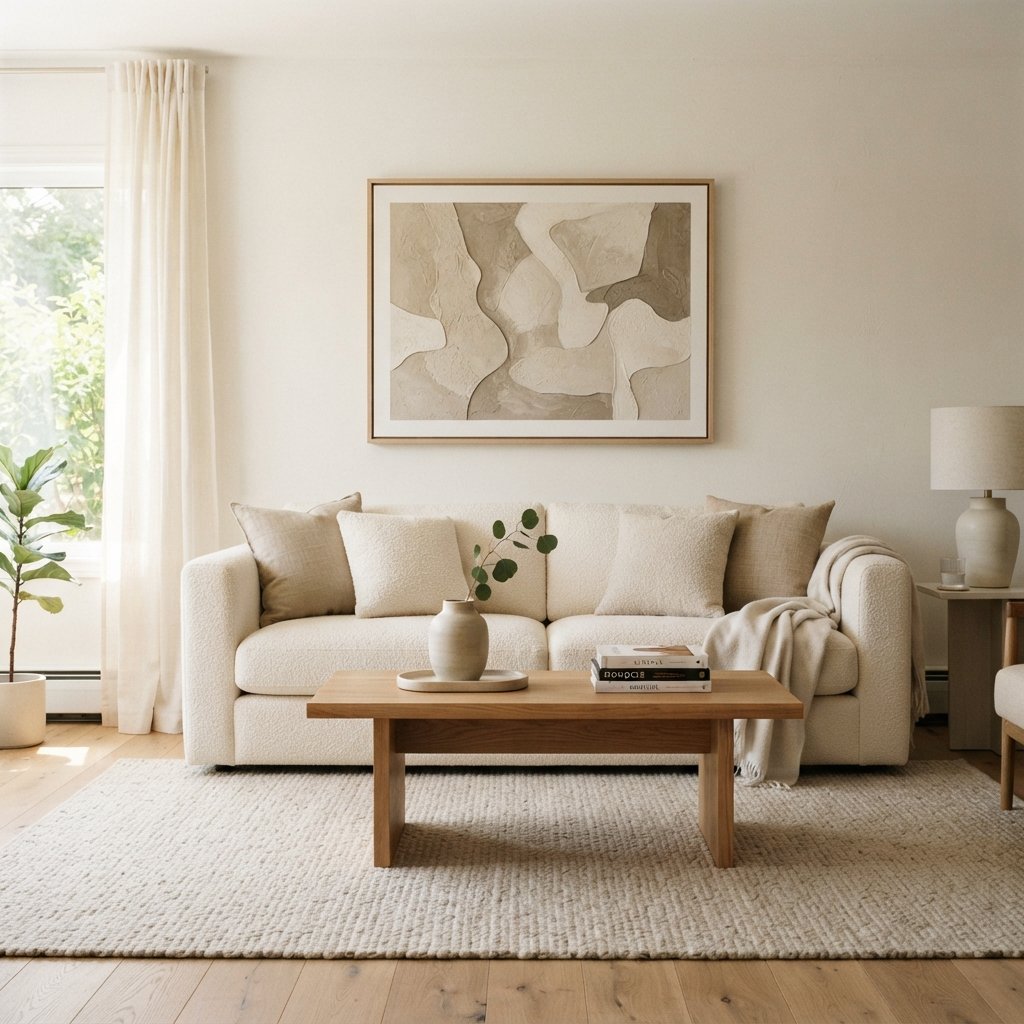
12. Keep Open Shelving Edited
Open shelves can work in minimalist rooms, but they require restraint.
Instead of filling every inch, create small groupings.
Try:
- Books
- Ceramic bowl
- Small framed art
- One plant
Then leave empty space.
The empty areas are part of the composition.
If you have many everyday items to store, closed cabinets may be a better choice.
13. Use Closed Storage
Hidden storage is one of the easiest ways to maintain a calmer living room.
Closed cabinetry can hold:
- Toys
- Games
- Electronics
- Cords
- Remotes
- Extra blankets
- Books
- Craft supplies
Choose storage based on your household.
A family living room might need much more hidden storage than a formal sitting room.
That’s completely compatible with minimalist decorating.
14. Hide Electronics Where Practical
Televisions, routers, game systems, speakers, and cables can quickly create visual clutter.
You don’t necessarily need to hide the television.
Instead, simplify the area around it.
Try:
- Simple media console
- Closed cabinets
- Organized cords
- Minimal decor
Don’t block required ventilation around electronics, and follow manufacturer clearance and installation instructions.
15. Manage Cords
Even a beautifully decorated room can feel messy when cords are hanging everywhere.
Use appropriate cable-management products to organize:
- Television cords
- Lamp cords
- Chargers
- Internet equipment
Never overload electrical outlets or power strips.
Keep cords positioned so they don’t create tripping hazards, and use electrical products according to their ratings and manufacturer instructions.
16. Bring in Natural Wood
Wood is one of the easiest ways to make minimalist decor feel warmer.
Use it through:
- Coffee table
- Side table
- Console
- Cabinet
- Picture frames
You don’t have to use the exact same wood tone throughout the room.
Related warm woods can create a collected appearance without adding visual clutter.

17. Add One or Two Plants
Plants can introduce color and organic shape without requiring lots of accessories.
Try:
- One floor plant
- Small plant on a side table
- Simple branch arrangement
Don’t turn every surface into an indoor garden if your goal is visual simplicity.
And if you have children or pets, verify that plants are appropriate for your household before bringing them into the space.
18. Keep Window Treatments Simple
Window treatments can make a big difference in a minimalist room.
Consider:
- Simple curtain panels
- Roman shades
- Roller shades
- Woven shades
If you want curtains to blend into the room, choose a color similar to the walls.
Mount hardware securely and according to the weight of the window treatment and wall construction.
19. Use a Large Area Rug
A properly scaled rug can visually unify the seating area.
A tiny rug floating beneath the coffee table often makes the room feel fragmented.
The ideal size depends on your furniture arrangement and room dimensions.
Before purchasing, use painter’s tape to mark the rug dimensions on the floor.
This gives you a much better sense of scale than guessing from a product photo.
20. Choose Lighting With Simple Shapes
Minimalist lighting doesn’t have to be boring.
Look for fixtures with:
- Clean lines
- Simple shades
- Natural materials
- Sculptural shapes
Layer your lighting rather than relying entirely on one overhead fixture.
You might use:
Ceiling light + floor lamp + table lamp
This makes the room much more comfortable in the evening.
Hardwired electrical work should follow applicable requirements and be completed by a qualified professional where appropriate.
21. Leave Some Space Empty
One of the hardest parts of minimalist decorating is knowing when to stop.
An empty corner doesn’t automatically need:
- Plant
- Basket
- Chair
- Floor lamp
- Pedestal
An empty wall doesn’t always need artwork.
And every shelf doesn’t need an accessory.
Negative space allows the furniture and objects you do choose to stand out.
How to Make a Minimalist Living Room Cozy
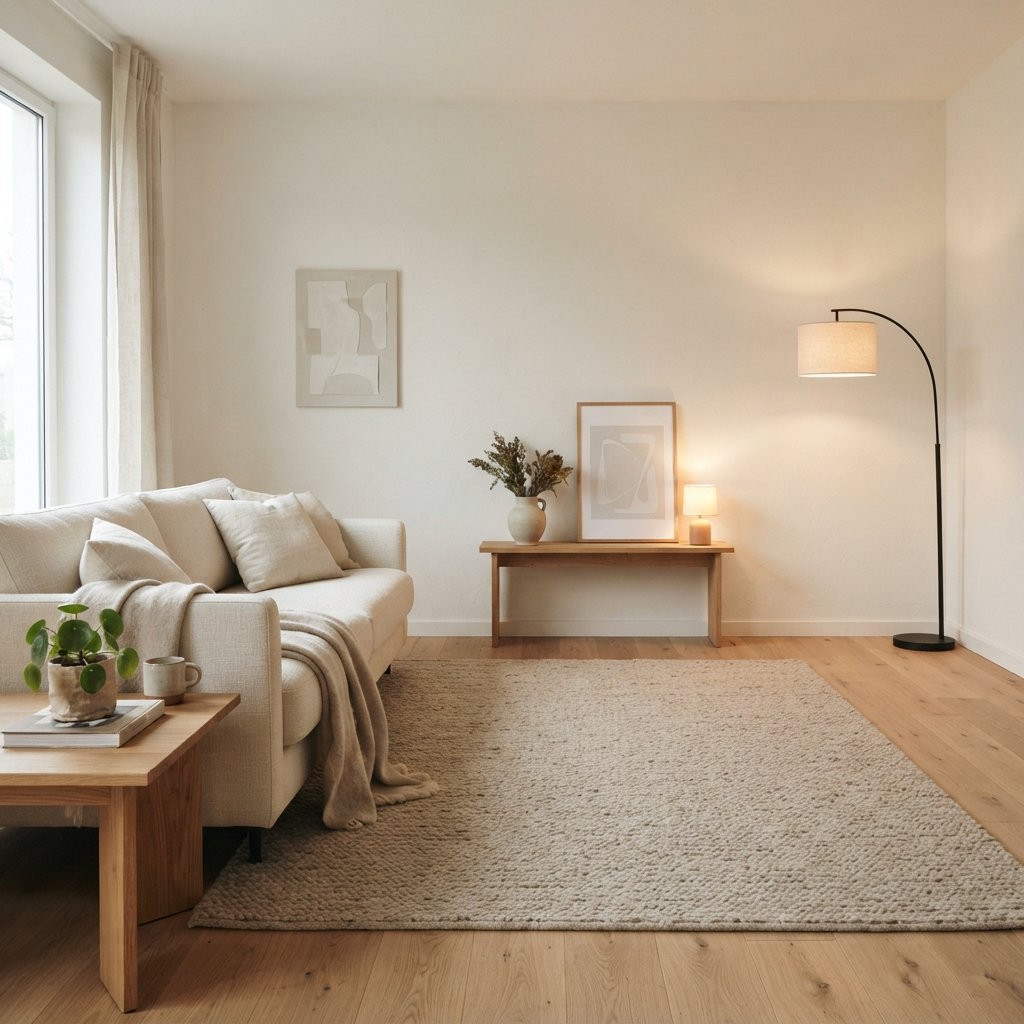
The easiest way to make minimalism cozy is through texture and warm materials.
Try combining:
- Warm paint color
- Wood
- Textured rug
- Linen
- Soft upholstery
- Warm lighting
Then add a small amount of personality through:
- Art
- Books
- Plants
- Handmade pottery
- Meaningful objects
Cozy doesn’t require clutter.
Minimalist Living Room Ideas for Small Spaces
Minimalism can work particularly well in a small living room because reducing unnecessary furniture improves circulation.
Start with the essentials.
You may only need:
- Sofa
- Coffee table or ottoman
- One side table
- Lighting
- Media/storage unit
Avoid filling every wall with furniture.
Choose pieces that are appropriately scaled to the room rather than assuming small spaces need lots of tiny furniture.
Sometimes fewer medium-size pieces make a room feel calmer than many small ones.
Small Minimalist Living Room With a TV
A television can absolutely work in a minimalist room.
Keep the area around it restrained.
A simple setup might include:
TV + low media cabinet + one decorative object
If you mount a television, use mounting hardware appropriate for the television, mount, wall construction, and weight, and follow manufacturer instructions. Get professional installation help when needed.
Minimalist Living Room With Kids
Minimalism and family life aren’t incompatible.
You just need storage.
Use closed cabinets, baskets, or drawers for:
- Toys
- Art supplies
- Games
- Books
Create realistic limits based on available storage.
The goal isn’t to make it look as though children don’t live there.
It’s to make cleanup straightforward.
Minimalist Living Room With Pets
Choose materials based on your actual pets.
Consider:
- Washable textiles
- Durable upholstery
- Practical rug materials
- Easy-to-clean surfaces
A beautiful white sofa isn’t minimalist if you spend your life trying to protect it from the people and animals who use the room.
Practicality matters.
Warm Minimalist Living Room Ideas
If you love minimalism but dislike cold contemporary interiors, focus on warmth.
Try a palette of:
Cream + camel + brown + wood
or:
Warm white + taupe + olive
Then use black sparingly for contrast.
Natural textures can provide much of the visual interest without adding more colors.
Minimalist Living Room With Color
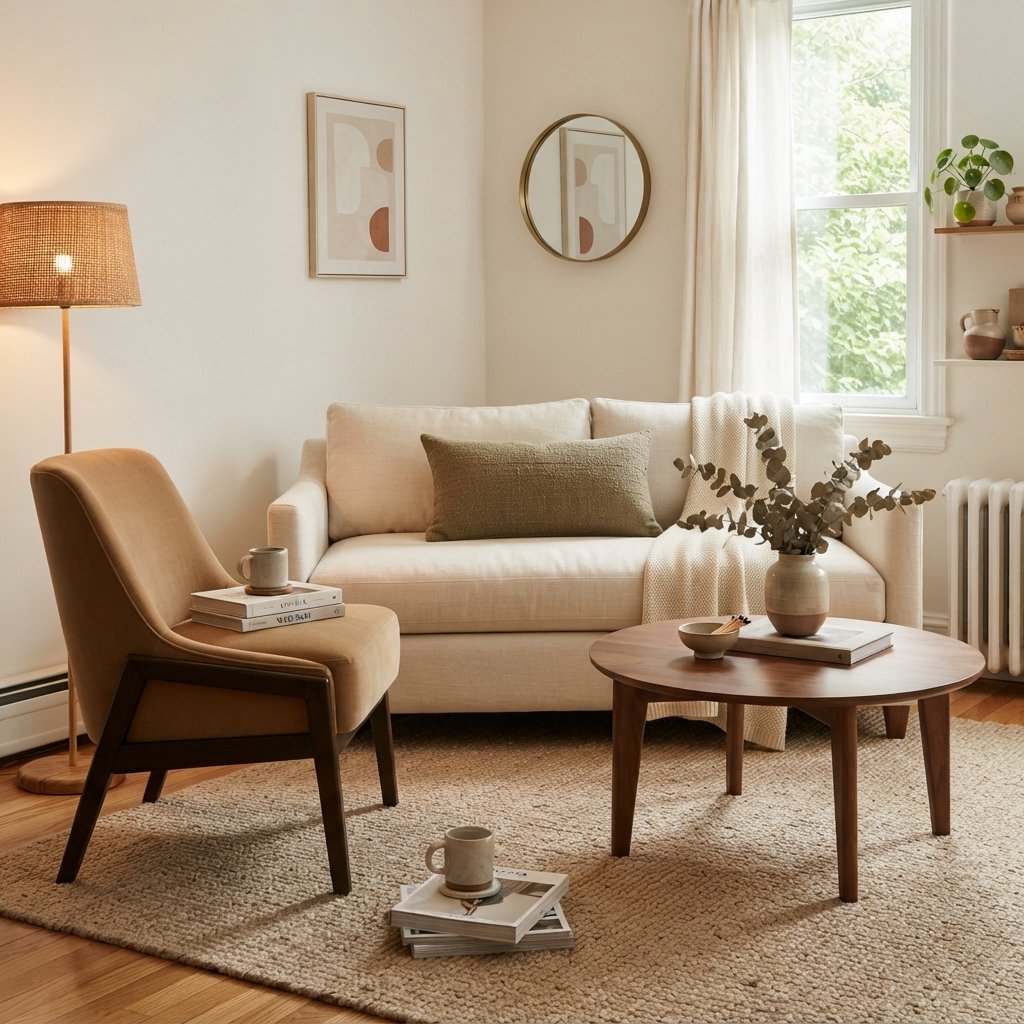
Minimalist doesn’t mean beige.
You can use color while keeping the room visually calm.
Choose one main accent color.
For example:
Green
Use olive pillows, artwork, and a plant.
Blue
Try a muted blue chair or large artwork.
Terracotta
Use one earthy pillow, pottery, or art piece.
Burgundy
Add a deep burgundy chair or throw for richer contrast.
The room can remain minimalist because you’re limiting the number of objects, not eliminating color.
Minimalist Living Room Wall Decor
Instead of decorating every wall, choose a focal point.
You might use:
- Large artwork
- Oversized mirror
- Textile hanging
- Small curated gallery
If you create a gallery wall, keep some consistency through color, subject matter, or frames so it doesn’t become visually chaotic.
Minimalist Living Room Fireplace Ideas
A fireplace naturally creates a focal point.
Keep the mantel simple.
Try:
One large artwork + one small object
or:
Large mirror + two understated accessories
You don’t have to line the mantel with decor.
If the fireplace is used, keep decorative objects, textiles, furniture, and combustible materials appropriately separated according to the fireplace manufacturer’s instructions and applicable safety requirements.
Minimalist Living Room Bookshelf Ideas
You don’t need to style a bookshelf until it barely holds books.
Books are useful and decorative on their own.
Group them naturally.
Then add only a few objects such as:
- Ceramic vase
- Bowl
- Framed art
- Small plant
If the shelf still feels busy, remove accessories before removing the books you actually use.
Minimalist Living Room Ideas on a Budget
You may be able to make the room feel more minimalist without buying anything.
Start by:
- Removing unnecessary accessories.
- Clearing the coffee table.
- Editing throw pillows.
- Organizing cords.
- Rearranging furniture.
- Consolidating storage.
- Moving decor between rooms.
Then identify what’s actually missing.
Maybe the room needs one large piece of art.
Maybe it needs closed storage.
Maybe it needs a better lamp.
Spend money only after you’ve simplified what you already have.
How to Declutter a Living Room for a Minimalist Look
Work one category at a time.
Coffee Table
Remove everything, then add back only what you want.
Sofa
Reduce pillows and throws.
Shelves
Remove accessories, then rebuild each shelf with fewer objects.
Media Cabinet
Organize electronics and cables.
Floor
Remove baskets, stools, and small tables that aren’t serving a purpose.
Walls
Ask whether every piece of artwork needs to remain.
You don’t need to declutter the entire house before improving one room.
Start here.
How to Make Minimalist Decor Feel Personal
Minimalist rooms sometimes feel generic because the homeowner has removed everything meaningful along with the clutter.
Keep pieces that tell your story.
That might be:
- Favorite artwork
- Travel object
- Family photograph
- Handmade ceramic
- Vintage furniture
- Books you love
You don’t need many.
A few meaningful objects have more impact when they’re not surrounded by dozens of unrelated accessories.
Common Minimalist Living Room Mistakes
Removing Too Much
The room still needs to function.
Buying Everything in White
Minimalism isn’t a color scheme.
Ignoring Texture
A limited palette needs material variation.
Choosing Looks Over Comfort
The sofa and chairs should be enjoyable to use.
Using Furniture That’s Too Small
Tiny furniture can make a room feel fragmented.
Leaving Clutter in Plain Sight
Closed storage can help.
Adding Too Many Small Accessories
Choose fewer, larger pieces.
Forgetting Lighting
A single ceiling fixture can make the room feel flat.
Hiding All Personality
Minimal doesn’t have to mean anonymous.
Filling Empty Space
Sometimes the empty space is exactly what the room needs.
FAQ About Minimalist Living Rooms
What should be in a minimalist living room?
Include whatever your household needs to comfortably use the space. Typically that means seating, a table or surface, lighting, and appropriate storage. Everything else can be added intentionally.
What colors work best in a minimalist living room?
Warm white, cream, beige, taupe, gray, brown, black, muted green, and other restrained colors can all work. Minimalism doesn’t require a neutral-only palette.
How do I make my living room minimalist?
Start by removing unnecessary visual clutter. Simplify surfaces, reduce accessories, organize cords, create closed storage, and make sure every major piece of furniture serves a purpose.
How do you make a minimalist living room cozy?
Use warm colors, wood, layered lighting, soft upholstery, textured rugs, linen, plants, and a few meaningful decorative pieces.
Can a minimalist living room have a TV?
Yes. Keep the media area simple and organize electronics and cables.
Can minimalist rooms have rugs?
Absolutely. A large rug can unify the furniture arrangement while adding softness and texture.
Can you use patterns in minimalist decor?
Yes. Use them selectively. One patterned rug, pillow, or artwork can add interest without making the room visually busy.
Does minimalist mean getting rid of everything?
No. The goal is intentionality, not emptiness. Keep what you need and what you genuinely enjoy.
Final Thoughts
The best minimalist living room ideas aren’t about creating an empty room.
They’re about creating a room with less visual noise and more intention.
Start with function.
Make sure you have comfortable seating, useful surfaces, good lighting, and enough storage for the way your household actually lives.
Then simplify.
Clear unnecessary objects from the coffee table.
Reduce the number of throw pillows.
Organize the cords.
Use closed storage for the things you don’t want on display.
Choose one substantial piece of artwork instead of filling every wall.
And don’t be afraid to leave a corner empty.
Once the clutter is reduced, focus on warmth.
Natural wood, textured fabrics, soft rugs, warm paint colors, plants, and layered lighting can make a minimalist room feel every bit as comfortable as a more heavily decorated one.
Most importantly, keep some personality.
Minimalism shouldn’t erase the people who live in the house.
Display the painting you love.
Keep the vintage table.
Put your favorite books on the shelf.
Use color if it makes you happy.
The goal isn’t to own the fewest things possible.
It’s to create a living room where the furniture, colors, textures, and objects you’ve chosen have enough room to be appreciated—and where you have enough room to actually live.

