

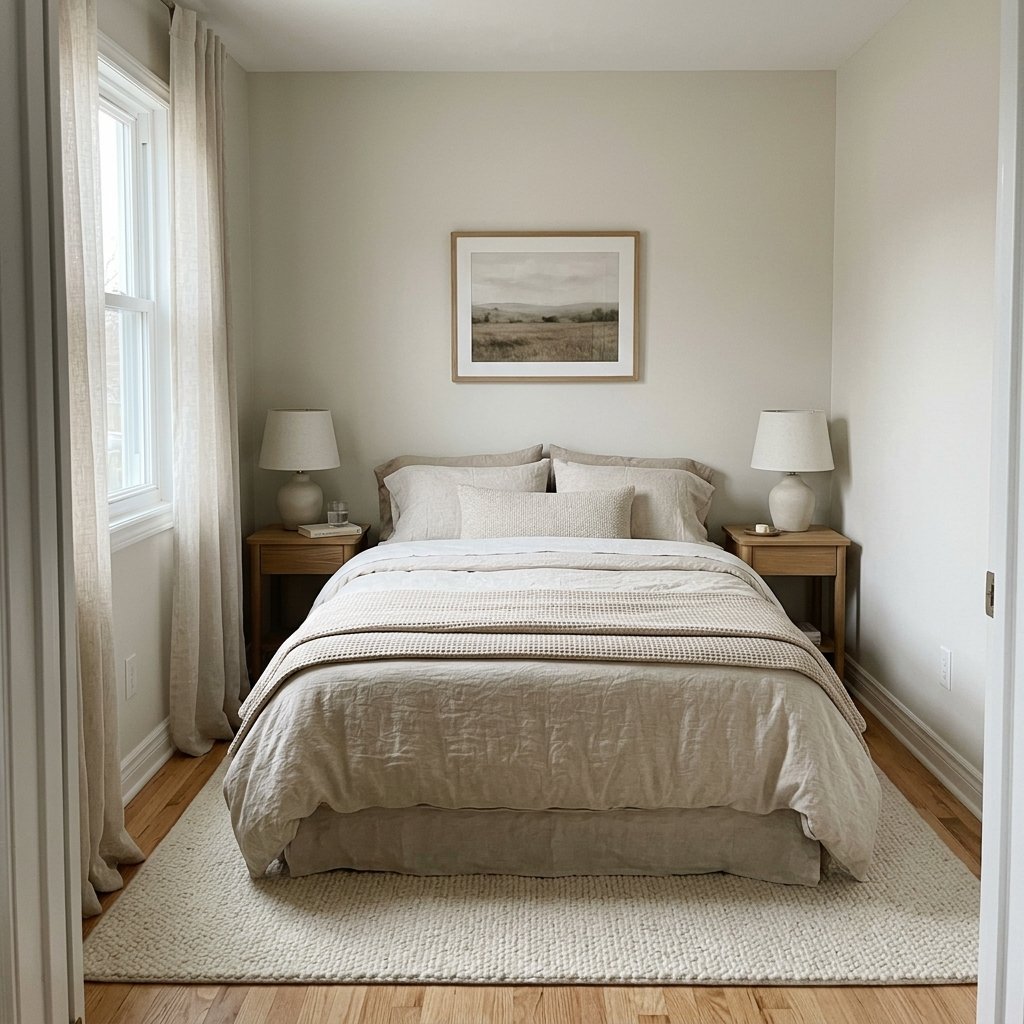
A small master bedroom makeover before and after can be surprisingly dramatic without changing the size of the room.
The biggest improvements often come from fixing the things that make a small bedroom feel crowded in the first place: furniture that’s too bulky, poor lighting, undersized rugs, awkward curtain placement, visual clutter, and a color palette that doesn’t feel connected.
You don’t necessarily need more square footage.
You need the existing square footage to work harder.
For this makeover approach, the goal is a bedroom that feels calmer, brighter, more comfortable, and visually larger while still having enough warmth and personality to feel finished.
And because a before-and-after keyword naturally suggests a real renovation story, one important note: the ideas below are structured as a complete makeover plan and reveal without claiming a specific personal renovation that hasn’t been documented.
Here’s how to take a small primary bedroom from cramped and unfinished to comfortable, layered, and pulled together.

The Before: Why a Small Bedroom Can Feel Even Smaller
A bedroom doesn’t need to be objectively tiny to feel cramped.
Often, several small decorating decisions combine to visually shrink the room.
The “before” version of a typical small bedroom might have:
- Oversized furniture
- Matching bulky bedroom set
- Small area rug
- Short curtains
- Too many small accessories
- Poor bedside lighting
- Furniture blocking pathways
- Cluttered dresser
- Several unrelated colors
- Bed pushed awkwardly into the room
None of these problems requires moving a wall.
That makes a small bedroom one of the best rooms for a decorating makeover.
Step 1: Start With the Furniture Layout
Before choosing paint, pillows, or artwork, figure out the layout.
In most bedrooms, the bed is the largest piece of furniture and should determine everything else.
Ask:
- Where is the longest uninterrupted wall?
- Where are the windows?
- Which doors need clearance?
- Where are the outlets?
- Can both people comfortably get into bed?
- Is there enough room to open drawers and closets?
- Is there a clear path through the room?
Sometimes the existing bed position is already correct.
Don’t move furniture just for the sake of creating a dramatic makeover.
The best layout is the one that makes the room easier to use.
Step 2: Make the Bed the Focal Point
In a small bedroom, creating one strong focal point can actually make the room feel calmer.
Usually, that focal point should be the bed.
Instead of scattering attention around the room, create a clear composition:
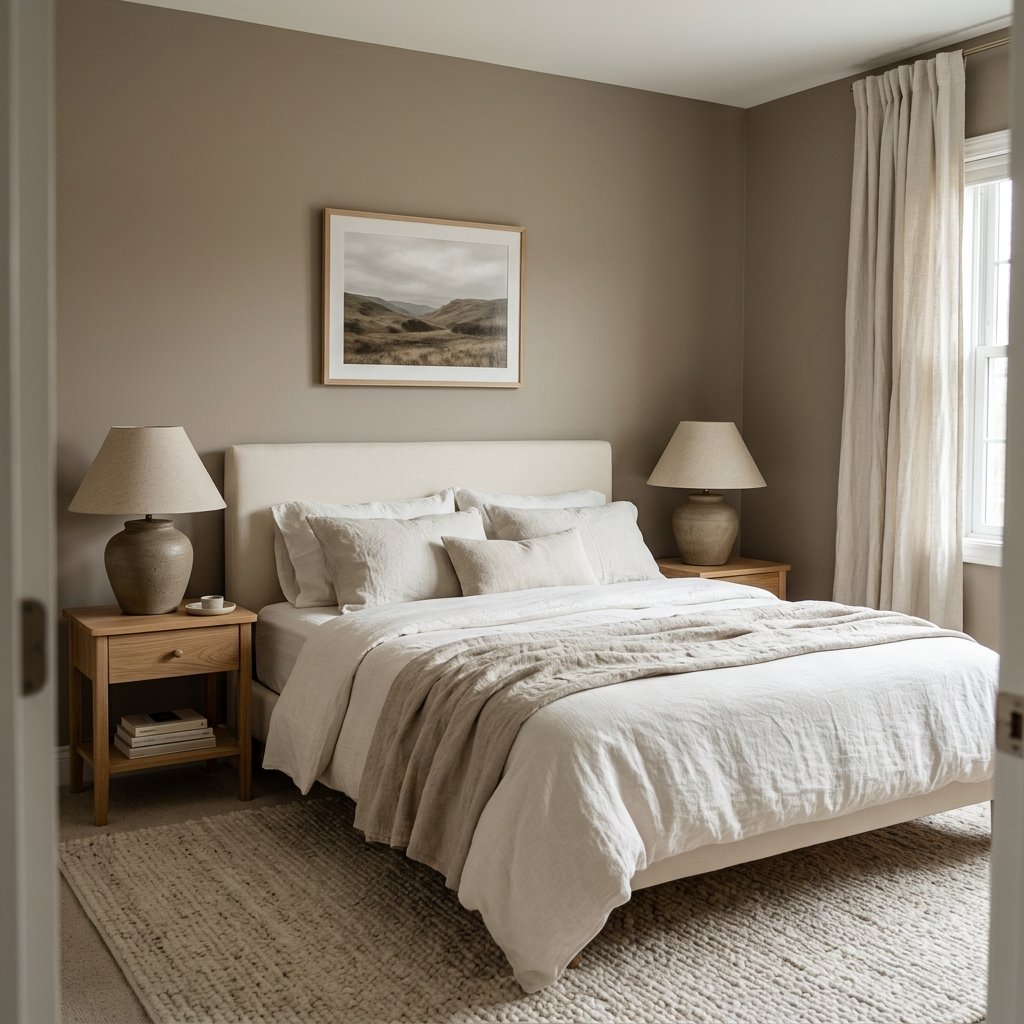
Bed + nightstands + lamps + artwork
That gives the eye somewhere to rest.
A simple upholstered or wood bed often works beautifully because it provides presence without excessive visual bulk.
If you’re keeping an existing bed, you may only need new bedding and better nightstand styling to create the same effect.
Step 3: Choose a Calm Color Palette
Small bedrooms can handle color.
They don’t automatically need to be white.
But a limited palette helps prevent the room from feeling visually chaotic.
A warm neutral combination might include:
- Warm white
- Mushroom
- Cream
- Taupe
- Natural wood
- Muted green
Or try:
Blue-gray + cream + medium wood + brown
For something moodier:
Olive + cream + walnut + brass
The important part isn’t choosing the lightest possible color.
It’s creating consistency.
Step 4: Paint the Walls
Paint can make a major difference in a bedroom makeover because it creates a fresh background for everything else.
For a small room, consider:
- Warm white
- Cream
- Pale mushroom
- Light greige
- Muted sage
- Soft blue-gray
Don’t choose paint based only on an online photograph.
Test samples in the actual bedroom and compare them with the flooring, furniture, and bedding.
Check them in the morning, afternoon, and evening.
A bedroom is often used most under artificial light, so make sure you like the color with the lamps on too.
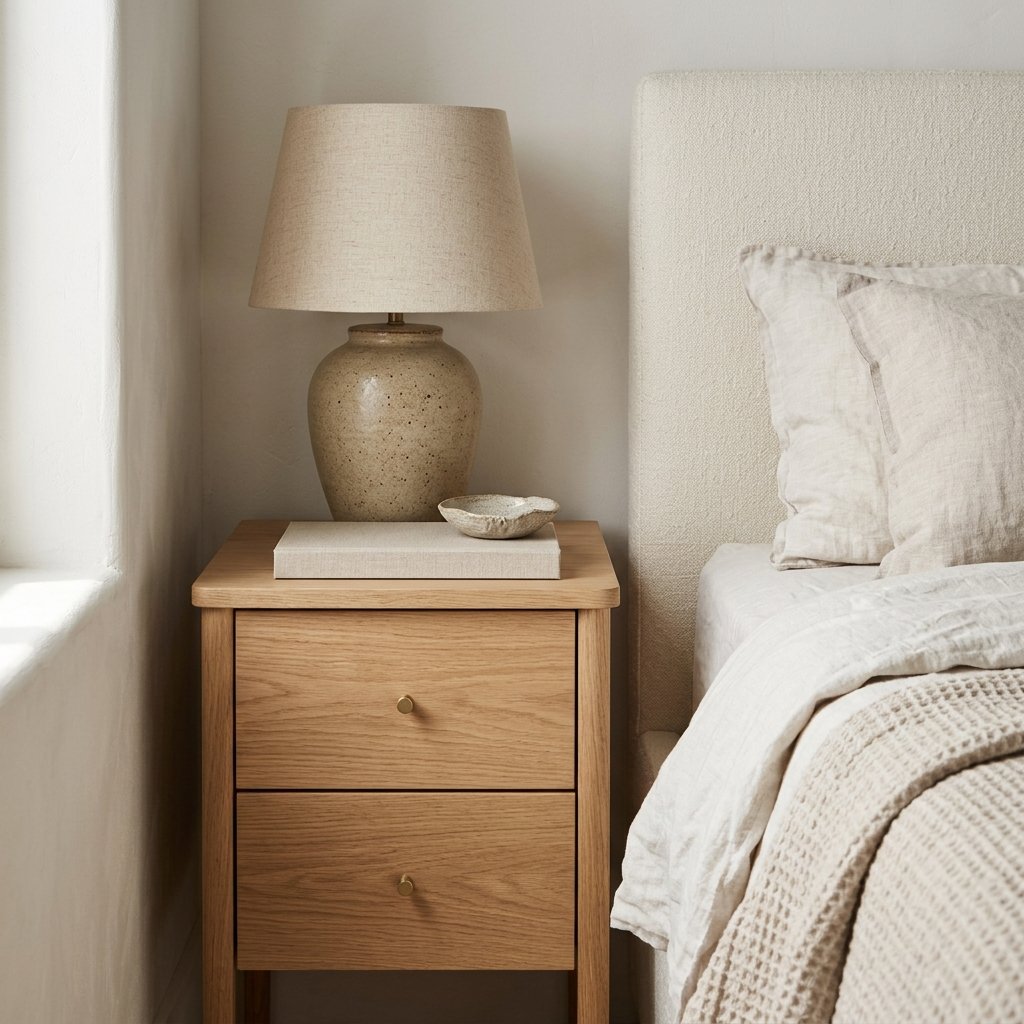
Step 5: Replace Bulky Nightstands With Better-Scaled Pieces
One of the easiest ways to gain visual space is to reconsider the nightstands.
Large nightstands can overwhelm a small bedroom.
But don’t automatically choose something tiny either.
A nightstand still needs to function.
Look for enough surface area for:
- Lamp
- Phone
- Water
- Book
Possible space-saving options include:
- Narrow nightstands
- Small drawer chests
- Wall-mounted nightstands
- Compact side tables
If storage is limited, choose drawers rather than an open table.
Step 6: Improve the Bedside Lighting
Small bedrooms often have either tiny lamps or no bedside lighting at all.
Proper lighting makes the room feel more intentional.
Consider:
- Table lamps
- Wall-mounted plug-in sconces
- Hardwired sconces
- Small pendants where appropriate
Wall-mounted lighting can free up nightstand space, but make sure the placement works for sitting and reading in bed.
Any hardwired electrical work should follow applicable requirements and be completed safely, with qualified professional help where appropriate.
Step 7: Hang the Curtains Higher
Curtains can dramatically change the proportions of a small bedroom.
When appropriate, hang the rod above the window rather than directly against the window casing.
This draws the eye upward.
Extending the rod beyond the window can also allow more glass to remain exposed when the curtains are open.
Choose full-length panels that relate to the floor rather than stopping awkwardly halfway down the wall.
For bedrooms, combine decorative curtains with suitable privacy and light-control treatments where needed.
Use mounting hardware appropriate for the curtain weight and wall construction.
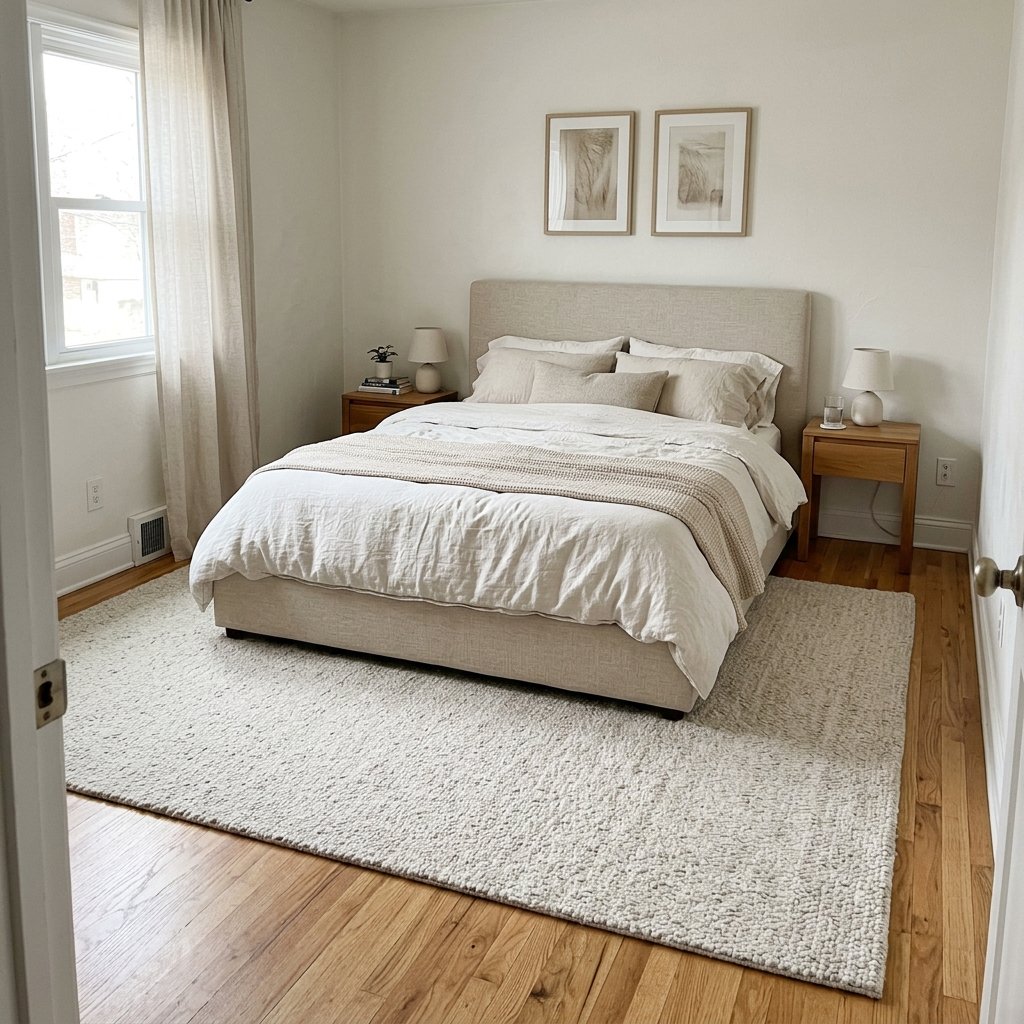
Step 8: Use a Larger Rug
An undersized rug can visually chop up the floor.
A better-scaled rug helps connect the bed and surrounding furniture.
The correct size depends on:
- Bed size
- Room dimensions
- Furniture layout
- How much floor you want exposed
The goal is for the rug to feel intentionally connected to the bed.
Before buying, mark the proposed dimensions on the floor with painter’s tape.
This is much easier than returning a rug that’s obviously too small.
Step 9: Simplify the Bedding
A small bedroom can become visually crowded when the bed contains too many layers.
You don’t need twelve decorative pillows.
Try:
- Sheets
- Duvet or comforter
- Quilt or coverlet
- Two sleeping pillows per person as needed
- Two decorative pillows
- One lumbar pillow
- One throw
Even that can be simplified further.
For a calm bedroom, keep the larger bedding pieces neutral and introduce color through smaller layers.
Step 10: Layer Texture Instead of Lots of Color
If you’re worried that a neutral bedroom will look boring, add texture.
Try:
- Linen-look bedding
- Cotton
- Waffle weave
- Quilted coverlet
- Wool rug
- Woven basket
- Upholstered headboard
- Wood furniture
Texture gives the room depth without adding visual noise.
This is particularly effective in small spaces.
Step 11: Use Vertical Space
When floor space is limited, look upward.
You might add:
- Taller curtains
- Vertical artwork
- Tall narrow mirror
- High shelves where appropriate
- Tall dresser instead of wide dresser
But don’t fill every wall.
Vertical space is useful only when it improves function or composition.
A small bedroom can feel larger when some wall area remains intentionally empty.
Step 12: Choose One Larger Piece of Art
Several tiny pieces of artwork can sometimes make a small wall feel busier.
Try one larger piece above the bed or dresser.
Choose artwork that relates to the room’s palette.
Possible options include:
- Landscape
- Abstract
- Botanical
- Photograph
- Textile art
Use mounting hardware appropriate for the artwork’s weight and wall construction.
Avoid placing inadequately secured heavy objects above a bed.

Step 13: Add a Mirror Strategically
A mirror can be useful in a small bedroom because it adds depth and reflects available light.
Good locations may include:
- Above dresser
- Beside closet
- On an appropriate wall opposite or adjacent to a window
- Full-length dressing area
Don’t position it purely because someone says every small room needs a mirror.
Think about what it will reflect.
A mirror reflecting a window, artwork, or attractive part of the room can be useful.
One reflecting clutter is less helpful.
Large and heavy mirrors must be securely mounted with hardware appropriate for the wall construction and mirror weight.
Step 14: Reduce Dresser Clutter
A dresser covered in dozens of small objects can make the entire room feel busier.
Instead, create one simple arrangement.
Try:
Lamp + tray + small vase
or:
Mirror + books + ceramic bowl
or:
Artwork + lamp + small plant
Leave some empty surface.
Negative space is one of the easiest ways to make a small bedroom feel calmer.
Step 15: Add Closed Storage Wherever It Helps
Small rooms need places to hide everyday clutter.
Look for storage in:
- Nightstand drawers
- Dresser
- Closet
- Under-bed storage
- Storage bench
- Baskets inside cabinets
Closed storage is particularly useful for:
- Chargers
- Medication
- Personal items
- Extra linens
- Seasonal clothing
But avoid buying storage containers before decluttering.
First remove what you don’t need.
Then organize what remains.
Step 16: Make the Closet Work Harder
Sometimes the bedroom isn’t the real problem.
The closet is.
An inefficient closet can force clothing, shoes, and accessories into the bedroom.
Consider whether you could improve it with:
- Additional hanging rod
- Shelving
- Drawer unit
- Shoe storage
- Hooks
- Bins
Any shelves or systems should be installed according to their load requirements and secured appropriately.
Improving the closet can remove an entire piece of storage furniture from the bedroom.
Step 17: Edit the Furniture
This is one of the most important makeover steps.
Ask whether every piece actually earns its place.
Do you need:
- Bed?
- Two nightstands?
- Large dresser?
- Second dresser?
- Bench?
- Chair?
- Bookcase?
Maybe.
But a small bedroom doesn’t automatically need all of them.
A beautiful chair that permanently holds laundry isn’t necessarily improving the room.
Removing one unnecessary piece can create more impact than adding three decorative ones.
How to Make a Small Master Bedroom Look Bigger
There isn’t one magic trick.
It’s usually a combination of choices.
Create Clear Sightlines
Don’t block pathways unnecessarily.
Use Appropriate Furniture Scale
Furniture that’s too large makes the room feel crowded.
Hang Curtains Intentionally
Draw the eye upward and expose as much window as practical.
Use a Cohesive Palette
Too many unrelated colors create visual fragmentation.
Choose a Larger Rug
Connect the furniture visually.
Reduce Clutter
Clear surfaces make the room feel calmer.
Improve Lighting
Dark corners can visually shrink a room.
Leave Some Empty Space
Not every wall or corner needs furniture.
What If You Can’t Replace the Bedroom Furniture?
You can still make a major difference.
Keep the bed and dresser.
Then update:
- Paint
- Bedding
- Curtains
- Lamps
- Rug
- Artwork
- Hardware
- Styling
If you have a matching furniture set, you don’t need to throw it away.
You could eventually replace just the nightstands or introduce a different bench to break up the matching look.
A makeover can happen gradually.
What If the Bed Has to Go Against a Wall?
Sometimes a very small bedroom simply doesn’t allow two-sided access.
That’s okay.
Prioritize function over arbitrary design rules.
Make the arrangement look intentional with:
- Pillows
- Artwork
- Wall lighting
- Bedding
Just ensure the placement doesn’t interfere with windows, heating or cooling equipment, outlets, or required access.
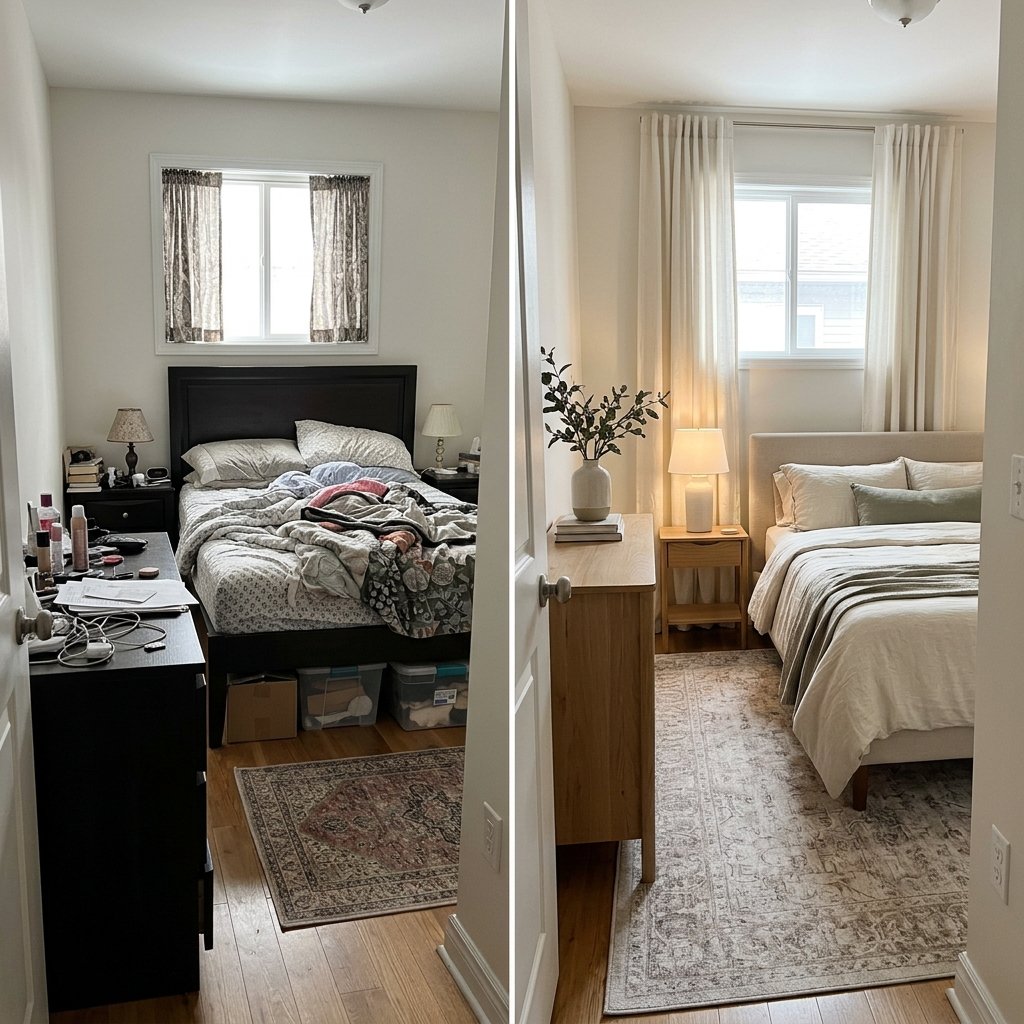
Before and After: The Biggest Changes
The most dramatic small-bedroom transformations usually come from a few high-impact improvements.
Before
- Bulky furniture
- Tiny rug
- Short curtains
- Weak lighting
- Cluttered surfaces
- Unrelated colors
- Too many accessories
After
- Better-scaled furniture
- Larger rug
- Full-length curtains
- Layered lighting
- Clear surfaces
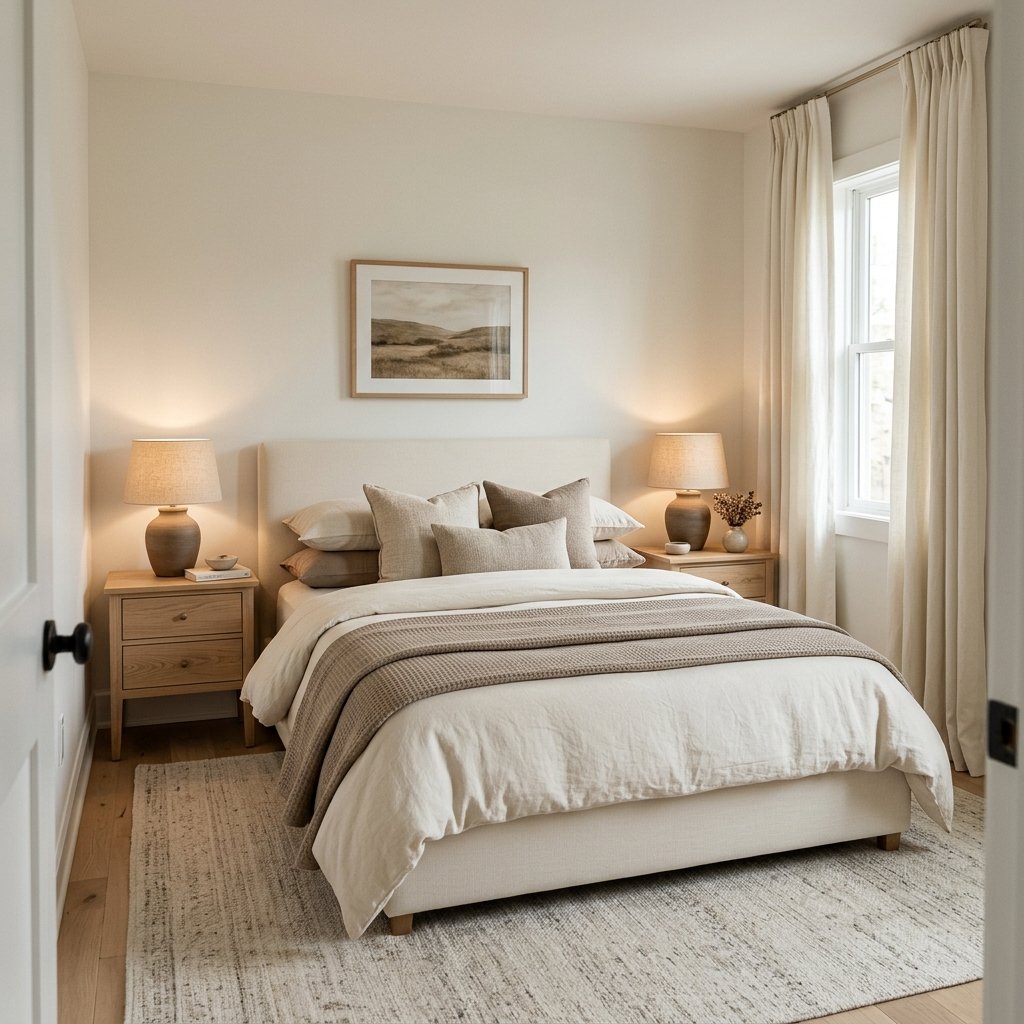
- Cohesive palette
- Fewer, larger decorative pieces
Notice that none of these requires adding square footage.
A Budget-Friendly Small Bedroom Makeover
If your budget is limited, don’t start with new furniture.
Try these changes first.
1. Declutter
Cost: potentially nothing.
2. Rearrange
Try another furniture layout.
3. Paint
One of the highest-impact changes.
4. Change the Bedding
A simple duvet or coverlet can alter the entire palette.
5. Hang Curtains Properly
Reuse existing curtains if they’re long enough.
6. Update Lamps
Shop your home before buying new ones.
7. Change Hardware
New dresser knobs can subtly modernize existing furniture.
8. Add Artwork
Use prints, photographs, or pieces you already own.
9. Add a Rug
If the room needs one, save for the correct size rather than buying an undersized option simply because it’s cheaper.
Where to Spend and Where to Save
Consider Spending More On
- Mattress
- Quality bed or headboard
- Window treatments you use daily
- Rug if it needs to withstand regular use
- Functional storage
Save On
- Decorative pillows
- Small accessories
- Artwork frames
- Baskets
- Side tables
- Decorative objects
Comfort and function should get the larger share of the budget.
Small Bedroom Makeover With Dark Furniture
Dark furniture isn’t automatically the problem.
If you have a dark bed or dresser, create contrast around it.
Try:
Dark wood bed + warm white walls + cream bedding + light rug
Then repeat the dark tone in a few small places:
- Picture frame
- Lamp
- Curtain rod
This makes the furniture feel intentional.
Small Bedroom Makeover With Carpet
You don’t have to replace carpet to create a dramatic before and after.
If the carpet is neutral, work with it.
Coordinate the wall paint and bedding with its undertone.
You can also layer a rug over carpet when the rug is stable and adds something useful, such as:
- Pattern
- Color
- Definition
Use appropriate rug-gripping methods where needed to reduce slipping or bunching.
Small Bedroom Makeover Without Painting
If you’re renting or simply don’t want to paint, focus on:
- Bedding
- Curtains
- Rug
- Lamps
- Artwork
- Furniture arrangement
- Decluttering
A cohesive textile palette can change the room dramatically even when the walls stay exactly the same.
Small Bedroom Makeover With a King Bed
A king bed can work in some small bedrooms, but measure carefully.
Don’t judge only by whether the mattress technically fits.
Also account for:
- Bed frame
- Nightstands
- Door swing
- Closet access
- Walkways
- Dresser clearance
Sometimes keeping a larger bed means eliminating another piece of furniture.
That’s often a worthwhile tradeoff if sleeping comfort is the priority.
Small Bedroom Lighting Ideas
Use multiple light sources when possible.
Consider:
Overhead Lighting
Provides general illumination.
Bedside Lamps
Useful for reading and evening light.
Sconces
Can free nightstand space.
Dresser Lamp
Adds another warm layer.
Use fixtures and bulbs compatible with the manufacturer’s requirements.
For electrical modifications or hardwired fixtures, follow applicable safety requirements and use qualified help where appropriate.
How to Make the Room Feel More Luxurious
Luxury doesn’t necessarily mean expensive materials.
In a small bedroom, it often comes from good proportions.
Try:
- Full-length curtains
- Substantial bedside lamps
- Larger rug
- Layered bedding
- One large artwork
- Clear surfaces
- Coordinated hardware
- Warm lighting
Fewer appropriately scaled items often look more expensive than many tiny accessories.
Common Small Bedroom Makeover Mistakes
Buying Tiny Everything
A small room doesn’t need miniature furniture and accessories.
Use fewer properly scaled pieces.
Buying a Rug That’s Too Small
Measure first.
Adding Too Much Storage Furniture
Sometimes removing belongings is more useful than adding another cabinet.
Overdecorating the Bed
Keep bedding manageable.
Using Only One Light
Layer the lighting.
Blocking Natural Light
Keep windows as open as practical.
Filling Every Wall
Allow visual breathing room.
Buying Before Measuring
Record dimensions before shopping.
Ignoring Door and Drawer Clearance
Test furniture placement before committing.
Prioritizing a Photo Over Daily Function
The room has to work when the camera is gone.
Small Bedroom Makeover Safety
A few practical considerations matter during any makeover.
- Anchor tall or tip-prone furniture where appropriate.
- Secure heavy mirrors and artwork properly.
- Use wall anchors suited to the wall construction and load.
- Check for concealed wiring, plumbing, or other utilities before drilling.
- Use stable ladders for curtains and artwork.
- Follow electrical safety requirements when replacing lighting.
- Don’t overload extension cords or outlets.
- Keep textiles appropriately away from heaters and other heat sources.
- Follow manufacturer weight limits for shelves and storage systems.
- If sanding or disturbing older painted surfaces, check applicable guidance for potentially hazardous legacy coatings.
A Simple Small Bedroom Makeover Plan
If you want to recreate this transformation, work in this order:
Step 1: Declutter
Remove everything that doesn’t need to stay.
Step 2: Measure
Record room, wall, window, bed, and furniture dimensions.
Step 3: Plan the Layout
Decide where the bed and major furniture belong.
Step 4: Choose the Palette
Base it on fixed finishes.
Step 5: Paint
Complete messy work before bringing in textiles.
Step 6: Install Window Treatments
Hang curtains at an intentional height and width.
Step 7: Position the Rug
Center it appropriately with the bed.
Step 8: Bring Back Furniture
Only return pieces that serve a purpose.
Step 9: Make the Bed
Layer bedding simply.
Step 10: Add Lighting
Create practical bedside and ambient light.
Step 11: Hang Artwork and Mirrors
Secure everything appropriately.
Step 12: Style Lightly
Add only the accessories the room actually needs.
FAQ About a Small Master Bedroom Makeover
How do I make a small master bedroom look bigger?
Use appropriately scaled furniture, clear walking paths, a cohesive palette, a correctly sized rug, intentional curtain placement, good lighting, and less visual clutter.
What color makes a small bedroom look bigger?
There isn’t one magic color. Warm whites, creams, pale greiges, mushroom tones, and other light colors can create an airy look, but darker colors can also work beautifully when you want a cozy, enveloping room.
Should a small bedroom have a rug?
It can. A rug adds softness and can visually connect the bed and furniture. Choose a size that relates properly to the bed and room.
Should I use small furniture in a small bedroom?
Use appropriately scaled furniture rather than automatically choosing the smallest pieces available. Too many tiny pieces can make a room look cluttered.
How do I make a small bedroom look expensive?
Focus on proportions: full-length curtains, substantial lamps, layered bedding, one larger artwork, a properly sized rug, and uncluttered surfaces.
Can I put a king bed in a small bedroom?
Possibly. Measure the entire bed frame and make sure there is adequate access to doors, closets, drawers, and walking paths.
How can I makeover a small bedroom on a budget?
Start with decluttering, rearranging furniture, paint, bedding, curtains, lighting, and artwork before replacing major furniture.
Should nightstands match in a small bedroom?
No. They can match, but they don’t have to. Two different pieces can work when their height, scale, color, or materials create a visual relationship.
Do dark walls make a small bedroom look smaller?
They can make the room feel more enclosed, but that isn’t necessarily negative. A deep color can make a small bedroom feel intentionally cozy and sophisticated.
What is the most important part of a small bedroom makeover?
Function. Before decorating, make sure the bed, storage, doors, closet, lighting, and walking paths work comfortably.
Final Thoughts
A dramatic small master bedroom makeover before and after doesn’t require a larger room.
It requires better decisions about the room you already have.
Start with the layout.
Make the bed the focal point.
Remove furniture that isn’t earning its space.
Choose a calm palette.
Use properly scaled nightstands and lighting.
Hang the curtains intentionally.
Choose a rug that connects the room rather than chopping it up.
Then simplify.
You don’t need dozens of decorative objects to make a small bedroom beautiful.
A comfortable bed, good lighting, a few useful pieces of furniture, layered textiles, one or two pieces of art, and some empty space can be far more effective.
The most successful “after” isn’t the bedroom with the most dramatic styling.
It’s the bedroom that suddenly feels easier to move through, easier to keep tidy, more comfortable at night, and much calmer when you walk through the door.
That’s the kind of makeover that can make a small bedroom feel completely different—even when the square footage hasn’t changed at all.