

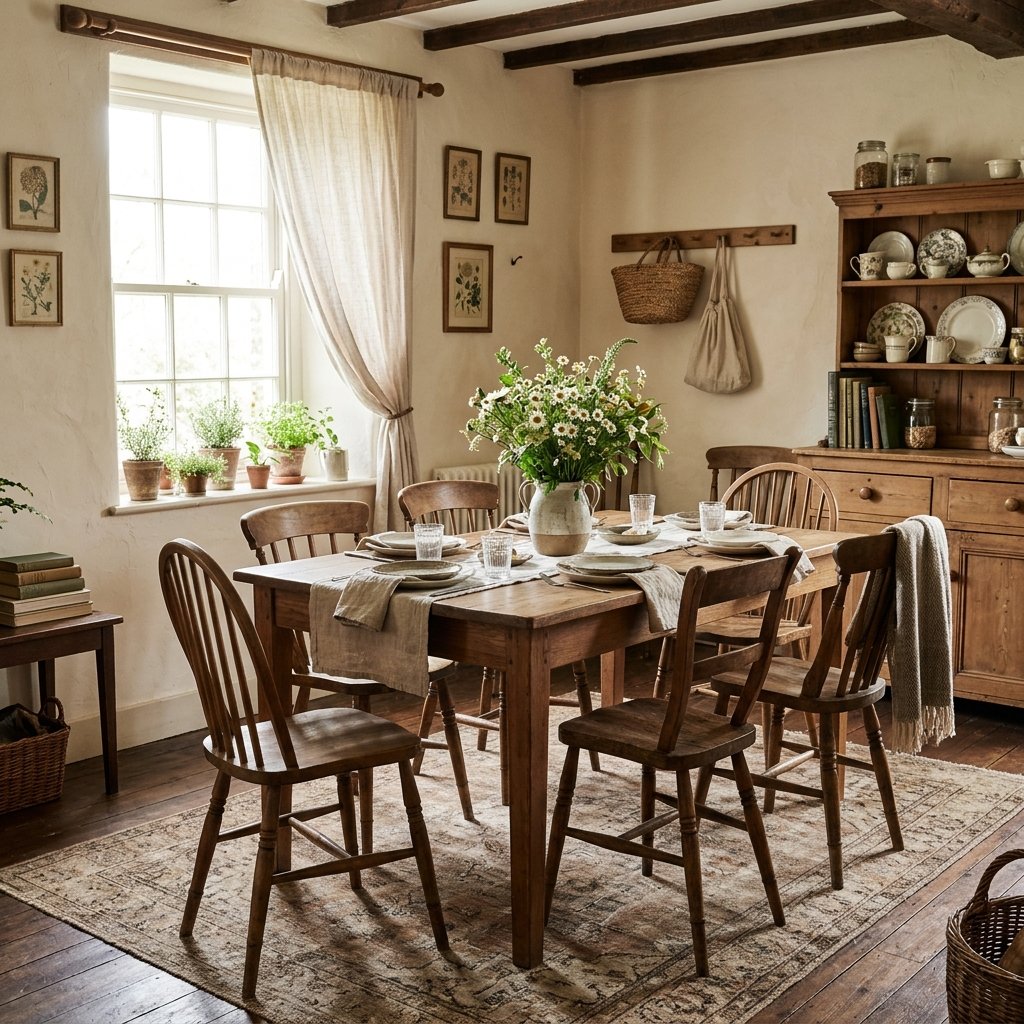
A cottagecore dining room should feel warm, welcoming, and a little collected over time.
Rather than looking perfectly coordinated, this decorating style celebrates natural materials, vintage-inspired furniture, soft colors, floral patterns, handmade-looking pottery, botanical artwork, and the comfortable imperfections that make a room feel lived in.
The dining table is usually the heart of the space.
Start there, then build outward with simple wood chairs, a vintage-style cabinet or hutch, soft curtains, warm lighting, and a rug if it makes sense for your household. Finish with practical decorative details such as flowers, baskets, candlesticks, and everyday dishes displayed beautifully.
You don’t need to live in an old English cottage—or replace everything you already own—to create the look.
Cottagecore can work in a newer home, an apartment dining area, or even a small breakfast nook. The key is adding warmth and character without turning the room into a collection of themed accessories.
Here are 21 cottagecore dining room ideas to help you create a space that feels cozy, timeless, and ready for slow breakfasts and long dinners.

What Is Cottagecore Dining Room Style?
Cottagecore interiors are inspired by an idealized version of simple country living.
In a dining room, that often translates to:
- Natural wood
- Vintage-inspired furniture
- Florals
- Gingham or stripes
- Warm paint colors
- Botanical artwork
- Handmade-looking ceramics
- Woven baskets
- Simple flowers and greenery
The style doesn’t need to be cluttered.
In fact, a restrained cottagecore room often looks more authentic than one filled with dozens of obviously themed decorations.
Think collected, not decorated all at once.
1. Start With a Simple Wood Dining Table
A wood table immediately gives a cottagecore dining room warmth.
Look for a finish that allows some natural grain to show.
The table doesn’t need to be distressed or antique.
A simple new table can work beautifully when combined with more characterful chairs, artwork, textiles, and lighting.
2. Try a Farmhouse-Style Table
A substantial farmhouse-inspired table can anchor a larger room.
Keep the surrounding furniture lighter so the space doesn’t feel overly heavy.
Pair it with:
- Simple chairs
- Linen runner
- Vintage cabinet
- Large pendant
Avoid adding rustic details to every single surface.
One strong farmhouse element is often enough.
3. Mix and Match Dining Chairs
Matching furniture isn’t required for cottagecore style.
Try combining:
- Wood chairs
- Painted chairs
- Upholstered end chairs
Keep one characteristic consistent, such as color, wood tone, or general scale, so the arrangement feels intentional.
Most importantly, chairs should be stable and comfortable enough for regular use.
4. Add Vintage-Style Chairs
Spindle-back, ladder-back, or other traditional chair silhouettes can introduce instant character.
You don’t need a full matching set.
Four similar wood chairs around a simple table can create plenty of cottage charm.
If you’re using genuinely old furniture, check joints and structural stability before putting it into everyday use.
5. Add a Dining Bench
A bench can make the room feel more relaxed.
Place it along one side of a rectangular table and use chairs on the others.
Make sure the bench is properly sized and stable.
Allow enough room for people to sit and stand comfortably without crowding walls or other furniture.
6. Bring in a Vintage Hutch
A hutch is almost perfect for cottagecore style because it combines storage and display.
Use it for:
- Plates
- Bowls
- Glassware
- Linens
Leave some empty space between objects.
Tall or top-heavy furniture should be appropriately secured, particularly in homes with children.
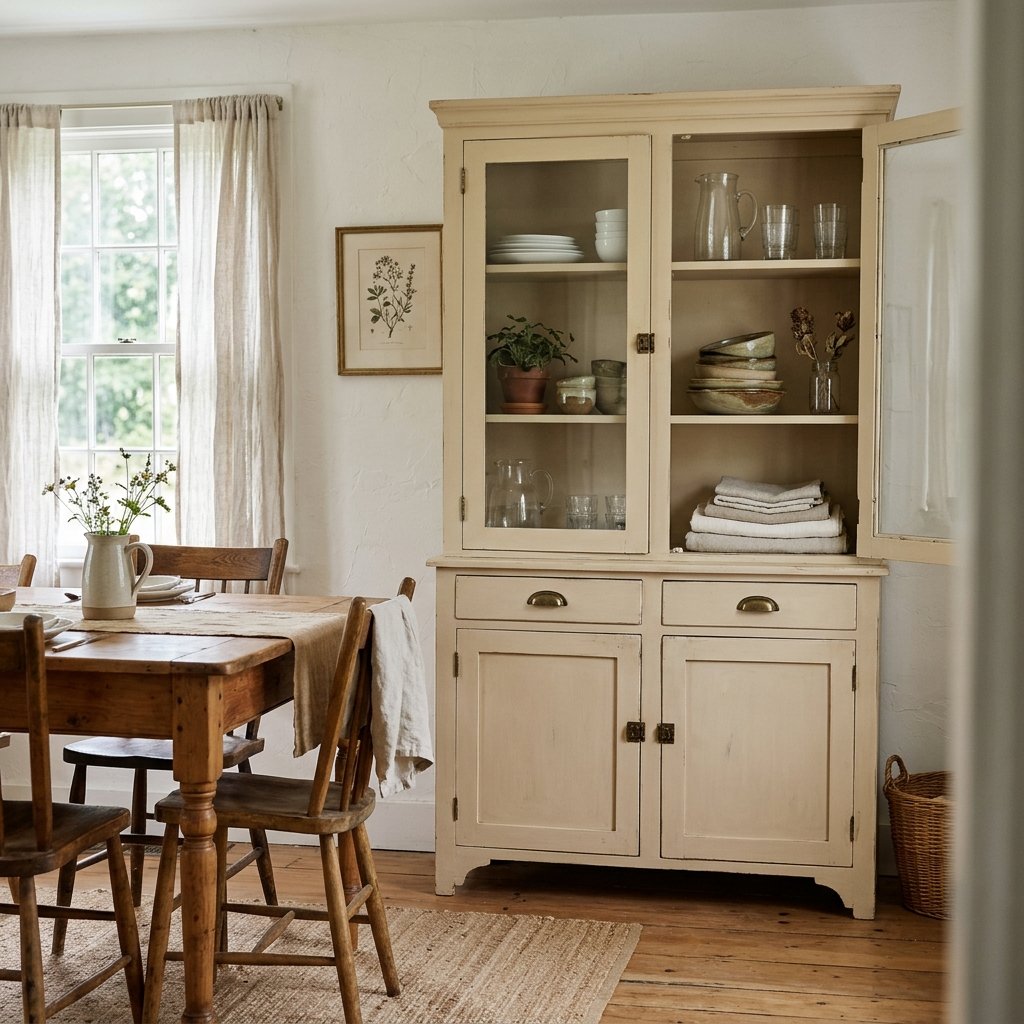
7. Use a Freestanding Cabinet
If you don’t have room for a full hutch, try a smaller cabinet.
A vintage-style dresser, sideboard, or cupboard can store dining essentials while creating a useful serving surface.
Style the top simply with:
Lamp + artwork + small vase
or:
Candlesticks + flowers
8. Paint the Walls Warm White
Warm white provides a simple backdrop for patterned textiles and wood furniture.
It can make a room feel bright without becoming stark.
Sample paint in the actual room before choosing.
Natural light, flooring, furniture, and artificial lighting can all change how a white appears.
9. Try a Soft Cream Dining Room
Cream can make the room feel warmer and slightly more traditional.
Pair it with:
- Medium wood
- Muted green
- Soft blue
- Burgundy
- Brown
Cream walls also work well if you want floral curtains or wallpaper to provide most of the pattern.
10. Use Muted Green
Green feels especially natural in a cottage-inspired room.
Try a muted:
- Sage
- Olive
- Moss
You can use it on:
- Walls
- Hutch
- Chairs
- Wainscoting
Then balance it with cream and natural wood.
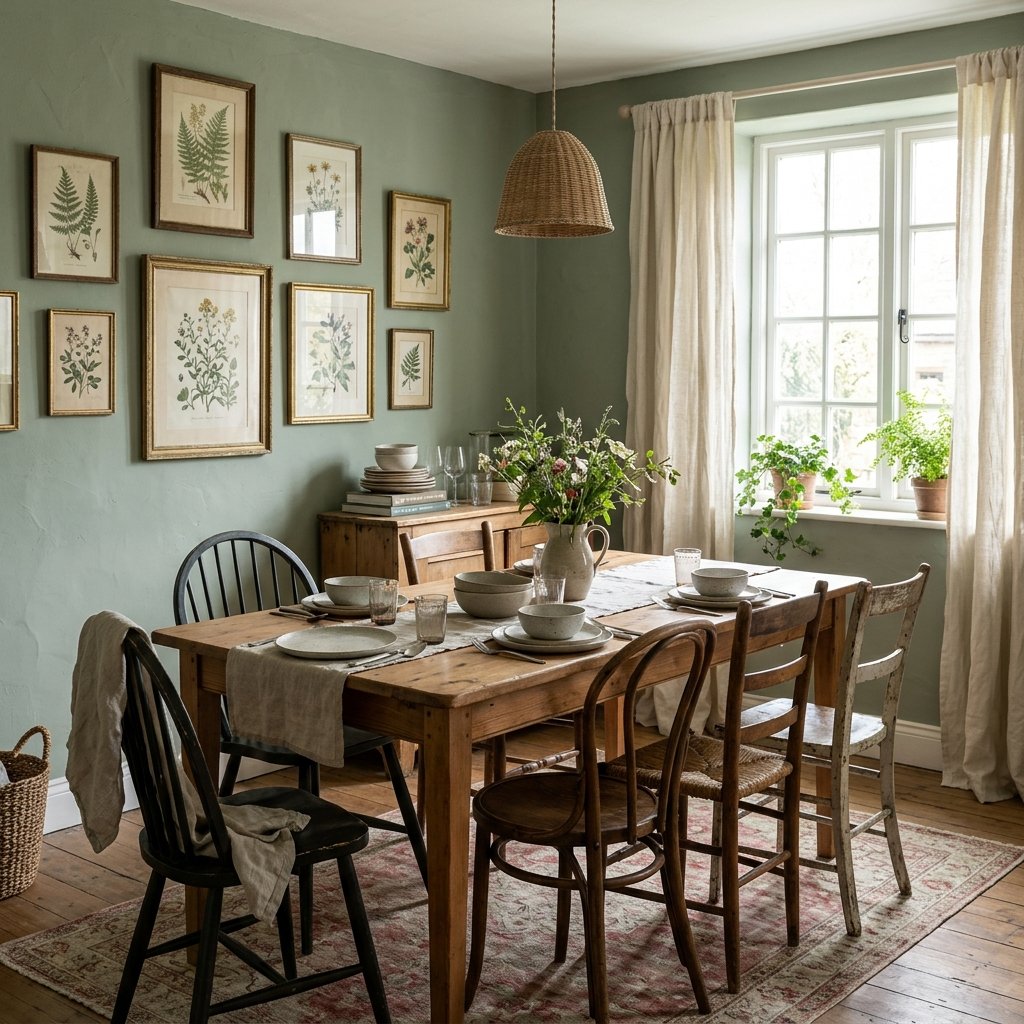
11. Add Floral Wallpaper
Wallpaper is an easy way to give a dining room cottage character.
Choose a floral with a restrained palette.
Try:
- Green and cream
- Blue and white
- Dusty rose and beige
If the wallpaper is busy, simplify the curtains and rug.
Proper wall preparation matters, and product-specific installation instructions should always be followed.
12. Wallpaper Above Wainscoting
For a more architectural look, combine wallpaper with wall paneling.
Try:
Cream wainscoting + muted floral wallpaper
or:
Sage wainscoting + warm neutral botanical print
This gives the room pattern without covering every inch of wall.
13. Add Simple Wall Paneling
Wall paneling can add cottage character even without wallpaper.
Consider:
- Beadboard
- Simple vertical paneling
- Traditional wainscoting
Paint it cream, soft green, or warm white.
Before fastening paneling, locate electrical wiring, plumbing, and other hidden utilities.
14. Hang Floral Curtains
Curtains can soften the hard surfaces found in dining rooms.
Try a small floral pattern with colors repeated elsewhere in the room.
For example:
Cream curtains + green floral pattern + green hutch
Keep other large patterns restrained.
15. Try Gingham Curtains
Gingham can create a charming cottage look without relying on florals.
Muted versions tend to be easiest to use.
Consider:
- Beige
- Sage
- Blue
Full-length curtains can feel more polished, while a smaller treatment may suit certain cottage-style windows.
Choose window coverings appropriate for privacy, light control, and any child-safety considerations.

16. Add a Vintage-Style Rug
A rug can make a dining room feel warmer and more layered.
Try a faded pattern containing:
- Brown
- Green
- Blue
- Burgundy
- Cream
Choose a rug large enough that dining chairs can move comfortably.
Use appropriate slip resistance and make sure the rug doesn’t create a tripping hazard.
17. Hang Botanical Artwork
Botanical prints naturally complement cottagecore style.
Use:
- One large botanical
- Pair of prints
- Small gallery arrangement
You can also mix botanical artwork with landscapes or vintage-inspired still lifes.
Use mounting hardware appropriate for the wall construction and artwork weight.
18. Add Vintage-Style Landscape Art
A landscape painting can make a cottage dining room feel collected rather than themed.
Try artwork depicting:
- Countryside
- Garden
- Trees
- Fields
One substantial piece often has more impact than many tiny signs.
19. Display Everyday Dishes
Cottagecore celebrates useful things.
Instead of buying objects purely for display, let attractive everyday dishes become part of the decor.
Open shelves or a hutch can hold:
- White plates
- Ceramic bowls
- Pitchers
- Glassware
Keep frequently used pieces easy to reach.
20. Add Simple Garden Flowers
Flowers are one of the easiest ways to make the room feel cottage-inspired.
You don’t need a formal arrangement.
Use whatever is appropriate and available, such as:
- Garden flowers
- Simple branches
- Greenery
Place them in a ceramic pitcher or simple vase.
21. Let the Room Feel Collected
This may be the most important cottagecore decorating idea.
Don’t try to make everything match.
Combine:
- Old and new
- Painted and natural wood
- Floral and stripe
- Refined and rustic
But edit as you go.
A room can feel collected without feeling crowded.
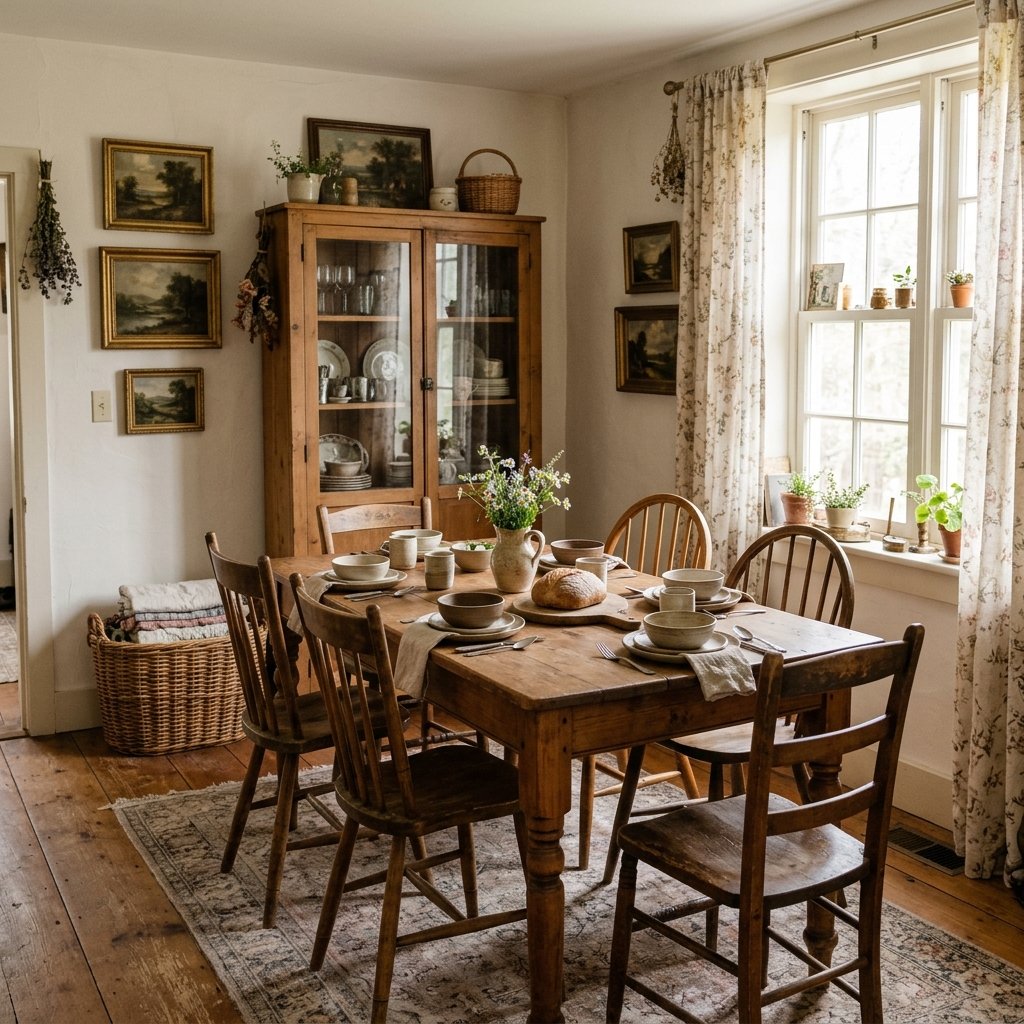
Cottagecore Dining Room Color Palette Ideas
A good palette can make the entire room easier to decorate.
Classic Cottage
Cream + sage + medium wood
English-Inspired
Olive + burgundy + cream + dark wood
Light Cottage
Warm white + pale blue + natural wood
Romantic Cottage
Cream + dusty rose + muted green
Earthy Cottage
Mushroom + olive + brown
Blue Cottage
Cream + faded blue + walnut
Choose two or three main colors, then allow smaller variations to appear naturally.
Small Cottagecore Dining Room Ideas
A small dining room doesn’t need miniature furniture everywhere.
Instead, choose fewer pieces.
Try:
Round table + four chairs + small cabinet
A round table can make circulation easier in certain compact rooms.
Use walls for artwork rather than filling the floor with decorative furniture.
Cottagecore Dining Nook Ideas
A dining nook can feel especially cozy.
Try:
- Small round table
- Built-in or freestanding bench
- Two chairs
- Pendant light
Add a cushion or two if the seating allows.
Keep fabrics practical for a dining environment.
Cottagecore Dining Room With a Round Table
Round tables naturally create a relaxed, conversational layout.
Pair one with:
- Four wood chairs
- Simple pendant
- Small floral arrangement
Avoid using an oversized centerpiece that blocks sightlines.
Cottagecore Dining Room With a Rectangular Table
A rectangular table can support a more traditional arrangement.
Try:
Wood table + mixed chairs + bench
Place a hutch or sideboard along one wall if circulation allows.
Cottagecore Dining Room With Dark Wood Furniture
Dark wood can create a beautiful, old-world cottage feeling.
Keep the room from becoming too heavy with:
- Cream walls
- Light curtains
- Muted wallpaper
- Pale upholstery
Dark wood doesn’t need to be painted to make a room feel fresh.
Cottagecore Dining Room With Light Wood Furniture
Light wood creates a softer Scandinavian-cottage interpretation.
Pair it with:
- Warm white
- Sage
- Dusty blue
- Linen
Add one or two vintage pieces so the room doesn’t feel too new.
Cottagecore Dining Room Lighting
Lighting can make or break the mood.
Use a substantial fixture over the table.
Consider styles inspired by:
- Simple lanterns
- Traditional chandeliers
- Pleated or fabric shades
- Aged-looking metal
- Simple glass
Scale the fixture to the table and room rather than choosing solely by style.
Hardwired electrical changes should be performed safely and according to applicable requirements.
Cottagecore Dining Room Chandelier Ideas
A chandelier can provide a more romantic look.
Try something simple rather than excessively ornate.
A traditional silhouette with candle-style lights or a restrained aged-metal finish can work beautifully.
Make sure the fixture doesn’t interfere with normal movement or sightlines.
Add Lamps to a Cottagecore Dining Room
Dining rooms don’t have to rely entirely on overhead lighting.
A lamp on a sideboard can create softer evening light.
Keep cords safely managed and don’t place lamps where they interfere with serving or walking paths.
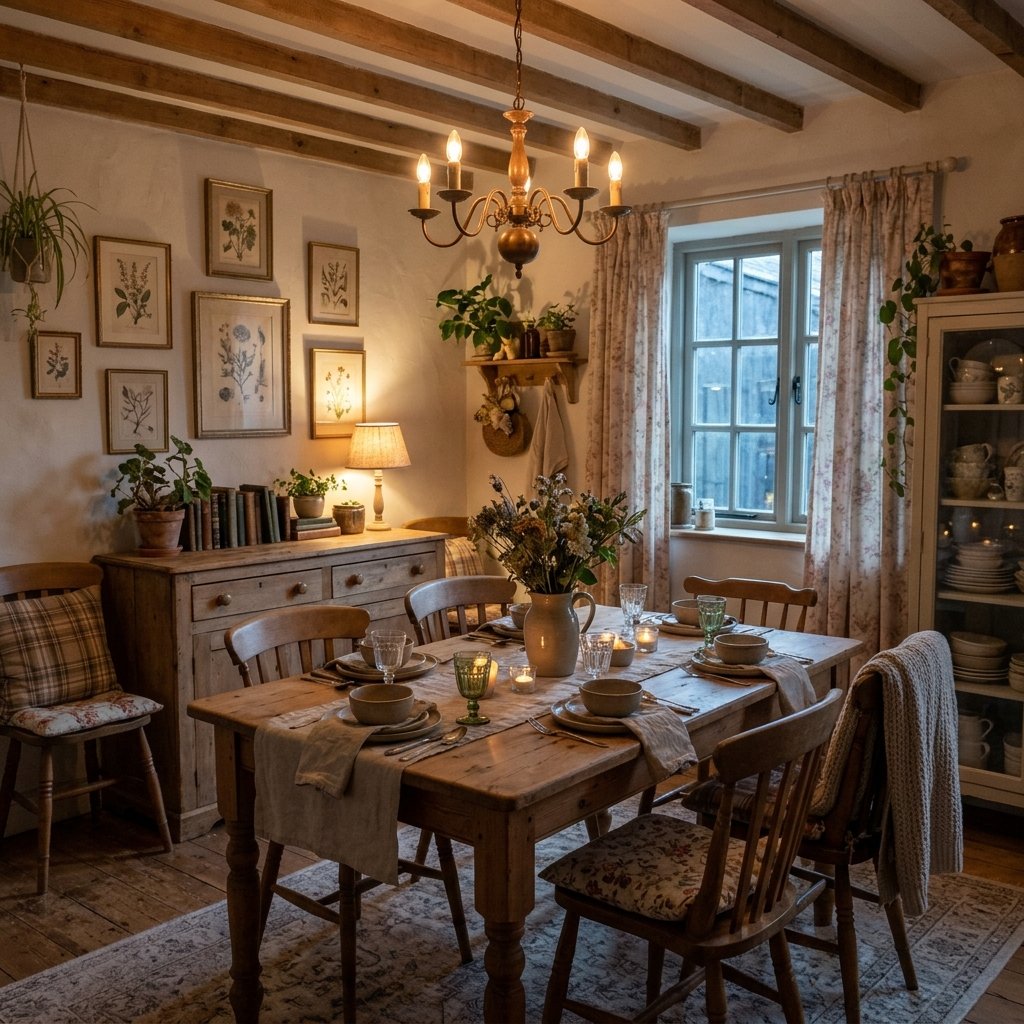
Cottagecore Dining Table Decor
Keep the table usable.
A simple everyday arrangement might be:
Ceramic vase + garden flowers
or:
Small bowl + two candlesticks
You shouldn’t have to remove an entire decorative display before every meal.
Cottagecore Dining Room Centerpiece Ideas
Good options include:
- Garden flowers
- Branches
- Fruit
- Simple ceramic bowl
- Candlesticks
Keep arrangements low enough for conversation.
For candles, use stable holders and maintain safe distance from flowers, textiles, paper, children, pets, and other combustible materials.
Cottagecore Table Setting Ideas
For a relaxed cottage table, layer:
- Simple plates
- Linen napkins
- Clear glassware
- Small flowers
Everything doesn’t need to match.
Slightly different dishes can enhance the collected look as long as they’re appropriate and safe for food use.
Cottagecore Dining Room Shelf Decor
Open shelving can work beautifully when styled with useful objects.
Try:
- Plates
- Bowls
- Pitchers
- Cookbooks
- Baskets
Don’t overload shelves.
Use appropriate mounting hardware and observe shelf and bracket load limits.
Cottagecore Dining Room Wall Decor
Instead of word signs, consider:
- Botanical art
- Landscapes
- Still lifes
- Vintage-inspired plates
- Small mirror
Mix shapes and sizes carefully.
Leave some wall space empty.
Cottagecore Dining Room With Plates on the Wall
Decorative plates can create an old-fashioned cottage look.
Arrange a small collection over a sideboard or on an otherwise empty wall.
Mount them securely with hardware suitable for the plate and wall.
Avoid hanging heavy or fragile pieces where they could easily be bumped.
Cottagecore Dining Room Storage
Cottagecore rooms may look relaxed, but they still need organization.
Use:
- Hutch
- Sideboard
- Cabinet
- Baskets
Closed storage is useful for items that aren’t attractive enough to display.
Open storage should be reserved for things that genuinely contribute to the room.
Cottagecore Dining Room on a Budget
You don’t need expensive antique furniture.
Start with what you own.
Then look for one or two character pieces, such as:
- Secondhand wood chair
- Vintage-style artwork
- Ceramic pitcher
- Woven basket
Paint can also make a big difference.
A basic cabinet painted muted green may become a beautiful focal point.
When buying secondhand furniture, inspect it for stability, damage, odors, pests, and other condition issues before bringing it indoors.
How to Get the Cottagecore Look Without Buying Anything
Begin by editing.
Remove modern accessories that don’t contribute to the look.
Then gather items you already own:
- Books
- Ceramics
- Baskets
- Flowers
- Wood serving boards
- Linen napkins
Move artwork from another room.
Put everyday dishes on display.
Cottagecore is particularly suited to decorating with ordinary useful objects.
How to Make Cottagecore Look Grown-Up
Use fewer novelty accessories.
Instead of decorating with obvious cottage-themed objects, focus on:
- Real materials
- Furniture silhouettes
- Pattern
- Artwork
- Color
A wood table, botanical wallpaper, linen curtains, vintage landscape, and ceramic dishes can create the mood without a single themed sign.
How to Mix Wood Tones in a Cottagecore Dining Room
Your table, chairs, hutch, and sideboard don’t have to be identical.
Mixing wood tones can actually make the room feel more collected.
Use repetition to create cohesion.
For example, if the table is medium oak and the cabinet is dark walnut, repeat each tone somewhere else in the room.
Avoid introducing a different wood finish on every object.
How to Mix Patterns in a Cottagecore Dining Room
Cottagecore style welcomes pattern, but scale is important.
Try:
Small floral wallpaper + wide striped pillow
or:
Gingham curtains + simple vintage rug
Vary the size of the patterns.
Repeat one or two colors across them.
Then use solid surfaces to give the eye somewhere to rest.
How to Make a Cottagecore Dining Room Look Expensive
Avoid trying to make every object a focal point.
Instead, invest your visual attention in:
- Substantial lighting
- Properly scaled curtains
- Large rug
- Good-looking table
- One beautiful cabinet
- Large artwork
Then use inexpensive flowers, pottery, and secondhand finds for character.
Cottagecore Dining Room Safety and Practical Tips
A dining room should still function comfortably.
Keep these considerations in mind:
- Maintain clear walking paths.
- Check old chairs and tables for structural stability.
- Secure tall or top-heavy cabinets appropriately.
- Use proper mounting hardware for shelves and artwork.
- Keep rugs flat and stable.
- Manage lamp cords safely.
- Use care with candles and open flames.
- Keep combustible decor away from heat sources.
- Use food-safe dishes and containers for serving.
- Consider child safety with cords, fragile objects, and furniture.
- Don’t overload shelves or wall-mounted storage.
Comfort and practicality should always come before styling.
Common Cottagecore Dining Room Mistakes
Buying Everything New
Mixing ages and finishes creates character.
Using Too Many Floral Patterns
Balance florals with solids and stripes.
Filling Every Wall
Leave breathing room.
Using Too Many Tiny Accessories
Choose useful or substantial pieces.
Distressing Every Piece of Furniture
Natural variation is enough.
Making Everything Match
Allow some contrast.
Ignoring Lighting
Use several sources of warm, practical light.
Choosing an Undersized Rug
Make sure chairs can function comfortably.
Using Uncomfortable Antique Chairs
Style shouldn’t replace usability.
Making the Room Too Themed
Focus on materials, color, and character instead of novelty decor.
A Simple Cottagecore Dining Room Formula
Step 1: Start With a Wood Table
Let it anchor the room.
Step 2: Add Simple Chairs
They don’t need to match perfectly.
Step 3: Choose a Warm Wall Color
Cream, warm white, or muted green works beautifully.
Step 4: Add One Pattern
Try wallpaper, curtains, or a rug.
Step 5: Bring in Storage
Use a hutch, cabinet, or sideboard.
Step 6: Add a Substantial Light Fixture
Center it appropriately over the table.
Step 7: Hang Vintage-Inspired Artwork
Botanicals and landscapes work especially well.
Step 8: Add Natural Texture
Use baskets, linen, or wood.
Step 9: Put Flowers on the Table
Keep them simple.
Step 10: Let the Room Evolve
Don’t try to finish the entire look in one shopping trip.

FAQ About Cottagecore Dining Rooms
How do I make my dining room look cottagecore?
Start with natural wood furniture, warm colors, vintage-inspired pieces, simple floral or botanical patterns, soft textiles, ceramics, baskets, and garden flowers.
What colors work in a cottagecore dining room?
Cream, warm white, sage, olive, dusty blue, muted rose, mushroom, brown, and burgundy can all work beautifully.
What kind of dining table works with cottagecore style?
A simple wood table is an easy choice. Farmhouse-style, vintage-inspired, round pedestal, and straightforward rectangular tables can all work.
Does cottagecore furniture have to be antique?
No. New furniture can work beautifully when mixed with vintage-inspired artwork, traditional shapes, natural materials, or secondhand accessories.
Can I mix dining chairs?
Yes. Mismatched chairs can enhance the collected cottagecore look. Repeat a color, wood tone, or silhouette to keep the arrangement cohesive.
What wallpaper works for a cottagecore dining room?
Small florals, botanicals, stripes, and block-print-inspired patterns are good options. Muted colors tend to be easier to layer with furniture and textiles.
What curtains work with cottagecore style?
Linen-look solids, small florals, gingham, and simple stripes can all work. Choose a pattern that doesn’t compete with the wallpaper or rug.
How can I create cottagecore style on a budget?
Use furniture you already own, shop secondhand selectively, display everyday dishes, add inexpensive flowers, rearrange existing artwork, and focus on one or two character pieces rather than buying an entire matching set.
Can cottagecore look modern?
Yes. Use the cottagecore principles—natural materials, soft color, vintage influence, and handcrafted texture—but simplify the number of accessories and patterns.
How do I keep cottagecore decor from looking cluttered?
Leave empty surfaces, limit small accessories, use closed storage, and make sure most displayed objects are either useful or visually meaningful.
Final Thoughts
A beautiful cottagecore dining room doesn’t come from buying a complete set of cottage-themed furniture and accessories.
It comes from layering character slowly.
Start with a wood table.
Add comfortable chairs that don’t necessarily match perfectly.
Bring in a hutch or sideboard for useful storage.
Then soften the room with warm paint, floral wallpaper, gingham curtains, a faded rug, or another pattern that feels right for your home.
Display dishes you actually use.
Hang landscapes and botanical artwork instead of novelty signs.
Put garden flowers in a simple ceramic pitcher.
And don’t worry if every wood tone, chair, or piece of pottery is slightly different.
Those differences are part of what makes the room feel collected.
The goal isn’t to create a dining room that looks like a cottagecore set.
It’s to create a comfortable room that feels warm, useful, personal, and as though it became more beautiful over time.