

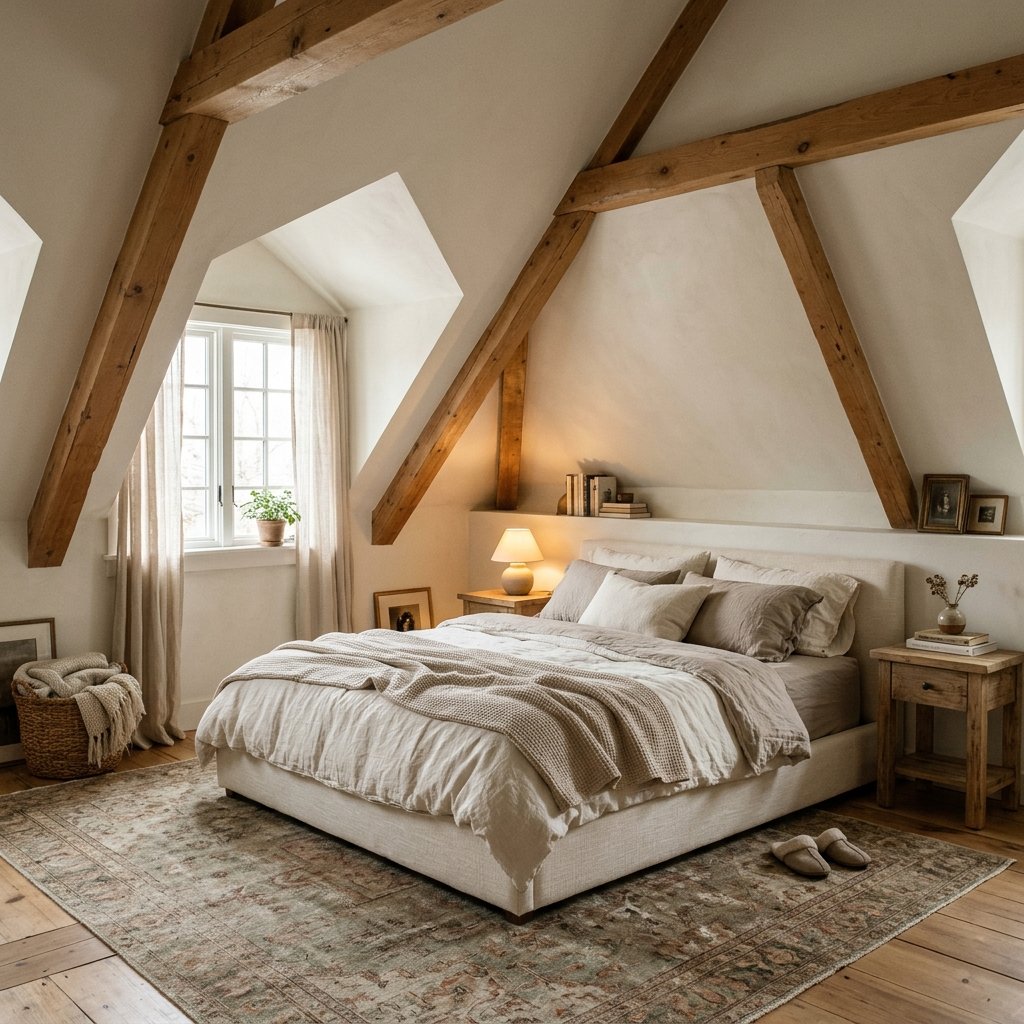
An attic bedroom can become one of the coziest rooms in the house.
Sloped ceilings, dormer windows, exposed beams, little alcoves, and unusual wall angles give attic rooms character that can be difficult to recreate in a standard bedroom. Instead of treating those features as problems, a thoughtful design can make them the reason the room feels special.
The challenge is making the space comfortable and functional.
Low ceilings can limit furniture placement. Awkward corners may need custom storage. Roof windows can bring in beautiful daylight but may also create glare or heat. And before converting an unfinished attic into sleeping space, structural capacity, insulation, ventilation, stairs, electrical work, heating and cooling, fire safety, and required emergency escape provisions all need proper consideration.
Once those practical issues are handled, decorating can be surprisingly simple.
Light paint can visually unify complicated ceiling lines. Low furniture works naturally beneath slopes. Built-in storage can turn awkward eaves into useful space. And warm wood, soft bedding, rugs, and layered lighting can make the entire room feel intentionally cozy rather than cramped.
Here are 21 attic bedroom ideas for making the most of a room beneath the roof.
Start With the Attic’s Architecture
Before deciding where the bed goes, study the room.
Identify:
- Highest ceiling area
- Lowest eaves
- Windows and roof windows
- Dormers
- Beams
- Doors
- Stairs
- Heating and cooling locations
- Electrical outlets
- Existing storage
Use the tallest areas for activities that require standing.
Use lower areas for furniture such as:
- Bed
- Dresser
- Storage
- Bench
This simple approach can make an awkward floor plan much easier to use.
1. Put the Bed Under a Sloped Ceiling
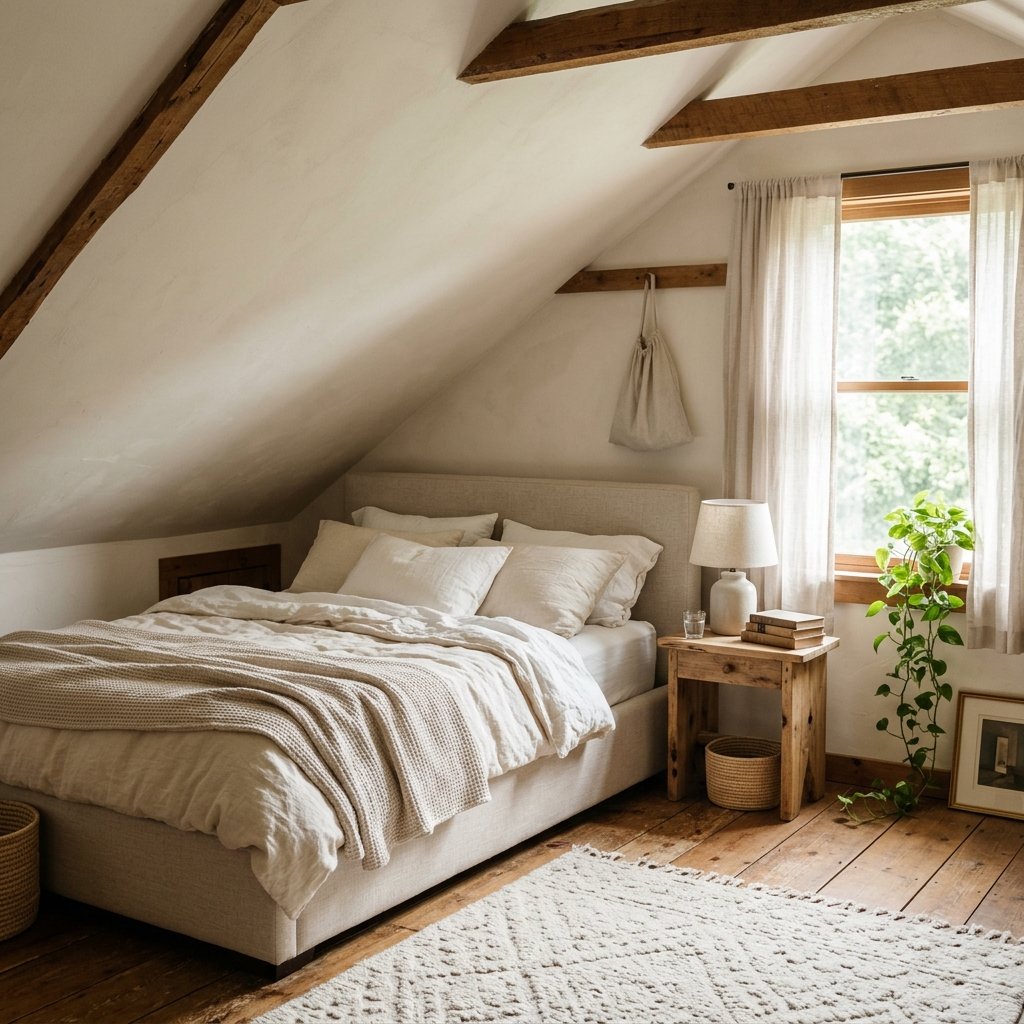
A bed is one of the easiest pieces of furniture to position beneath a slope because you don’t normally need full standing height over the entire mattress.
Placing the headboard beneath a sloped section can also emphasize the attic architecture.
Before settling on the layout, make sure there is enough comfortable clearance where people sit up, get out of bed, and walk around it.
2. Center the Bed Under the Highest Point
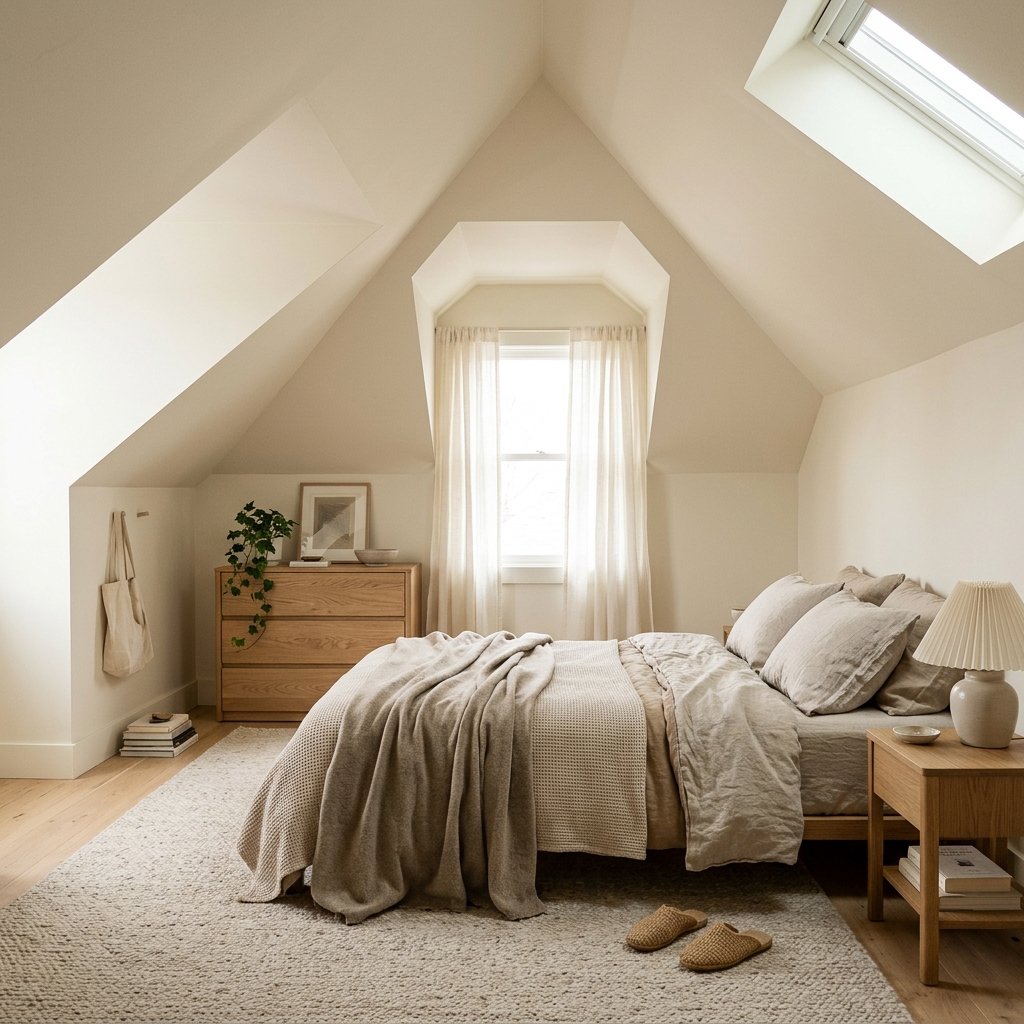
If the room has a symmetrical pitched ceiling, consider centering the bed beneath the ridge.
This creates a natural focal point.
Add matching or coordinating nightstands on either side where space permits.
The strong symmetry can make even an unusual attic room feel intentional.
3. Use a Low-Profile Bed
Low furniture works particularly well in rooms with limited ceiling height.
A low bed can provide more visual space above the mattress and keep the room from feeling crowded.
Choose a bed that’s still comfortable to get in and out of.
Low doesn’t need to mean mattress-on-the-floor.
4. Skip an Oversized Headboard
A tall headboard can compete with a sloped wall.
Instead, try:
- Low upholstered headboard
- Simple wood headboard
- Bed without a prominent headboard
Let the architecture remain visible.
5. Paint the Walls and Ceiling the Same Color
Attic rooms often have many separate planes.
Painting walls, slopes, and ceiling the same or a closely related color can visually simplify all those angles.
Warm white is an easy choice.
But you can also try:
- Cream
- Pale beige
- Soft greige
- Muted green
A continuous color can make complicated architecture feel calmer.
6. Try a Moody Attic Bedroom
An attic doesn’t have to be white.
A deeper color can make the room feel cocooning.
Consider:
- Deep green
- Navy
- Charcoal
- Warm brown
Painting walls and slopes together in one darker color can create a dramatic effect.
Make sure the room still has adequate practical lighting.
7. Highlight Exposed Beams
If the attic already has attractive structural beams, let them become part of the design.
Natural wood beams can look beautiful against:
- Warm white
- Cream
- Pale gray
- Soft green
Don’t assume an exposed structural element should be cut, drilled, altered, or refinished without understanding its role and condition.
8. Add Wood to the Ceiling
Wood paneling can make an attic bedroom feel warm and cabin-like.
Consider using it selectively on:
- Sloped ceiling
- Small section
- Dormer area
Any added ceiling finish introduces weight and may affect assemblies related to insulation, vapor control, fire performance, or access, so substantial changes should be evaluated appropriately.
9. Turn a Dormer Into a Reading Nook
A dormer is an ideal place for a small reading area.
Depending on its dimensions, add:
- Chair
- Small table
- Built-in bench
A cushion and a few pillows can make a built-in seat especially inviting.
Permanent window seating needs appropriate structural support and should not compromise safe window operation or required emergency escape.

10. Use the Eaves for Built-In Storage
Low eaves can be difficult to furnish but excellent for storage.
Consider built-in:
- Drawers
- Cabinets
- Shelves
Closed cabinetry can make the room look calmer while using space that might otherwise go unused.
Avoid altering structural roof components or blocking ventilation paths without appropriate professional guidance.
11. Add a Low Dresser
Not every attic needs custom built-ins.
A low dresser may fit perfectly beneath a sloped wall.
Use the top for a lamp, tray, or a few decorative objects.
Secure furniture where appropriate, especially in children’s rooms.
12. Create a Built-In Wardrobe
Wardrobes can be difficult in an attic because full-height walls may be limited.
Custom cabinetry can follow the ceiling slope and make better use of the available volume.
Plan around:
- Roof framing
- Electrical
- Ventilation
- Access points
Don’t permanently cover building systems that require inspection or service.
13. Add a Window Seat
A window seat can transform an awkward corner into a feature.
Use it for:
- Reading
- Relaxing
- Extra storage
Keep cushions appropriately sized so they don’t interfere with window operation.
If the window serves a required emergency escape function, the design must preserve that function.
14. Create a Small Attic Guest Bedroom
An attic can make a charming guest room even when the floor area is limited.
Keep it simple:
- Comfortable bed
- Small nightstand
- Lamp
- Hooks
- Small dresser
Guests generally need less furniture than a full-time occupant.

15. Create a Twin Attic Bedroom
Twin beds can work beautifully beneath symmetrical roof slopes.
Place one bed on each side with a shared table between them if the layout allows.
This is particularly useful for:
- Children’s room
- Guest room
- Vacation home
Maintain adequate clearances and safe access around both beds.
16. Make an Attic Bedroom for Kids
Children may enjoy the cozy scale of an attic room, but safety requires extra attention.
Consider:
- Stair safety
- Window safety
- Furniture anchoring
- Guardrails where applicable
- Heat
- Emergency escape
- Smoke and carbon monoxide alarms where required
Avoid placing climbable furniture where it creates an unsafe relationship with windows or guards.
17. Create an Attic Teen Bedroom
An attic can provide a teenager with a sense of separation from the rest of the house.
Create zones for:
- Sleeping
- Studying
- Storage
- Relaxing
Use low furniture around the edges and reserve the highest part of the room for circulation and desk space.
18. Add a Small Desk
A compact desk can fit beneath a dormer or along a full-height wall.
Natural light is useful, but avoid positioning the computer where direct sunlight constantly creates screen glare.
Make sure there is adequate headroom at the chair and where the user stands.
19. Use Wall-Mounted Lighting
When sloped walls make traditional bedside lamps awkward, wall-mounted lighting can save space.
Sconces can work beside the bed or in a reading nook.
Electrical work should be planned around the wall and roof assembly and completed according to applicable requirements.
20. Layer the Lighting
Attic bedrooms often have shadows because of their unusual geometry.
Use several light sources:
- Ceiling fixtures where appropriate
- Bedside lamps
- Sconces
- Floor lamp
Don’t rely on a single central fixture.
Layered lighting can make the room feel significantly more comfortable at night.
21. Keep the Decor Simple
Attic architecture already provides visual interest.
You may only need:
- Beautiful bedding
- Rug
- Two lamps
- A few pieces of art
Avoid filling every low wall and corner simply because the space exists.
A little negative space can make the room feel larger.

Small Attic Bedroom Ideas
In a small attic bedroom, decide what is essential.
Usually that’s:
- Bed
- Nightstand
- Lighting
- Clothing storage
Add other furniture only if there is comfortable space.
Don’t block circulation with a chair or bench that nobody will actually use.
Very Small Attic Bedroom Ideas
For a tiny room, use the architecture strategically.
Place the bed beneath the lowest usable slope.
Keep the center walkway open.
Try:
- Wall-mounted light
- Narrow bedside shelf
- Under-eave storage
- Hooks
A tiny room can feel charming when it isn’t overloaded with furniture.
Low-Ceiling Attic Bedroom Ideas
Don’t fight the low ceiling.
Use lower furniture.
Beds, benches, and dressers naturally fit under lower sections.
Reserve full standing-height areas for pathways and places where people dress.
Use paint to visually unify the ceiling and walls.
Attic Bedroom Ideas With Slanted Walls
Slanted walls make conventional decorating difficult, so don’t treat them like standard vertical walls.
Instead of forcing large artwork onto them, let the angles remain simple.
Use vertical gable walls for:
- Artwork
- Mirrors
- Shelving
Mount objects securely and appropriately for the wall construction.
Attic Bedroom Ideas With Exposed Beams
Let the beams provide contrast.
If they’re natural wood, repeat a similar tone through:
- Nightstand
- Bench
- Picture frame
You don’t need large amounts of additional wood.
A few repetitions can make the room feel cohesive.
Attic Bedroom Ideas With Roof Windows
Roof windows can bring excellent daylight into an attic.
They can also introduce:
- Glare
- Heat
- Early morning light
Use window coverings specifically compatible with the window system.
Avoid improvised coverings that interfere with operation, ventilation, or manufacturer requirements.
Attic Bedroom Ideas With Dormer Windows
Dormers create useful pockets of full-height space.
Use them for:
- Desk
- Reading chair
- Window seat
- Dresser
Treat each dormer as a small functional zone.
Attic Bedroom Ideas With No Closet
If there is no conventional closet, combine several storage strategies.
Try:
- Low dresser
- Under-eave cabinets
- Appropriately placed clothing rail
- Hooks
Keep visible clothing storage organized so it doesn’t make the room feel cluttered.
Attic Bedroom Storage Ideas
Start with the lowest parts of the room.
These areas may work for:
- Drawers
- Cabinets
- Lidded storage
Built-ins can be useful, but don’t sacrifice access to roof spaces or mechanical systems that need servicing.

Attic Bedroom Closet Ideas
If full-height wardrobes fit only on one wall, use that wall strategically.
A combination of full-height wardrobe and low eave storage may provide more usable capacity than trying to force tall cabinets around the entire room.
Measure carefully before ordering furniture.
Attic Bedroom Color Ideas
A few palettes work particularly well beneath the roof.
Warm Neutral
Warm white + beige + medium wood
Cottage
Cream + muted blue + vintage wood
Garden-Inspired
Warm white + sage + oak
Moody
Deep green + cream + walnut
Soft Scandinavian
Warm white + pale wood + greige
Rustic
Cream + natural wood + earthy brown
Use the amount of daylight to help guide how light or dark you go.
White Attic Bedroom Ideas
White can simplify complicated ceiling lines.
But avoid choosing white from a tiny sample.
Test it beside the flooring, beams, and fabrics.
A slightly warm white often pairs naturally with wood and cozy textiles.
Green Attic Bedroom Ideas
Muted green can make an attic feel restful.
Try it on:
- All walls and slopes
- One gable wall
- Built-in cabinetry
Pair it with cream bedding and wood furniture.
Blue Attic Bedroom Ideas
Dusty blue can create a relaxed bedroom.
It works particularly well in:
- Guest rooms
- Cottage homes
- Coastal-inspired spaces
Use warm wood to prevent blue from making the room feel overly cool.
Dark Attic Bedroom Ideas
Deep color can emphasize the cozy nature of the attic.
Instead of using a single dark accent wall, consider carrying the color across multiple planes for a more intentional effect.
Strong practical lighting remains important.
Attic Bedroom Flooring Ideas
Flooring should suit both the structure and bedroom use.
Depending on the project, appropriate options might include:
- Carpet
- Wood
- Engineered flooring
- Other suitable resilient flooring
Consider:
- Structural load
- Subfloor condition
- Sound transmission
- Temperature
- Installation requirements
Attic floor assemblies vary, so check compatibility before adding substantial new materials.
Attic Bedroom Rug Ideas
A rug can add warmth even when the room already has carpet.
For hard floors, a large rug can visually anchor the bed.
Make sure it lies flat and doesn’t create a trip hazard near stairs or tight circulation areas.
Attic Bedroom Curtain Ideas
Standard curtains aren’t always practical around sloped or roof windows.
For vertical dormer windows, curtains may work normally.
For roof windows, purpose-designed shades or blinds are often more practical.
Keep window coverings compatible with the actual window and its required operation.
How to Make an Attic Bedroom Cozy
Attics already have a natural advantage: enclosed geometry.
Enhance that feeling with:
- Warm bedding
- Rugs
- Wood
- Soft lighting
- Warm paint colors
- Upholstered furniture
Avoid mistaking cozy for crowded.
Leave clear space around the bed and main walking routes.
How to Make an Attic Bedroom Look Bigger
Simplify the room.
Use:
- One continuous wall-and-ceiling color
- Low furniture
- Limited accessories
- Clear pathways
- Appropriately sized rug
Don’t automatically paint every architectural plane a different color.
Visual continuity can make the room feel calmer and larger.
How to Make an Attic Bedroom Look Expensive
Work with the architecture instead of hiding it.
Focus on:
- Good-quality-looking bedding
- Large rug
- Substantial lighting
- Built-in-looking storage
- Restrained color palette
- One strong piece of artwork
Avoid scattering small decor throughout every nook.
Budget Attic Bedroom Ideas
Custom cabinetry can be useful, but it isn’t always necessary.
Try:
- Low secondhand dresser
- Simple bedside tables
- Paint
- Large rug
- Wall-mounted hooks
- Ready-made low storage
Spend first on comfort and function.
Attic Bedroom Ideas Without Buying Anything
Rearrange the room before shopping.
Try moving the bed beneath a slope.
Move a low dresser into the eaves.
Remove furniture that blocks the highest part of the room.
Bring in a lamp, artwork, or rug from elsewhere in the house.
A better layout can have more impact than new decor.
Attic Bedroom Insulation
A bedroom directly beneath the roof can be especially affected by outdoor temperatures.
Proper thermal performance depends on the roof assembly, climate, insulation system, ventilation strategy, and local requirements.
Don’t simply pack insulation into roof cavities without understanding how the complete assembly is intended to manage heat and moisture.
Poorly planned changes can contribute to condensation and moisture problems.
Attic Bedroom Ventilation
Ventilation matters for both occupant comfort and the building.
Roof ventilation requirements vary depending on the roof and insulation assembly.
Don’t block existing ventilation paths when adding storage, insulation, or finishes.
Persistent condensation or moisture should be investigated rather than concealed.
Heating and Cooling an Attic Bedroom
Upper floors can experience different temperatures than the rest of the house.
Before converting an attic, consider whether the existing heating and cooling system can serve the additional finished space effectively.
Solutions depend on the building and climate.
A qualified professional may need to assess the system rather than simply extending existing ductwork.
Attic Bedroom Stairs
Safe access is fundamental.
A permanent bedroom should not depend on an improvised ladder or unsafe stair arrangement.
Requirements for:
- Stair dimensions
- Headroom
- Handrails
- Guards
- Landings
vary by location and project.
Verify applicable requirements before converting an attic into habitable space.
Attic Bedroom Egress and Fire Safety
A room used for sleeping may be subject to specific requirements for emergency escape and rescue openings, smoke alarms, fire separation, and other life-safety provisions.
Requirements vary by jurisdiction and building.
Don’t assume an existing attic window automatically satisfies bedroom requirements.
Check applicable rules before treating a converted attic as a legal bedroom.
Structural Considerations
An attic originally designed primarily for storage may not automatically be suitable for bedroom loads.
Before adding:
- New floor assemblies
- Heavy built-ins
- Large wardrobes
- Bathtubs in an attic suite
- Significant partitions
make sure the structure is appropriate.
Never cut or modify roof trusses, rafters, joists, beams, or other structural members casually to make furniture or storage fit.
Attic Bedroom Electrical Planning
Plan electrical work before closing walls and ceilings.
Consider:
- Outlets
- Bedside lighting
- Ceiling lighting
- Smoke alarms
- Heating and cooling equipment
Electrical work should comply with applicable requirements and be performed by qualified professionals where required.
Common Attic Bedroom Mistakes
Ignoring Headroom
Plan around where people stand.
Filling Every Eave With Furniture
Leave breathing room.
Buying Tall Furniture
Low pieces often work better.
Using Only One Light
Layer the lighting.
Blocking Roof Ventilation
Understand the building assembly first.
Covering Important Access Points
Mechanical and roof spaces may need future access.
Ignoring Summer Heat
Comfort needs to be addressed before decorating.
Assuming the Existing Floor Is Adequate
Structural capacity matters.
Forgetting Emergency Escape
Sleeping rooms can have specific life-safety requirements.
Altering Structural Members for Storage
Never modify framing casually.
A Simple Attic Bedroom Design Formula
Step 1: Confirm the Space Is Suitable
Address structure, access, safety, and building requirements.
Step 2: Identify Full-Height Areas
Reserve them for circulation.
Step 3: Place the Bed
Use the slopes strategically.
Step 4: Add Low Storage
Make the eaves useful.
Step 5: Choose a Simple Color Palette
Unify complicated angles.
Step 6: Add a Large Rug
Bring warmth to the room.
Step 7: Layer the Lighting
Illuminate dark corners.
Step 8: Add Window Treatments
Control privacy, glare, and early light where needed.
Step 9: Keep Decor Restrained
Let the architecture provide character.
Step 10: Make It Comfortable
Temperature, ventilation, and safety matter more than styling.

FAQ About Attic Bedroom Ideas
How do you arrange a bedroom with slanted ceilings?
Place lower furniture such as the bed, dressers, benches, and storage beneath the slopes, and reserve the tallest parts of the room for standing and circulation.
What colors make an attic bedroom look bigger?
Warm white, cream, pale beige, and other light colors can create visual continuity. Painting walls and sloped ceilings the same color can also simplify complicated angles.
Where should the bed go in an attic bedroom?
The bed can often sit beneath a slope or be centered beneath the roof’s highest point. The best position provides comfortable clearance for sitting up, getting out of bed, and walking.
How can I make a small attic bedroom cozy?
Use a low bed, warm bedding, a rug, wood accents, soft lighting, and restrained decor. Avoid filling every available corner.
What can I put under low attic eaves?
Low dressers, drawers, cabinets, benches, and other low storage can work well, provided they don’t block ventilation, structural elements, or required access.
Are dark colors good for an attic bedroom?
Yes. Deep green, navy, charcoal, and warm brown can create a cozy effect, especially when the room has good natural and artificial lighting.
How do you add storage to an attic bedroom?
Use low dressers, under-eave cabinetry, drawers, hooks, and custom wardrobes where appropriate. Plan around structural framing, ventilation, electrical systems, and access.
Can I turn any attic into a bedroom?
Not necessarily. Structural capacity, stairs, headroom, insulation, ventilation, heating and cooling, electrical systems, emergency escape, fire safety, and local requirements may all affect whether an attic can be converted into habitable sleeping space.
How do I keep an attic bedroom from getting too hot?
The solution depends on the roof assembly and climate. Insulation, air sealing, shading, ventilation strategy, glazing, and appropriately designed cooling can all play roles. Persistent overheating may require professional assessment.
How do you make an attic bedroom look expensive?
Use the architecture intentionally. Combine a restrained palette with quality-looking bedding, a substantial rug, layered lighting, built-in-looking storage, and a small number of well-scaled decorative pieces.
Final Thoughts
The best attic bedroom ideas don’t try to disguise the fact that the room is beneath the roof.
They celebrate it.
Let the ceiling slope.
Keep the beams visible when appropriate.
Turn a dormer into a reading nook.
Fit useful storage beneath the eaves.
And choose lower furniture that works naturally with the room’s proportions.
For decorating, simplicity often works best.
A continuous paint color can calm complicated ceiling angles. Warm wood adds character. A large rug and soft bedding create comfort, while several light sources help eliminate dark corners.
But an attic bedroom is also a project where what’s behind the finished surfaces matters enormously.
Before converting unfinished attic space, make sure the structure, stairs, insulation, ventilation, electrical work, heating and cooling, emergency escape, and fire-safety provisions are appropriate for a habitable sleeping room.
Once those fundamentals are handled correctly, the unusual architecture stops feeling like a limitation.
It becomes the feature that makes an attic bedroom one of the most charming and memorable rooms in the house.