

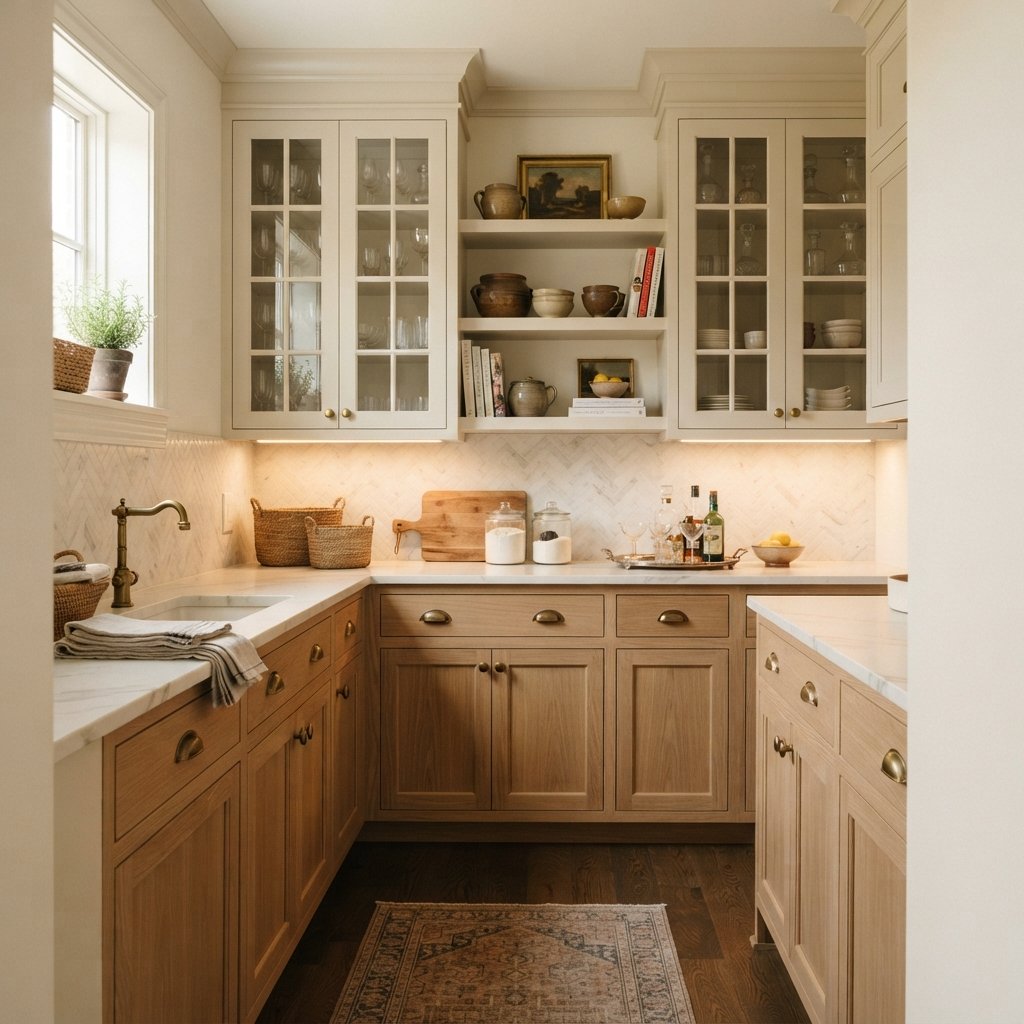
A butler’s pantry can be one of the hardest-working spaces in a home.
Tucked between or near the kitchen and dining area, it can provide extra storage, keep small appliances off the main kitchen counters, create a dedicated place for serving and entertaining, and give everyday clutter somewhere to go.
And you don’t necessarily need a huge house to benefit from one.
A small passageway, unused alcove, oversized pantry, or section of cabinetry near the kitchen may be enough to create a practical butler’s pantry.
The key is deciding what you actually want the space to do before choosing cabinets, countertops, or a backsplash.
Do you need food storage? A coffee station? A place for serving dishes? A second sink? Small-appliance storage? A beverage refrigerator?
Once you know its purpose, the design becomes much easier.
Whether you’re planning a new butler’s pantry or updating an existing one, these ideas can help you create a space that’s beautiful enough to leave visible and functional enough to make your kitchen work better every day.
What Is a Butler’s Pantry?
Traditionally, a butler’s pantry was a service and storage space associated with formal dining and household staff.
Modern versions have evolved considerably.
Today, the term often describes a secondary space near the kitchen used for some combination of:
- Food storage
- Dish storage
- Serving
- Beverage preparation
- Small appliances
- Entertaining supplies
- Meal preparation
Some butler’s pantries are narrow passageways between the kitchen and dining room.
Others resemble small secondary kitchens.
You may also hear related terms such as scullery, back kitchen, or working pantry, although these spaces aren’t always identical in purpose or layout.
Butler’s Pantry vs. Walk-In Pantry
A traditional walk-in pantry is primarily about storage.
A butler’s pantry often combines storage with a usable countertop.
It may also include:
- Sink
- Refrigerator
- Dishwasher
- Coffee maker
- Wine or beverage storage
- Serving area
But there are no universal requirements.
Your pantry should be designed around your home rather than around a label.
1. Start With the Purpose of the Space
Before choosing finishes, make a list of everything you want the pantry to hold.
For example:
Food Storage
Dry goods, snacks, baking supplies, bulk items.
Serving Storage
Platters, bowls, table linens, holiday dishes.
Appliances
Toaster, blender, mixer, coffee maker.
Entertaining
Glassware, drinks, ice, serving trays.
Then rank those needs.
A beautiful beverage refrigerator isn’t helpful if what you really need is room for cereal boxes and a stand mixer.
2. Add Floor-to-Ceiling Cabinetry
Tall cabinetry makes excellent use of limited square footage.
Use it for items that don’t need to remain on the countertop.
Depending on your needs, tall cabinets can store:
- Pantry food
- Small appliances
- Serving pieces
- Table linens
- Cleaning supplies
Keep frequently used items within comfortable reach.
Reserve higher shelves for lightweight or less frequently used pieces rather than heavy objects that are difficult to retrieve safely.
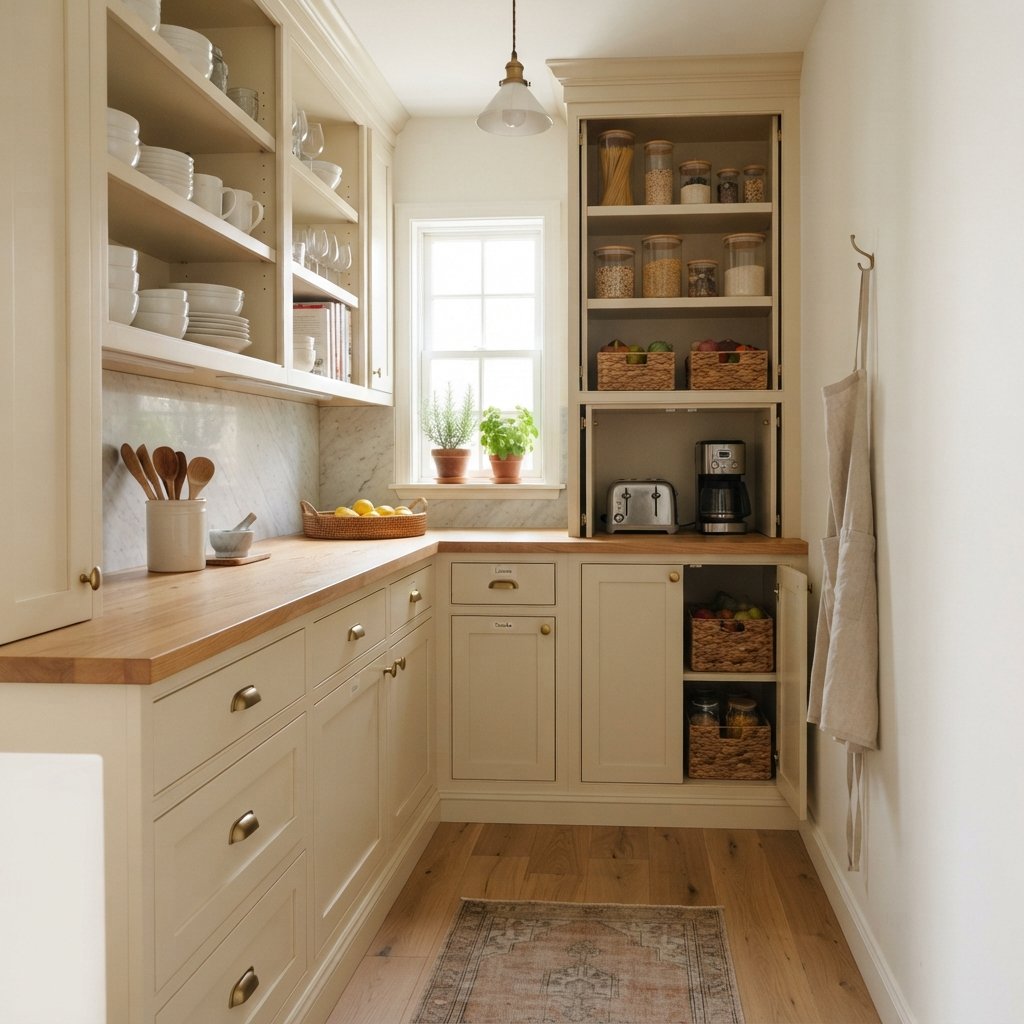
3. Include Plenty of Drawers
Deep drawers can be more practical than lower cabinets with fixed shelves.
They allow you to see what’s stored at the back.
Use drawers for:
- Linens
- Utensils
- Baking supplies
- Snacks
- Small dishes
- Food storage containers
If you’re designing new cabinetry, inventory your belongings before deciding drawer heights.
4. Create a Small-Appliance Zone
One of the biggest advantages of a butler’s pantry is getting small appliances off the main kitchen counters.
You might store:
- Toaster
- Blender
- Mixer
- Food processor
- Coffee maker
- Electric kettle
Decide which appliances will actually be operated in the pantry and which will simply be stored there.
Appliances have different electrical, ventilation, clearance, heat, and operating requirements. Follow manufacturer instructions and applicable electrical requirements rather than assuming every appliance can safely operate inside a closed cabinet.
5. Add a Coffee Station
A butler’s pantry is a natural location for a dedicated coffee bar.
Store:
- Coffee maker
- Mugs
- Coffee
- Tea
- Sweeteners
- Spoons
Add a nearby drawer for smaller supplies.
If the pantry has plumbing, a sink can make the coffee station even more convenient.
Without plumbing, the setup can still work perfectly well as a storage and brewing area.
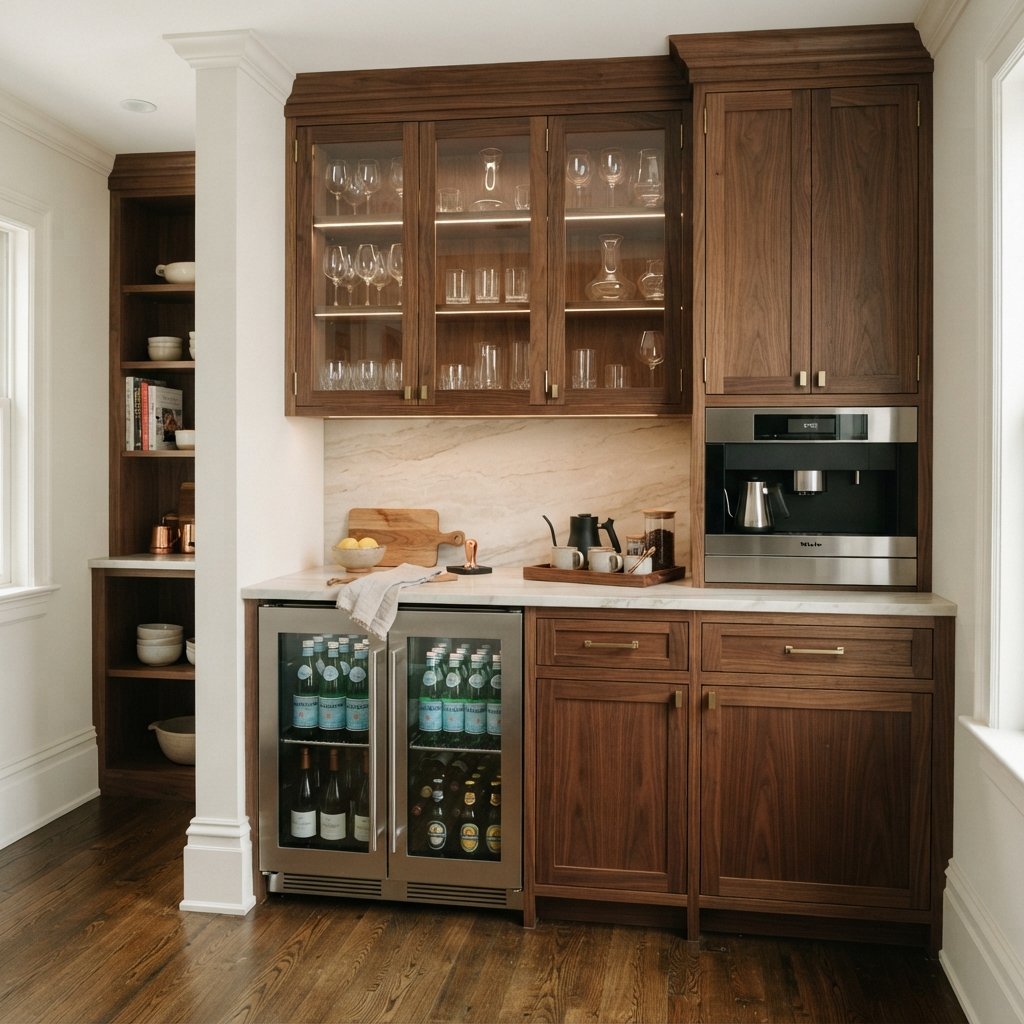
6. Include a Beverage Refrigerator
If you entertain frequently, a small beverage refrigerator can free valuable space in the main refrigerator.
Use it for whatever drinks make sense for your household.
Before adding one, verify:
- Dimensions
- Ventilation requirements
- Electrical requirements
- Door swing
- Manufacturer clearances
Not every refrigerator is designed to be enclosed tightly within cabinetry.
7. Install a Prep Sink
A small sink can make a butler’s pantry significantly more functional.
It may be useful for:
- Coffee preparation
- Washing produce
- Filling pitchers
- Cleaning serving pieces
- Entertaining
But adding plumbing can substantially increase project complexity and cost.
If you’re remodeling an existing space, consult appropriate professionals before assuming a sink can be added easily.
8. Consider a Second Dishwasher
For households that entertain frequently, a second dishwasher can be useful.
It allows serving pieces and glassware to be handled outside the main kitchen.
But don’t add one simply because luxury kitchens often have them.
Ask whether your household genuinely produces enough dishes to justify the:
- Cost
- Cabinet space
- Plumbing
- Electrical requirements
For many homes, drawers or extra storage will be much more valuable.
9. Use a Durable Countertop
The countertop should suit the way you intend to use the pantry.
If it’s primarily decorative, your options are broad.
If you’ll prepare food, make coffee, or wash dishes there, durability and maintenance become more important.
Potential materials include various:
- Natural stones
- Engineered surfaces
- Solid surfaces
- Other countertop products rated for the intended use
Each material has different requirements for maintenance, staining, heat, scratching, sealing, or cleaning.
Review the specific product information before selecting it.
10. Make the Backsplash a Feature
A butler’s pantry is a great place to use a backsplash you love.
Because the area may be smaller than the main kitchen, you can create impact without covering an enormous amount of wall.
Consider:
- Handmade-look tile
- Subway tile
- Stone
- Slab backsplash
- Small patterned tile
If your main kitchen already has a statement backsplash, the pantry doesn’t necessarily need another competing one.
Coordinate the spaces rather than making them fight for attention.
11. Try a Dark Cabinet Color
A small pantry is a good place to experiment with deeper cabinetry.
Consider:
- Forest green
- Navy
- Charcoal
- Burgundy
- Deep brown
- Soft black
Balance darker cabinets with appropriate lighting and contrasting surfaces.
A dark pantry doesn’t need to look gloomy.
It can feel cozy and intentional.
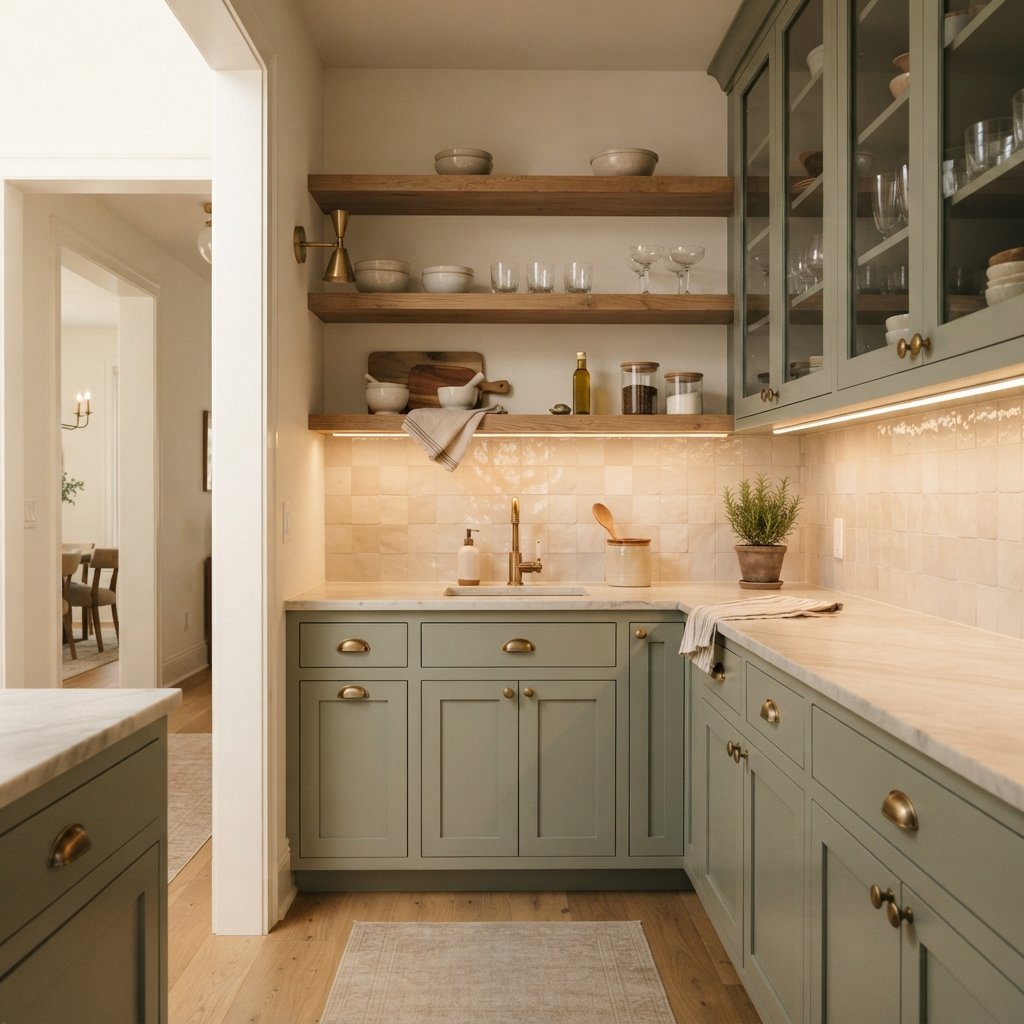
12. Use Sage Green Cabinets
If you want color without a highly dramatic look, sage is an easy option.
Pair it with:
- Warm white
- Cream
- Light stone
- Wood
- Brass
- Bronze
Muted green can feel particularly natural in a pantry because it works well with baskets, wood cutting boards, food storage, and other organic materials.
13. Choose Natural Wood Cabinets
Wood cabinetry can make a butler’s pantry feel warm and furniture-like.
Consider wood for:
- Lower cabinets
- Tall pantry cabinets
- Open shelves
- Countertop accents
You don’t have to match the kitchen cabinetry exactly.
For example, a white kitchen might transition beautifully into a warm oak or walnut pantry.
14. Mix Wood and Painted Cabinetry
A combination of materials can create a custom look.
Try:
Cream upper cabinets + wood lower cabinets
or:
Sage cabinets + natural wood shelves
or:
Wood tall cabinets + painted base cabinets
Repeat hardware, countertops, or another finish to connect the materials.
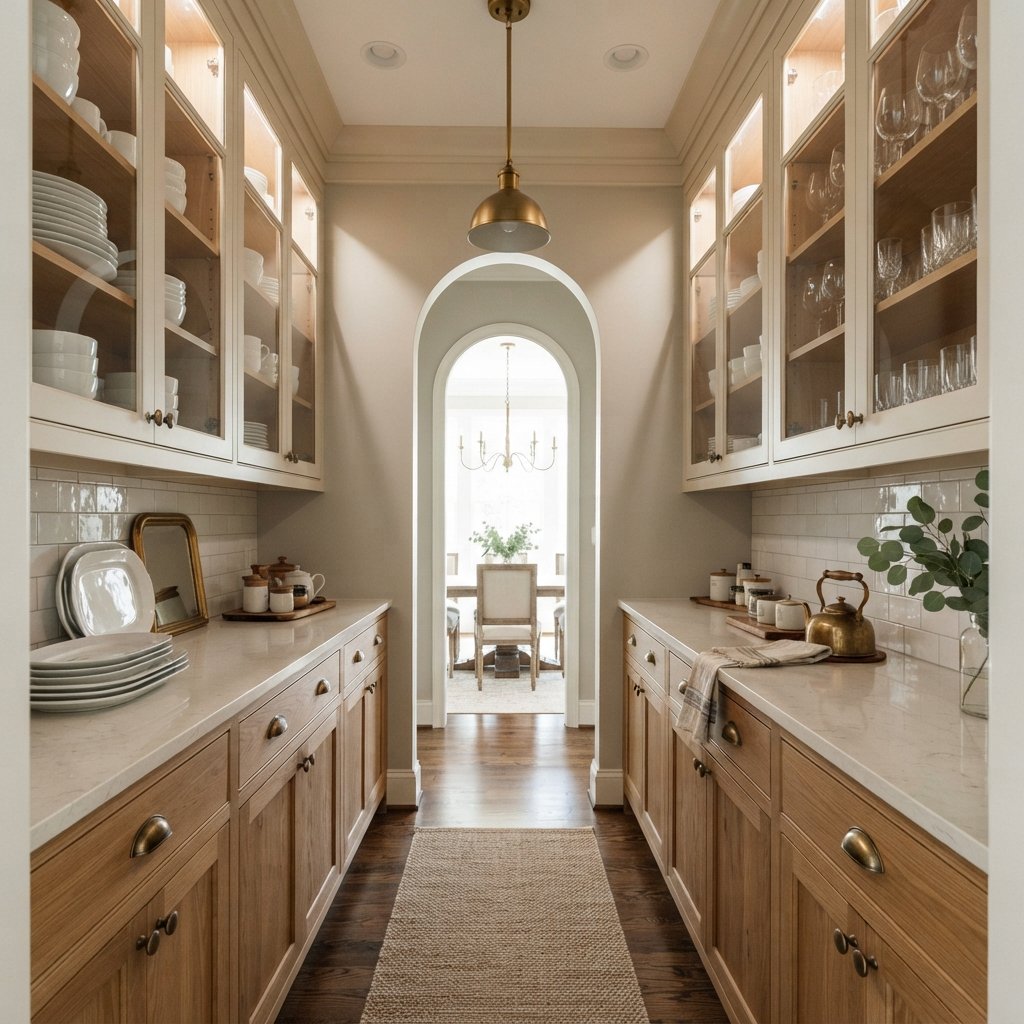
15. Add Glass-Front Cabinets
Glass doors can make a narrow butler’s pantry feel more open.
They’re especially useful for displaying:
- Glassware
- White dishes
- Serving bowls
- Pretty pitchers
But remember that glass-front cabinets put their contents on display.
Use solid doors for less attractive necessities.
16. Use Open Shelving Selectively
Open shelves can make frequently used items easy to reach.
They’re good for:
- Mugs
- Bowls
- Canisters
- Cookbooks
- Serving boards
But don’t automatically replace all upper cabinets with shelving.
A pantry’s main job is usually storage.
A combination of closed cabinets and one or two open shelves often provides the best balance.
17. Add a Pantry Ladder Only When It Makes Sense
Library-style ladders look beautiful in tall pantries, but they’re not automatically practical.
If cabinetry extends well above comfortable reach, a properly designed access solution may be useful.
But don’t add a decorative ladder that creates a tripping hazard or isn’t designed for climbing.
Follow manufacturer installation, use, and weight guidance for any ladder system.
18. Create a Serving Station
If the pantry connects the kitchen and dining room, use part of the countertop as a serving area.
This can provide a temporary location for:
- Desserts
- Drinks
- Serving platters
- Coffee
Keeping some counter space intentionally empty makes the pantry more flexible.
Don’t fill every inch with decorative accessories.
19. Store Entertaining Pieces Here
Instead of squeezing serving pieces into everyday kitchen cabinets, dedicate part of the pantry to entertaining.
Store:
- Platters
- Pitchers
- Serving bowls
- Cake stands
- Table linens
- Seasonal dishes
Group similar items together.
This makes setting the table much easier.
20. Add Lighting Inside Cabinets
Lighting can make a small pantry feel more polished while also improving visibility.
Options may include:
- Under-cabinet lighting
- Interior cabinet lighting
- Shelf lighting
- Ceiling lighting
- Decorative fixture
Use lighting products suitable for the installation and follow electrical and manufacturer requirements.
Hardwired electrical work should be handled by a qualified professional where appropriate.
21. Add a Beautiful Ceiling Light
A butler’s pantry doesn’t need to rely on a generic ceiling fixture.
A small pendant, flush mount, or semi-flush fixture can add personality.
Choose a fixture scaled to:
- Ceiling height
- Walkway
- Cabinet doors
- Room dimensions
In a narrow pantry, avoid a fixture that hangs so low it interferes with movement.
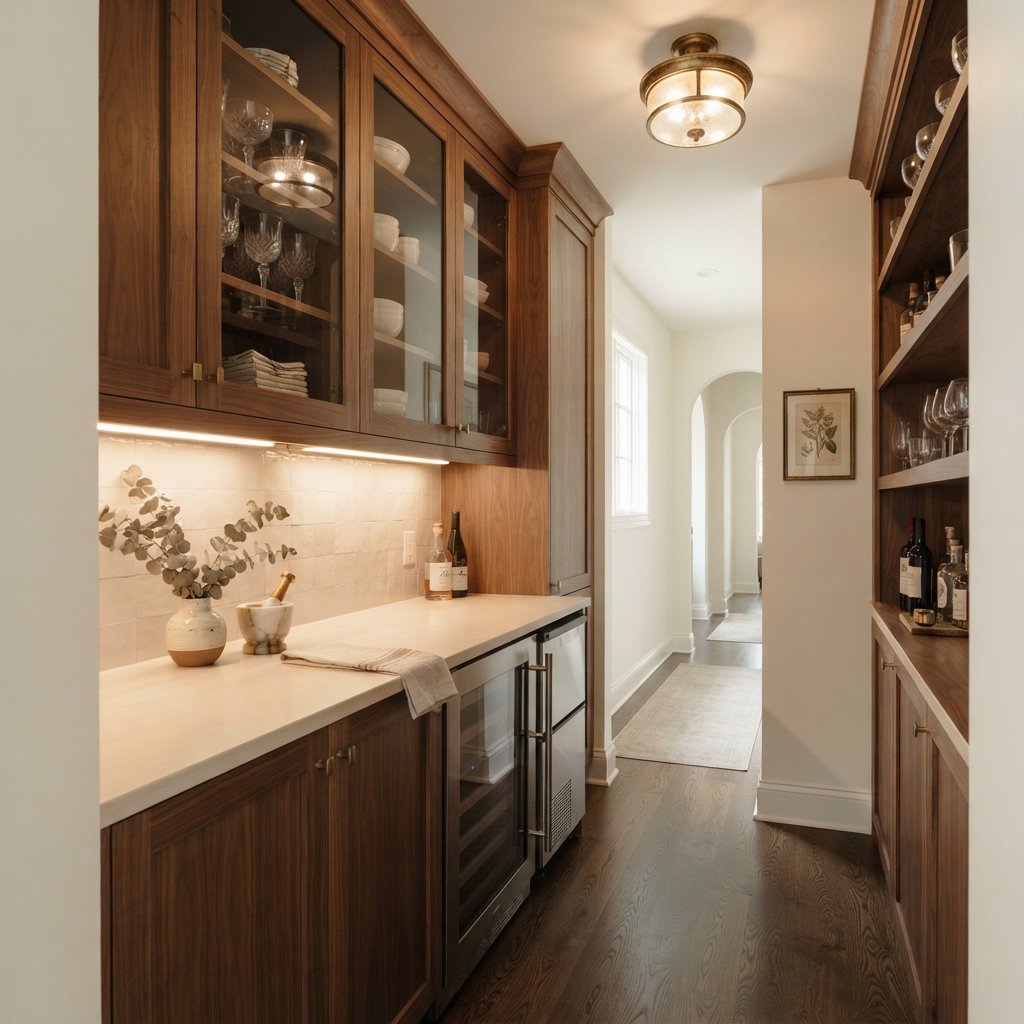
Small Butler’s Pantry Ideas
A butler’s pantry doesn’t have to be a separate room.
If you have a narrow area between the kitchen and dining room, consider cabinetry along one wall.
A small setup might include:
Base cabinets + countertop + upper cabinets
That’s enough to provide valuable storage and serving space.
You could also transform:
- Unused hallway niche
- Closet
- Oversized pantry
- Section of kitchen cabinetry
The goal is functionality, not square footage.
Butler’s Pantry in a Hallway
A pass-through pantry can work particularly well between the kitchen and dining room.
Keep circulation in mind.
Avoid cabinet depths, hardware, open doors, or appliance doors that make the passage uncomfortable or unsafe.
A single-wall arrangement may work better than cabinets on both sides when space is limited.
Butler’s Pantry Without a Sink
You absolutely don’t need a sink.
A dry butler’s pantry can still provide:
- Food storage
- Coffee station
- Appliance storage
- Serving counter
- Beverage refrigerator
- Dish storage
Skipping plumbing may also simplify a renovation.
Butler’s Pantry Without Upper Cabinets
If you want a more open look, combine lower cabinetry with shelving.
This can work especially well when the pantry is primarily a beverage or serving station.
Just make sure you’re not giving up storage you actually need for the sake of appearance.
Butler’s Pantry With a Window
Natural light can make a small pantry feel wonderful.
If there’s a window, design cabinetry around it rather than automatically covering it.
A countertop beneath the window can become:
- Prep zone
- Coffee area
- Serving surface
Avoid blocking required window access or egress where applicable.
Butler’s Pantry With a Pocket Door
A pocket door can be useful where a swinging door would consume valuable floor space.
However, pocket-door walls require appropriate framing and can’t simply accommodate plumbing, electrical components, or structural elements wherever you want.
Plan the door early in the design process.
Butler’s Pantry Door Ideas
Depending on the layout, you might use:
- Standard paneled door
- Pocket door
- Glass door
- Arched opening
- No door
A glass door can visually connect the pantry to the kitchen.
A solid door allows you to hide clutter.
Neither is inherently better.
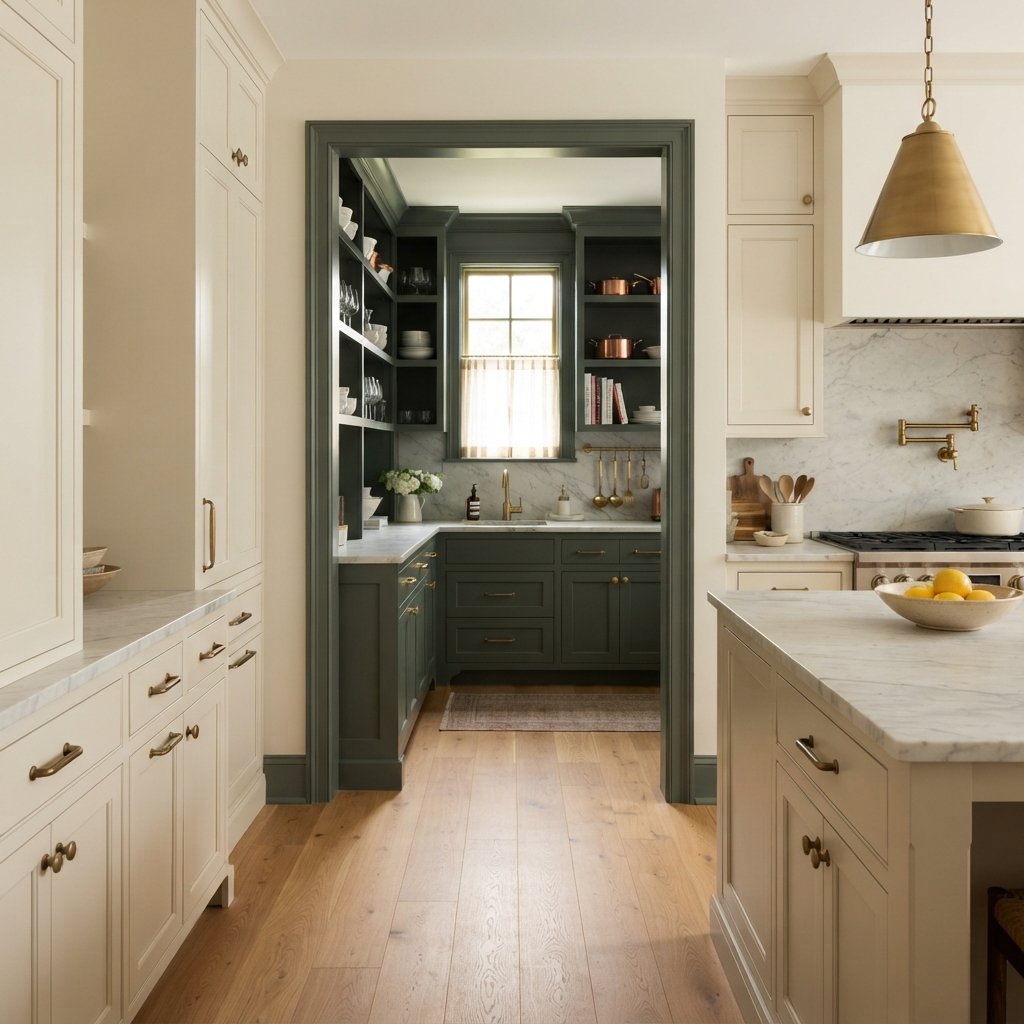
Should a Butler’s Pantry Match the Kitchen?
It can, but it doesn’t have to.
Matching cabinetry creates continuity.
Contrasting cabinetry creates personality.
For example:
White kitchen + walnut pantry
or:
Wood kitchen + deep green pantry
can work beautifully.
Connect the rooms with one or two repeated elements such as:
- Hardware
- Flooring
- Countertop
- Wall color
- Wood tone
Butler’s Pantry Color Ideas
A pantry is a good place to add color.
Try:
Warm and Neutral
Cream, mushroom, taupe, warm white.
Earthy
Sage, olive, warm brown.
Dramatic
Forest green, navy, burgundy, charcoal.
Natural
Oak, walnut, or other wood finishes.
Sample paint and cabinet finishes in the actual room.
A small pantry with limited natural light can make colors appear significantly different from a bright kitchen.
How to Organize a Butler’s Pantry
Start by creating zones.
Everyday Food
Keep frequently used food within easy reach.
Baking
Store flour, sugar, baking tools, and mixer near each other.
Breakfast
Group cereal, oatmeal, bread, and related items.
Coffee
Keep mugs and supplies near the coffee maker.
Entertaining
Group serving pieces and table linens.
Appliances
Give each frequently used appliance a designated location.
The exact categories should reflect your household.
Don’t Overdo the Storage Containers
Matching jars and baskets look beautiful, but transferring everything into a container can create extra work.
Use containers where they solve a problem.
They’re particularly useful for:
- Small snack packets
- Baking supplies
- Bulk food
- Awkward packages
Keep other products in their original packaging if that’s easier for your household.
How Deep Should Butler’s Pantry Cabinets Be?
There isn’t one correct dimension for every pantry.
Cabinet and counter depths should be planned around:
- Available room width
- Intended appliances
- Storage needs
- Comfortable circulation
- Manufacturer requirements
This is especially important in narrow pass-through spaces.
Have the actual layout measured and planned rather than assuming standard kitchen dimensions will work everywhere.
What Should You Store in a Butler’s Pantry?
Prioritize things that either don’t fit comfortably in the kitchen or are used together.
Good candidates include:
- Pantry food
- Small appliances
- Serving pieces
- Glassware
- Table linens
- Baking supplies
- Coffee supplies
- Entertaining accessories
Avoid turning the pantry into a miscellaneous dumping ground.
Common Butler’s Pantry Design Mistakes
Designing It Before Deciding What Goes Inside
Inventory first.
Adding Too Many Appliances
Each appliance requires space and may require specific electrical or ventilation considerations.
Making a Narrow Walkway Even Narrower
Circulation matters.
Filling Every Counter With Decor
Leave usable workspace.
Using Too Much Open Shelving
A pantry benefits from hidden storage.
Forgetting Task Lighting
Counters need useful illumination.
Choosing Finishes Only for Appearance
Counters, cabinetry, and flooring need to suit actual use.
Ignoring Door Swings
Check cabinet, appliance, room, and dishwasher doors.
Assuming Plumbing Is Easy to Add
A sink or dishwasher can substantially change the scope of a renovation.
Creating Storage That’s Difficult to Reach
Put everyday items where they’re accessible.
FAQ About Butler’s Pantries
What is a butler’s pantry used for?
Modern butler’s pantries may provide food storage, serving space, small-appliance storage, beverage preparation, dish storage, or additional prep space.
Does a butler’s pantry need a sink?
No. A dry butler’s pantry can still be extremely useful. A sink simply adds another function.
What’s the difference between a pantry and a butler’s pantry?
A pantry is typically focused primarily on storage, while a butler’s pantry often includes a countertop and may support serving, beverage preparation, or food prep.
Is a butler’s pantry worth it?
It can be valuable if it solves genuine storage or workflow problems. The usefulness depends on your home’s layout and how you use the kitchen.
Should the butler’s pantry match the kitchen?
It can, but it doesn’t need to. Contrasting cabinetry can create a beautiful secondary space when some materials or finishes are repeated for continuity.
Can you make a small butler’s pantry?
Yes. Even a single wall of base cabinets, countertop, and upper storage near the kitchen can function as a compact butler’s pantry.
What appliances should go in a butler’s pantry?
That depends on your lifestyle. Coffee makers, toasters, mixers, beverage refrigerators, and other small appliances are common possibilities. Always account for electrical, heat, ventilation, clearance, and manufacturer requirements.
Does a butler’s pantry add value?
A functional secondary pantry may be attractive to future buyers, but the financial effect varies by home, market, quality, and project cost. Design it primarily to improve how your household uses the home.
Final Thoughts
A butler’s pantry can be beautiful, but its real value comes from what it does for the rest of your kitchen.
It can hide the toaster and coffee maker.
It can give oversized serving pieces a permanent home.
It can provide additional food storage, free up kitchen counters, create a convenient beverage station, and make entertaining easier.
But you don’t need every possible feature.
A sink, second dishwasher, beverage refrigerator, appliance garage, open shelving, and floor-to-ceiling cabinetry might all look wonderful individually—but adding everything doesn’t automatically make the room more useful.
Start by deciding what problem you’re trying to solve.
Then build the pantry around that need.
For a small home, that might mean a narrow wall of cabinets with a coffee station.
For a family, it could mean floor-to-ceiling food storage and snack drawers.
For someone who loves entertaining, it might mean glassware storage, a beverage refrigerator, and a large serving counter.
Once the function is right, have fun with the design.
Use warm wood, deep green cabinetry, a beautiful backsplash, interesting hardware, or a decorative light to give the pantry personality.
When storage, workflow, and style are planned together, a butler’s pantry can become much more than an extra room off the kitchen.
It can become the space that helps the entire kitchen work better.