

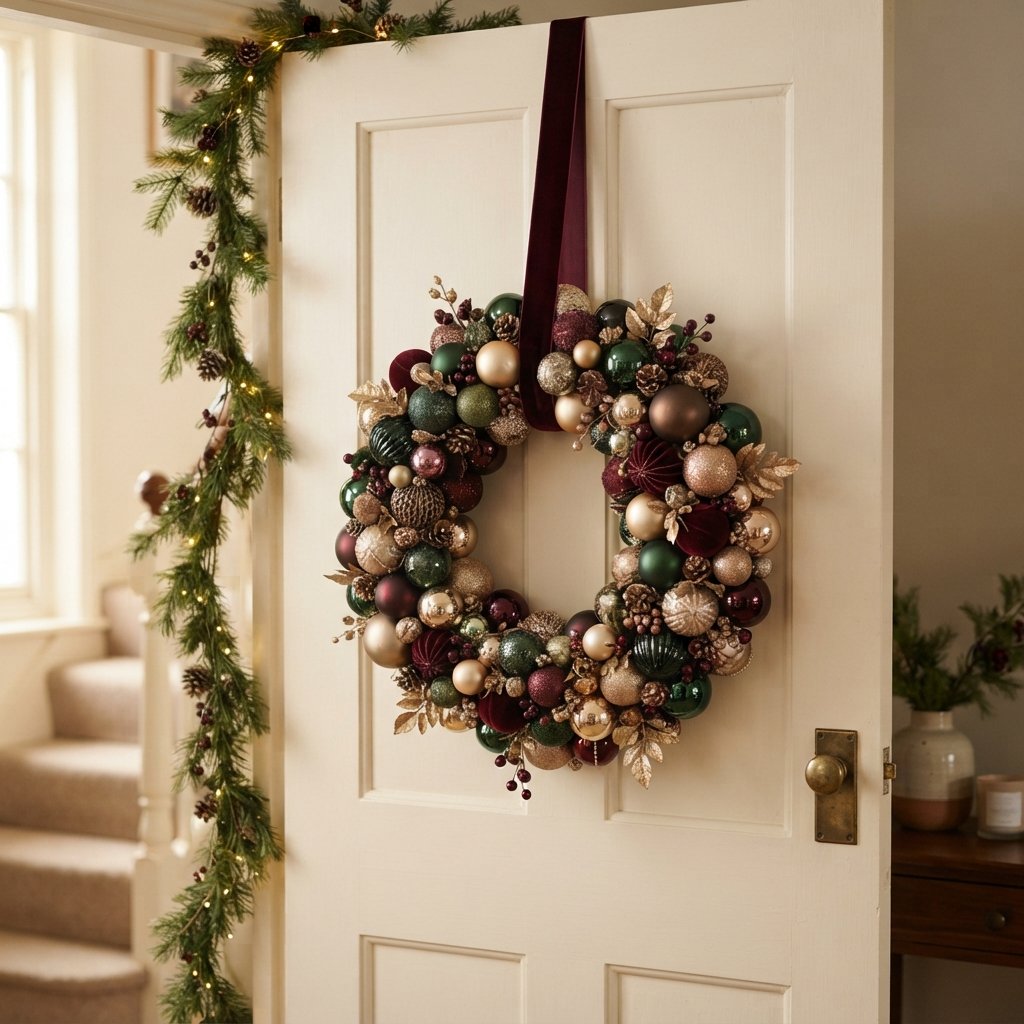
An ornament wreath is one of those Christmas decorations that can look surprisingly impressive without requiring complicated crafting skills.
Instead of greenery, the wreath is covered with Christmas ornaments in different sizes, finishes, and sometimes colors. The result can be traditional and colorful, soft and elegant, vintage-inspired, or completely modern depending on the ornaments you choose.
Even better, a DIY ornament wreath is easy to customize.
You can make one with classic red and gold ornaments, use silver and champagne for a sophisticated look, mix jewel tones for something dramatic, or stick with several shades of one color for a more modern holiday wreath.
The trick to making an ornament wreath look full rather than sparse is layering.
Larger ornaments establish the overall shape. Medium ornaments fill most of the remaining space. Tiny ornaments tuck into awkward gaps and hide the wreath form underneath.
With a little planning, you can create a Christmas ornament wreath that looks beautifully collected instead of randomly assembled.
Here is how to make one, plus plenty of ideas for choosing colors, arranging ornaments, adding ribbon, and displaying your finished wreath.
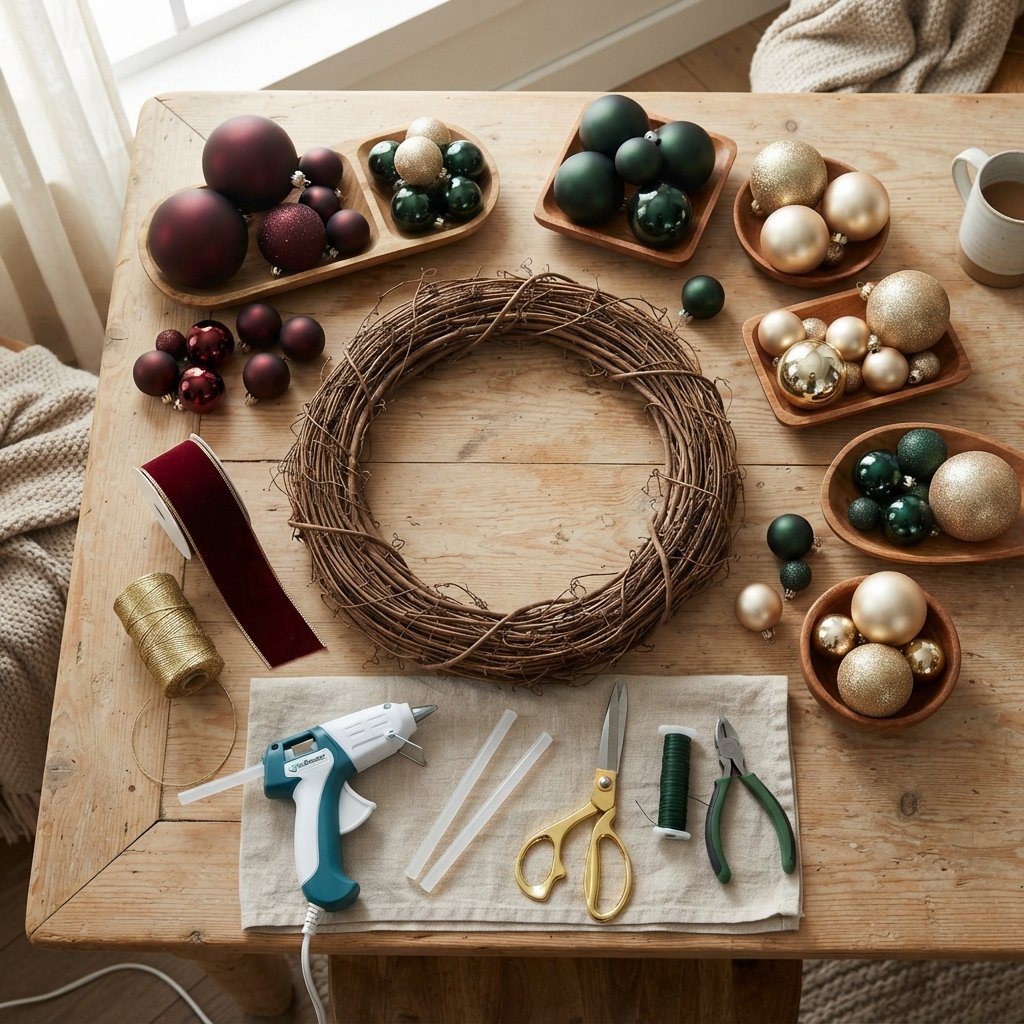
Supplies for a DIY Ornament Wreath
Your exact supplies will depend on the size and construction method, but you may need:
- Wreath form
- Christmas ornaments in several sizes
- Hot glue gun and appropriate glue sticks
- Ribbon for hanging
- Floral wire if needed
- Wire cutters if using wire
- Scissors
- Protective work surface
Optional additions include:
- Velvet ribbon
- Small decorative bells
- Pinecones
- Faux greenery
- Berries
- Decorative picks
For a wreath that may be exposed to outdoor conditions, make sure every material and adhesive is appropriate for that environment.
Many decorative ornaments and craft adhesives are intended primarily for indoor use.
What Kind of Wreath Form Should You Use?
Several wreath bases can work.
Depending on your preferred construction method, you might use:
Foam Wreath Form
Provides a substantial base and makes it easy to build a rounded wreath.
Wire Wreath Form
Lightweight and useful for methods that involve wiring or attaching ornaments around the frame.
Grapevine Wreath
Works especially well if you want some natural texture to remain visible.
The best option depends on whether you plan to glue, wire, or otherwise secure the ornaments.
Whatever you choose, remember that the finished wreath may become surprisingly heavy.
Plan the hanging method accordingly.
How Many Ornaments Do You Need?
There is no universal number because it depends on:
- Wreath diameter
- Ornament sizes
- Wreath-form thickness
- Whether you cover the back
- How tightly ornaments are packed
- Whether you add greenery or ribbon
Instead of shopping by a fixed number, think in proportions.
Buy the most ornaments in your medium size.
Then use fewer large ornaments and plenty of small ornaments for filling gaps.
It is useful to have a few extras because the smaller ornaments often make the biggest difference at the end.
How to Make an Ornament Wreath
1. Choose Your Color Palette
Before attaching anything, decide on the overall look.
Limiting the palette makes it much easier to create a cohesive wreath.
Try combinations such as:
- Red + gold + green
- Burgundy + forest green + gold
- Champagne + cream + gold
- Silver + white + pale blue
- Pink + champagne + cream
- Navy + silver + white
- Mixed jewel tones
- Multicolor vintage-inspired ornaments
You can also create a monochromatic wreath using several shades of one color.
For example, mix deep green, emerald, olive, and pale sage ornaments.
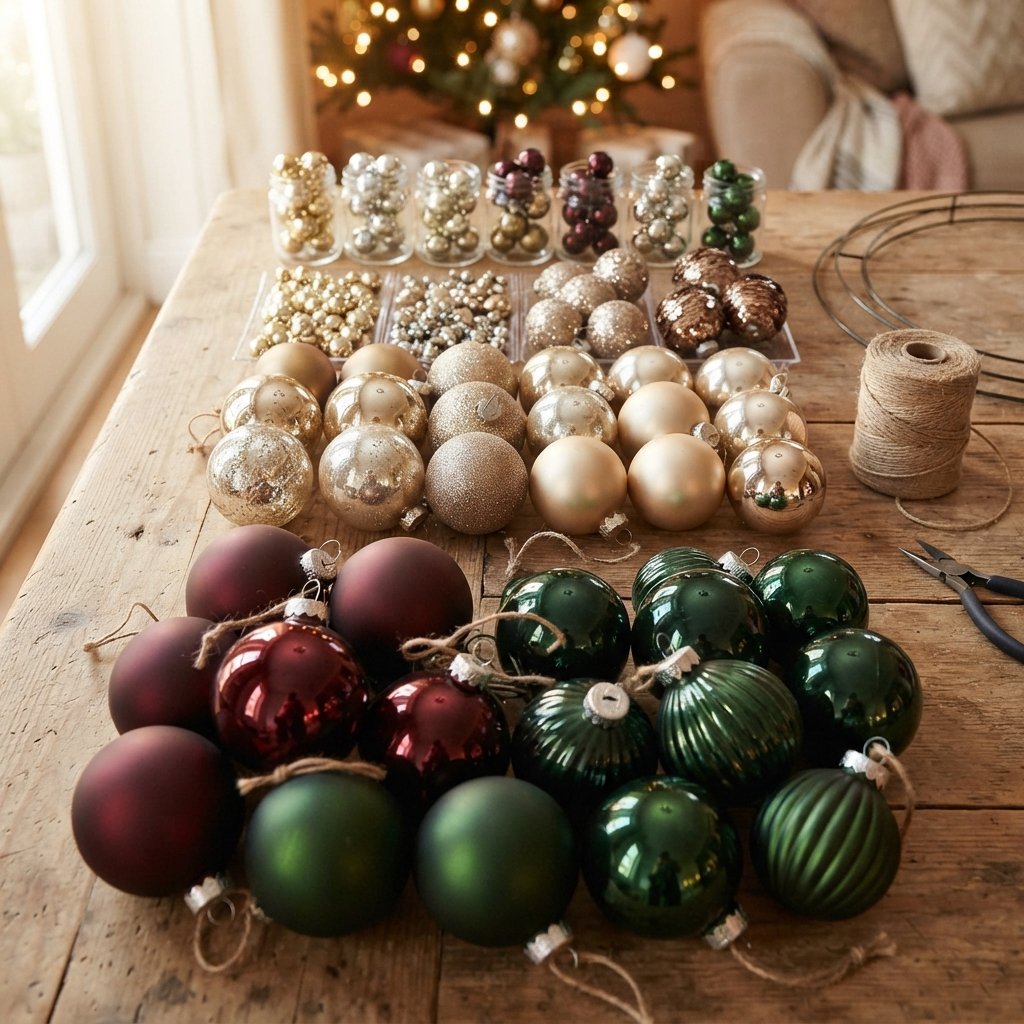
2. Mix Ornament Finishes
A beautiful wreath does not need dozens of colors.
Texture can create just as much visual interest.
Combine:
- Matte
- Shiny
- Metallic
- Glittered
- Frosted
- Ribbed or textured
If every ornament has the same glossy finish, the wreath can sometimes look flatter.
Mixing finishes helps individual ornaments stand out while keeping the palette controlled.
3. Choose Several Ornament Sizes
This step makes a major difference.
Use:
Large Ornaments
To establish the overall composition.
Medium Ornaments
To cover most of the wreath.
Small Ornaments
To fill gaps and create a finished look.
Tiny ornaments are particularly helpful around awkward spaces where two larger ornaments meet.
4. Protect Your Work Surface
Before using adhesive, cover your table.
Hot glue can drip through spaces between ornaments, and glitter can spread surprisingly far.
Keep extra glue sticks, small ornaments, and tools within reach.
If using hot glue, follow the glue gun manufacturer’s instructions and protect your skin from burns.
5. Prepare the Wreath Form
Depending on your wreath base and design, you may want to cover or paint areas that could remain visible between ornaments.
A base color similar to your ornament palette can make small gaps less noticeable.
For example, a dark green base can work beneath a green, burgundy, and gold wreath.
If using paint or another coating, confirm that it is compatible with the wreath material and allow it to dry completely according to product instructions.
6. Lay Out the Largest Ornaments First
Do not start gluing immediately.
Place the largest ornaments loosely around the wreath to determine their spacing.
Avoid arranging them in a perfectly predictable pattern.
Instead, distribute them around the wreath so the visual weight feels balanced.
Step back occasionally and look at the entire composition.
The wreath should feel balanced without looking perfectly symmetrical.
7. Secure the Large Ornaments
Once you are happy with the placement, begin attaching the larger ornaments using a method appropriate for the wreath form and ornaments.
If using hot glue, apply it carefully according to the glue gun and adhesive instructions.
Some ornament materials can deform or react to heat, so test your method on an extra ornament if necessary.
If using wire, make sure ornaments are firmly secured without creating sharp exposed ends.
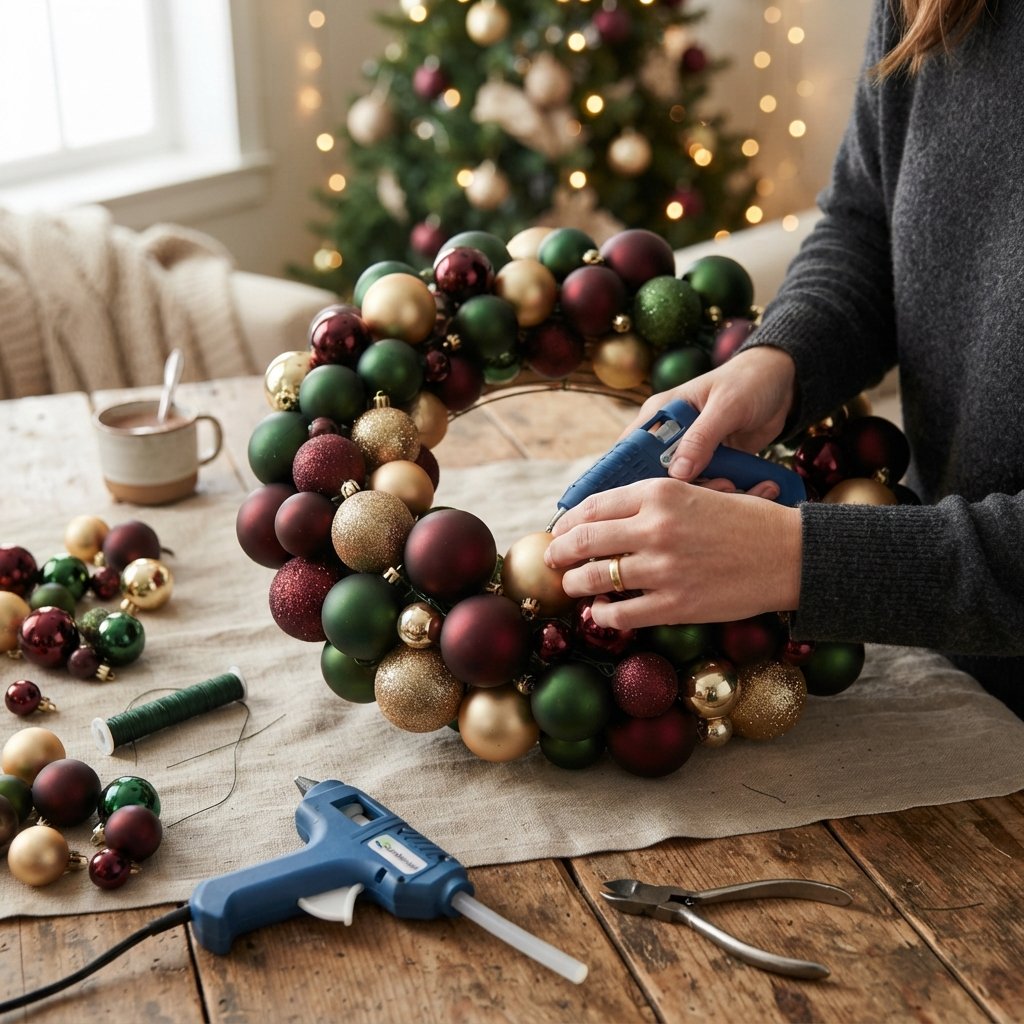
8. Add Medium Ornaments
Now fill the spaces between the large ornaments.
This is where the wreath begins to look full.
Rotate colors and finishes rather than grouping every identical ornament together.
For example, if two glossy ornaments are next to each other, add a matte or textured ornament nearby.
This creates more visual variation.
9. Build Out the Outer and Inner Edges
Do not concentrate only on the front surface.
Look at the outer perimeter and the inside opening.
Adding ornaments around these edges helps disguise the wreath form and creates a fuller, more dimensional silhouette.
Turn the wreath occasionally as you work.
Viewing it from different angles helps reveal gaps you might miss from directly above.
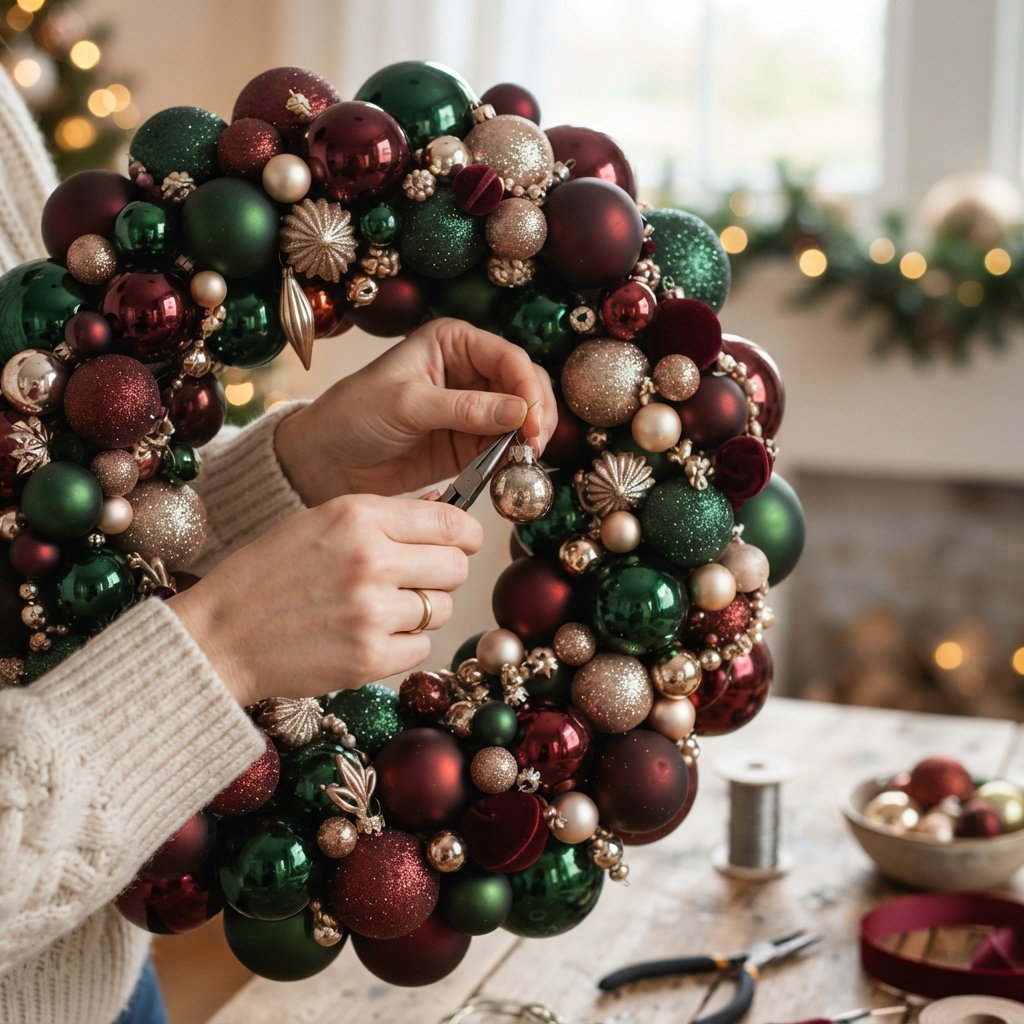
10. Fill Small Gaps
Once the large and medium ornaments are attached, you will probably see small spaces.
This is exactly why you need miniature ornaments.
Tuck them between larger ornaments to hide:
- Wreath form
- Adhesive
- Awkward openings
- Uneven transitions
Small ornaments can make a wreath look significantly more polished.
Do not feel obligated to fill every tiny space.
A little depth between ornaments can keep the arrangement from looking like one flat surface.
11. Add Decorative Accents
Once the ornaments are finished, decide whether the wreath needs anything else.
You could add a small amount of:
- Faux greenery
- Berries
- Bells
- Pinecones
- Decorative stems
Use restraint.
The ornaments should remain the main feature.
If the wreath already feels full and balanced, you may not need any additional decorations.
12. Add a Ribbon
Ribbon can completely change the style of an ornament wreath.
Try:
- Velvet
- Satin
- Grosgrain
- Tartan
- Simple solid ribbon
You can create a bow, use ribbon only as a hanger, or skip visible ribbon entirely.
A wide velvet ribbon works especially well with elegant ornament wreaths.
13. Check the Wreath From a Distance
Before calling it finished, prop the wreath upright.
Look at it from several feet away.
Check for:
- Large empty areas
- Too much of one color
- Clusters of identical finishes
- Visible wreath form
- Uneven silhouette
Make small adjustments rather than automatically adding more ornaments everywhere.
14. Attach a Secure Hanger
An ornament wreath can become heavy.
Use a hanging method appropriate for:
- Wreath weight
- Door or wall material
- Hanging hardware
- Location
Do not assume a lightweight adhesive hook can safely hold a heavy ornament wreath.
Check the rated capacity and surface requirements of any hanging product you use.
Red and Gold Ornament Wreath
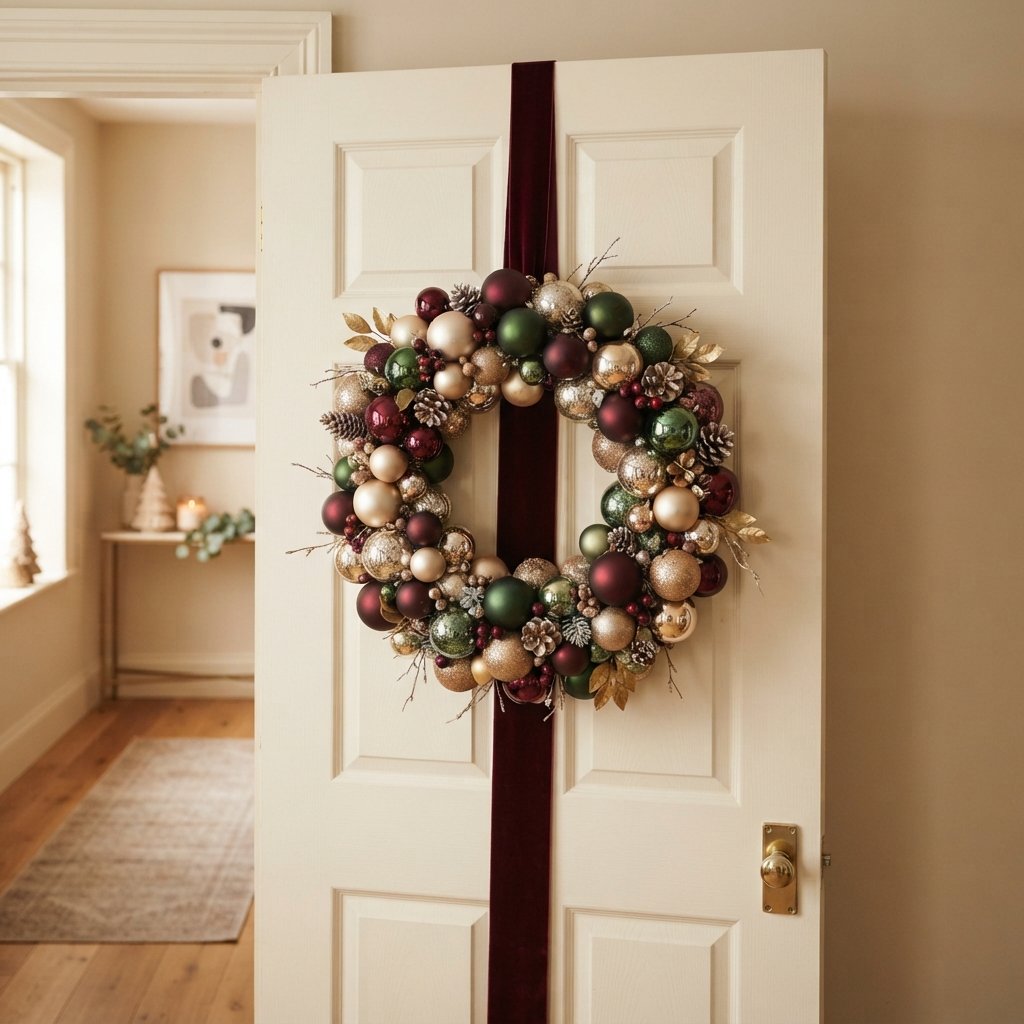
Red and gold is one of the most classic Christmas combinations.
To keep it from looking flat, use several reds:
- Deep red
- Burgundy
- Cranberry
- Bright traditional red
Then mix metallic gold with champagne.
A few dark green ornaments can add depth and connect the wreath to other Christmas greenery in the room.
Green and Gold Ornament Wreath
A green ornament wreath can feel elegant without being overly colorful.
Combine:
- Forest green
- Emerald
- Olive
- Antique gold
- Champagne
Use both shiny and matte ornaments.
A deep green velvet ribbon makes a beautiful finishing detail.
Burgundy and Green Ornament Wreath
Burgundy and dark green create a rich, traditional Christmas palette.
Add antique gold rather than bright yellow-gold for a softer, more sophisticated look.
Try approximately three main colors with several variations in finish rather than adding lots of unrelated shades.
This palette works beautifully with warm white walls, wood doors, brass accents, and natural greenery.
Silver and White Ornament Wreath
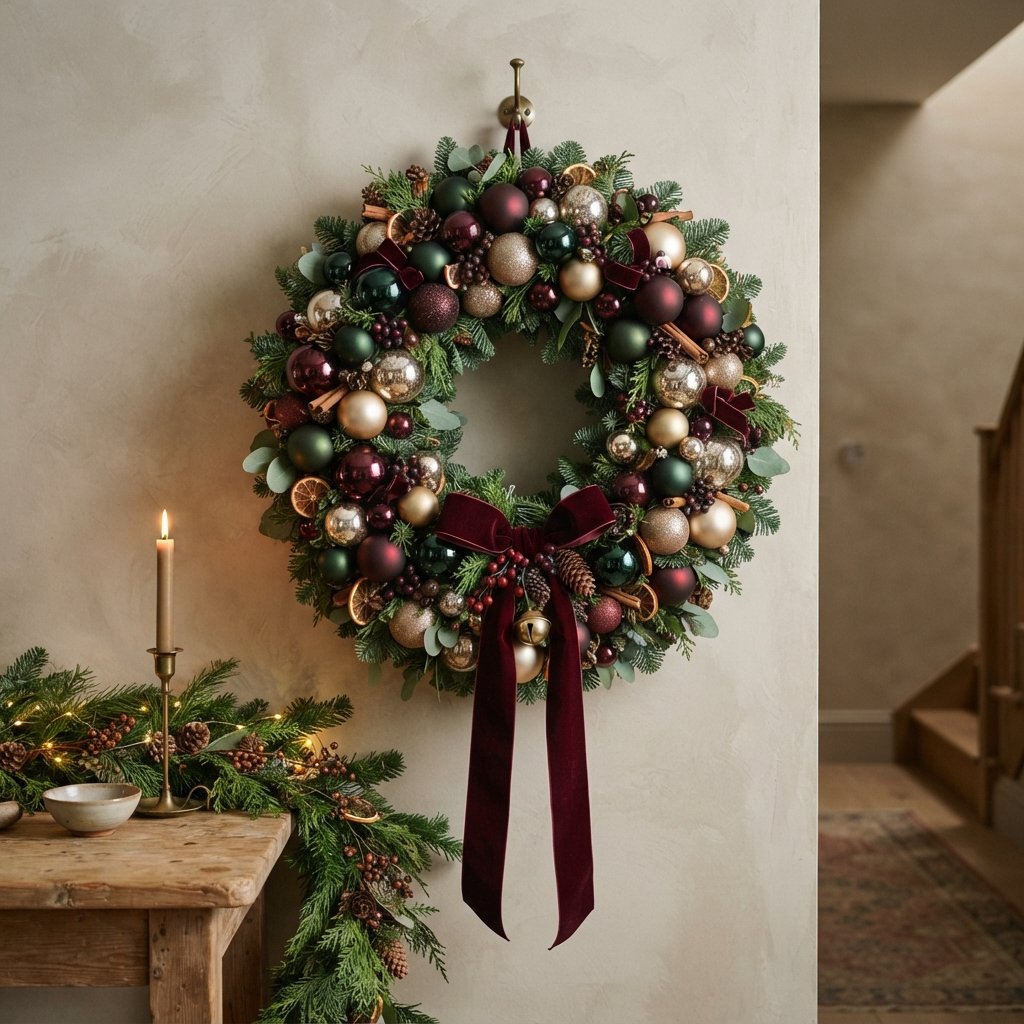
For a cooler Christmas palette, combine white with:
- Silver
- Pewter
- Pearl
- Frosted clear ornaments
Mix glossy and matte surfaces so the wreath does not disappear into one pale mass.
A few charcoal or pale blue ornaments can add definition if desired.
Pink Ornament Wreath
Pink can create a playful or elegant Christmas wreath depending on the shades.
For a softer look, combine:
- Blush
- Dusty rose
- Champagne
- Cream
For something more dramatic, use:
- Hot pink
- Burgundy
- Red
- Gold
Keep the rest of the Christmas decor relatively restrained if the wreath is highly colorful.
Colorful Vintage-Inspired Ornament Wreath
A multicolor ornament wreath is perfect if you love nostalgic Christmas decor.
Use a mixture of:
- Red
- Green
- Pink
- Blue
- Gold
- Silver
The key is repeating colors throughout the wreath.
If every ornament is completely different, the result can feel random.
Repeating each major color several times creates visual rhythm.
Monochromatic Ornament Wreath
A one-color wreath can be surprisingly dramatic.
Choose one color and vary:
- Shade
- Size
- Finish
- Texture
For example, a green wreath might contain sage, olive, forest, emerald, and metallic green ornaments.
This creates depth without introducing multiple competing colors.
Ornament Wreath With Ribbon
Ribbon can be used in several ways.
Hanging Ribbon
Simple and elegant.
Large Bow
Creates a traditional focal point.
Small Tailored Bow
More understated.
Ribbon Woven Through the Wreath
Creates additional texture, although it can make an already full wreath feel busy.
If the ornaments are colorful, a solid ribbon is usually easiest to coordinate.
Ornament Wreath Without Ribbon
You do not need a bow.
A wreath made entirely from ornaments can feel cleaner and more modern.
Use an appropriate hidden hanging system so the wreath appears to float against the door or wall.
This works particularly well with monochromatic or metallic wreaths.
How to Make an Ornament Wreath Look Full
Use Multiple Ornament Sizes
This is the most important trick.
Cover the Inner Edge
Do not leave the center ring unfinished.
Cover the Outer Edge
Build dimension around the perimeter.
Use Tiny Ornaments
They fill difficult spaces.
Mix Finishes
Variation adds visual depth.
Rotate the Wreath as You Work
Look for gaps from every angle.
Do Not Arrange Everything in Rows
A slightly irregular layout looks more natural.
How to Make an Ornament Wreath Look Expensive
You do not necessarily need expensive ornaments.
Focus on the overall composition.
Limit the Color Palette
Two to four related colors can feel more cohesive.
Use Different Finishes
Combine matte, glossy, metallic, and textured ornaments.
Include Several Sizes
Scale variation creates depth.
Choose a Rich Ribbon
A simple velvet ribbon can elevate the finished look.
Hide the Base
Visible foam or wire makes the wreath look unfinished.
Avoid Perfect Symmetry
Balanced is better than rigid.
Stop Before It Becomes Too Busy
More decoration is not always better.
Budget Ornament Wreath Ideas
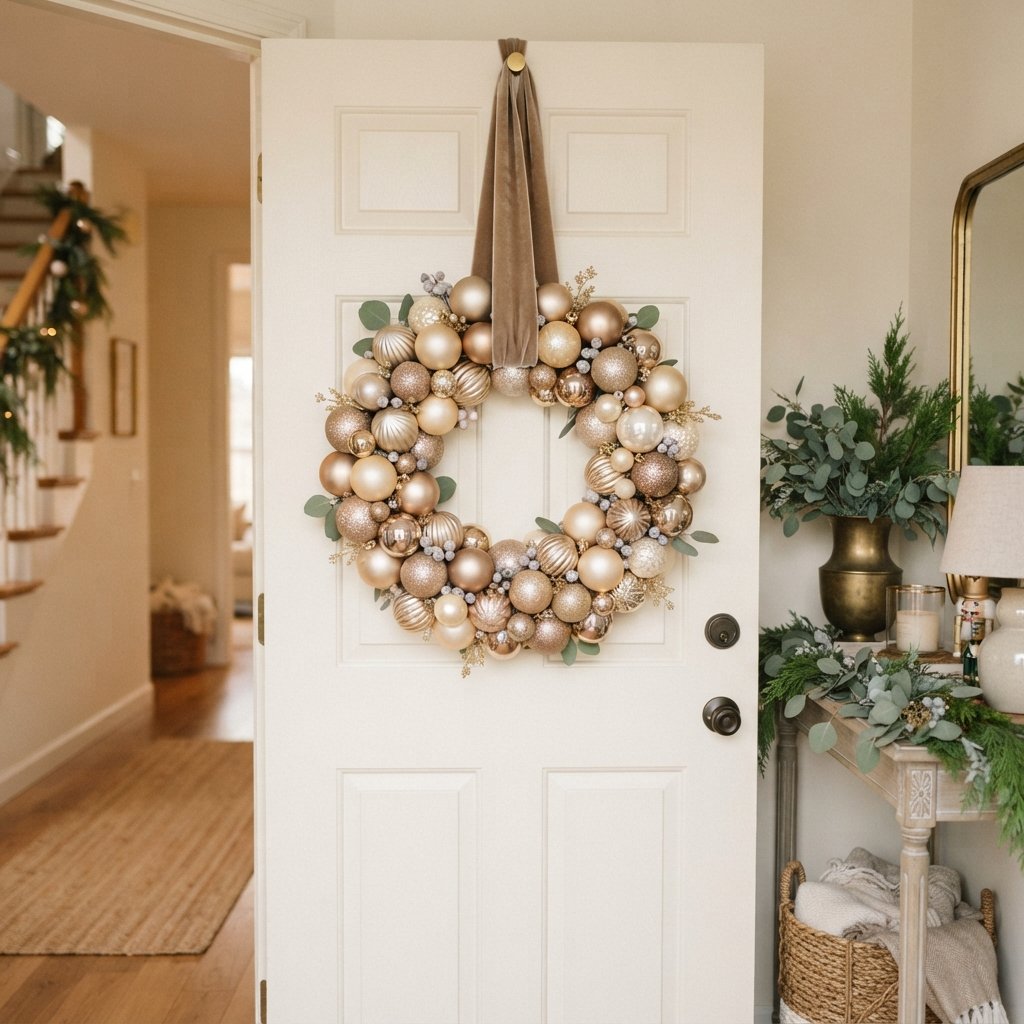
Ornament wreaths can use a surprising number of ornaments, so material costs can add up.
To save money:
- Reuse ornaments you already own
- Mix inexpensive plain ornaments with a few decorative ones
- Shop post-holiday clearance for a future project
- Use small ornaments strategically to fill spaces
- Add ribbon you already have
- Keep the back less decorated if it will never be visible
A mixture of simple and decorative ornaments often looks better than using elaborate ornaments everywhere.
Can You Make an Ornament Wreath With Plastic Ornaments?
Shatter-resistant ornaments can be practical for this project.
They are generally lighter and less fragile than glass ornaments, which can make crafting and storage easier.
However, check the material before using hot glue or other adhesives because compatibility varies.
Test the attachment method if you are unsure.
Can You Use Glass Ornaments?
You can incorporate glass ornaments, but they require extra care.
They can break while crafting, hanging, storing, or if the wreath falls.
For doors that are frequently opened and closed, lightweight shatter-resistant ornaments may be more practical.
If you do use glass, consider limiting it to a few special ornaments and handle them carefully.
Can an Ornament Wreath Go Outside?
That depends on the materials.
Many ornaments are designed for indoor Christmas trees and may not tolerate:
- Rain
- Humidity
- Strong sunlight
- Freezing temperatures
- Heat
- Wind
Hot glue and decorative finishes can also fail outdoors.
For an exterior door, choose materials and attachment methods specifically suitable for the expected weather conditions.
A covered porch still experiences temperature and humidity changes.
How to Hang an Ornament Wreath on a Door
Options may include:
- Over-the-door wreath hanger
- Appropriately rated removable hook
- Ribbon secured by a suitable method
- Permanent hook where appropriate
Choose based on the door material, wreath weight, and hanging hardware rating.
Make sure the wreath does not interfere with the door’s operation, lock, peephole, or weather sealing.
How to Store an Ornament Wreath
Storage matters because ornaments can become loose or damaged.
Store the wreath:
- In a sturdy container
- In a dry location
- Away from crushing pressure
- Protected from extreme temperatures where required by the materials
Avoid placing heavy Christmas bins directly on top of it.
Before storing, check for loose ornaments and repair them.
Common Ornament Wreath Mistakes
Using Only One Ornament Size
The wreath can look flat or leave awkward gaps.
Attaching Ornaments Before Planning the Colors
Lay out the main ornaments first.
Forgetting the Inner Edge
The exposed wreath form will be visible.
Forgetting the Outer Edge
A full perimeter creates dimension.
Using Too Many Colors Without Repetition
Repeat colors throughout the wreath.
Adding Too Many Decorative Picks
Let the ornaments remain the focal point.
Using Inappropriate Adhesive
Make sure it works with the ornament and wreath materials.
Underestimating the Finished Weight
Plan the hanging system before installation.
Using Indoor Materials Outdoors
Weather can damage finishes and weaken attachments.
Ornament Wreath Safety Tips
Use hot glue guns according to manufacturer instructions and protect your skin and work surface from hot adhesive.
Keep hot glue guns, wire, scissors, broken ornaments, and other crafting tools away from children and pets.
If using glass ornaments, inspect them for cracks and handle them carefully. Dispose of broken glass safely.
If using wire, tuck or cover sharp ends so they cannot scratch hands, doors, or walls.
Secure every ornament appropriately. Loose ornaments can fall when the wreath is moved or when a door closes.
Use hanging hardware rated for the finished wreath weight and appropriate for the mounting surface.
Keep wreaths away from open flames, candles, fireplaces, heaters, and other heat sources unless all materials and placement are specifically suitable.
If displaying the wreath outdoors, verify that the ornaments, wreath form, adhesive, ribbon, and hanging method are appropriate for the conditions.
FAQ About Ornament Wreaths
How do you make an ornament wreath look full?
Use ornaments in several sizes. Place large ornaments first, fill around them with medium ornaments, and use miniature ornaments to close small gaps.
What colors look good on an ornament wreath?
Classic combinations include red and gold, green and gold, burgundy and green, silver and white, and champagne and cream. You can also create a colorful vintage-inspired wreath or use several shades of one color.
Do ornament wreaths need a bow?
No. A bow creates a more traditional look, while a wreath without a bow can feel simpler and more modern.
What type of ornaments should I use?
Lightweight, shatter-resistant ornaments are often convenient for wreath making. Mix sizes and finishes for a layered look.
Can I use old Christmas ornaments?
Absolutely. An ornament wreath is a useful way to repurpose ornaments that no longer fit your Christmas tree decor.
How do I fill gaps in an ornament wreath?
Use miniature ornaments, small bells, or another lightweight coordinating element. Tiny ornaments are particularly useful because they maintain the overall ornament-covered appearance.
Can I hang an ornament wreath outside?
Only if the materials and attachment method are suitable for outdoor conditions. Many standard ornaments and craft adhesives are intended for indoor use.
How do you store an ornament wreath?
Place it in a sturdy wreath box or container where it will not be crushed. Store according to the temperature and moisture requirements of the materials used.
Final Thoughts
A DIY ornament wreath is an easy way to turn a collection of Christmas ornaments into a statement holiday decoration.
And the project can be as traditional or modern as you want.
Use red, green, and gold for a classic Christmas wreath. Combine burgundy, forest green, and antique gold for something rich and elegant. Choose champagne and cream for a neutral look, or bring together a rainbow of vintage-inspired ornaments for a cheerful, nostalgic wreath.
Whatever palette you choose, the technique is similar.
Start with the largest ornaments.
Fill the main spaces with medium ornaments.
Then use those tiny ornaments to disguise the wreath form and create a full, dimensional shape.
Mix matte, glossy, metallic, and textured finishes so the wreath catches the light in different ways.
Finally, add a ribbon or a few simple accents if the wreath needs them.
The result is a Christmas decoration you can bring out year after year—and one that can be completely customized to match the rest of your holiday decor.