

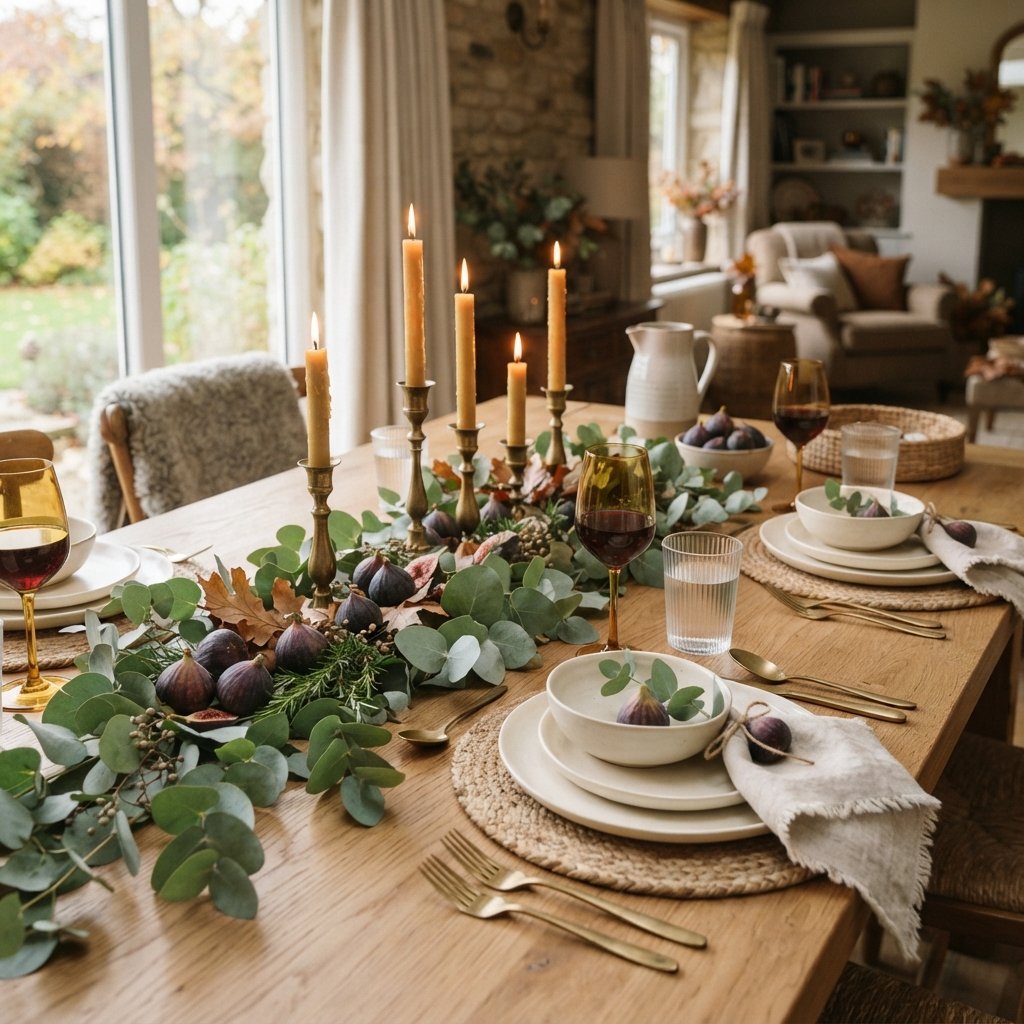
Fall table decor doesn’t have to mean covering the dining room with orange pumpkins and autumn leaves.
If you prefer something a little softer, a fall table setting with figs and eucalyptus creates a beautiful seasonal look using rich natural color, fresh greenery, simple dishes, and plenty of texture.
Deep purple figs naturally bring in those moody fall tones, while eucalyptus keeps the arrangement loose and organic. Add warm neutrals, linen napkins, candles, and a few wood or brass accents, and you have a table that feels seasonal without being overly themed.
It’s also an easy tablescape to adapt.
You can make it casual for an early fall dinner, dress it up for Thanksgiving, or simplify it for an everyday dining table.
The key is keeping the centerpiece low, using the figs intentionally rather than scattering them everywhere, and repeating a few colors throughout the place settings.
Here’s how to create a simple fall table setting using figs and eucalyptus, along with ideas for dishes, linens, candles, centerpieces, and inexpensive ways to get the same look.
Why Figs and Eucalyptus Work for Fall
Figs have a naturally autumnal palette.
Depending on the variety and ripeness, their skins may contain shades of:
- Deep purple
- Burgundy
- Brown
- Green
- Plum
Inside, the fruit can reveal beautiful shades of rose, ruby, and cream.
Eucalyptus provides contrast.
Its soft green or silvery foliage prevents all those deeper colors from making the table feel heavy.
Together, they create a palette that feels organic and elegant rather than overtly seasonal.
Choose a Simple Fall Color Palette
Before setting the table, narrow your palette to a few colors.
For this tablescape, a beautiful combination is:
Plum + eucalyptus green + cream + warm wood
Then add small amounts of:
- Brass
- Black
- Brown
- Soft gray
You don’t need every item to match exactly.
Natural variation is part of what makes this style work.
1. Start With a Bare Wood Table
If you have a wood dining table you love, let it become part of the tablescape.
The wood adds warmth and gives the figs and greenery a natural background.
You can skip the tablecloth entirely and use:
- Linen runner
- Placemats
- Individual napkins
This creates a relaxed fall table that doesn’t feel overly formal.
If your table needs protection, choose an appropriate runner, tablecloth, or placemats instead.
2. Or Use a Neutral Linen Tablecloth
A cream, oatmeal, or warm white tablecloth creates a softer look.
Avoid a bright seasonal print if you want the figs and eucalyptus to be the focal point.
A neutral tablecloth also works beautifully when your dining table is dark.
The contrast helps the greenery stand out.

3. Create a Loose Eucalyptus Runner
Instead of a traditional floral centerpiece, run eucalyptus loosely along the center of the table.
The arrangement doesn’t need to be perfectly symmetrical.
Let a few stems extend naturally in different directions.
Depending on the eucalyptus you’re using, you can:
- Lay individual stems along the table
- Group several stems together
- Tuck smaller pieces into the arrangement
Keep the greenery relatively low so guests can easily see across the table.
A Note About Eucalyptus Around Food
Decorative plant material should be handled thoughtfully around food.
Don’t assume ornamental greenery is appropriate for direct food contact.
Keep eucalyptus separate from serving food and plates unless you have reliable information that the specific material and intended use are appropriate.
This is particularly important if children or pets can access the table.
For purely decorative greenery, keeping it in the center of the table and away from food is the simplest approach.
4. Tuck Figs Into the Greenery
Once your eucalyptus is in place, add figs.
Don’t line them up.
Instead, create a few small clusters.
Try:
- One fig beside a candlestick
- Three figs grouped near the center
- A pair tucked beside a small vase
Varying the placement makes the centerpiece feel more organic.
If the figs will be eaten, keep them clean and avoid placing them directly against decorative materials that aren’t intended for food contact.
Alternatively, place edible figs in small food-safe dishes nestled visually among the greenery.
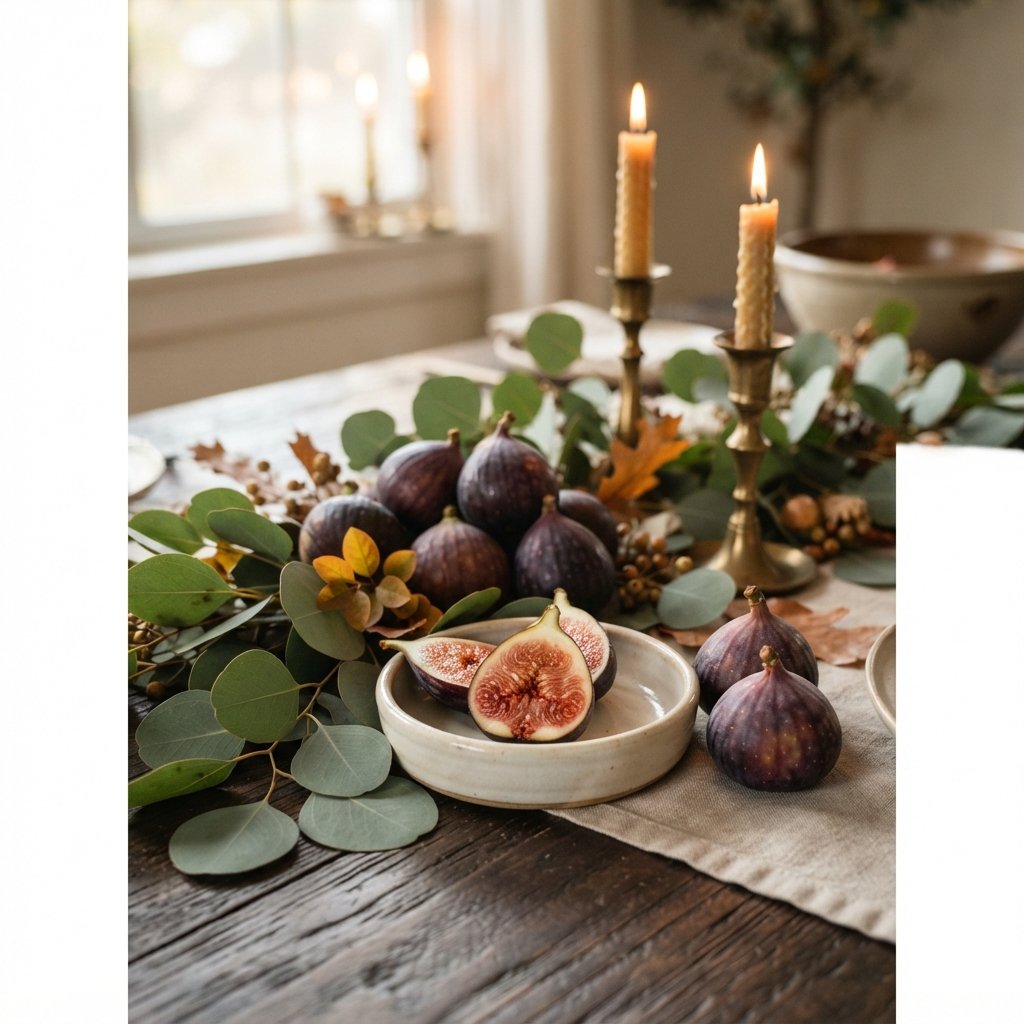
5. Cut a Few Figs Open for Color
A sliced fig introduces another layer of color.
The deep pink interior can look gorgeous against muted green foliage.
For a food-safe display, put cut figs on a small plate, board, or other food-safe surface rather than directly on the table or decorative greenery.
Cut fruit should also be handled and stored appropriately rather than left sitting at room temperature indefinitely.
If the figs are purely decorative and you want the table set well in advance, realistic faux fruit can be an easier alternative.
6. Use Cream or White Dishes
Simple dishes allow the centerpiece to shine.
Try:
- Cream stoneware
- Classic white dishes
- Warm off-white ceramic plates
If you want additional pattern, add one smaller plate with a subtle border.
But you don’t need highly decorative dinnerware.
The fruit and greenery already provide plenty of visual interest.
7. Layer the Place Settings
You can keep the place setting simple or add a few layers.
A pretty combination might include:
- Natural woven placemat
- Cream dinner plate
- Smaller salad plate
- Linen napkin
For a casual dinner, skip the extra plate and keep only what guests will actually use.
A practical table almost always feels more inviting than one crowded with unnecessary pieces.
8. Choose Warm Linen Napkins
Linen adds softness and texture.
Good colors for this table include:
- Oatmeal
- Cream
- Taupe
- Dusty rose
- Muted plum
- Olive
If your centerpiece already has strong purple tones, a neutral napkin may be all you need.
You don’t need an elaborate fold.
Loosely knot the napkin, fold it beneath the plate, or place it simply on top.
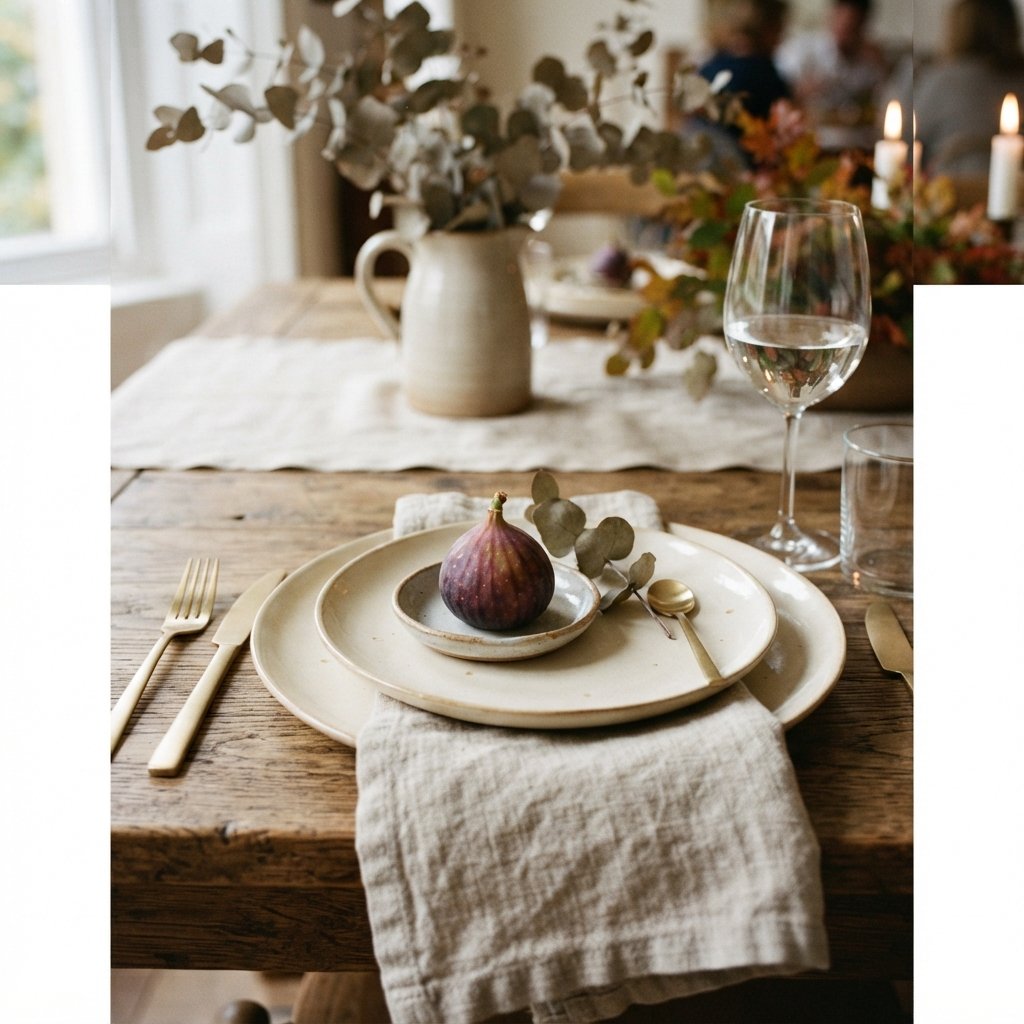
9. Add a Fig to Each Place Setting
A whole fig can become a simple decorative detail at each place.
Set one:
- Beside the napkin
- On a small food-safe plate
- Next to the place card
If guests will eat the figs, keep food-safety and cleanliness in mind rather than treating edible fruit exactly like a craft decoration.
For a table that needs to stay decorated for several days, faux figs may be more practical.
10. Bring in Brass or Warm Metal
A little warm metal works beautifully with the purple and green palette.
You might use:
- Brass candlesticks
- Warm metal flatware
- Small brass bowl
- Napkin rings
You don’t need all of these.
A pair of aged brass candlesticks can be enough.
The goal is to add warmth rather than make the table feel overly formal.
11. Add Taper Candles
Tall taper candles add height without creating the visual bulk of a large flower arrangement.
For this table, consider:
- Cream
- Taupe
- Deep plum
- Muted green
Mixing heights can make the table more interesting.
Keep candle flames well away from eucalyptus, linens, fruit, hair, children, pets, and other combustible materials.
Never leave burning candles unattended.
For a densely decorated centerpiece, quality flameless tapers may be a safer option.
12. Mix in Small Vases
If the eucalyptus runner feels too flat, add two or three small vessels.
Fill them with:
- A few flowers
- Additional greenery
- Small branches
Keep arrangements loose and low.
You don’t need one giant centerpiece.
Several small elements spread along the table often work better for dining.
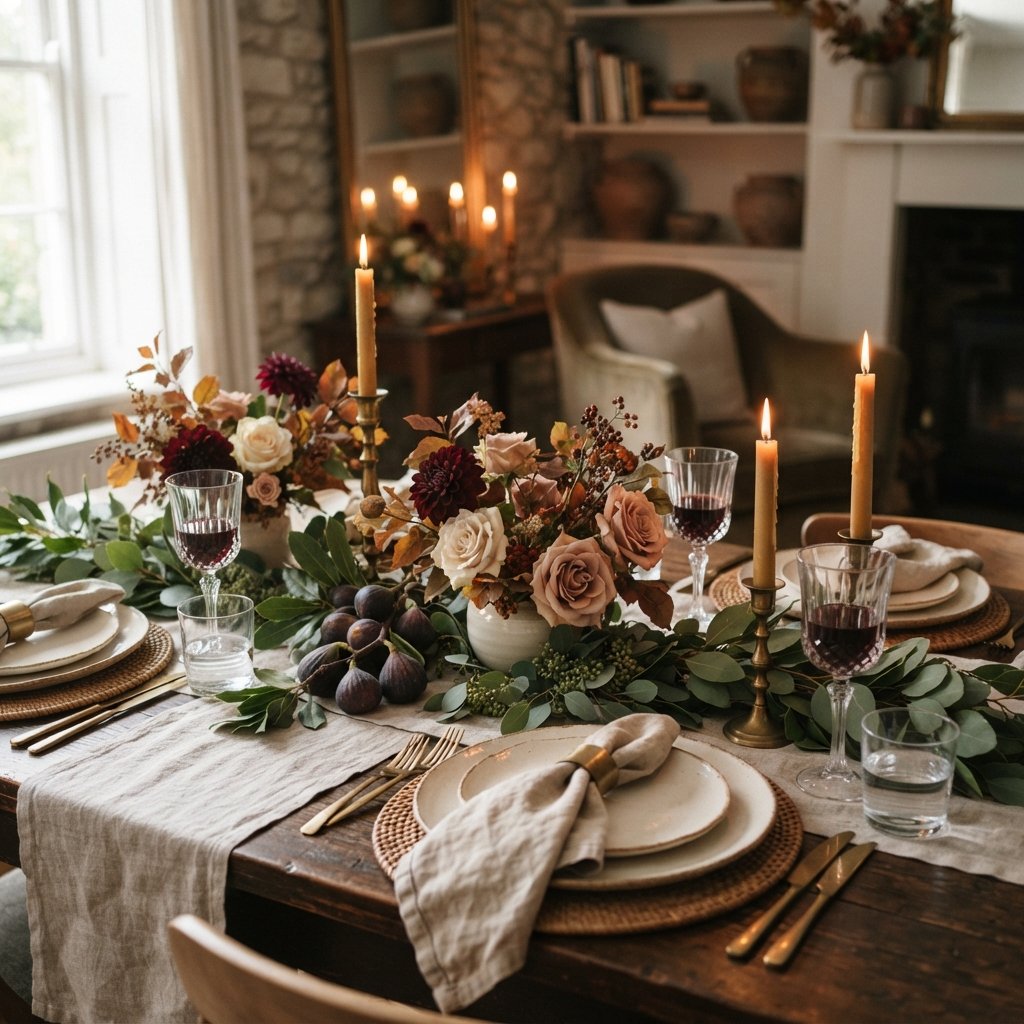
13. Add Dark Flowers for a Moodier Table
If you want more drama, mix in a few flowers that echo the figs.
Look for colors such as:
- Burgundy
- Plum
- Dusty rose
- Cream
You only need a few.
Let eucalyptus remain the primary greenery.
This approach is particularly beautiful for a fall dinner party or Thanksgiving table.
14. Use Wood for Extra Warmth
Wood can keep the table grounded and casual.
Try adding:
- Wood serving board
- Small wood bowls
- Wood napkin rings
- Natural dining table
Don’t feel like every accessory needs to match.
Slightly different wood tones can add depth.
15. Add Woven Texture
If the table still needs something, bring in one woven element.
Try:
- Rattan placemats
- Woven tray
- Natural-fiber runner
- Small basket
The texture complements eucalyptus and helps the table feel warm and layered.
16. Keep Glassware Simple
Clear glassware is an easy choice.
It doesn’t compete with the centerpiece and keeps the table from becoming visually heavy.
If you already own colored glassware, muted green, amber, or smoky glass can also work beautifully.
Use what you have before buying something specifically for one tablescape.
17. Add Simple Place Cards
Place cards aren’t necessary for a casual dinner, but they can make a fall gathering feel more intentional.
Keep them understated.
A small cream card with each guest’s name works beautifully.
Place it beside a fig or on the napkin.
If you’re hosting Thanksgiving or a larger dinner, assigned seating can also make it easier to plan the table.
18. Don’t Overfill the Center
Figs and eucalyptus are both visually distinctive.
You don’t need pumpkins, pinecones, leaves, acorns, gourds, and multiple flower arrangements too.
Choose a few elements and repeat them.
For this table, the basic formula is:
Eucalyptus + figs + candles + simple dishes
Everything else is optional.
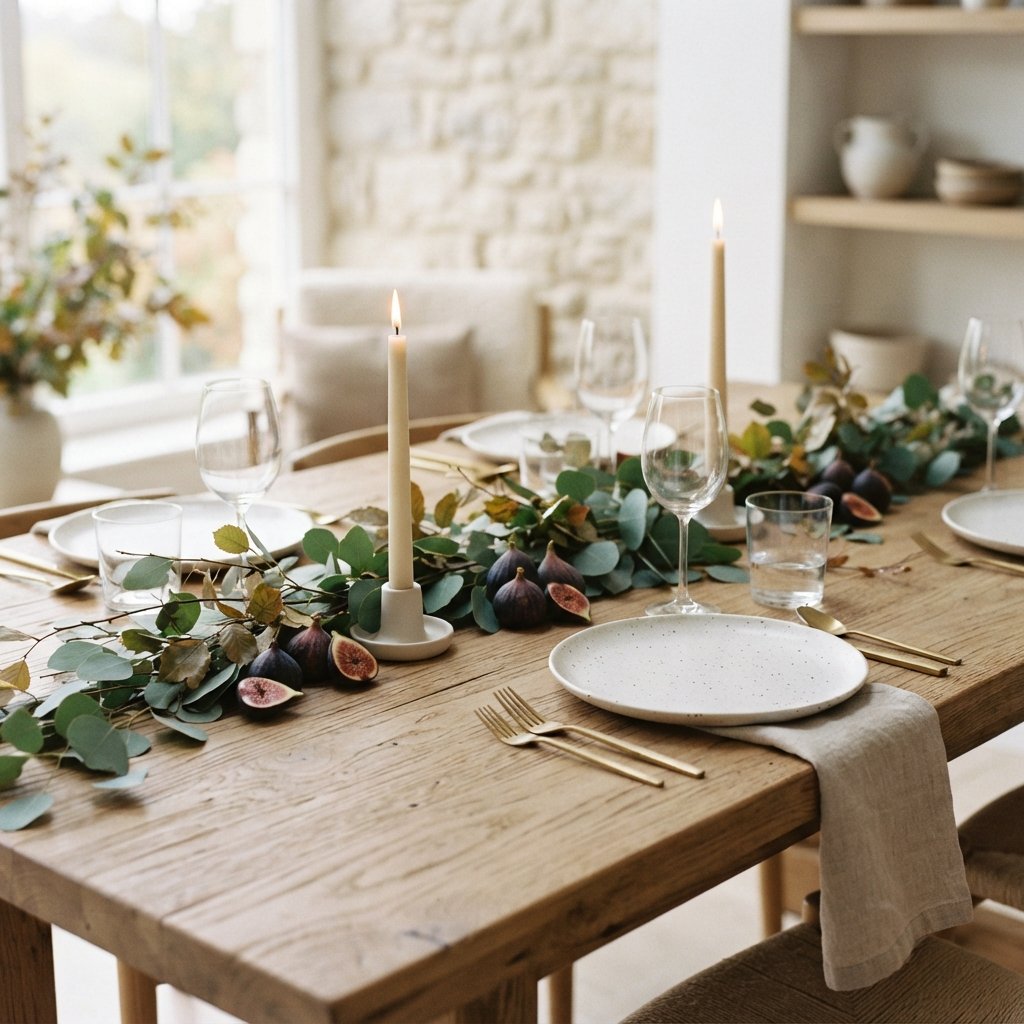
A Simple Fall Table Setting Formula
If you’re recreating the look, start with this easy combination:
Natural wood or neutral linen
Cream dishes
Oatmeal napkins
Eucalyptus
Deep purple figs
Brass candlesticks
That’s enough for a complete tablescape.
Add flowers, woven texture, or place cards only if you feel the table needs more.
How to Arrange Eucalyptus Down a Table
Begin near the center.
Place one stem pointing toward one end of the table.
Overlap another stem facing the opposite direction.
Continue layering stems until you reach the length you want.
Don’t try to create a perfectly uniform line.
Vary the leaves and stem directions.
Then step back.
Look for empty spots and fill only those areas.
The greenery should feel loose rather than packed together like a thick hedge.
How Much Eucalyptus Do You Need?
The amount depends on:
- Table length
- Eucalyptus variety
- Stem fullness
- Desired look
- Other centerpiece elements
Instead of buying based on a universal number of stems, visualize the arrangement based on your actual table.
A sparse runner can look just as beautiful as a full one.
Fresh vs. Faux Eucalyptus
Both can work.
Fresh Eucalyptus
Provides natural variation and texture but will change as it dries.
Faux Eucalyptus
Can be reused and allows you to set the table well in advance.
If using artificial greenery, look for:
- Matte leaves
- Varied leaf sizes
- Natural stem shapes
- Muted rather than fluorescent green
Mixing several stem shapes can make faux greenery look more realistic.
Fresh vs. Faux Figs
Fresh figs bring beautiful natural color, but they are perishable.
Use them when:
- Figs are readily available
- You’re setting the table shortly before the meal
- You intend to serve them
Faux figs work better if you want to decorate the table days in advance.
A high-quality artificial fig can still provide the deep purple accent that makes this color palette work.
Fall Table Setting for Thanksgiving
This combination transitions easily into Thanksgiving.
Add:
- Place cards
- Additional candles
- A few deeper flowers
- Special serving pieces
Keep enough room for the meal.
If serving food family style, consider moving some of the decorative elements to a buffet or console before dinner begins.
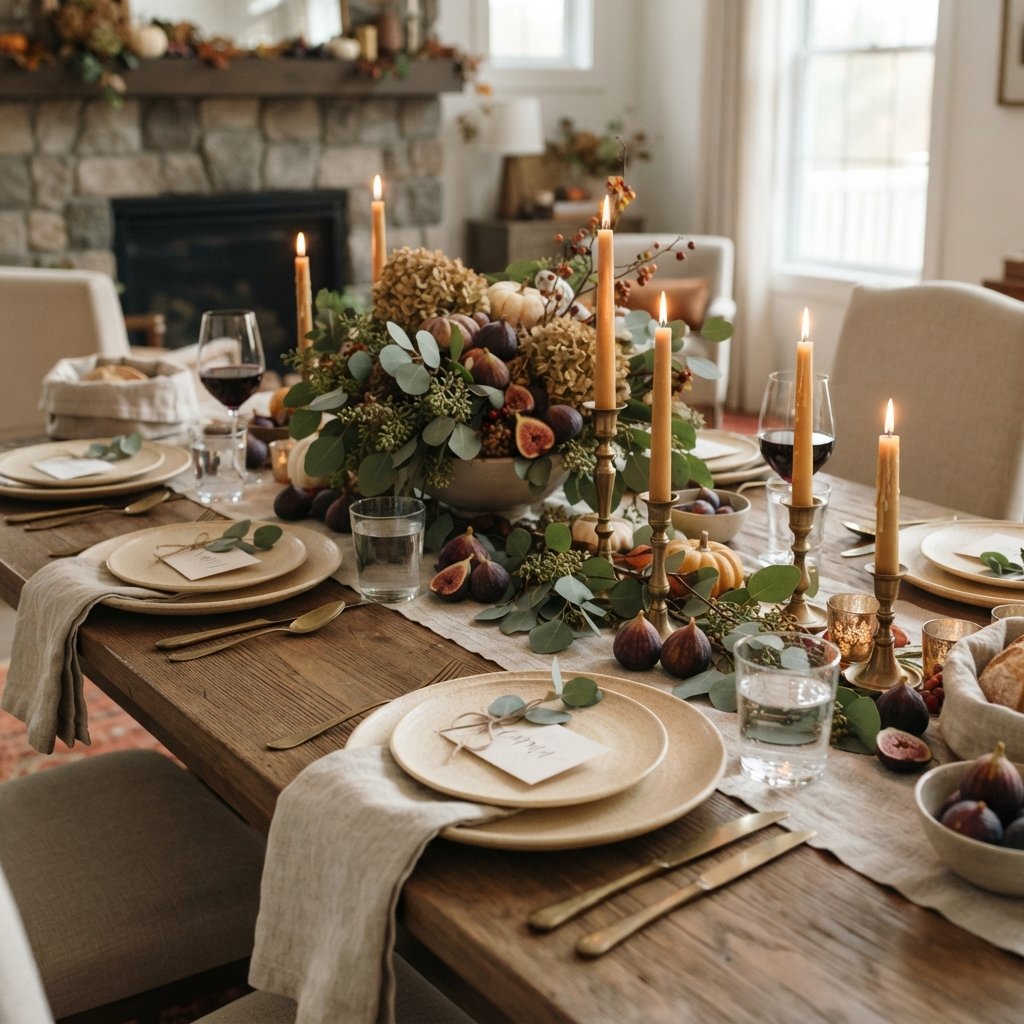
Fall Table Setting Without Pumpkins
One of the biggest advantages of this look is that you don’t need pumpkins at all.
The figs provide seasonal color while eucalyptus brings natural texture.
This can be particularly useful if you want a fall table that feels:
- Elegant
- Organic
- Transitional
- Less themed
You can use the same dishes and linens in other seasons simply by changing the centerpiece.
Budget-Friendly Fig and Eucalyptus Table Decor
Start by shopping your home.
Use:
- Everyday white dishes
- Clear drinking glasses
- Existing candlesticks
- Neutral napkins
- Wood serving pieces
Then purchase only the fresh elements you need.
If fresh figs are expensive or difficult to find, use fewer of them.
Three strategically placed clusters can provide more impact than scattering fruit everywhere.
You can also use faux figs and greenery year after year.
How to Style a Small Dining Table
On a small table, scale everything down.
Instead of a full eucalyptus runner, use:
- One small arrangement
- Several eucalyptus sprigs
- A few figs
Add two candles if there’s room.
Avoid forcing a long centerpiece onto a table that needs the space for food.
How to Style a Round Table With Figs and Eucalyptus
For a round table, create a central arrangement instead of a runner.
Try:
Low vase with eucalyptus + figs in small food-safe bowl + candles
Keep the centerpiece compact enough that guests still have comfortable place settings.
Styling a Buffet or Console to Match
You don’t need to repeat the entire tablescape.
Use one or two related elements.
For example:
- Eucalyptus in a vase
- Bowl of figs
- Brass candlesticks
This connects the room without making every surface look identical.
Common Fall Tablescape Mistakes
Using Too Many Seasonal Decorations
Figs and eucalyptus already establish the fall mood.
Making the Centerpiece Too Tall
Keep conversation sightlines open.
Letting Greenery Touch Food
Keep decorative plant materials appropriately separated.
Leaving Cut Fruit Out Too Long
Handle fresh fruit according to appropriate food-safety practices.
Putting Candles Too Close to Greenery
Drying plant material can be combustible.
Overcrowding the Table
Leave room for glasses, serving dishes, and people.
Using Every Fall Color at Once
A limited palette often feels more sophisticated.
Buying an Entire New Set of Dishes
Everyday neutral dishes can work beautifully.
Making Everything Perfectly Symmetrical
Natural materials look particularly good when arranged a little more loosely.

FAQ About Fall Table Settings With Figs and Eucalyptus
Are figs good for fall table decor?
Yes. Their deep purple, burgundy, green, and brown tones work beautifully with autumn color palettes. Use fresh figs close to the meal or faux figs for longer-lasting decor.
What colors go with figs in a tablescape?
Cream, eucalyptus green, oatmeal, warm brown, dusty rose, burgundy, plum, brass, and muted gold tones all coordinate beautifully.
Can eucalyptus be placed directly on a dining table?
It can be used decoratively, but keep plant material appropriately separated from food and consider children and pets. Don’t assume ornamental greenery is suitable for direct food contact.
What dishes look best with figs and eucalyptus?
Simple white, cream, or warm neutral dishes allow the rich fruit and green foliage to stand out.
Can I use faux eucalyptus?
Yes. Faux eucalyptus is reusable and convenient when you want to decorate well before an event. Choose realistic stems with matte, varied foliage.
How can I make a fall table without pumpkins?
Use seasonal colors and natural materials instead. Figs, eucalyptus, warm linen, wood, candles, and deeper floral colors can create an autumn look without a single pumpkin.
How do I make a fall tablescape look elegant?
Limit the color palette, keep the centerpiece low, use a few repeated natural elements, and leave enough open space that the table doesn’t feel crowded.
Can I use this table setting for Thanksgiving?
Absolutely. Add place cards, additional candles, or a few deeper-colored flowers to dress it up for Thanksgiving.
Final Thoughts
A fall table setting with figs and eucalyptus proves that seasonal decorating doesn’t have to rely on traditional orange, red, and yellow.
The combination feels unmistakably autumnal without being overly themed.
Start with a neutral foundation.
Use a wood table or simple linen.
Add cream dishes and soft napkins.
Then run eucalyptus loosely along the center and tuck in a few clusters of rich purple figs.
Finish the table with warm candlelight and perhaps a touch of brass or wood.
And then stop.
You don’t need to keep adding decorations simply because there’s an empty spot.
Part of what makes this tablescape beautiful is its simplicity.
The figs bring the color.
The eucalyptus brings texture.
The linen softens everything.
And the candles add warmth.
It’s a simple formula you can use for an early fall dinner, a casual gathering with friends, or a more formal Thanksgiving table.
Most importantly, keep the centerpiece low, leave room for the meal, separate decorative greenery from food, and make sure your guests can actually see one another across the table.
Because the best tablescapes don’t just look beautiful before everyone arrives.
They make people want to sit down and stay awhile.

