

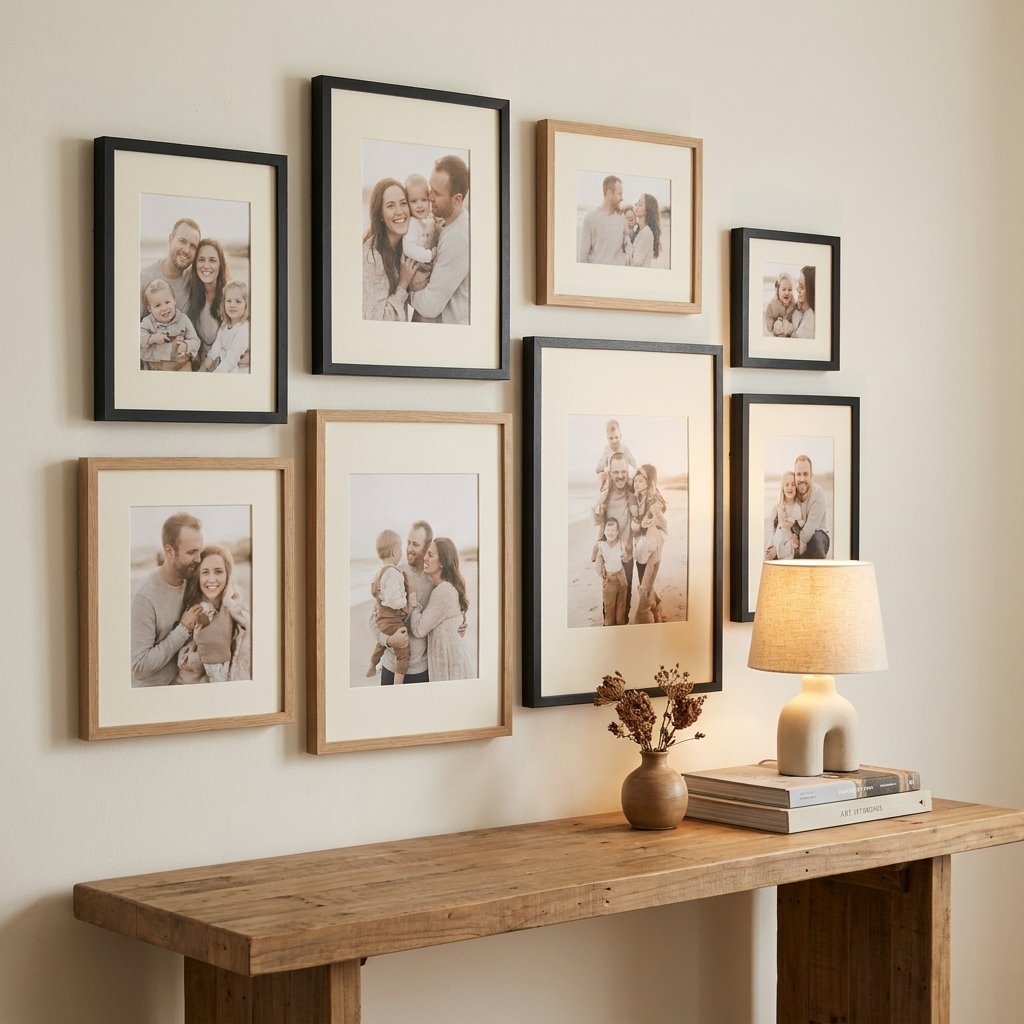
Family photos are some of the most personal things you can use to decorate your home, but figuring out how to display them without making a wall feel cluttered can be surprisingly difficult.
Should every frame match?
Should the photos be black and white?
How much space should you leave between frames?
And where is the best place for a family photo wall in the first place?
The good news is that there isn’t one correct arrangement.
The best family photo wall ideas combine personal photos with enough consistency to make the collection feel intentional. That consistency might come from matching frames, similar photo editing, repeated matting, a simple grid, or even just consistent spacing.
Whether you want a large gallery wall in the living room, a simple hallway display, a staircase filled with family memories, or just a few favorite pictures above a console, these ideas can help you create a photo wall that feels personal without becoming visually overwhelming.
Before You Create a Family Photo Wall
Before ordering frames or putting holes in the wall, decide what you want the display to feel like.
Do you want it to be:
- Clean and modern?
- Casual and collected?
- Traditional?
- Colorful?
- Minimal?
- Symmetrical?
Also consider how many photos you actually want to display.
A photo wall doesn’t have to include every favorite image you’ve ever taken.
Often, a smaller collection of carefully chosen photographs creates a stronger display.
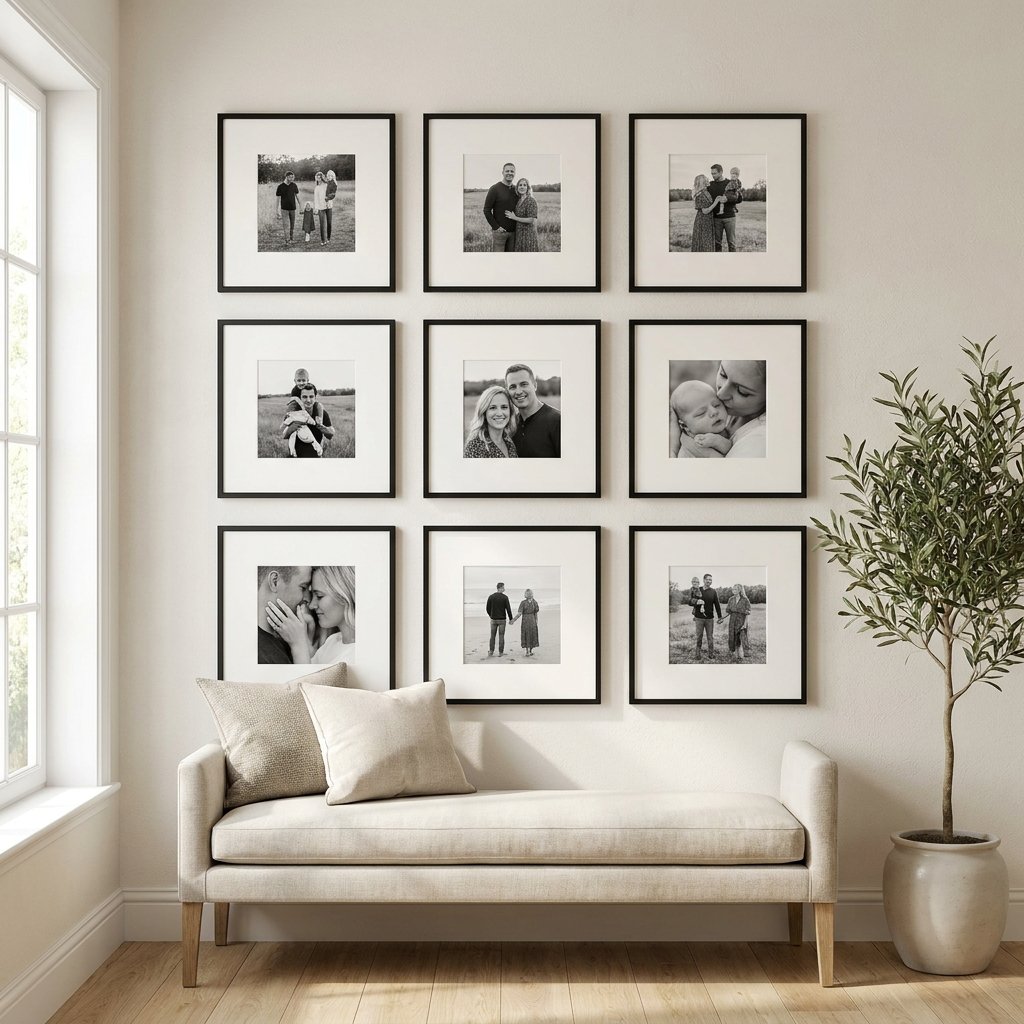
1. Create a Classic Grid Gallery Wall
A grid is one of the easiest ways to make family photos feel polished.
Use frames that are:
- The same size
- The same finish
- Equally spaced
Then arrange them in neat rows.
For example:
- 2 x 3
- 3 x 3
- 3 x 4
A grid works particularly well with black-and-white photography because the repeated frame shape and consistent photo treatment create a strong visual rhythm.
This is a great option for a living room, hallway, or large blank wall.
2. Use Black Frames and White Mats
If you’re overwhelmed by frame choices, black frames with white or warm-white mats are hard to beat.
The contrast gives each photograph definition.
And because the frame treatment remains consistent, you can mix photos taken at different times without the display feeling chaotic.
Try this combination with:
- Black-and-white photos
- Muted color photography
- A mixture of both
If you’re displaying colorful images, consistent matting can help connect them.
3. Try Natural Wood Frames
Black isn’t your only option.
Natural wood frames can create a softer, warmer family photo display.
They work especially well in rooms with:
- Wood furniture
- Warm white walls
- Neutral textiles
- Organic textures
- Traditional or transitional decor
The wood frames don’t necessarily need to match your furniture exactly.
Aim for tones that relate rather than trying to make every wood identical.
4. Mix Black and Wood Frames
Can’t choose between black and wood?
Use both.
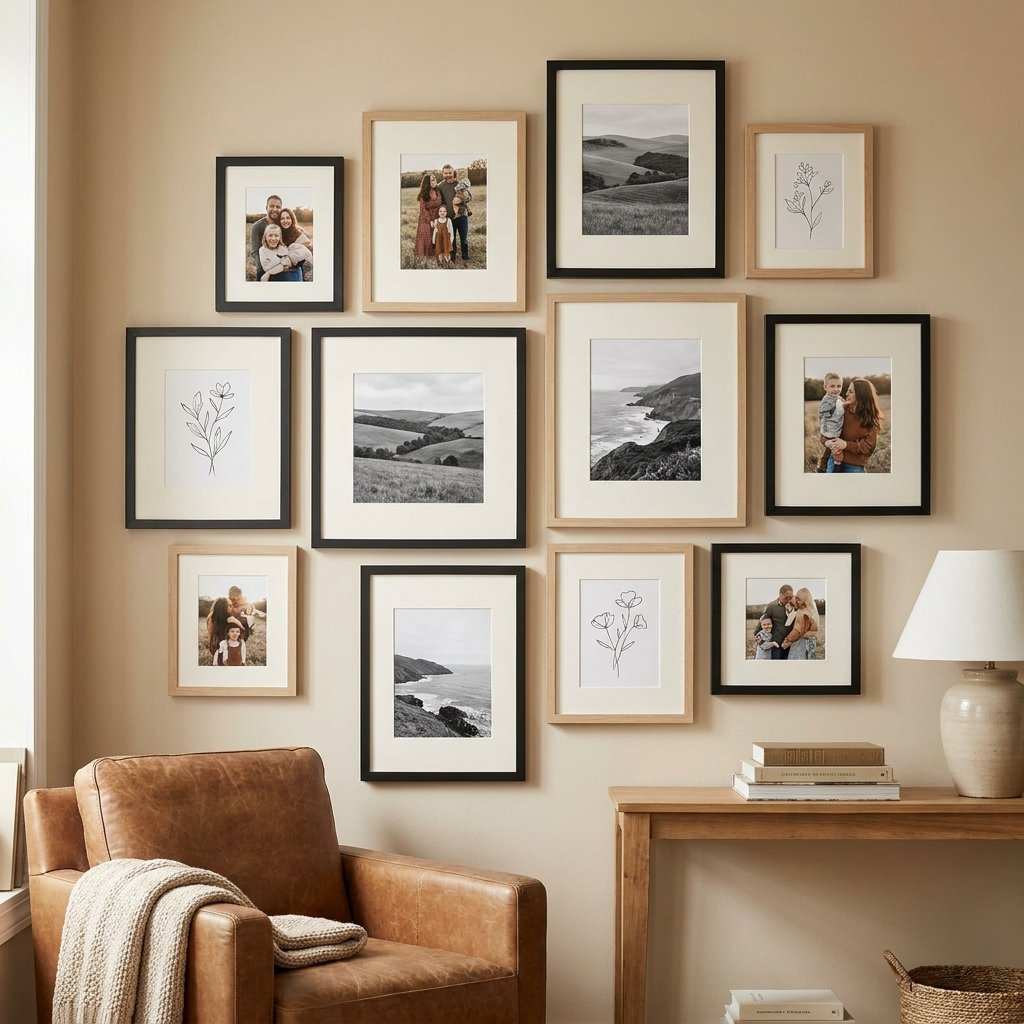
A mixture of black and natural wood can create a collected look while still feeling cohesive.
The key is repetition.
Don’t use one random black frame among twelve wood frames.
Repeat both finishes several times so the combination looks intentional.
Keep another element consistent, such as:
- Mat color
- Photo style
- Frame profile
- Spacing
5. Turn Family Photos Black and White
One of the easiest ways to unify photographs taken in different locations and lighting conditions is to convert them to black and white.
This works particularly well if your original photos contain lots of competing colors.
Black-and-white photography can also help the wall blend more easily with the room’s decor.
You don’t have to edit every photo exactly the same way, but keeping the overall contrast and brightness reasonably consistent creates a more polished result.
6. Use Muted Color Photos
If you love color, keep it.
Family photos don’t need to be black and white to look sophisticated.
Instead, choose images with relatively compatible colors or edit them with a similar overall feel.
Avoid combining extremely saturated photographs with very muted images unless you like an eclectic look.
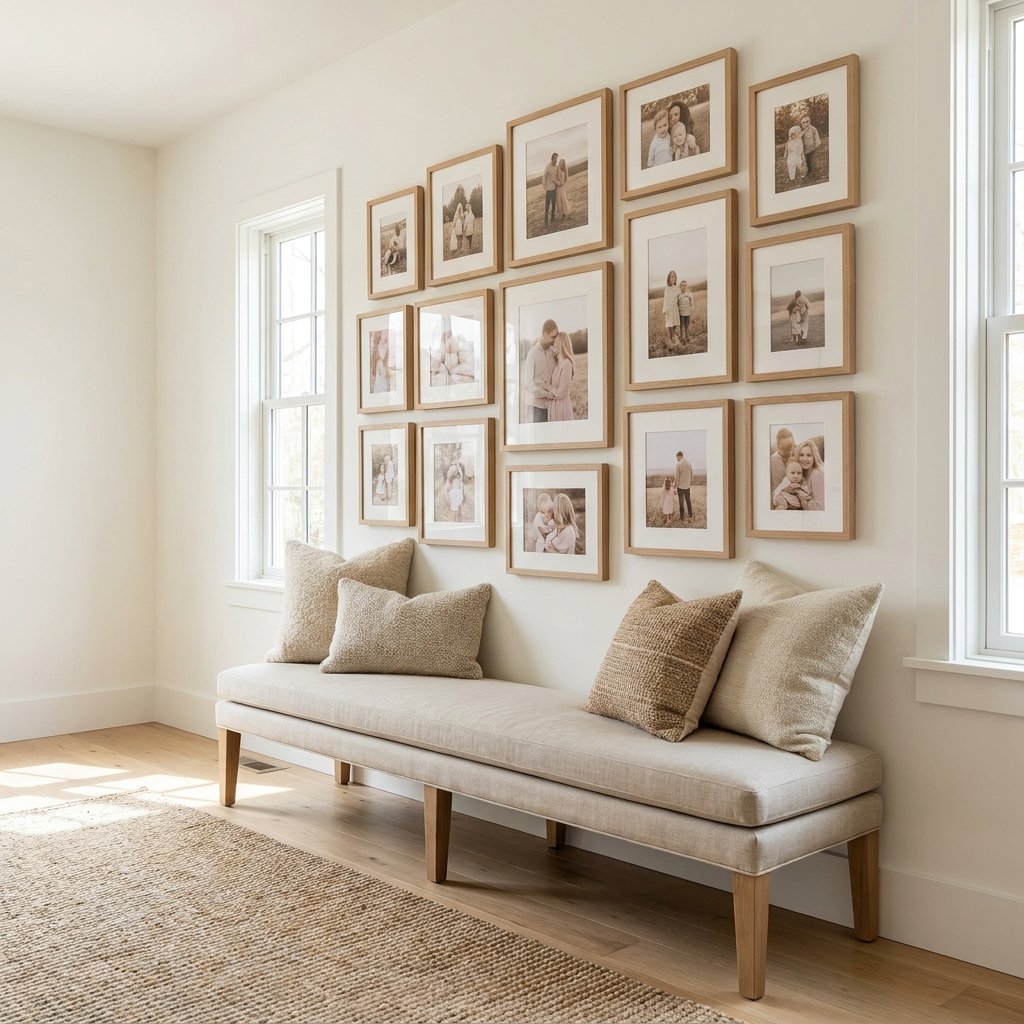
7. Create a Large Living Room Photo Wall
A big blank living room wall is a great place for family photography.
But scale matters.
A handful of tiny frames can look lost above a large sofa.
Instead, create enough visual mass to relate to the furniture beneath it.
You could use:
- Large grid
- Oversized photographs
- Mixed gallery wall
- Long horizontal arrangement
Stand across the room before finalizing the layout.
The wall needs to work from normal viewing distance, not just while you’re standing directly in front of it.
8. Hang Family Photos Above a Console Table
A console table gives a photo wall a natural visual anchor.
Center the overall arrangement in relation to the furniture rather than automatically centering everything on the entire wall.
Then style the console simply.
Try:
- Lamp
- Small bowl
- Books
- Plant or vase
Don’t fill the table with so many accessories that they compete with the photographs.
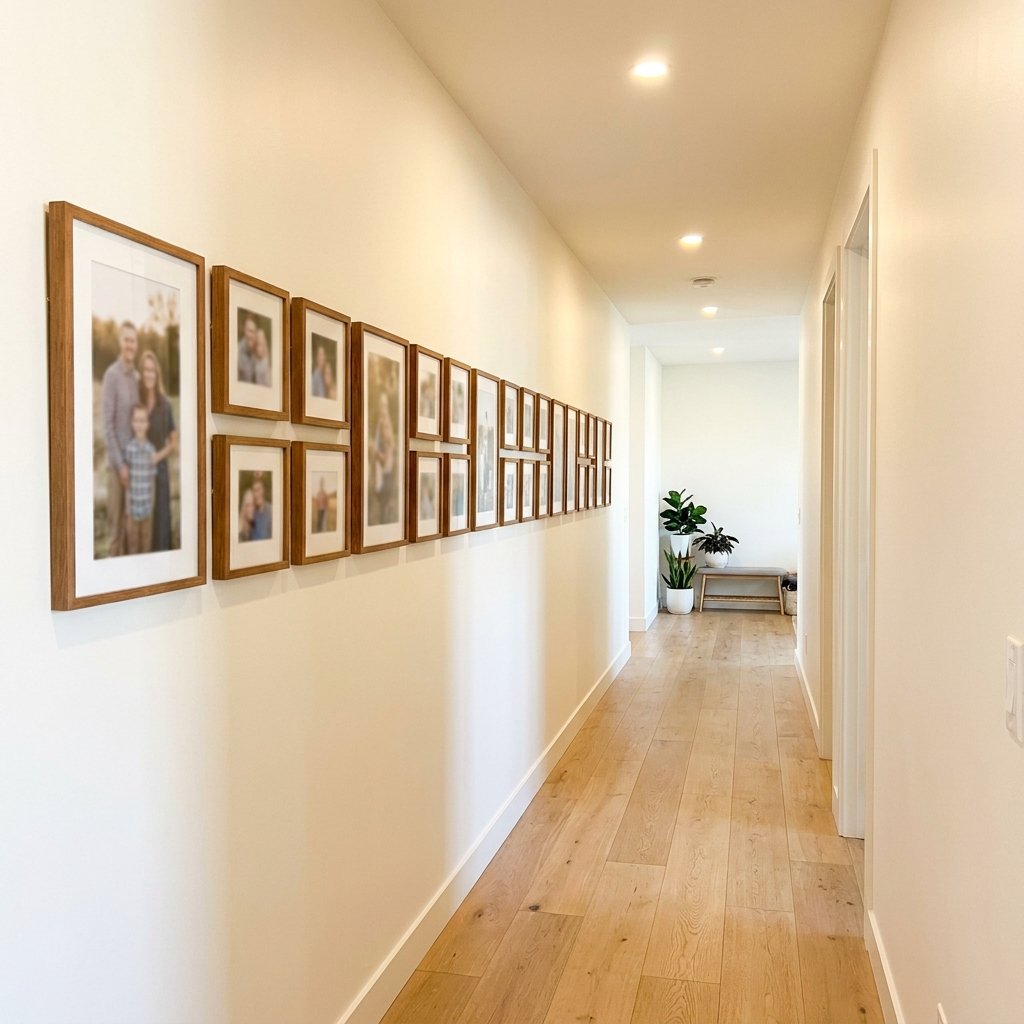
9. Create a Hallway Photo Gallery
Hallways are perfect for family photos because they’re transitional spaces where you can enjoy a collection up close.
A long hallway works especially well with:
- Straight horizontal rows
- Repeated grids
- Matching frames
If the hallway is narrow, consider frames with relatively slim profiles so they don’t project unnecessarily into the walkway.
10. Decorate a Staircase With Family Photos
Staircases naturally lend themselves to gallery walls.
You can arrange the frames so the overall collection rises with the stairs.
The challenge is maintaining order.
Before hanging anything, plan the complete arrangement.
Use paper templates or another layout method to visualize the spacing and flow.
Don’t simply start at the bottom and add frames until you reach the top.
11. Create a Floor-to-Ceiling Staircase Gallery
If you want something more dramatic, turn the staircase wall into a large collected gallery.
Mix:
- Family photographs
- Vacation photos
- Children’s portraits
- Meaningful snapshots
You can also incorporate a limited number of other personal pieces, such as small artwork.
Keep enough repetition in the frames or matting to prevent the display from becoming visually chaotic.
12. Use Oversized Family Photos
A family photo display doesn’t need dozens of pictures.
One or two large photographs can have more impact than twenty small ones.
This works particularly well in a minimal or modern home.
Consider:
- Large family portrait
- Favorite candid photograph
- Meaningful travel image
- Beautiful photo of your children
Give the image enough surrounding empty wall space to breathe.
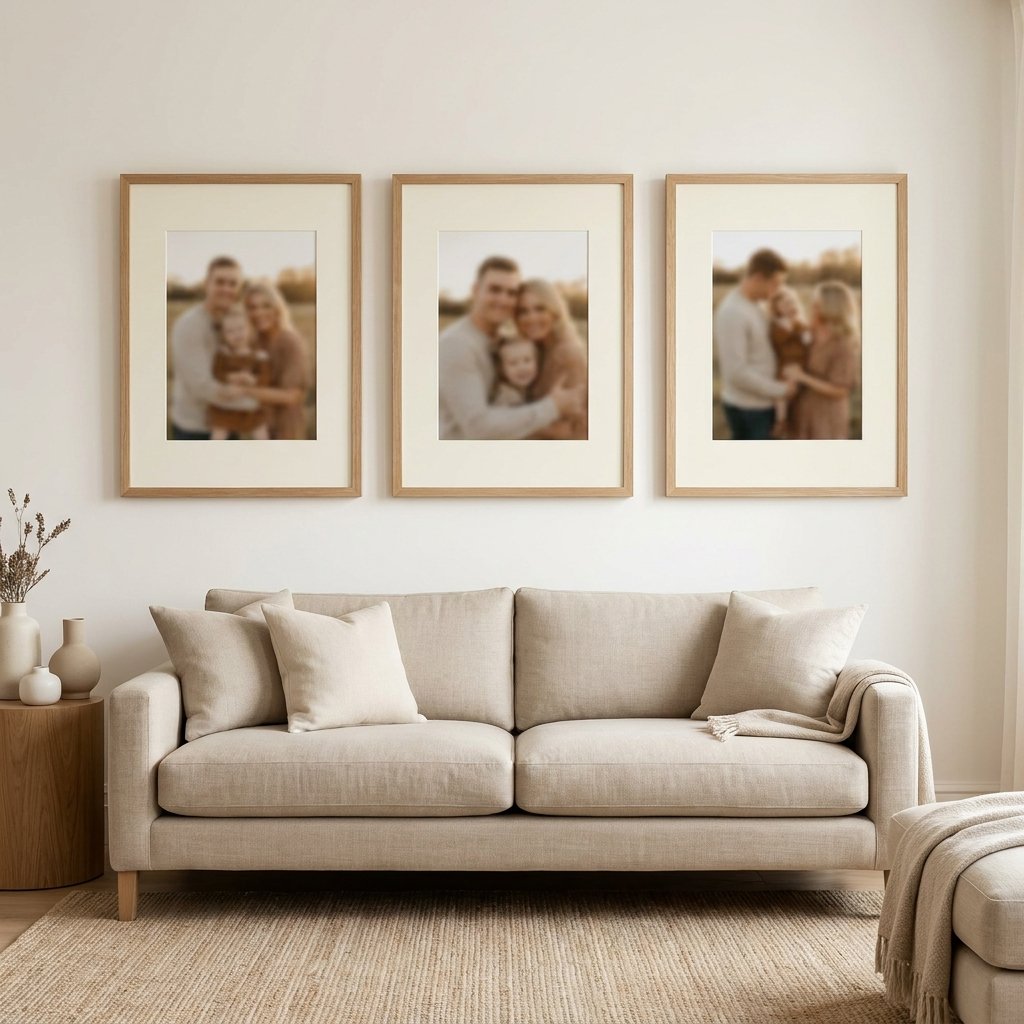
13. Display Three Large Photos in a Row
Three coordinating photographs can create a simple alternative to a traditional gallery wall.
Use the same:
- Frame size
- Frame finish
- Mat
- Orientation
This arrangement is especially effective above:
- Sofa
- Sideboard
- Console
- Bed
Choose images that relate visually.
They don’t have to be from the same photo session.
14. Use Picture Ledges for Family Photos
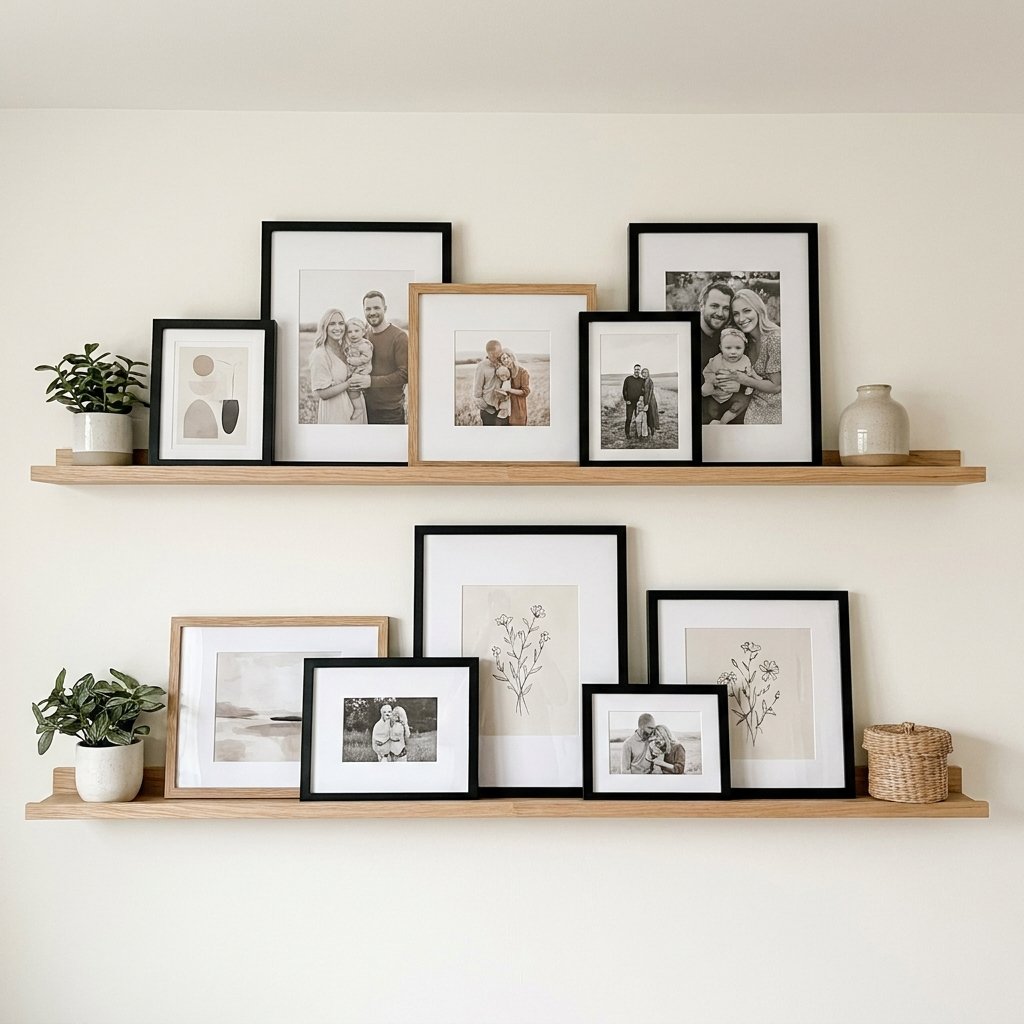
If you like changing photographs frequently, picture ledges provide more flexibility than a fixed gallery arrangement.
Layer several framed photos along the ledge.
Vary the frame heights while keeping the overall palette controlled.
You can update the display as:
- Children grow
- New photos are taken
- Seasons change
- Family milestones happen
Install ledges using hardware appropriate for the wall construction and expected load.
15. Layer Frames Instead of Spacing Everything Evenly
A picture ledge is also a good place to overlap frames slightly.
This creates a casual, collected look.
Place taller frames toward the back and smaller ones in front.
Avoid stacking so many pieces that important faces disappear behind other frames.
16. Mix Family Photos With Artwork
Family photos don’t have to exist in isolation.
You can combine them with:
- Landscapes
- Abstract art
- Children’s artwork
- Small sketches
- Meaningful prints
The trick is balance.
If the photographs are visually busy, keep the surrounding artwork relatively simple.
Repeat frame finishes or colors to connect the collection.
17. Include Meaningful Places
A family wall can tell a broader story than portraits alone.
Add photographs of:
- Childhood homes
- Favorite vacation destinations
- Wedding location
- Family property
- Meaningful landscape
- Hometown
This creates a display that feels personal without requiring every frame to contain a face.
18. Create a Family Photo Wall in the Bedroom
Family photos aren’t limited to common spaces.
A bedroom can be a wonderful place for a smaller, more personal collection.
Try:
- Two large photos above a dresser
- Small grid beside the bed
- Picture ledge
- Several framed photos on a dresser
For wall-mounted pieces near sleeping areas, make sure frames and hardware are securely installed and appropriate for the wall and frame weight.
Avoid placing heavy or breakable objects where falling could create a hazard.
19. Add a Small Photo Wall to a Home Office
Family photographs can make a home office feel warmer without taking over the room.
Try a small arrangement near your desk.
A simple four- or six-frame grid can be enough.
Keep the layout controlled so it doesn’t create distracting visual clutter in your workspace.
20. Use Family Photos in an Entryway
An entryway family photo wall immediately makes a home feel personal.
Use photographs above:
- Console table
- Bench
- Small cabinet
This can be especially beautiful when paired with a lamp, mirror elsewhere in the space, and a few simple accessories.
Keep the display proportionate to the furniture below it.
21. Create a Family Photo Wall That Can Grow
Families change.
Your photo wall should be able to change too.
If you know you’ll want to add new photographs over time, plan for expansion from the beginning.
A grid can be expanded with additional rows or columns if wall space permits.
Picture ledges make swapping photos especially easy.
A collected gallery can leave intentional openings for future additions.
You don’t need to put every photo on the wall today.
How to Choose Photos for a Family Gallery Wall
This is often harder than choosing the frames.
Start by collecting more photographs than you need.
Then narrow them down.
Look for a mixture of:
- Close portraits
- Full-body photos
- Candid moments
- Detail shots
- Travel images
- Family group photos
Avoid choosing ten photographs with nearly identical compositions.
Variation creates interest.
Should Family Photos All Be From the Same Photo Session?
No.
In fact, mixing years and events can make a family wall more meaningful.
The trick is creating visual consistency afterward.
You can connect different photos through:
- Black-and-white editing
- Similar color treatment
- Matching mats
- Coordinated frames
That lets the collection tell a story without looking random.
How to Make Family Photos Look Cohesive
There are several ways.
You don’t need to use all of them.
Pick two or three.
For example:
Option 1
Matching black frames + white mats + black-and-white photos.
Option 2
Natural wood frames + muted color photos + consistent spacing.
Option 3
Mixed frames + black-and-white photography + similar matting.
Option 4
Matching frames + consistent photo sizes + grid layout.
The more varied your photographs are, the more consistency you’ll generally want elsewhere.
How to Mix Frame Sizes
A mixed gallery wall can feel relaxed and collected, but random isn’t the same as intentional.
Start with one or two larger frames.
These become your anchors.
Then fill around them with medium and smaller frames.
Try not to cluster every small frame in one corner.
Distribute visual weight across the arrangement.
How Far Apart Should Gallery Wall Frames Be?
Consistency matters more than chasing one universal measurement.
Choose a spacing that suits the frame sizes and arrangement, then repeat it as consistently as possible.
Very large gaps can make individual pictures feel disconnected.
Extremely tight spacing can make the wall feel crowded.
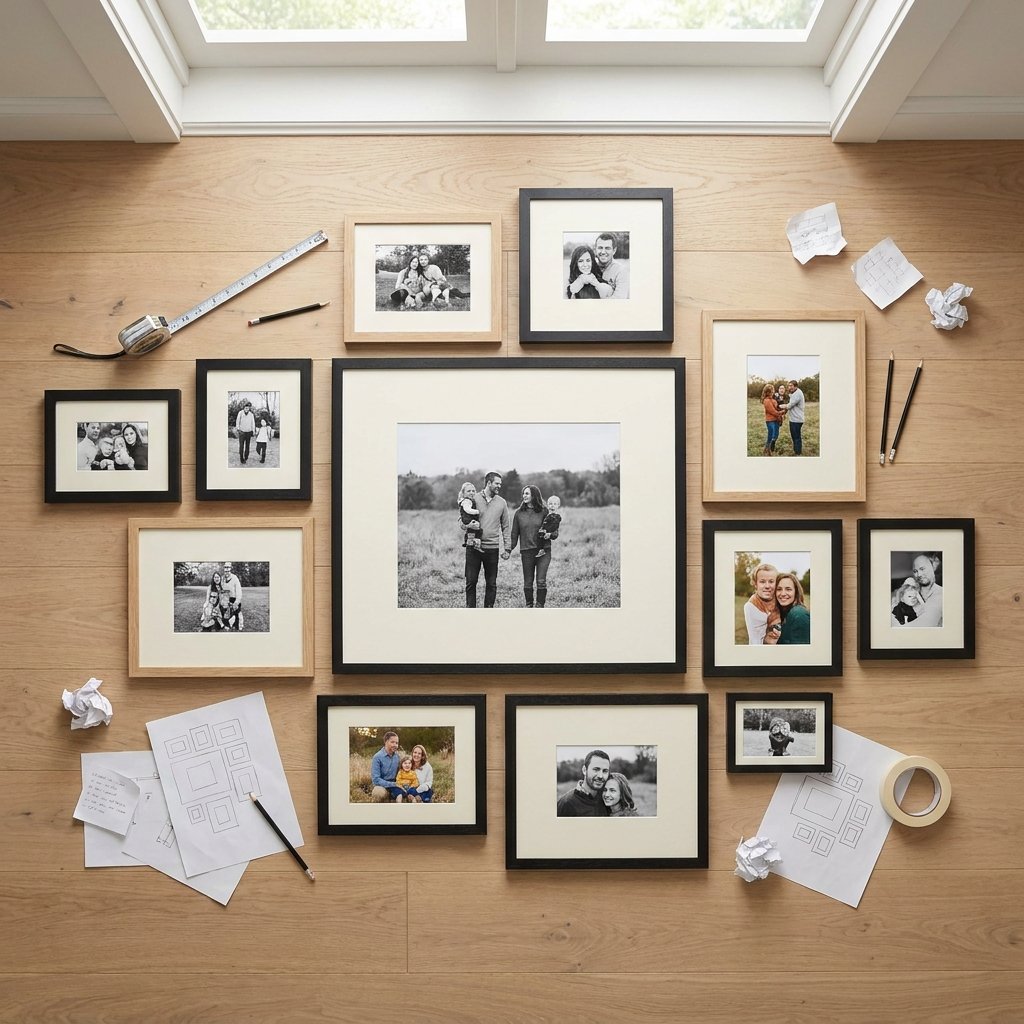
Before drilling holes, test the arrangement with paper templates or lay everything out on the floor.
How High Should You Hang Family Photos?
Think about the collection as a single piece of art.
The overall arrangement should relate comfortably to eye level and any furniture beneath it.
Avoid pushing the entire gallery too close to the ceiling.
If you’re hanging photographs above a console, sofa, or bench, visually connect the display to the furniture rather than leaving a huge empty gap between them.
How to Plan a Gallery Wall Before Hanging It
Planning first can save a lot of unnecessary holes.
Try this process:
- Measure the available wall.
- Measure your frames.
- Arrange the frames on the floor.
- Photograph the arrangement.
- Make paper templates if helpful.
- Transfer the arrangement to the wall.
- Check spacing and overall scale.
- Install appropriate hanging hardware.
- Hang and level the frames.
For heavier pieces, use hardware appropriate for the frame weight and wall construction.
Don’t assume a small nail or adhesive strip is suitable for every frame.
How to Arrange Family Photos on a Wall
There are two main approaches.
Symmetrical
Best for a cleaner, more formal look.
Try:
- Grid
- Straight row
- Matching pairs
Asymmetrical
Best for a collected, casual look.
Use different frame sizes while maintaining visual balance.
Neither approach is better.
Choose the one that matches the room.
Should You Use Matching Frames?
You don’t have to.
Matching frames make cohesion easier.
Mixed frames create more personality.
If you’re new to gallery walls, matching or closely coordinated frames are usually simpler.
If you mix frames, limit the number of finishes.
For example:
Black + natural wood
is much easier to manage than black, gold, silver, white, oak, walnut, red, and blue.
Where Should You Put a Family Photo Wall?
Good locations include:
- Living room
- Hallway
- Staircase
- Entryway
- Family room
- Home office
- Bedroom
- Upstairs landing
Choose somewhere you naturally see and enjoy the photographs.
You don’t have to hide family photos in a hallway simply because they’re personal.
How to Make a Family Photo Wall Look Expensive
The secret isn’t expensive frames.
It’s editing.
Focus on:
- Consistent spacing
- Good-quality photo printing
- Thoughtful photo selection
- Generous matting
- Appropriate scale
- Limited frame finishes
- Straight, secure installation
And don’t overcrowd the wall.
Empty space is part of the design.
Common Family Photo Wall Mistakes
Using Frames That Are Too Small
Consider the scale of the wall and furniture.
Hanging the Gallery Too High
Keep the arrangement visually connected to the room.
Trying to Display Every Photo
Edit the collection.
Using Too Many Frame Finishes
Limit the palette.
Ignoring Photo Editing
Very different colors and exposures can make a gallery feel disconnected.
Leaving Inconsistent Gaps
Spacing is one of the easiest ways to create order.
Making the Layout Too Perfect for Your Style
If your home is relaxed and collected, an asymmetrical gallery may suit it better than a rigid grid.
Not Planning Before Making Holes
Lay out the arrangement first.
Using Inappropriate Hanging Hardware
Choose hardware based on wall construction and frame weight.
Hanging Heavy Frames Unsafely
Install substantial pieces securely, particularly in homes with children.
A Simple Family Photo Wall Formula
Want an easy starting point?
Try:
Photos
Nine favorite black-and-white family images.
Frames
Nine matching black frames.
Mats
Warm white.
Layout
3 x 3 grid.
Wall
Warm white or soft neutral.
Furniture
Wood console.
Accessories
One lamp + small bowl + simple vase.
It’s uncomplicated, personal, and easy to adapt to many decorating styles.
FAQ About Family Photo Walls
How do you make a family photo wall look good?
Create consistency through the frames, matting, photo editing, layout, or spacing. You don’t need every element to match, but repeating a few design choices makes the collection feel intentional.
Should family photos be black and white?
They don’t have to be, but black-and-white editing can help unify photographs taken at different times and in different settings.
Should all frames on a photo wall match?
No. Matching frames create a clean look, while a controlled mix can feel more collected. If mixing, repeat each finish and keep the number of frame styles manageable.
Where is the best place for a family photo wall?
Living rooms, staircases, hallways, entryways, family rooms, offices, and bedrooms can all work. Choose a location where you’ll actually enjoy seeing the photos.
How do I arrange family photos on a staircase?
Plan the entire arrangement before hanging anything and let the overall gallery visually rise with the stairs. Paper templates can help establish the spacing and shape.
Can I mix family photos and artwork?
Yes. Mix photographs with meaningful artwork, landscapes, or children’s art while using repeated frame finishes, colors, or matting to connect everything.
How can I make a gallery wall without making lots of holes?
Picture ledges can reduce the need to reposition individual frame hardware repeatedly. Other hanging methods may also work depending on the frame weight, wall material, and product instructions.
How many family photos should go on a gallery wall?
There’s no required number. Three oversized photographs may be enough, while a large staircase could hold dozens. Let the wall size, frame scale, and desired look determine the number.
Final Thoughts
The best family photo wall ideas aren’t necessarily the ones with the most photographs.
They’re the ones that make the photos you love feel intentional.
Start by deciding what kind of display fits your home.
If you love clean, orderly rooms, try a grid of matching frames.
If your style is warmer and more collected, mix natural wood and black frames in an asymmetrical gallery.
If you like changing photos frequently, use picture ledges.
And if a large gallery wall feels overwhelming, skip it entirely and hang three beautiful oversized family photographs instead.
Then create cohesion.
You can do that through matching frames.
Consistent matting.
Black-and-white editing.
Muted color photography.
Repeated spacing.
Or a combination of several of these.
Most importantly, don’t feel like you need to display every family photograph at once.
Choose the pictures that make you stop and look.
The candid moment.
The family vacation.
The beautiful portrait.
The picture that captures your kids exactly as you remember them at that age.
A family photo wall isn’t just another decorating project.
Done well, it gives your home something no store-bought artwork can replicate: a collection that actually belongs to the people who live there.

