

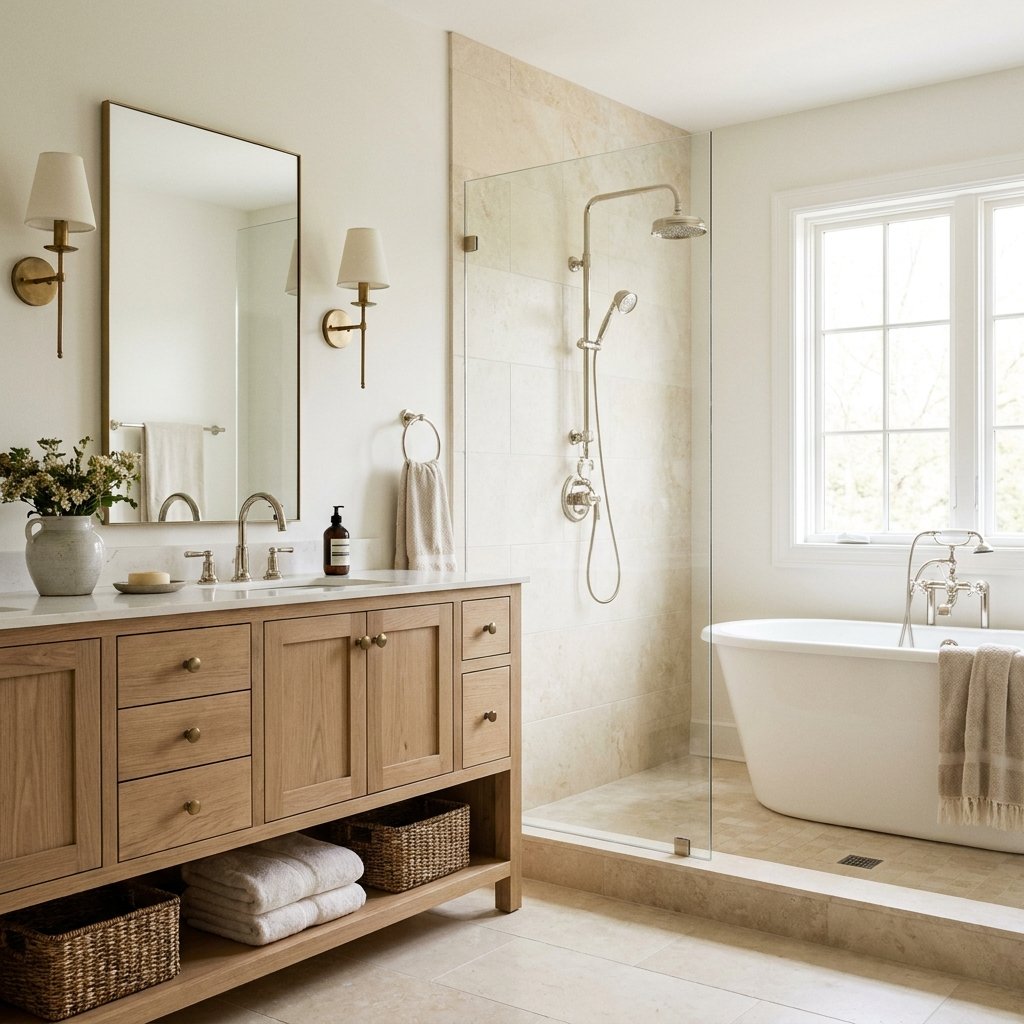
Mixing metal finishes is one of the easiest ways to make a bathroom feel more layered and thoughtfully designed.
The tricky part is knowing how to mix metals in a bathroom without ending up with a collection of fixtures that looks accidental.
Should your faucet match the shower hardware?
Can you use brass with chrome?
Does the mirror need to match the vanity hardware?
And how many different metal finishes can you use before the room starts looking busy?
Fortunately, your bathroom hardware doesn’t have to match perfectly.
In fact, using two complementary metal finishes can often make a bathroom more interesting than using the exact same finish everywhere.
The secret is creating repetition, balance, and a clear hierarchy.
Whether you’re remodeling an entire bathroom or simply replacing a few fixtures, these tips will help you mix brass, chrome, nickel, black, bronze, and other finishes with confidence.
1. Start With One Dominant Metal
The easiest way to mix metals is to choose one finish as your dominant metal.
This is the finish you’ll see most often throughout the bathroom.
For example, your dominant metal might appear on the:
- Sink faucet
- Shower fixtures
- Tub filler
- Towel bars
- Toilet paper holder
Then introduce a second finish as an accent.
This creates hierarchy instead of making every finish compete for attention.
A bathroom with equal amounts of chrome, brass, black, and bronze can easily feel chaotic.
A bathroom that’s primarily polished nickel with a few intentional brass details feels much more controlled.
A Simple Formula
Try:
Dominant metal: 60–70%
Accent metal: 30–40%
You don’t need to calculate exact percentages. The idea is simply to make one finish clearly more prominent than the other.
2. Stick With Two Metal Finishes
For most bathrooms, two metal finishes are enough.
A large primary bathroom may be able to support three, but a small powder room usually doesn’t need that much variety.
Using two finishes gives you enough contrast to make the room interesting without making it complicated.
Easy combinations include:
- Brass + polished nickel
- Brass + chrome
- Black + brass
- Black + polished nickel
- Bronze + brass
- Nickel + black
There isn’t one universal combination that’s right for every bathroom.
The surrounding materials matter just as much as the metals themselves.

3. Mix Warm and Cool Metals
One of the easiest ways to create contrast is to combine a warm metal with a cooler one.
Warm Metals
These often include:
- Brass
- Gold-toned finishes
- Bronze
- Copper
Cooler Metals
These commonly include:
- Chrome
- Polished nickel
- Brushed nickel
- Stainless steel
Black is relatively neutral and can often work alongside either group.
For example:
Brass + polished nickel
can look beautiful because the finishes are intentionally different.
Trying to match two slightly different gold finishes can sometimes look less intentional than deliberately combining gold with silver.
4. Don’t Try to Match Every Fixture
One of the biggest misconceptions about bathroom design is that everything needs to match.
It doesn’t.
Your faucet doesn’t necessarily have to match:
- Mirror
- Light fixture
- Cabinet pulls
- Shower hardware
- Towel bar
In fact, forcing every piece into the exact same finish can sometimes make a room feel more like a showroom than a collected home.
Instead, think in groups.
For example:
Plumbing Group
Polished nickel faucet, shower fixtures, and tub filler.
Decorative Group
Brass mirror, sconces, and cabinet hardware.
Now the mix has a clear logic.
5. Keep Plumbing Fixtures Consistent
Although you can mix metals throughout the bathroom, keeping major plumbing fixtures in the same finish is one of the easiest ways to create cohesion.
For example, use polished nickel for:
- Sink faucet
- Shower controls
- Showerhead
- Tub filler
Then use brass elsewhere.
This isn’t an absolute design rule, but it’s a very beginner-friendly approach.
Plumbing fixtures tend to visually relate to one another, so keeping them consistent creates a strong foundation.
It also makes future replacement decisions easier.

6. Repeat Each Metal at Least Twice
If you introduce a second metal only once, it can look accidental.
Repetition makes it look intentional.
Imagine a bathroom with:
- Chrome faucet
- Chrome shower fixtures
- Chrome towel bars
- Chrome toilet paper holder
- One brass light fixture
That single brass fixture may feel disconnected.
Instead, repeat the brass somewhere else.
For example:
- Brass sconces
- Brass cabinet pulls
Now your eye recognizes a pattern.
You could also use:
- Brass mirror + brass hardware
- Black mirror + black lighting
- Nickel faucet + nickel shower hardware
The pieces don’t need to be right next to each other.
They simply need enough repetition to establish a relationship.
7. Separate the Metals by Function
Another easy strategy is assigning different finishes to different categories.
For example:
Polished nickel: plumbing fixtures
Aged brass: lighting and cabinet hardware
Or:
Matte black: plumbing fixtures
Brass: mirror and lighting
This makes mixing metals much easier because you’re not randomly choosing a finish for every object.
You’ve created a simple system.
This is especially useful during a renovation when you’re making dozens of decisions at once.
8. Pay Attention to the Finish, Not Just the Color
Two metals can technically be the same color but still look completely different.
For example, brass might be:
- Polished
- Brushed
- Satin
- Aged
- Antique
- Unlacquered
Nickel can also range from softly brushed to highly polished.
Chrome tends to have a brighter, mirror-like appearance.
The level of shine affects how the finishes interact.
A polished nickel faucet and aged brass mirror can create an interesting contrast because you’re mixing both color and texture.
If every finish is highly polished, the bathroom may feel more glamorous.
Brushed or aged finishes generally create a softer appearance.

9. Let the Bathroom Style Guide Your Metals
Your home’s decorating style can help narrow the choices.
Traditional Bathroom
Try:
- Polished nickel
- Aged brass
- Antique brass
These finishes work beautifully with marble, paneled cabinetry, and classic fixtures.
Modern Bathroom
Try:
- Matte black
- Chrome
- Brushed nickel
Keep shapes simple and streamlined.
Transitional Bathroom
This style is particularly easy for mixed metals.
Try:
- Polished nickel + brass
- Black + brass
- Chrome + brass
The combination of classic and contemporary elements naturally supports a mix.
Organic or Warm Modern Bathroom
Try:
- Brushed brass
- Matte black
- Soft nickel
Pair them with:
- Oak
- Stone
- Plaster-like finishes
- Warm whites
- Textured tile
Coastal-Inspired Bathroom
Polished nickel, chrome, soft brass, and natural wood can create a fresh look without becoming overly nautical.
10. Use Black as a Bridge
Matte black can be surprisingly useful when you’re mixing metals.
Technically, black isn’t a metal color in the same way brass or nickel is, but black hardware can act as a visual bridge between other finishes.
For example:
Brass mirror + polished nickel faucet + black shower frame
can work because the black creates definition without competing strongly with either metal.
You might repeat black through:
- Shower frame
- Mirror
- Lighting
- Door hardware
- Picture frames
Be careful not to introduce black everywhere just because it’s easy to coordinate.
A few intentional repetitions are usually enough.
11. Coordinate Metals With the Vanity
Your vanity can help determine which metals will look most natural.
White Vanity
White cabinetry gives you a relatively neutral backdrop.
Consider:
- Brass
- Nickel
- Chrome
- Black
Light Wood Vanity
Light oak works beautifully with warmer metals.
Try:
- Brass
- Aged brass
- Black
- Polished nickel for contrast
Dark Wood Vanity
Dark walnut can handle richer finishes such as:
- Brass
- Bronze
- Polished nickel
Painted Blue or Green Vanity
Brass can add warmth, while nickel or chrome can create a cooler, cleaner effect.
Black creates stronger contrast.

12. Look at the Entire Material Palette
Metal finishes shouldn’t be selected in isolation.
Your bathroom also contains:
- Tile
- Countertops
- Vanity
- Flooring
- Wall color
- Mirrors
- Lighting
Put samples of everything together before ordering expensive fixtures.
For example, imagine this palette:
Warm white tile + white oak vanity + creamy stone + aged brass + polished nickel
The brass relates to the warmth of the wood.
The nickel introduces a cooler, cleaner contrast.
Now imagine:
Cool gray tile + cool white vanity + blue-gray stone + aged brass + bronze
That combination might need more careful evaluation because several undertones are competing.
The bathroom should work as one complete palette.
Should the Bathroom Faucet Match the Cabinet Hardware?
No.
The faucet and cabinet hardware don’t have to match.
One of the easiest mixed-metal combinations is:
Nickel faucet + brass cabinet pulls
or:
Chrome faucet + brass cabinet pulls
The key is repeating those finishes elsewhere.
If your faucet is nickel, repeat nickel on the shower fixtures.
If the cabinet pulls are brass, repeat brass in the lighting or mirror.
Now both finishes feel intentional.
Should the Bathroom Faucet Match the Shower?
It doesn’t absolutely have to, but matching the faucet and shower fixtures is an easy way to simplify the design.
For example:
- Polished nickel faucet
- Polished nickel shower fixtures
- Brass cabinet hardware
- Brass lighting
This creates a clear visual system.
If you intentionally want different sink and shower finishes, make sure both metals are repeated elsewhere so the variation doesn’t look accidental.
Should the Bathroom Mirror Match the Faucet?
No.
The mirror is a great place to introduce your second finish.
Try:
Polished nickel faucet + brass mirror
Then repeat the brass through:
- Sconces
- Cabinet pulls
Or use:
Brass faucet + black mirror
and repeat black through the shower frame or lighting.

Should Bathroom Light Fixtures Match the Faucet?
They can, but they don’t need to.
Lighting is another easy place to introduce a contrasting finish.
For example:
Chrome plumbing + brass lighting
can create more depth than using chrome on every fixture.
The shape and style of the light fixture should still relate to the room.
A metal finish alone can’t make two completely unrelated design styles work together.
Should Door Hardware Match Bathroom Fixtures?
Not necessarily.
If your entire home has black door hardware, you don’t need to replace it simply because your bathroom faucet is polished nickel.
Whole-house architectural hardware can operate as its own category.
The same applies to:
- Door hinges
- Window hardware
- Shower frames
Consider the entire house before changing permanent hardware for one room.
Can You Mix Brass and Chrome in a Bathroom?
Yes.
Brass and chrome can create an attractive warm-cool contrast.
Chrome is bright and reflective.
Brass adds warmth.
A simple combination could be:
Chrome plumbing fixtures + brass mirror + brass lighting
Repeat both finishes and the combination will look intentional.
Can You Mix Brass and Nickel?
Yes.
This is one of the most versatile mixed-metal combinations.
Polished nickel can be especially beautiful with aged or brushed brass.
You get contrast without introducing the stronger graphic quality of black.
This combination works particularly well in traditional and transitional bathrooms.
Can You Mix Black and Brass?
Absolutely.
Black and brass create strong contrast.
Try:
- Black faucet
- Black shower fixtures
- Brass mirror
- Brass sconces
Or reverse the hierarchy.
Just be careful not to turn every object into a contrasting statement.
Leave some elements quiet.
Can You Mix Chrome and Black?
Yes.
Chrome and black can create a crisp, contemporary bathroom.
For example:
Chrome faucet and shower + black mirror and lighting
works particularly well with white tile and natural wood.
Can You Mix Three Metals in a Bathroom?
You can, but it’s harder.
Three finishes generally work better in a large primary bathroom where there are enough fixtures to repeat each one.
For example:
- Polished nickel plumbing
- Brass lighting and hardware
- Black shower frame and mirror detail
In a small bathroom, two finishes are usually easier.
If you’re uncertain, stop at two.

The Easiest Mixed-Metal Bathroom Formula
If you want a formula that’s difficult to mess up, try this:
Plumbing
Polished nickel or chrome.
Cabinet Hardware
Aged or brushed brass.
Lighting
Brass.
Mirror
Either brass or a neutral material such as wood.
Shower Frame
Match the plumbing or use black if black is repeated elsewhere.
Door Hardware
Keep consistent with the rest of the home.
This gives you a dominant cool metal with warm accents.
You can also reverse it:
Plumbing
Brass.
Cabinet Hardware
Brass.
Mirror
Black.
Lighting
Black.
Now brass is dominant and black becomes the accent.
How to Mix Metals in a Small Bathroom
A small bathroom needs restraint more than a large bathroom.
Use:
- One dominant finish
- One accent finish
- Repetition
- Simple shapes
For example:
Chrome faucet + chrome towel ring + brass mirror + brass light
That’s enough.
You don’t need to introduce a third finish simply because there’s another piece of hardware to choose.
How to Mix Metals in a Primary Bathroom
A larger primary bathroom gives you more opportunities.
You may have:
- Two faucets
- Shower fixtures
- Tub filler
- Cabinet hardware
- Lighting
- Mirrors
- Towel bars
Because there are more pieces, repetition becomes easier.
You might use polished nickel throughout the plumbing and brass throughout the decorative fixtures.
The room will feel layered without becoming chaotic.
Mixed Metals With Marble
Marble can work beautifully with several metal finishes.
Classic combinations include:
- Marble + polished nickel + brass
- Marble + chrome + black
- Marble + brass + black
Look closely at the stone itself.
Warm veining may relate naturally to brass.
Cool gray veining may work beautifully with nickel or chrome.
Use the stone as part of the decision rather than treating it as a neutral background.
Mixed Metals With White Tile
White tile gives you plenty of flexibility.
You could use:
- Brass + nickel
- Brass + chrome
- Black + brass
- Black + chrome
But check whether the tile is actually warm white or cool white.
The undertone can influence the overall palette.
Mixed Metals With Wood
Wood adds warmth, making it particularly useful when you’re combining cool and warm metals.
For example:
White oak + brass + polished nickel
creates a balanced warm-cool palette.
Or:
Walnut + brass + black
creates a richer, moodier look.

Common Mistakes When Mixing Metals in a Bathroom
Using Too Many Finishes
Two metals are usually enough.
Introducing a Finish Only Once
Repeat each important finish so it looks intentional.
Trying to Match Similar Metals Poorly
Two almost-matching brass finishes can sometimes look more awkward than deliberately mixing brass and nickel.
Ignoring the Rest of the House
Door hardware and other architectural finishes don’t necessarily need to change for one bathroom.
Forgetting About the Shower Frame
A black shower enclosure is a strong visual element and should be considered part of the palette.
Choosing Hardware Before Tile and Stone
Permanent materials should influence your metal selections.
Making Every Fixture a Statement
Let some pieces be quiet.
Mixing Styles as Well as Finishes
Mixing metal colors is easier when the shapes and design language still relate.
Buying Everything Before Seeing Samples Together
Metal finishes vary considerably between manufacturers.
Look at physical samples whenever possible.
How to Plan Your Bathroom Metals Before Buying Anything
Create a simple list.
Write down every metal item in the bathroom:
- Sink faucet
- Showerhead
- Shower controls
- Tub filler
- Cabinet hardware
- Mirror
- Lighting
- Towel bars
- Towel rings
- Toilet paper holder
- Shower frame
- Door hardware
Now assign each item to one of your two finishes.
For example:
Polished nickel: faucet, shower, tub filler, towel bars.
Aged brass: cabinet pulls, mirrors, lighting.
Once you see the plan written down, inconsistencies become much easier to spot.
FAQ About Mixing Metals in a Bathroom
Is it okay to mix metals in a bathroom?
Yes. Mixing metal finishes can make a bathroom feel more layered and intentional when the finishes are repeated and balanced.
How many metals can you mix in a bathroom?
Two finishes are usually the easiest choice. Large bathrooms can sometimes support three, but every additional finish makes the design more complicated.
Does the bathroom faucet need to match the shower?
No, but keeping major plumbing fixtures consistent is an easy way to create cohesion, especially for beginners.
Does the bathroom faucet need to match cabinet hardware?
No. Using one finish for plumbing and another for cabinet hardware is one of the easiest ways to mix metals.
Can you mix chrome and brass?
Yes. Chrome provides a cool, reflective finish while brass adds warmth. Repeat both finishes so the combination looks intentional.
Can you mix polished nickel and brass?
Yes. Polished nickel and brass are a classic combination that works particularly well in traditional and transitional bathrooms.
Can you mix matte black and brass?
Yes. Black and brass create strong contrast and work well in modern, transitional, and warm contemporary bathrooms.
Should all bathroom accessories match?
No. Towel bars, mirrors, lighting, faucets, and cabinet hardware don’t all need to match. A clear dominant finish and repeated accent finish will usually create a more cohesive result.
Should the mirror match the cabinet hardware?
It can, and doing so is an easy way to repeat your accent metal. But the mirror could also be wood, black, or another material that relates to the room.
Final Thoughts
Learning how to mix metals in a bathroom is less about following rigid design rules and more about creating relationships between the finishes.
Start with one dominant metal.
Add one contrasting finish.
Repeat both.
Then make sure the metals relate to the vanity, countertop, tile, flooring, lighting, and overall decorating style.
For an especially simple approach, keep your plumbing fixtures consistent and use a second metal for decorative pieces such as cabinet hardware, mirrors, and lighting.
For example:
Polished nickel plumbing + aged brass hardware and lighting
or:
Brass plumbing + black mirrors and lighting
Both can look intentional because there’s a clear system behind the mix.
Most importantly, don’t worry about making every metallic object in the bathroom match perfectly.
A beautifully designed bathroom often looks more interesting when the finishes coordinate rather than match.