

If opening a drawer means digging through a pile of batteries, tangled cords, takeout menus, pens, random hardware, and things you forgot you owned, it might be time for a drawer reset.
Learning how to organize every drawer in your house sounds like a huge project, but it becomes much more manageable when you tackle one drawer at a time.
You don’t need matching organizers in every room, either.
The most effective drawer organization starts with removing what doesn’t belong, grouping similar items together, and giving frequently used things an obvious place to live. Dividers, trays, small bins, and boxes can help, but they’re most useful after you’ve decided what actually needs to stay in the drawer.
From kitchen utensils and bathroom toiletries to dresser drawers, office supplies, junk drawers, and kids’ storage, the same basic organizing principles work throughout the house.
This room-by-room guide will help you create drawers that are easier to use—and, just as importantly, easier to keep organized.
Before You Buy Drawer Organizers, Do This First
It’s tempting to begin an organizing project by shopping for containers.
Wait.
Organizers can’t solve a drawer that’s holding too much stuff.
Before buying anything:
- Empty the drawer.
- Decide what belongs there.
- Remove trash and unwanted items.
- Relocate things that belong somewhere else.
- Group similar items.
- Measure the drawer.
- Choose organizers only if they’re actually needed.
You may discover that you already own small trays, boxes, or containers that fit perfectly.
Measure the Inside of Your Drawers
Measure the usable interior:
- Width
- Depth
- Height
Remember that the drawer’s exterior dimensions aren’t necessarily the same as the usable interior space.
Also check for hardware or drawer construction that reduces usable space.
Keep the measurements on your phone while shopping.
The Basic Formula for Organizing Almost Any Drawer
No matter which room you’re working in, follow this sequence:
Empty → Sort → Edit → Group → Measure → Contain → Label if helpful
The most important step is editing.
If you skip it, you’ll simply organize clutter into smaller compartments.
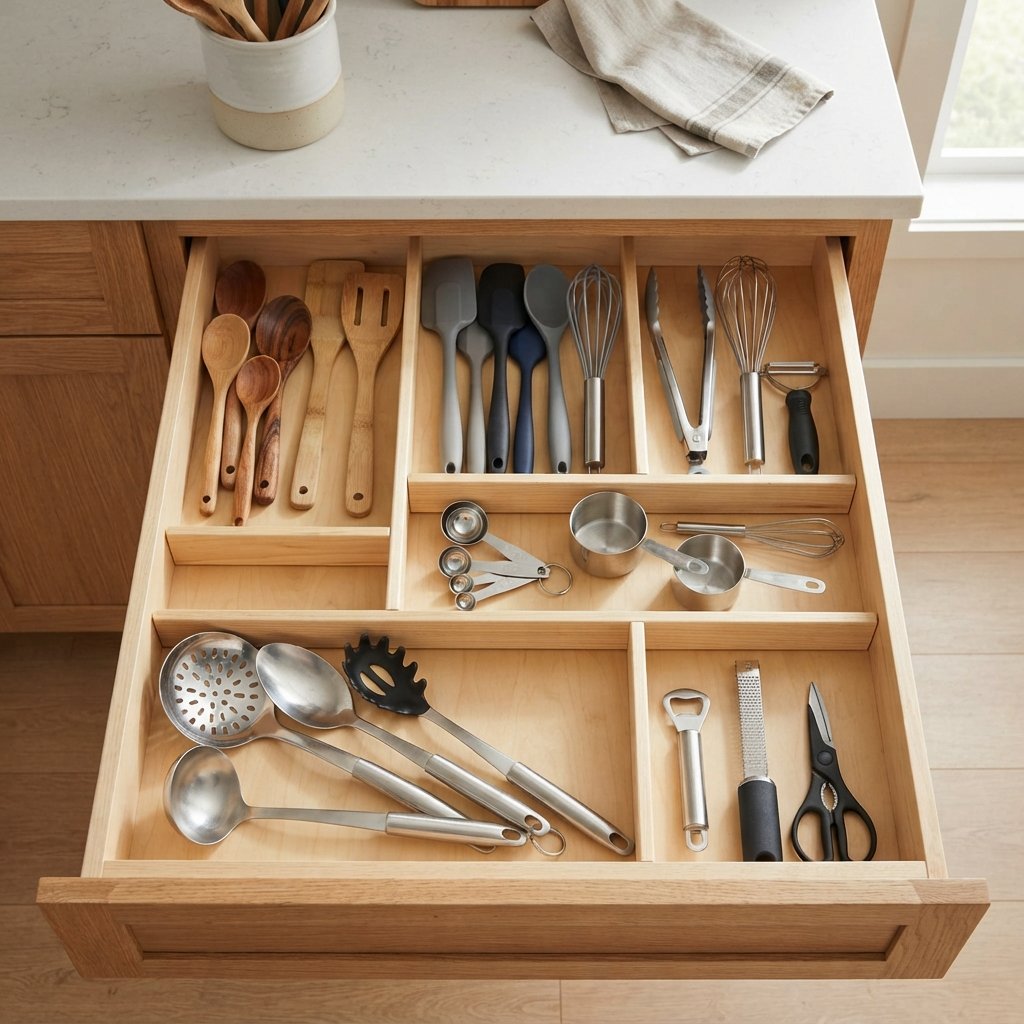
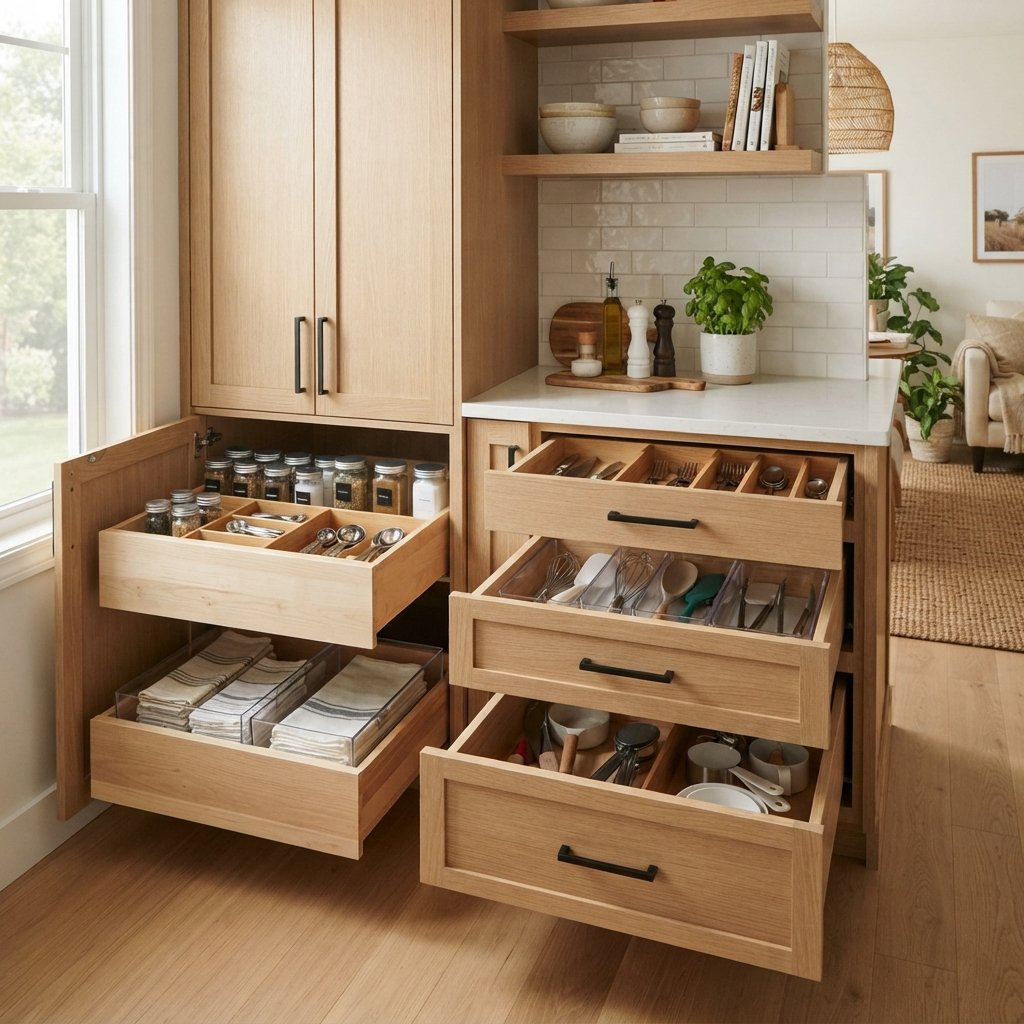
1. Organize the Kitchen Utensil Drawer
Start with one of the most frequently used drawers in the house.
Empty everything onto the counter.
Group utensils by function:
- Spatulas
- Spoons
- Tongs
- Peelers
- Measuring tools
- Openers
Remove duplicates you don’t use.
Then decide what deserves prime drawer space.
Everyday tools should be easiest to reach. Less frequently used specialty tools may work better in another drawer or cabinet.
Use adjustable dividers or long narrow trays to prevent everything from sliding together.
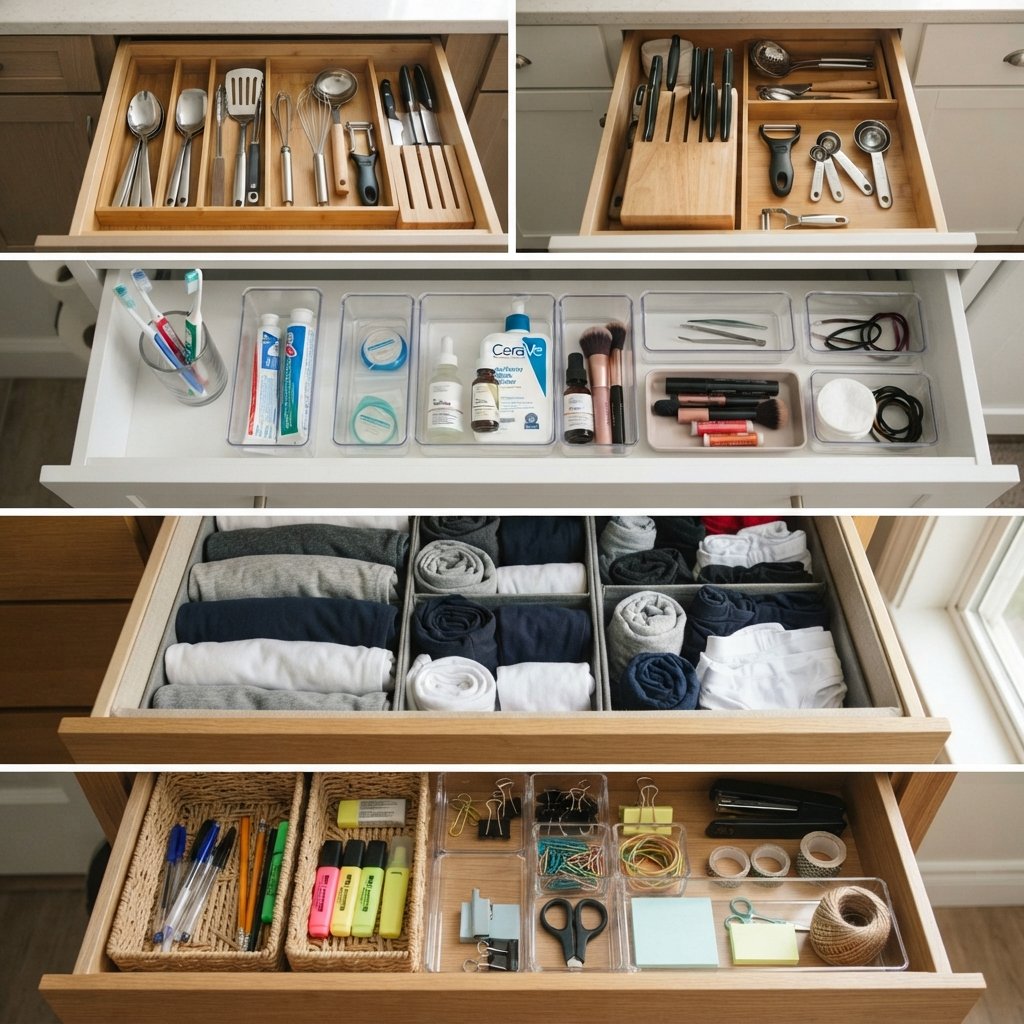
2. Organize the Silverware Drawer
A divided cutlery tray is usually the simplest solution.
Separate:
- Forks
- Spoons
- Knives
- Serving utensils
Before putting everything back, check for random pieces that don’t belong to your current flatware set.
If your drawer is narrow, an appropriately sized compact organizer may use the available space more efficiently.
Keep sharp knives in storage designed to protect the blade and reduce accidental contact rather than tossing them loosely into a general utensil compartment.
3. Organize the Kitchen Junk Drawer
Yes, you can keep a junk drawer.
The goal isn’t to eliminate miscellaneous items. It’s to keep the miscellaneous drawer from becoming a dumping ground.
First, remove anything that has a better permanent home.
Then create categories such as:
- Pens
- Tape
- Small notepads
- Clips
- Measuring tape
- Flashlight
Use small compartments so tiny objects can’t migrate across the entire drawer.
Avoid storing unidentified loose batteries, leaking batteries, medications, sharp objects, or other potentially hazardous items casually in a general junk drawer.
4. Organize Food Storage Bags and Wraps
If you keep food storage supplies in a drawer, group them by type.
You might have:
- Sandwich bags
- Freezer bags
- Foil
- Parchment
- Reusable food bags
Arrange frequently used items toward the front.
Before transferring products out of original packaging, consider whether the packaging contains instructions, safety information, or identification you’ll need later.
Sometimes simply arranging the original boxes neatly is the most practical solution.
5. Organize Kitchen Towels
Instead of stacking towels flat, try folding them so you can see several at once when the drawer opens.
Group:
- Dish towels
- Hand towels
- Cleaning cloths
Keep cleaning cloths used with chemicals separate from kitchen textiles used around food when appropriate.
Don’t pack the drawer so tightly that removing one towel destroys the entire arrangement.
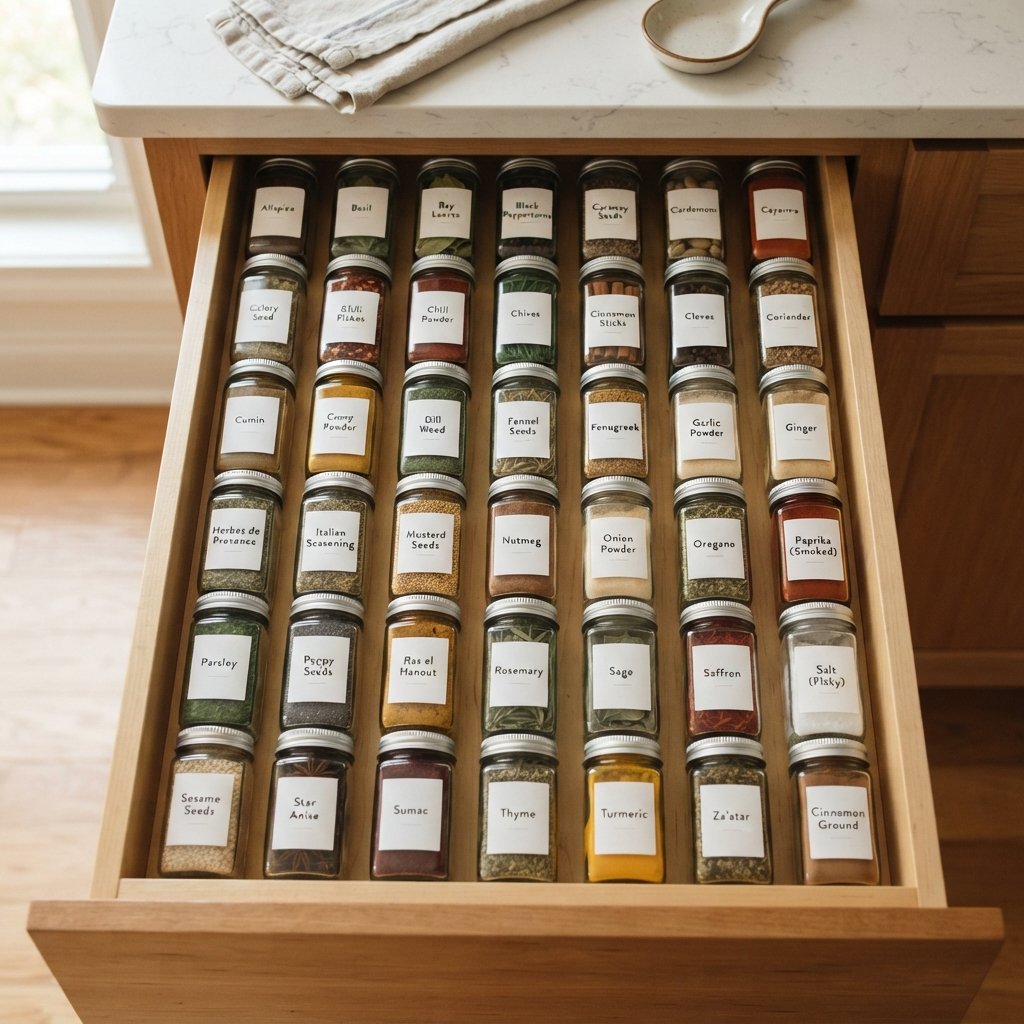
6. Organize a Spice Drawer
A spice drawer can make labels easier to see than a deep cabinet.
Arrange spices:
- Alphabetically
- By frequency
- By cooking category
Whichever system you choose, keep it consistent.
Check dates and condition periodically, and keep original product identification or clear labels on containers.
Don’t put unidentified powders into unlabeled jars.
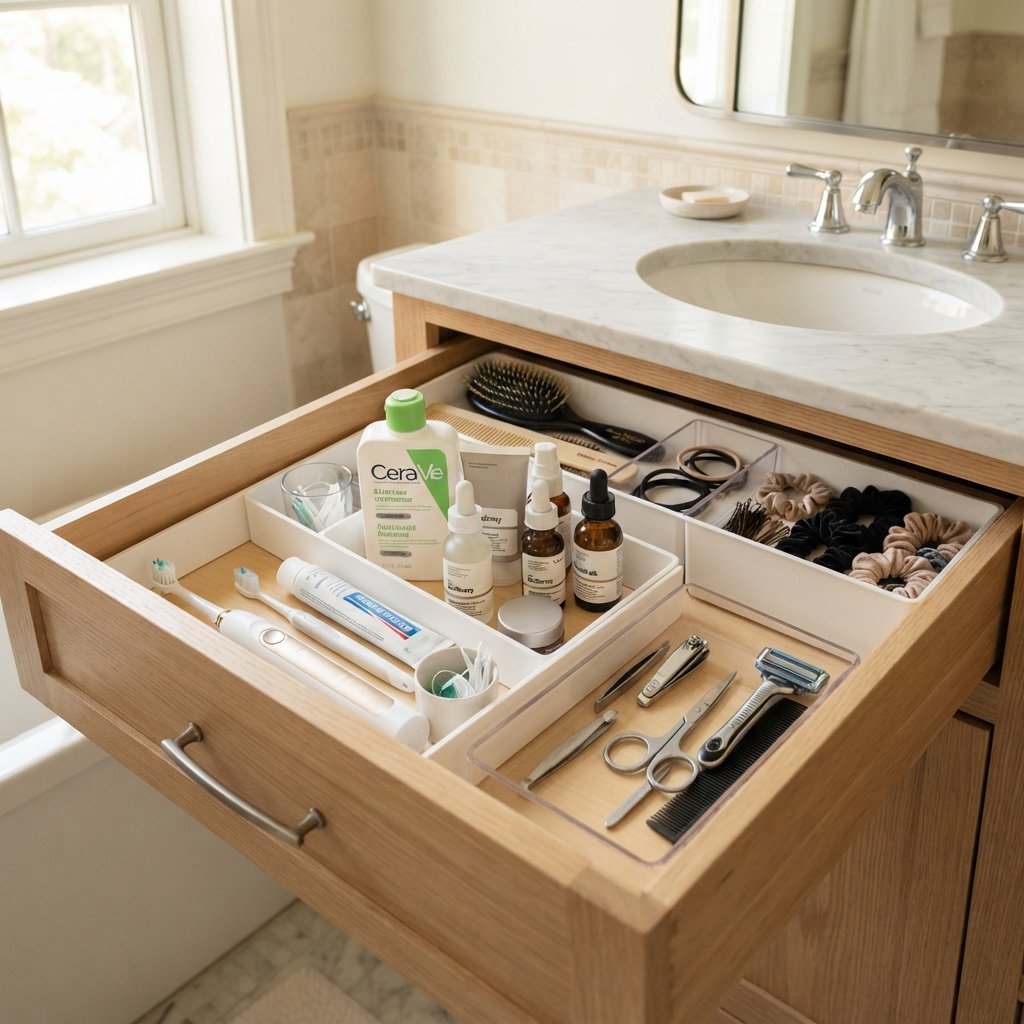
7. Organize the Bathroom Vanity Drawer
Bathroom drawers easily become crowded with samples and half-used products.
Empty the drawer and group items into:
- Dental care
- Hair accessories
- Skin care
- Grooming
- Everyday essentials
Discard empty packaging and dispose of unwanted or expired products according to their labeling and local disposal guidance.
Use washable trays or bins for products that may leak.
Keep the things you use every morning toward the front.
8. Organize Makeup Drawers
Group makeup by type:
- Face
- Eyes
- Lips
- Brushes
Keep everyday products easiest to reach.
Rather than storing every product you own in the prime drawer, move occasional items elsewhere if necessary.
Washable organizers are helpful because makeup residue can accumulate over time.
Follow product guidance for shelf life, hygiene, and disposal.
9. Organize Hair Accessories
Hair ties and clips are exactly the type of small objects that benefit from compartments.
Create sections for:
- Hair ties
- Clips
- Bobby pins
- Headbands
Keep very small accessories contained rather than loose.
If children can access the drawer, consider whether small items could present a choking hazard and store them appropriately.
10. Organize Bathroom Backup Supplies
If you have a deep drawer, you may use part of it for backup toiletries.
But don’t turn it into a miniature store.
Keep only a reasonable amount of:
- Toothpaste
- Soap
- Skin care
- Personal care supplies
Group similar items together so you can see what you already have before buying more.
11. Organize T-Shirt Drawers
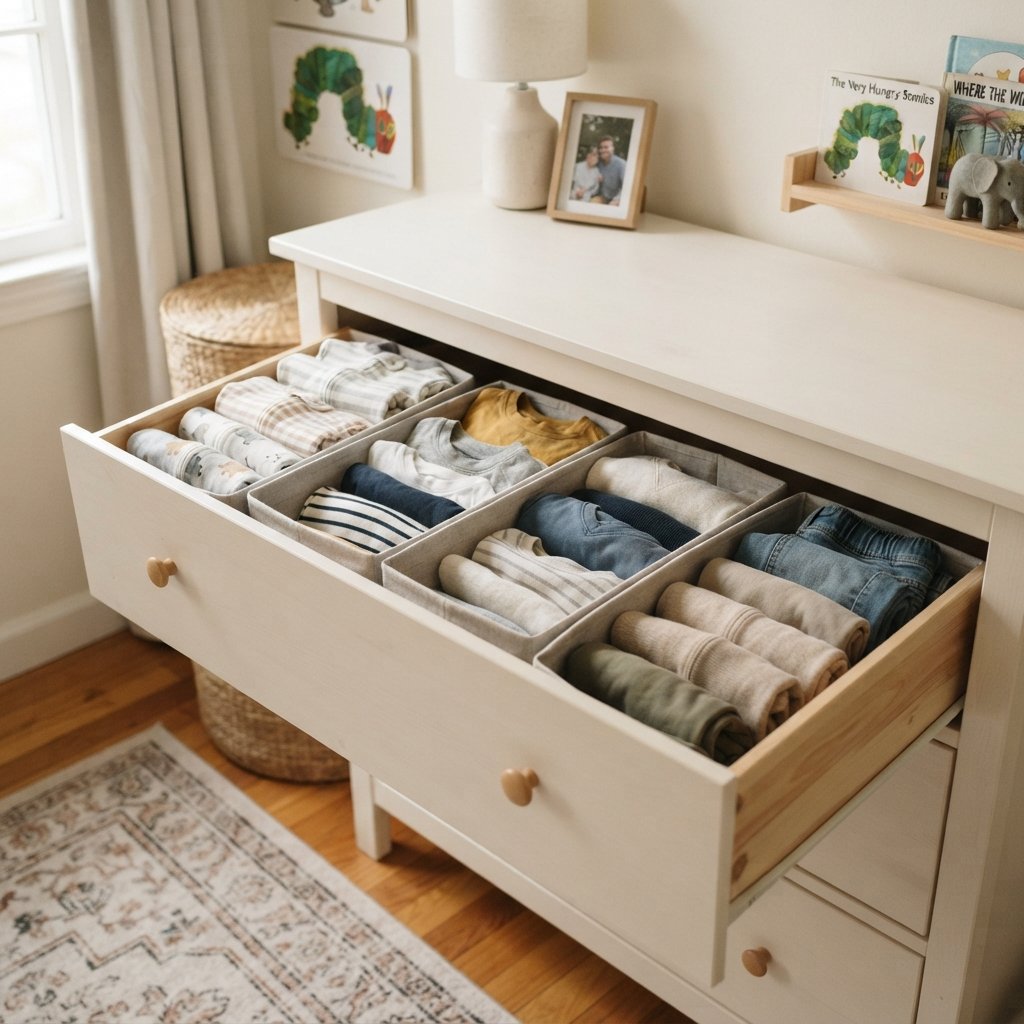
Folding shirts so several are visible at once can make choosing clothes easier than stacking them in a tall pile.
Group them by:
- Type
- Color
- Use
For example:
Everyday tees | workout tees | sleep shirts
Don’t compress clothing so tightly that it’s difficult to remove individual pieces.
12. Organize Underwear Drawers
Small fabric bins or dividers can prevent smaller clothing items from becoming mixed together.
Create simple sections for the categories you actually own.
Avoid making dozens of tiny compartments.
The system should make laundry easier to put away, not turn folding into a complicated chore.
13. Organize Sock Drawers
Start by matching pairs.
Remove:
- Worn-out socks
- Singles you’ve kept indefinitely
- Socks you never wear
Then divide the remaining pairs into useful groups such as:
- Everyday
- Athletic
- Dress
- Seasonal
Simple dividers are usually enough.
14. Organize Pajama Drawers
Keep pajama sets together if possible.
Separate heavier and lighter sleepwear if you have enough of both to make that useful.
Seasonal pieces that won’t be used for months can move to less accessible storage if you’re short on drawer space.
15. Organize Kids’ Clothing Drawers
Kids’ drawers should be simple enough that children can participate in putting clothes away.
Use broad categories such as:
- Shirts
- Pants
- Pajamas
- Underwear
If labels help, consider simple words or pictures depending on the child’s age.
Avoid creating an overly complicated system that only an adult can maintain.
16. Organize the Nightstand Drawer
A nightstand drawer can easily become a second junk drawer.
Keep it focused on things you actually use around bedtime.
That might include:
- Hand cream
- Notepad
- Pen
- Reading glasses
- Sleep mask
Remove receipts, old packaging, random cords, and objects that belong elsewhere.
Keep medications stored according to their labels and household safety needs rather than automatically putting them in a bedside drawer.
17. Organize the Home Office Drawer
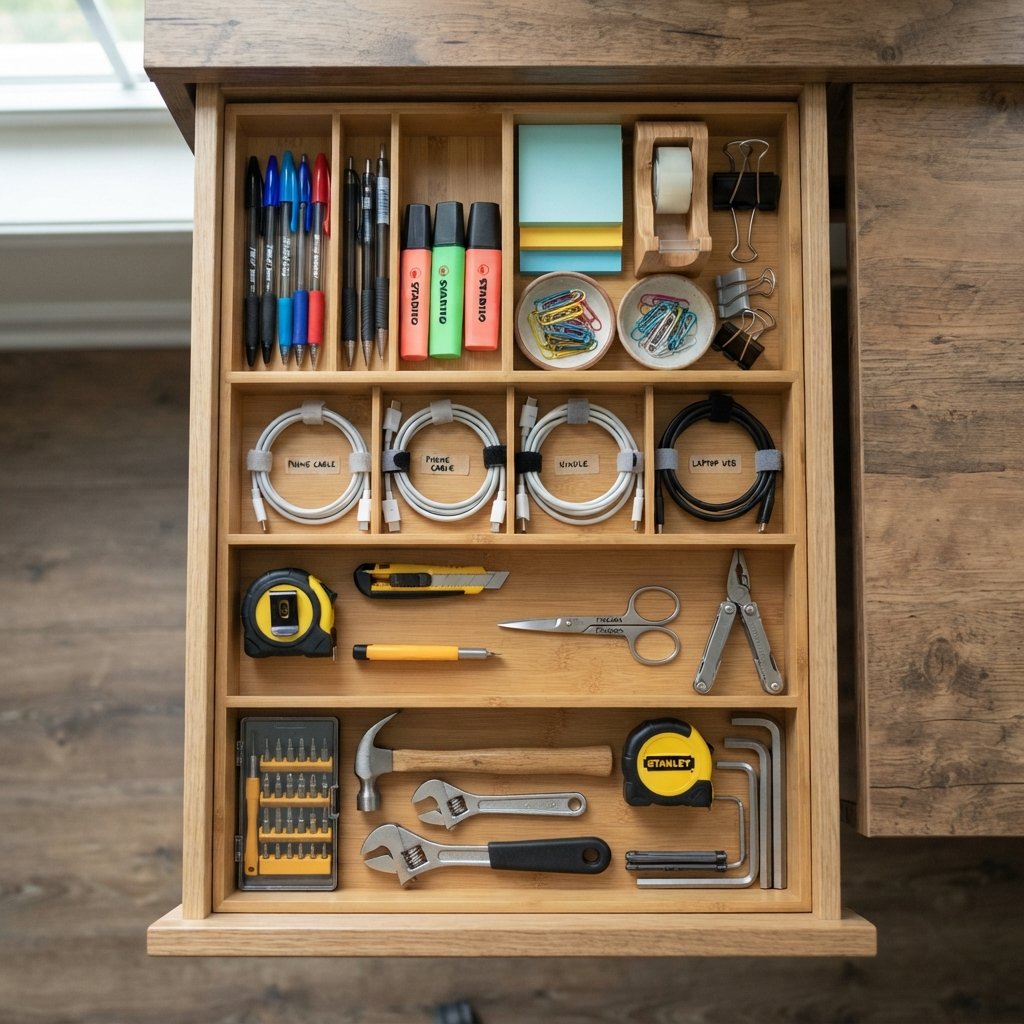
Divide office supplies into categories.
Try:
- Pens
- Pencils
- Markers
- Sticky notes
- Clips
- Tape
Use shallow trays so items stay visible.
Test pens and markers before putting them back.
There’s no reason to organize a drawer full of supplies that no longer work.
18. Organize Cords and Chargers
First, identify every cord.
If you don’t know what something belongs to, investigate before deciding whether to keep it.
Group cables by type or device.
Reusable cable ties can prevent tangles.
Labels can be helpful for similar-looking chargers.
Avoid tightly bending, crushing, or storing damaged cords. Follow manufacturer guidance for electronics and charging accessories, and replace damaged items appropriately.
19. Organize Batteries Safely
Batteries deserve their own storage rather than being tossed loosely into a junk drawer.
Keep them:
- In original packaging when practical
- Or in a storage system designed for the battery type
Don’t allow loose batteries to contact metal objects such as coins, keys, or paper clips, which can create electrical hazards.
Follow manufacturer instructions for battery storage and local guidance for disposal or recycling.
20. Organize Craft Drawers
Craft drawers can become chaotic because they contain so many small materials.
Sort by activity or supply type:
- Markers
- Colored pencils
- Glue
- Paper tools
- Stickers
- Tape
Use shallow containers for small pieces.
Keep scissors, blades, hot glue tools, adhesives, paints, and other potentially hazardous craft supplies stored appropriately for the people who can access the drawer.
21. Organize a Tool Drawer
Don’t mix household tools with random office supplies.
Group tools by function.
You might create sections for:
- Screwdrivers
- Pliers
- Measuring tools
- Small hand tools
Sharp tools should be secured appropriately.
Keep power tool batteries, chemicals, adhesives, blades, and other products according to manufacturer storage instructions.
22. Organize Entryway Drawers
An entryway drawer should support things you do while entering or leaving the house.
Depending on your household, that might include:
- Sunglasses
- Dog-walking accessories
- Small reusable bags
- Everyday accessories
Be selective.
The entryway is a common dumping zone, so don’t let the drawer become storage for every unidentified object carried through the front door.
23. Organize the Dining Room Sideboard Drawers
Use these drawers for items related to dining and entertaining.
Try:
- Cloth napkins
- Placemats
- Serving utensils
- Table accessories
Seasonal table linens can be grouped separately.
Keep frequently used pieces in the easiest-to-reach drawer.
24. Organize Linen Storage Drawers
If you store linens in drawers, group by type or location.
For example:
- Guest towels
- Pillowcases
- Hand towels
Don’t overfill.
Textiles need enough room that you can remove one item without pulling everything else out with it.
25. Organize Cleaning Supply Drawers Carefully
Not every cleaning product belongs in a drawer.
Always follow the product label for safe storage.
Keep household chemicals in their original labeled containers unless the manufacturer specifically directs otherwise.
Never transfer cleaners into food or beverage containers.
Store products away from children and pets as required, and don’t mix chemicals.
If you have a drawer suitable for safe cleaning storage, it may work better for nonchemical supplies such as:
- Clean microfiber cloths
- Replacement sponges
- Cleaning brushes
- Gloves
How to Organize a Junk Drawer That Actually Stays Organized
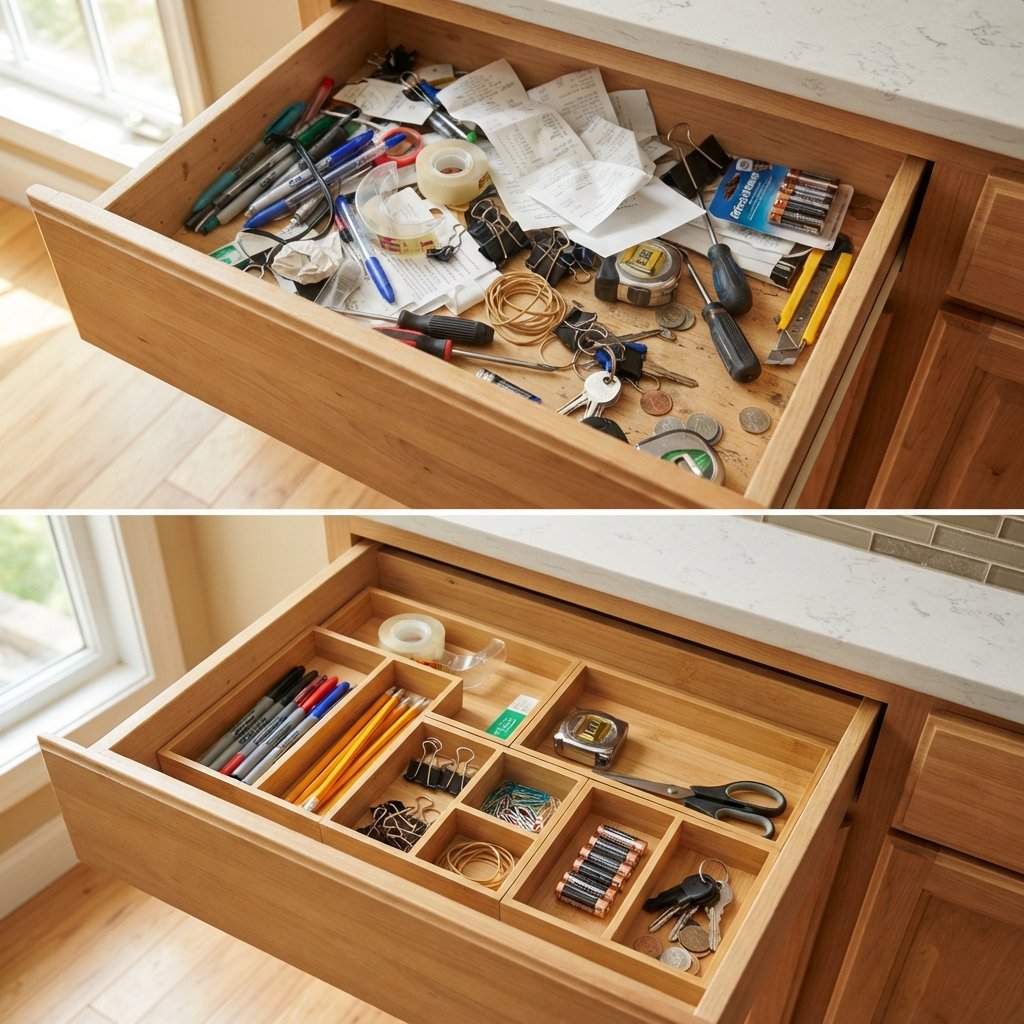
The junk drawer deserves its own strategy because almost every house has one.
Empty Everything
Don’t organize around the existing mess.
Remove Obvious Trash
Old receipts, empty packages, dried-out pens, and other trash can go immediately.
Relocate Items
A screwdriver belongs with tools.
A hair tie belongs with hair accessories.
A charging cable belongs with electronics.
Create Categories
Whatever remains should fit into a few small groups.
Use Compartments
Give each category boundaries.
Leave Empty Space
Don’t fill every compartment.
A little open space gives the drawer somewhere to absorb new items without immediately becoming chaotic.
How to Choose Drawer Organizers
The most useful organizer is the one that fits both the drawer and the objects going inside.
Consider:
Adjustable Dividers
Good for larger categories such as clothing or utensils.
Small Trays
Useful for office supplies, makeup, and junk drawers.
Washable Plastic Organizers
Practical for bathrooms and makeup.
Fabric Bins
Useful inside deep dresser drawers.
Expandable Organizers
Helpful when drawer widths vary.
Repurposed Small Boxes
Good for inexpensive organizing when appearance isn’t a priority.
Measure before buying.
A beautiful organizer that’s half an inch too wide is useless.
Don’t Make Every Drawer Look the Same
Organization doesn’t require matching containers throughout the house.
A bathroom drawer has different needs from a sock drawer.
Choose storage based on function.
For example:
- Bathroom: washable
- Kitchen: easy to wipe clean
- Bedroom: flexible dividers
- Office: shallow compartments
- Kids’ room: simple, broad categories
Function matters more than having identical organizers.
How to Organize Drawers Without Buying Anything
Try the project before shopping.
Use small boxes you already have to test different layouts.
You can also simply use the drawer itself as the boundary when a category doesn’t need additional containment.
Sometimes the best solution is not another bin.
It’s owning less.
How to Keep Drawers Organized
Getting organized is the easy part.
Keeping it that way requires a system that’s simple enough to maintain.
Give Everything a Home
If you can’t decide where something belongs, the system isn’t finished.
Don’t Overfill Compartments
Leave room for items to move in and out easily.
Put Things Back Immediately
A five-second reset is easier than reorganizing the drawer every six months.
Stop Using Empty Space as an Invitation to Shop
An empty compartment doesn’t need to be filled.
Edit Regularly
When a drawer becomes difficult to close, don’t buy another organizer.
Remove what no longer belongs.
Try the One-Drawer-a-Day Method
Organizing every drawer in your house in one weekend may sound productive, but it can quickly become overwhelming.
Instead, organize one drawer a day.
Day 1 might be the kitchen junk drawer.
Day 2 could be silverware.
Day 3 might be your bathroom vanity.
Even if you organize only five drawers a week, you’ll make steady progress without turning the entire house upside down.
Common Drawer Organization Mistakes
Buying Organizers First
Declutter and measure before shopping.
Keeping Too Many Duplicates
You probably don’t need six versions of an item you rarely use.
Creating Too Many Categories
Simple systems are easier to maintain.
Overfilling the Drawer
Leave some breathing room.
Hiding Items You Use Daily
Prime drawer space should go to frequently used items.
Using Deep Containers for Tiny Objects
Items disappear at the bottom.
Decanting Everything
Original packaging can contain important labels, directions, dates, warnings, and product identification.
Making the System Too Pretty to Use
An organizer should make everyday life easier.
Ignoring Safety
Batteries, medications, chemicals, blades, tools, electronics, and small objects may need specific storage rather than simply a neat-looking compartment.
Drawer Organization Safety Tips
Some household drawers contain items that need more careful storage.
- Store medications according to product directions and away from children or others who should not access them.
- Keep cleaning chemicals in original labeled containers and follow storage instructions.
- Never mix household chemicals.
- Store batteries according to manufacturer guidance and prevent loose terminals from contacting metal objects.
- Keep blades, sharp tools, knives, and scissors secured appropriately.
- Keep choking hazards and other small dangerous items away from young children.
- Don’t store damaged electrical cords or charging equipment for continued use.
- Follow manufacturer recommendations for lithium-ion batteries, power tool batteries, and electronics.
- Don’t place heat-generating or charging electronics in enclosed drawers unless the product and installation are designed for that use.
- Store potentially hazardous craft materials according to their labels.
- Use child-resistant storage or other appropriate safeguards where needed.
FAQ About Organizing Every Drawer in Your House
What is the easiest way to organize a drawer?
Empty it completely, remove what doesn’t belong, group similar items, and use dividers or trays only where they make those categories easier to maintain.
Should I buy drawer organizers before decluttering?
No. Declutter first, then measure the drawer and the items you’re keeping. Otherwise, you may buy containers you don’t need or that don’t fit.
What should I use to organize junk drawers?
Small trays, adjustable dividers, and shallow containers work well because they prevent tiny miscellaneous objects from mixing together.
How do I organize deep drawers?
Use larger bins or dividers to create broad categories. Avoid piling small items on top of one another where they become difficult to see.
How do I organize clothes in drawers?
Group clothing by type and fold pieces so they’re easy to see and remove. Dividers can help separate smaller categories.
How do I organize drawers on a budget?
Declutter before buying anything, reuse small boxes and containers you already own, and purchase organizers only for drawers that genuinely need them.
How do I keep drawers from getting messy again?
Give every category a defined home, avoid overfilling compartments, and put things back immediately after use.
How long does it take to organize all the drawers in a house?
That depends on the number of drawers and how much decluttering they require. Rather than tackling everything at once, organizing one drawer a day can make the project much more manageable.
Final Thoughts
Trying to organize every drawer in your house can sound like an enormous project until you stop thinking about the entire house and focus on one drawer.
Empty it.
Remove the trash.
Relocate anything that doesn’t belong.
Group similar items.
Then decide whether you actually need dividers or containers.
That’s the basic system whether you’re organizing forks, makeup, socks, pens, craft supplies, or kitchen utensils.
And don’t aim for perfection.
Your drawers don’t need to look like store displays. They need to make everyday life easier.
When you can open a drawer, immediately see what you need, take it out, and put it back without rearranging everything else, the system is working.
Start with the drawer that frustrates you most.
Then tackle another tomorrow.
One drawer at a time, you can create a home that’s easier to use without spending an entire weekend surrounded by piles of stuff.