

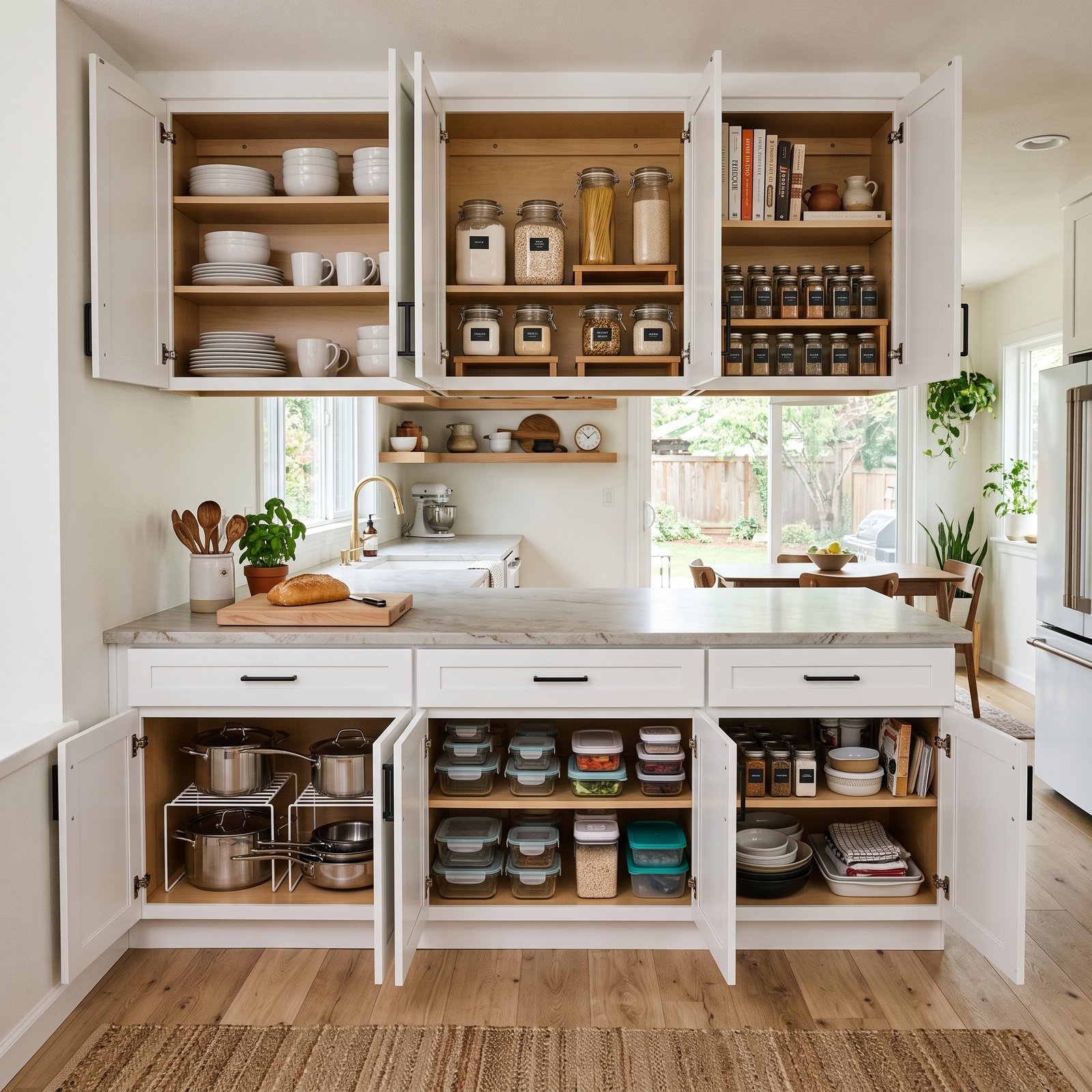
Learning how to organize kitchen cabinets can make everyday cooking, cleaning, and grocery unloading noticeably easier.
Kitchen cabinets tend to become cluttered gradually. Mugs multiply, food containers lose their lids, rarely used appliances take over valuable shelves, and everyday ingredients somehow end up behind things you barely touch. Eventually, finding one pan or spice means moving five other things first.
The solution is not necessarily buying more organizers.
A well-organized kitchen starts with deciding what belongs in each cabinet, placing frequently used items where they are easiest to reach, and choosing storage solutions only when they solve a specific problem.
Whether you have a small kitchen with limited cabinets or plenty of storage that never seems organized, these practical ideas can help you create a system that is easier to use—and easier to maintain.
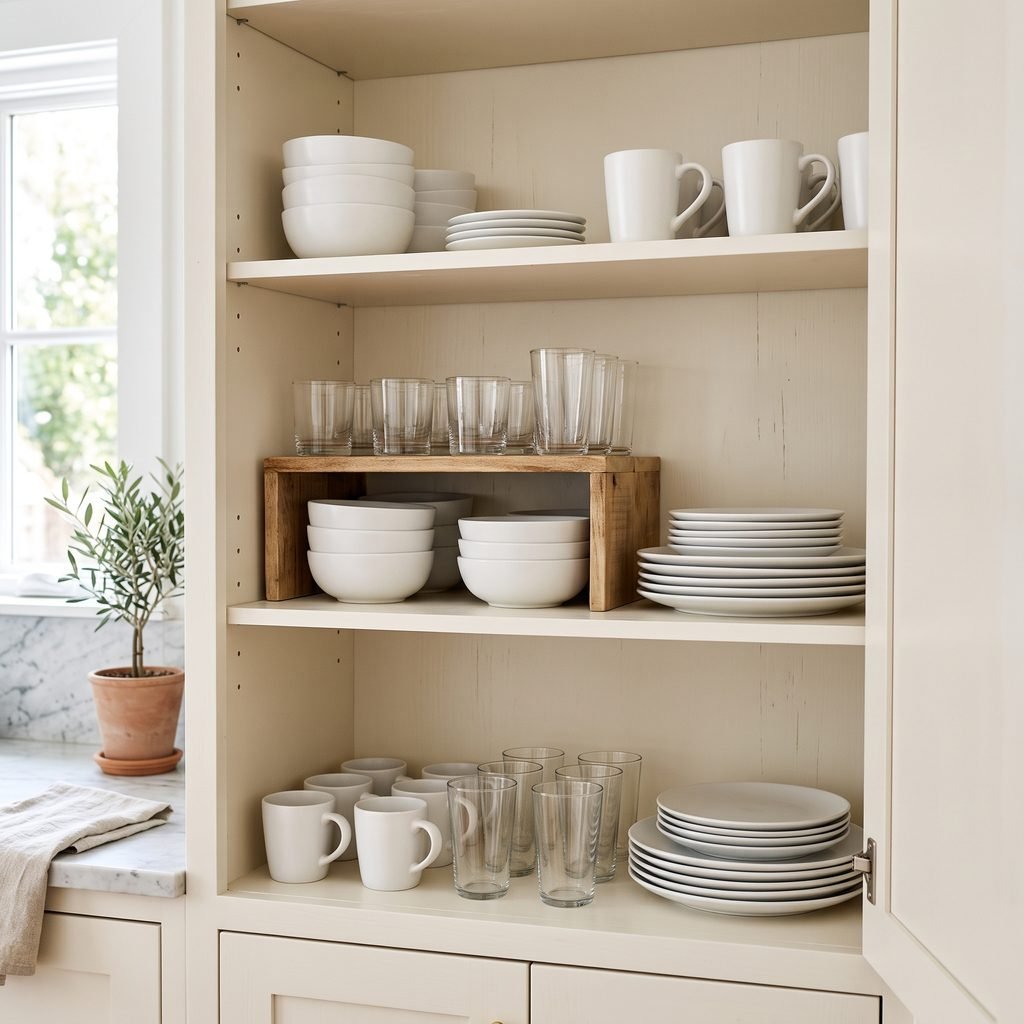
1. Empty One Cabinet at a Time
You do not have to empty the entire kitchen onto the floor.
Instead, work cabinet by cabinet.
Remove everything from one area and place the contents on a counter or table.
Then ask:
- Do I use this?
- Does it belong in the kitchen?
- Do I have duplicates?
- Is it damaged?
- Would I buy it again?
- Is this the best cabinet for it?
Check expiration or quality dates on foods where relevant, and discard products that are spoiled, damaged, or otherwise unsafe to use.
Working one cabinet at a time makes the project much less overwhelming.
2. Clean the Cabinets Before Reorganizing
An empty cabinet is the perfect opportunity for cleaning.
Vacuum or wipe away:
- Crumbs
- Dust
- Spilled spices
- Sticky residue
Then clean shelves with a method appropriate for the cabinet material and finish.
Avoid saturating wood or engineered-wood cabinetry with water.
Let surfaces dry completely before returning food, dishes, or organizers.
This small step makes the finished kitchen feel significantly fresher.
3. Create Kitchen Zones
Instead of putting items wherever they fit, organize the kitchen around activities.
Useful zones might include:
Cooking Zone
Pots, pans, cooking utensils, oils, and frequently used seasonings.
Baking Zone
Flour, sugar, baking pans, measuring cups, and mixing bowls.
Coffee Zone
Mugs, coffee, tea, filters, and related accessories.
Food Storage Zone
Containers, lids, wraps, and reusable bags.
Dish Zone
Plates, bowls, glasses, and everyday serving pieces.
Snack Zone
Frequently used packaged snacks and lunch supplies.
Place each zone close to where you use it whenever the kitchen layout allows.
This reduces unnecessary movement and makes putting things away more intuitive.
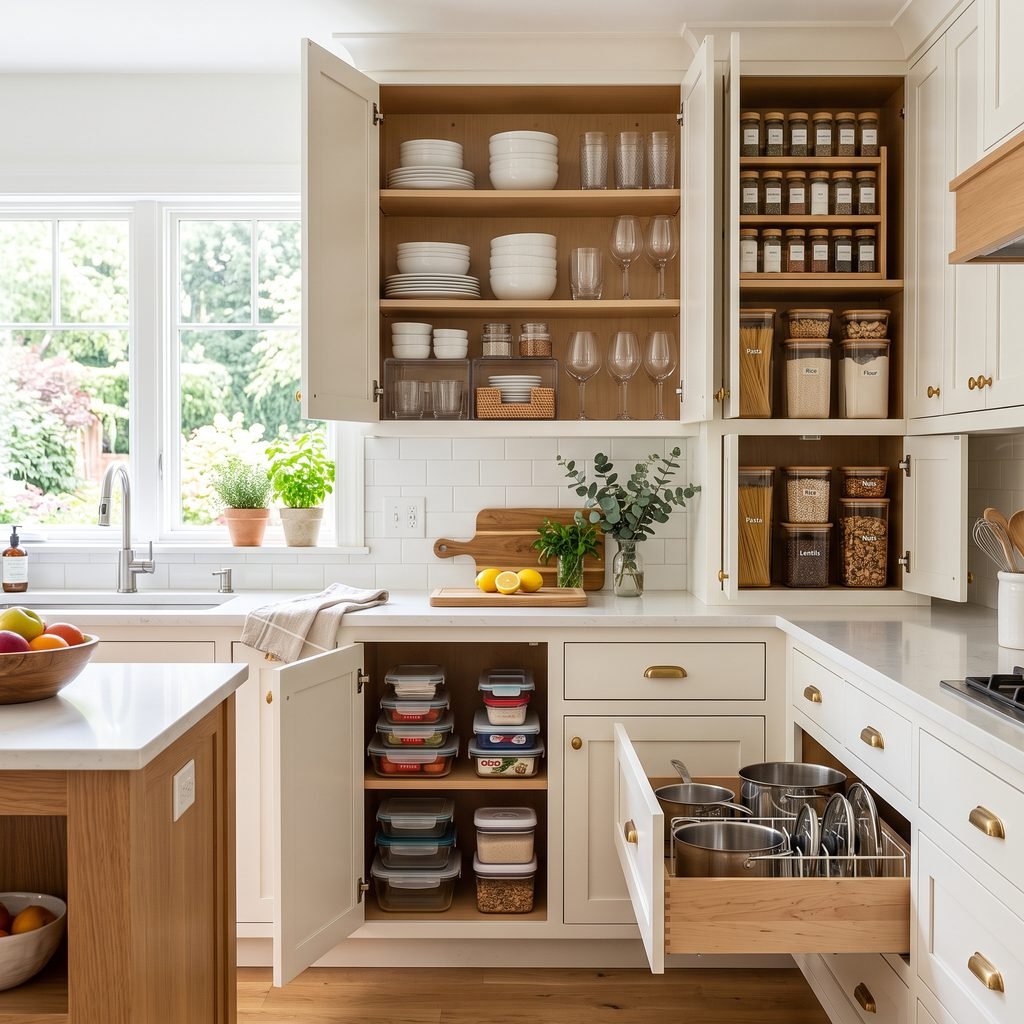
4. Keep Everyday Items at Eye Level
Prime cabinet space should go to the things you use most.
Place frequently used items where you can reach them comfortably.
That might include:
- Dinner plates
- Bowls
- Drinking glasses
- Coffee mugs
- Everyday pantry staples
Higher shelves are better for lighter, less frequently used pieces.
Very heavy items are generally safer on lower shelves rather than overhead.
A cabinet becomes frustrating when you have to move rarely used dishes every morning just to reach your favorite mug.
5. Use Shelf Risers to Double Usable Space
Tall cabinet shelves often waste vertical space.
A shelf riser creates a second level so you can store items above and below each other without building an unstable tower.
They are especially helpful for:
- Plates
- Bowls
- Mugs
- Small pantry items
- Food containers
Before buying risers, measure the cabinet’s width, depth, and usable height.
Choose sturdy organizers suitable for the weight you intend to place on them.
The goal is easier access—not squeezing twice as much clutter into the cabinet.
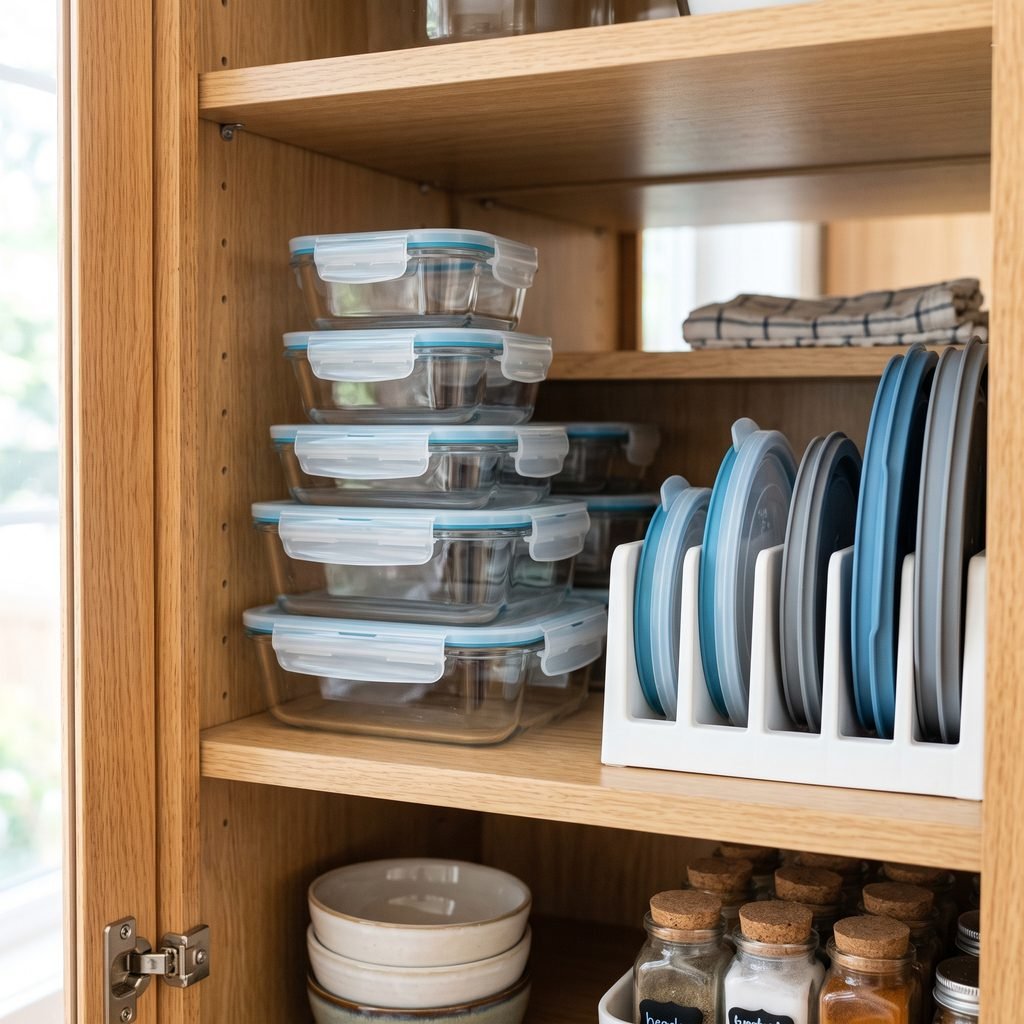
6. Organize Food Storage Containers and Lids
Food storage containers can quickly take over an entire cabinet.
Start by matching every container with its lid.
Recycle or dispose of damaged containers as appropriate, and remove orphaned lids that no longer fit anything.
Then choose a simple system.
You might:
- Nest similar containers
- Stack containers by size
- Store lids vertically
- Use a divided bin for lids
Avoid stacking containers so deeply that removing one causes everything else to fall over.
If possible, limit the number of different shapes and sizes you keep.
7. Store Baking Sheets and Cutting Boards Vertically
Large flat items are often awkward when stacked horizontally.
Instead, store them vertically when cabinet dimensions allow.
This works well for:
- Baking sheets
- Muffin tins
- Cutting boards
- Cooling racks
- Serving trays
Use sturdy vertical dividers designed for cabinet storage.
This arrangement lets you pull out one item without lifting an entire stack.
A narrow cabinet near the oven can be an especially convenient location for baking pans.
8. Organize Pots and Pans by How Often You Use Them
Pots and pans are bulky, so they need intentional storage.
Keep everyday cookware easiest to reach.
Less-used pieces can go farther back or on a different shelf.
If nesting pots, protect surfaces when necessary according to the cookware manufacturer’s care guidance.
Store lids separately if that makes the cabinet easier to use.
Possible lid storage solutions include:
- Vertical dividers
- Dedicated lid racks
- Deep drawer dividers
Do not create a complicated system just because it looks good in a photograph. You should be able to grab a saucepan without dismantling the cabinet.
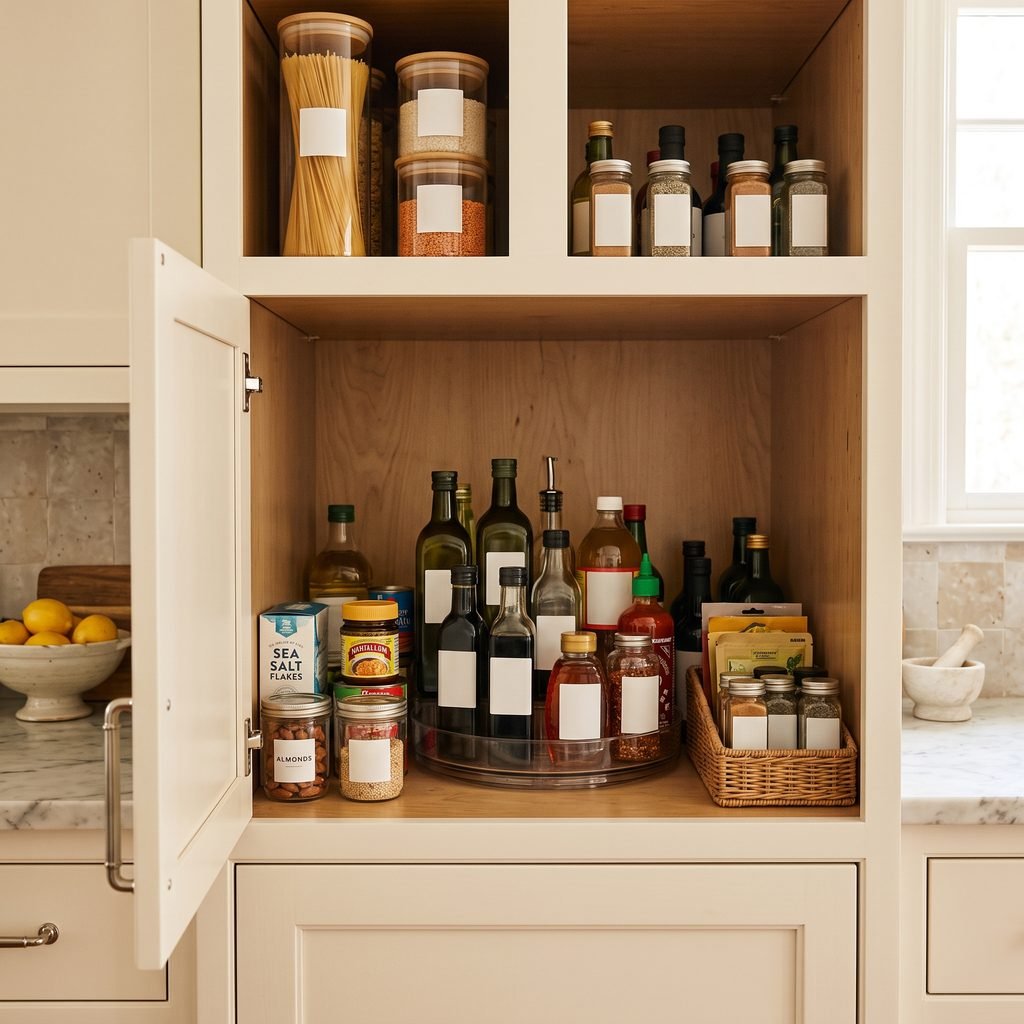
9. Use Turntables for Hard-to-Reach Items
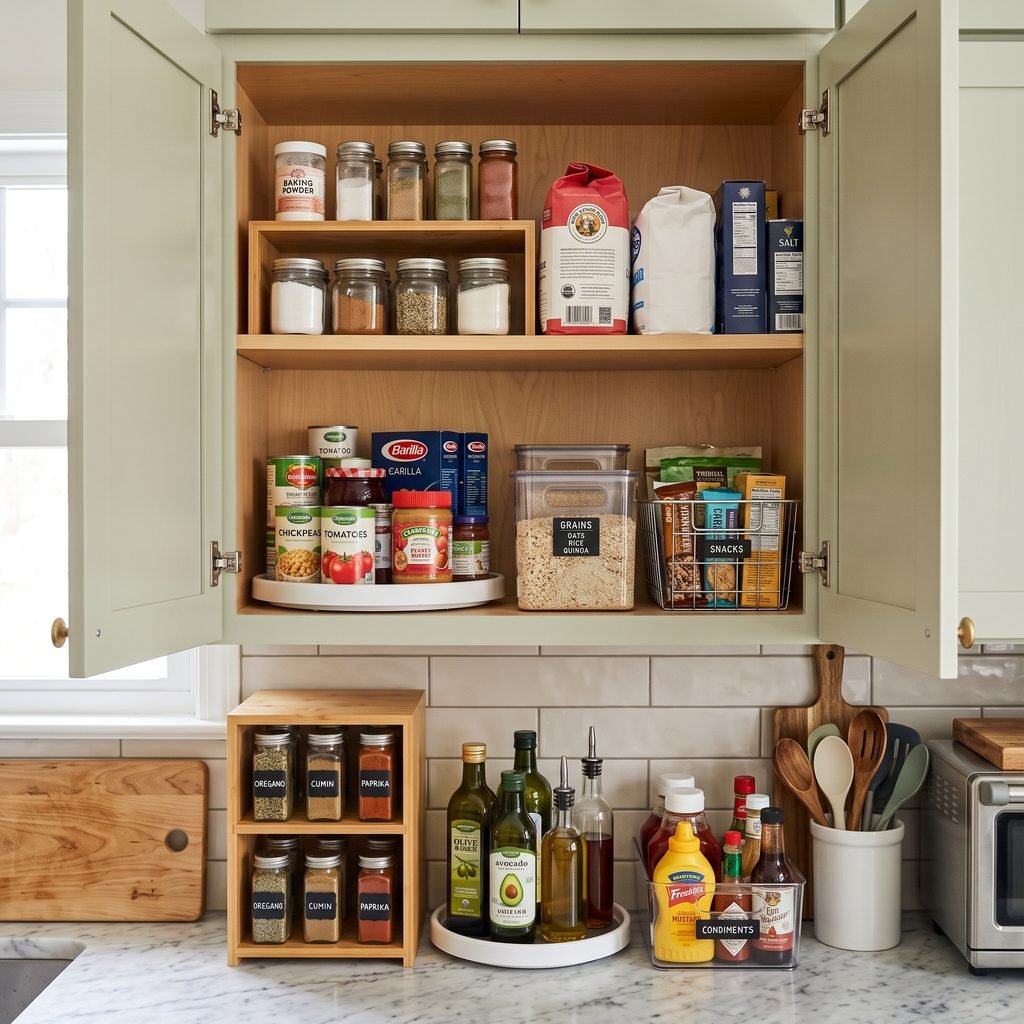
A turntable can make deep cabinets more accessible.
They work particularly well for smaller bottles and containers such as:
- Oils
- Vinegars
- Condiments
- Spices
Choose one that fits comfortably inside the cabinet and remains stable when rotated.
Avoid putting tall, unstable glass bottles on a turntable if they are likely to tip.
A turntable is most useful when it solves the problem of items disappearing at the back.
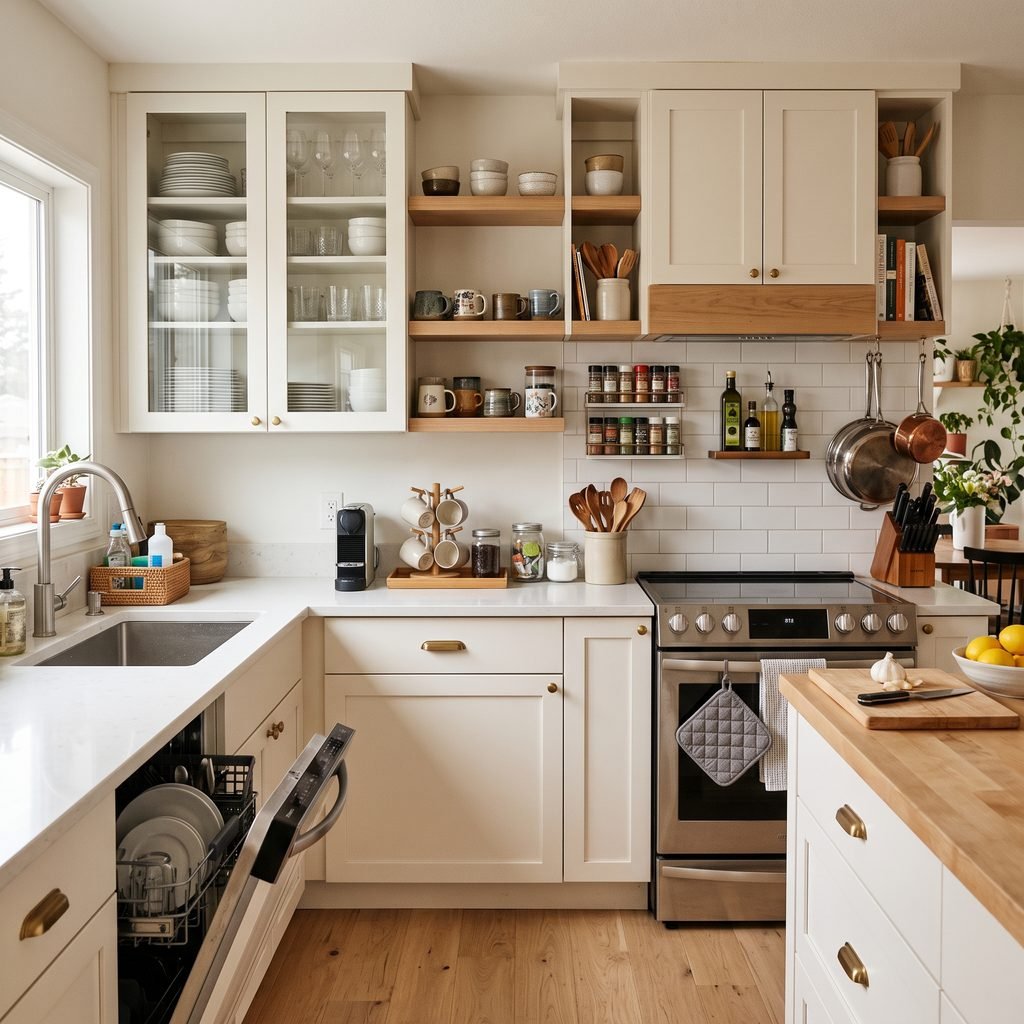
10. Organize Spices So You Can See Them
Spices are easy to overbuy because small containers disappear behind each other.
There are several ways to organize them:
- Tiered shelf
- Shallow drawer
- Spice rack
- Small turntable
- Door-mounted organizer where suitable
Alphabetical organization is useful if you have a large collection.
For a smaller collection, grouping by use may be easier.
For example:
- Everyday seasonings
- Baking spices
- Herbs
- Specialty blends
Check older spices periodically and replace them when quality has noticeably deteriorated.
If transferring spices to other containers, label them clearly so you know what they contain.
11. Use Bins for Small Pantry Categories
Small items become easier to manage when they are grouped.
Use bins for categories such as:
- Snacks
- Baking supplies
- Breakfast items
- Lunch supplies
- Tea
- Packaged mixes
The container should make the category easier to access rather than becoming another layer you have to remove.
For example, an open-front bin may work better than a lidded box for snacks used every day.
Avoid excessively broad labels like “miscellaneous.”
If a category is too vague, clutter tends to return.
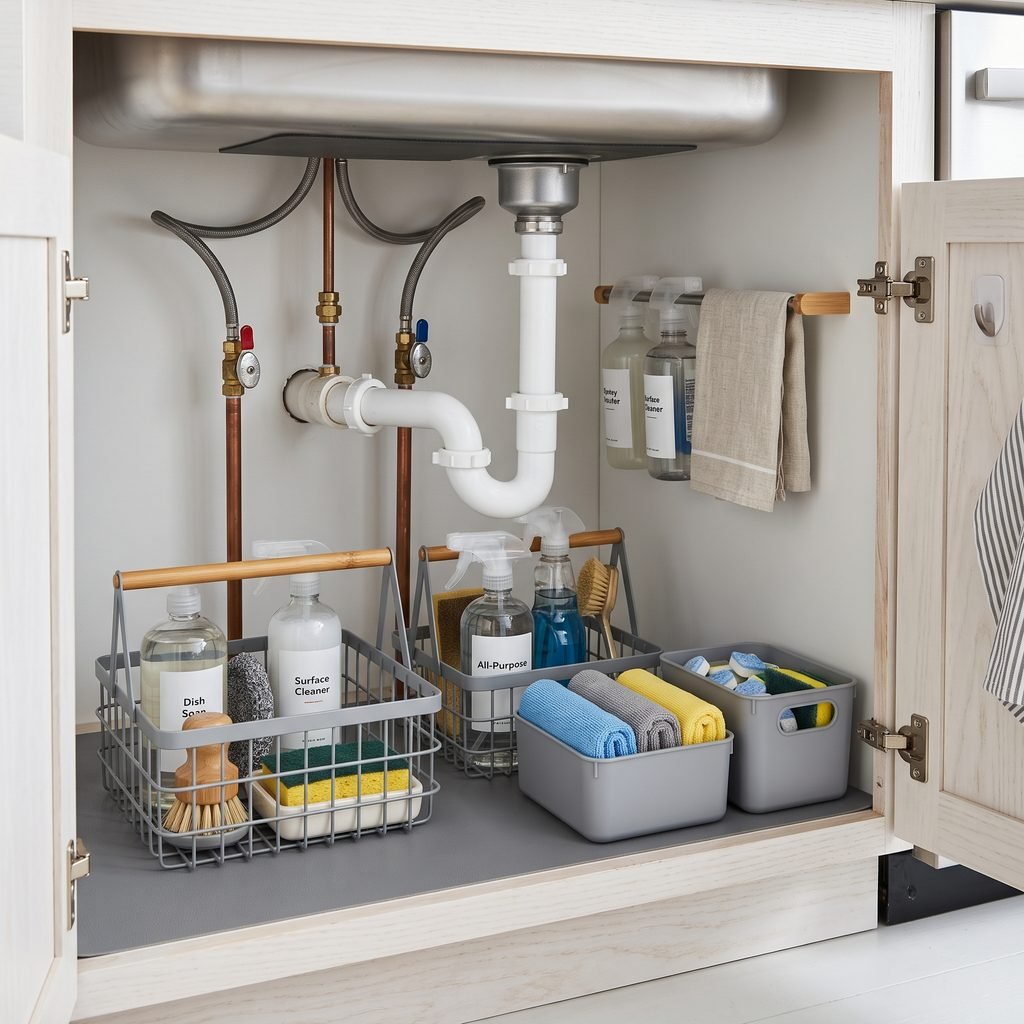
12. Organize Under the Kitchen Sink Carefully
The cabinet under the sink can be challenging because pipes, garbage disposals, filters, and other plumbing components take up space.
Start by removing products that do not need to be there.
Then organize around the plumbing.
Possible storage options include:
- Shallow bins
- Small pull-out drawers
- Door-mounted storage where appropriate
- Removable caddies
Keep access to plumbing and shutoff valves clear.
Do not build permanent storage around connections that may need servicing.
Cleaning products should remain properly labeled and stored according to manufacturer directions. Keep hazardous products securely away from children and pets.
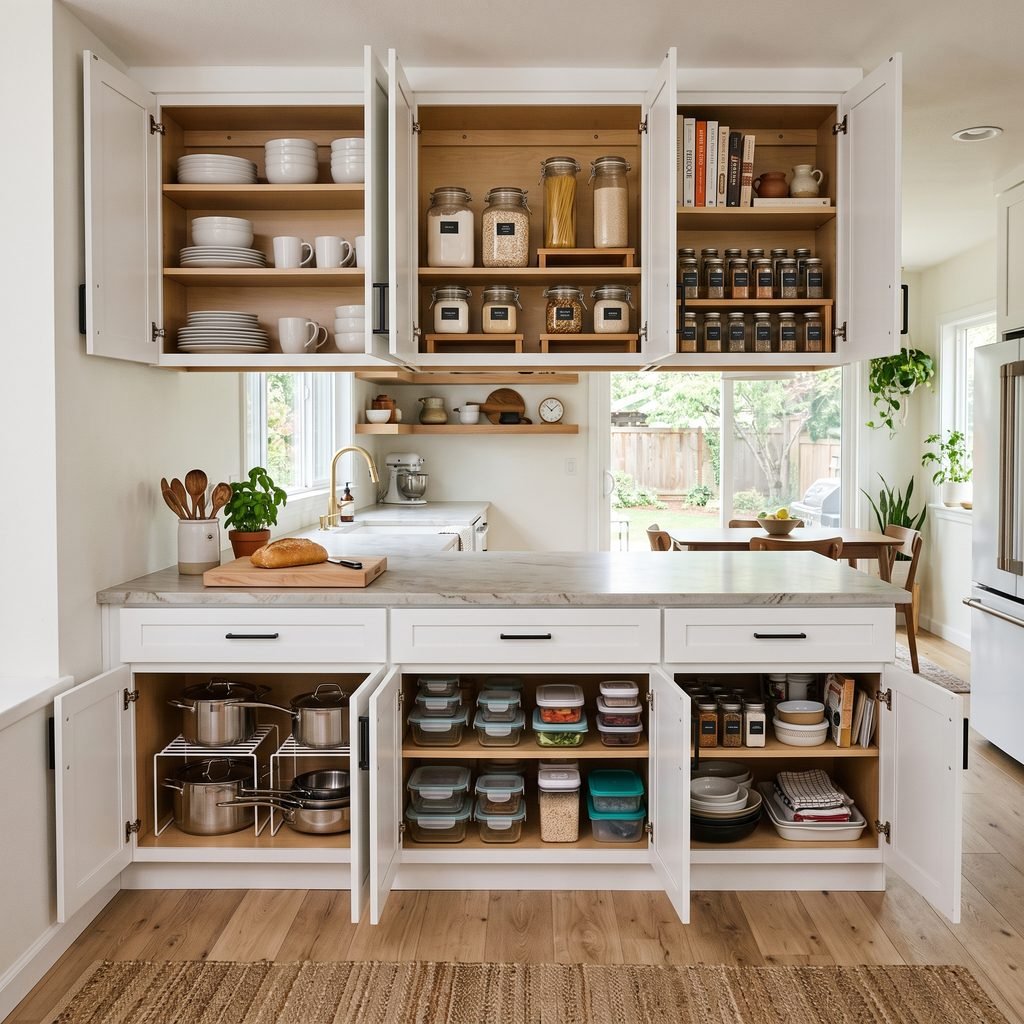
13. Make Corner Cabinets Easier to Use
Corner cabinets can provide plenty of storage but are often difficult to reach.
Use them for larger items rather than dozens of tiny objects.
Good candidates include:
- Mixing bowls
- Large serving bowls
- Small appliances
- Colanders
If your cabinet has a rotating shelf system, avoid overloading it and follow its weight limitations.
Keep frequently used items toward the easiest-to-access areas.
Deep corners are not ideal for anything you need every morning.
14. Use Cabinet Doors for Extra Storage—Carefully
The inside of a cabinet door can sometimes provide useful extra space.
Depending on the door and hinges, you might add:
- Lightweight measuring spoons
- Small wraps organizer
- Cleaning cloth holder
- Lightweight spice storage
Before installing anything, check that the door can support the additional weight.
Make sure the organizer does not hit shelves or cabinet contents when the door closes.
Avoid drilling into cabinet doors unless you are confident about their construction and appropriate fastener depth.
15. Move Rarely Used Items Up High
Not everything deserves prime cabinet space.
Move occasional items to upper shelves.
Examples might include:
- Holiday serving pieces
- Specialty baking pans
- Extra pitchers
- Party dishes
- Rarely used appliances
Keep these items grouped logically so you can still find them.
Use a stable step stool when accessing high cabinets rather than climbing on countertops or chairs.
Heavy or fragile items are usually better stored lower, even if you use them infrequently.
16. Avoid Overfilling Cabinets
An organized cabinet needs a little empty space.
If every shelf is packed edge to edge, maintaining the system becomes difficult.
You should be able to remove and replace common items without rearranging the cabinet.
If you are struggling to fit everything, reconsider what you own before buying another organizer.
You may discover:
- Duplicate mugs
- Too many food containers
- Appliances you never use
- Extra serving dishes
- Expired pantry products
Decluttering can create more useful storage than an elaborate organizing system.
17. Label Only Where Labels Are Helpful
Labels can make organization easier, but you do not need to label every shelf.
They are most useful for bins where the contents are not immediately obvious.
Good categories might include:
- Snacks
- Baking
- Breakfast
- Tea
- Lunch
Clear containers may not need labels at all if the contents are easy to identify.
For food removed from original packaging, make sure you retain important information when needed, such as the product identity, allergen information, preparation directions, or expiration information.
A functional kitchen matters more than creating perfectly matching containers.
How to Organize Upper Kitchen Cabinets
Upper cabinets are generally best for lighter everyday items.
Consider storing:
- Plates
- Bowls
- Glasses
- Mugs
- Pantry ingredients
- Lightweight serving pieces
Place everyday items on the easiest-to-reach shelves.
Upper shelves can hold lighter pieces you use less frequently.
Avoid placing very heavy appliances or large stacks of heavy dishes overhead if there is a safer lower location available.
How to Organize Lower Kitchen Cabinets
Lower cabinets are useful for larger, heavier items.
Consider:
- Pots
- Pans
- Mixing bowls
- Small appliances
- Large serving dishes
Pull-out shelves can make deep lower cabinets easier to use.
If adding pull-outs yourself, verify cabinet dimensions and follow the hardware manufacturer’s installation and weight-rating instructions.
Keep cookware close to the stove when practical, while making sure nothing interferes with appliance ventilation or required clearances.
How to Organize Kitchen Cabinets in a Small Kitchen
Small kitchens benefit from being especially selective.
First, decide what truly needs to live in the kitchen.
Then maximize existing space with:
- Shelf risers
- Vertical dividers
- Stackable storage
- Turntables
- Compact bins
- Door storage where appropriate
Do not automatically use every inch.
A little open space makes cabinets easier to use.
If something is used only once or twice a year, consider storing it elsewhere if you have suitable storage available.
How to Organize Kitchen Cabinets Without a Pantry
When there is no separate pantry, designate several kitchen cabinets for food.
Group similar items together.
For example:
Cabinet 1: Breakfast
Cereal, oats, spreads, and breakfast staples.
Cabinet 2: Cooking
Rice, pasta, canned foods, sauces, and cooking ingredients.
Cabinet 3: Baking
Flour, sugar, baking ingredients, and decorating supplies.
Use bins only where they prevent smaller packages from getting lost.
Keep frequently used ingredients at eye level and less-used items above.
How to Organize Deep Kitchen Cabinets
Deep cabinets often become cluttered because items disappear behind each other.
Instead of filling the cabinet from front to back with unrelated products, create sections.
Try:
- Pull-out bins
- Turntables
- Large categories
- Stackable shelf risers
Store similar items behind each other if possible.
For example, keeping backup pasta behind the open pasta makes more sense than hiding a jar of sauce behind a mixing bowl.
If you cannot see or easily retrieve an item, the storage system needs improvement.
How to Organize Kitchen Cabinets on a Budget
You do not need matching acrylic containers throughout the kitchen.
Start by organizing with what you already own.
Reuse:
- Small baskets
- Sturdy bins
- Boxes
- Trays
- Existing shelf organizers
Spend money only after you identify a recurring storage problem.
A shelf riser may be worthwhile if plates waste half the cabinet’s vertical space.
A turntable may help if bottles constantly disappear in a deep corner.
But buying organizers before decluttering often leaves you with the same amount of stuff plus a collection of storage products.
Where Should Everything Go in Kitchen Cabinets?
There is no universal arrangement because every kitchen is different.
A practical starting point is:
Near the Dishwasher
Plates, bowls, glasses, and everyday utensils.
Near the Stove
Cookware and frequently used cooking tools.
Near the Prep Area
Cutting boards, mixing bowls, and commonly used ingredients.
Near the Coffee Maker
Mugs, coffee, and tea.
Near the Refrigerator
Food storage containers can be convenient here for leftovers.
Arrange the kitchen according to your actual habits rather than copying someone else’s layout exactly.
How to Keep Kitchen Cabinets Organized
The best organizing system is one you can maintain.
Once the cabinets are organized, use a few simple habits.
Put Things Back in Their Zones
Do not let items slowly migrate into unrelated cabinets.
Check Before Buying
Look at what you already have before buying more pantry staples or storage containers.
Reset Problem Cabinets
If one cabinet becomes messy repeatedly, the system may be inconvenient.
Change it rather than constantly reorganizing it.
Declutter Periodically
Remove damaged items, duplicates, and things you no longer use.
Leave Room for Groceries
Pantry cabinets need some open capacity for new food.
Common Kitchen Cabinet Organization Mistakes
Buying Organizers First
Declutter and measure before shopping.
Decanting Everything
Matching containers can look attractive, but transferring every food item creates extra work and may separate products from useful safety, allergen, preparation, and expiration information.
Making Categories Too Complicated
Simple categories are easier to maintain.
Stacking Too High
Unstable stacks make cabinets frustrating and can create a safety hazard.
Putting Heavy Items Up High
Store heavy cookware and appliances lower when possible.
Ignoring Measurements
Measure cabinet interiors before purchasing bins, racks, or shelf risers.
Blocking Plumbing
Under-sink organizers should not prevent access to pipes and shutoff valves.
Organizing for Appearance Instead of Routine
The prettiest system will fail if everyday items are inconvenient to reach.
Kitchen Cabinet Organization Safety Tips
Organization should make the kitchen safer as well as tidier.
Keep these considerations in mind:
- Store heavy items on sturdy lower shelves when practical.
- Do not overload shelves, pull-outs, or rotating organizers.
- Follow organizer and cabinet hardware weight ratings.
- Use a stable step stool for high storage.
- Keep cleaning chemicals stored according to their labels and away from children and pets.
- Do not mix cleaning products.
- Keep plumbing shutoffs accessible.
- Avoid placing organizers where they interfere with appliances, vents, outlets, or utility access.
- Secure added cabinet hardware properly.
- Store knives and other sharp tools in appropriate locations, especially in homes with children.
- Keep food storage areas clean and address signs of pests or moisture promptly.
FAQ About How to Organize Kitchen Cabinets
What is the best way to organize kitchen cabinets?
Create zones based on how you use the kitchen, keep frequently used items easy to reach, place heavy items lower, and use organizers only when they improve access.
What should go in upper kitchen cabinets?
Upper cabinets are useful for dishes, glasses, mugs, pantry ingredients, and other relatively lightweight items.
What should go in lower kitchen cabinets?
Lower cabinets work well for pots, pans, mixing bowls, appliances, and other larger or heavier items.
How do I organize kitchen cabinets without spending money?
Declutter first, group similar items, rearrange shelves where possible, nest containers, store flat items vertically, and reuse baskets or boxes you already have.
How do I organize food storage containers?
Match containers with their lids, remove damaged or unmatched pieces, nest compatible containers, and store lids vertically or in a divided bin.
How do I organize deep kitchen cabinets?
Use turntables, pull-out bins, shelf risers, or large categories so items at the back remain visible and accessible.
Should I put everything in matching containers?
No. Matching containers can be useful in some situations, but they are not necessary for an organized kitchen. Original packaging can preserve useful information such as allergens, directions, and dates.
How often should I reorganize my kitchen cabinets?
There is no fixed schedule. Instead, make small adjustments whenever a cabinet repeatedly becomes cluttered. A quick periodic declutter can prevent a larger organizing project later.
Final Thoughts
Learning how to organize kitchen cabinets is less about creating picture-perfect shelves and more about making the kitchen easier to use.
Start by decluttering and cleaning.
Then create practical zones based on where you cook, prep food, unload dishes, make coffee, and store leftovers.
Keep everyday items within comfortable reach, move occasional items out of prime storage, and use tools such as shelf risers, turntables, bins, and vertical dividers only when they solve a real problem.
Most importantly, leave some breathing room.
A cabinet packed to maximum capacity rarely stays organized for long.
When everything has a logical home and you can easily take something out without moving several other items, your kitchen becomes faster to use, easier to clean, and much simpler to keep organized.