

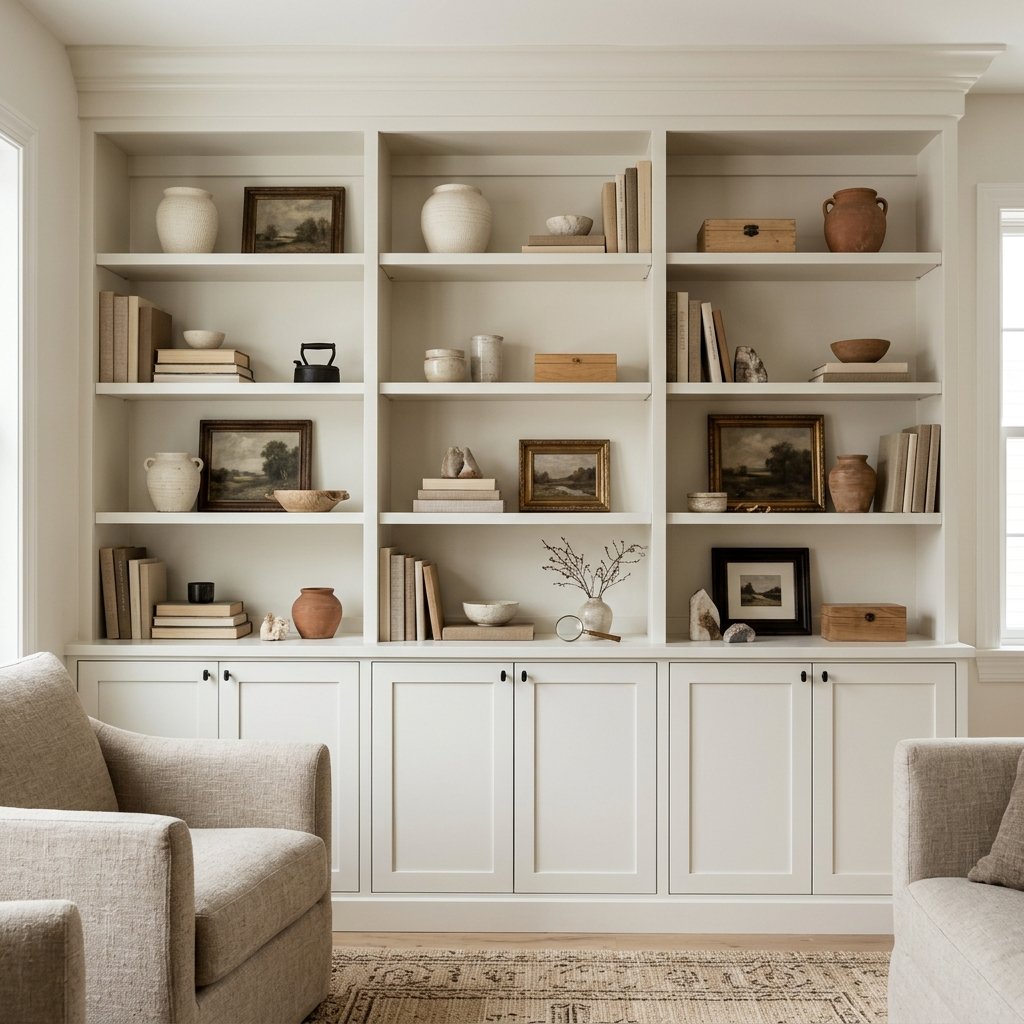
A beautifully styled bookcase can make an entire room feel more finished, but getting there isn’t always as effortless as it looks.
You arrange the books. Add a vase. Move the vase. Add a bowl. Take the bowl away. Then suddenly every shelf either looks empty or completely cluttered.
The secret to learning how to style a bookcase isn’t buying more decor. It’s creating balance between books, decorative objects, artwork, texture, color, and—just as importantly—empty space.
Well-styled shelves usually contain a mixture of useful and decorative pieces arranged at different heights and scales. Some shelves may hold several items, while others need only one substantial object.
And your bookcase should still look like it belongs in your home.
You don’t need shelves filled entirely with color-coordinated books and expensive decorative objects. Use books you actually enjoy, meaningful pieces, framed photographs, pottery, collected objects, and a few larger accessories to create shelves that feel polished without looking staged.
Here are 15 practical bookcase styling ideas and a simple step-by-step process you can use for living room built-ins, freestanding bookcases, office shelves, and everything in between.
Before You Style: Empty the Bookcase
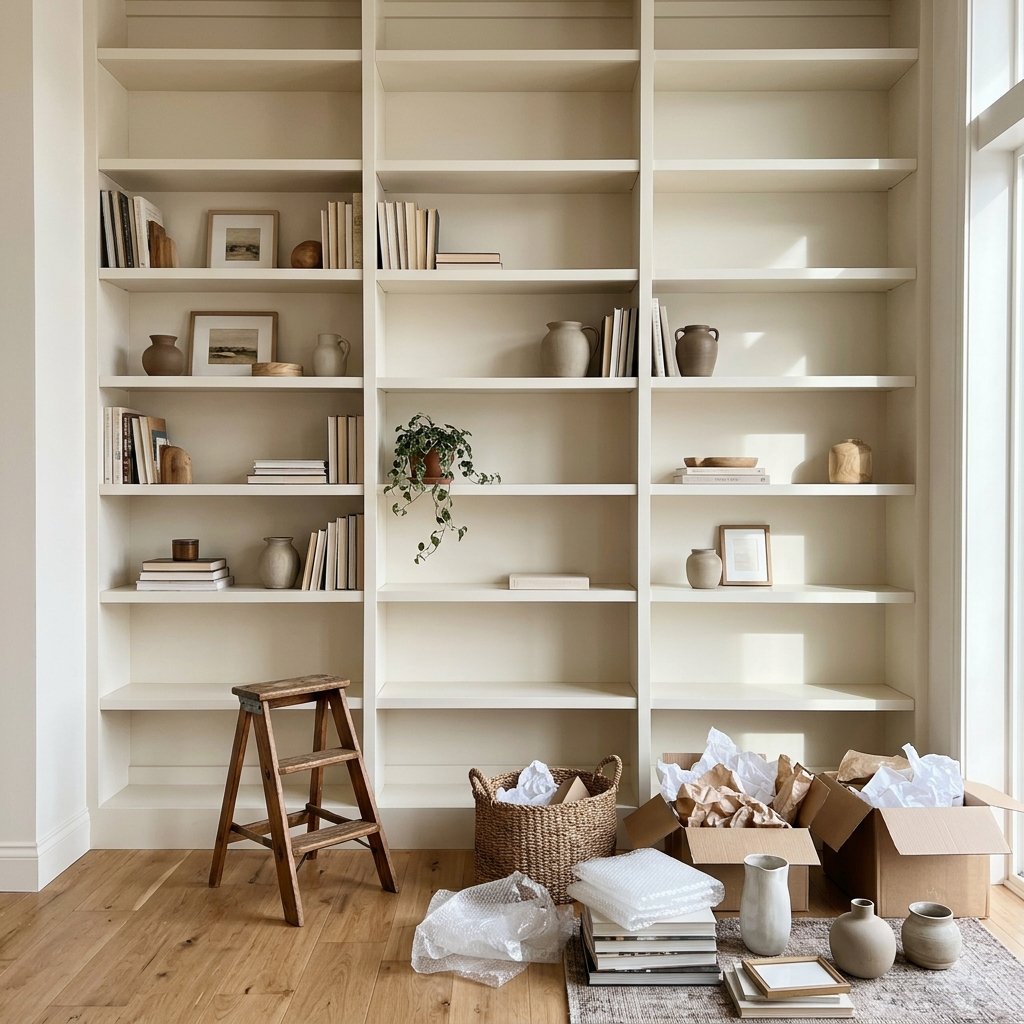
If possible, start with relatively empty shelves.
Trying to restyle a bookcase one shelf at a time without removing anything makes it difficult to see the overall composition.
Take out:
- Books
- Frames
- Vases
- Baskets
- Decorative objects
Then clean the shelves.
You don’t necessarily have to remove every book if you have an extensive collection, but creating a blank or simplified starting point makes the process much easier.
Gather Everything Before You Start
Next, collect possible accessories in one place.
Shop your home before buying anything.
Look for:
- Books
- Vases
- Pottery
- Bowls
- Boxes
- Framed photos
- Small artwork
- Sculptural objects
- Baskets
- Candlesticks
- Natural objects
Don’t assume everything you gather will end up on the shelves.
Having more options simply makes styling easier.
1. Start With the Books
A bookcase should be allowed to contain books.
You don’t need to turn every shelf into a display case.
Start by placing your larger groups of books.
If the shelves are primarily decorative, distribute books throughout the bookcase rather than putting them all on one shelf.
If it’s a working library, prioritize accessibility and organization first, then style around the collection.
Books immediately introduce:
- Height
- Color
- Pattern
- Texture
They also provide useful platforms for smaller decorative objects.
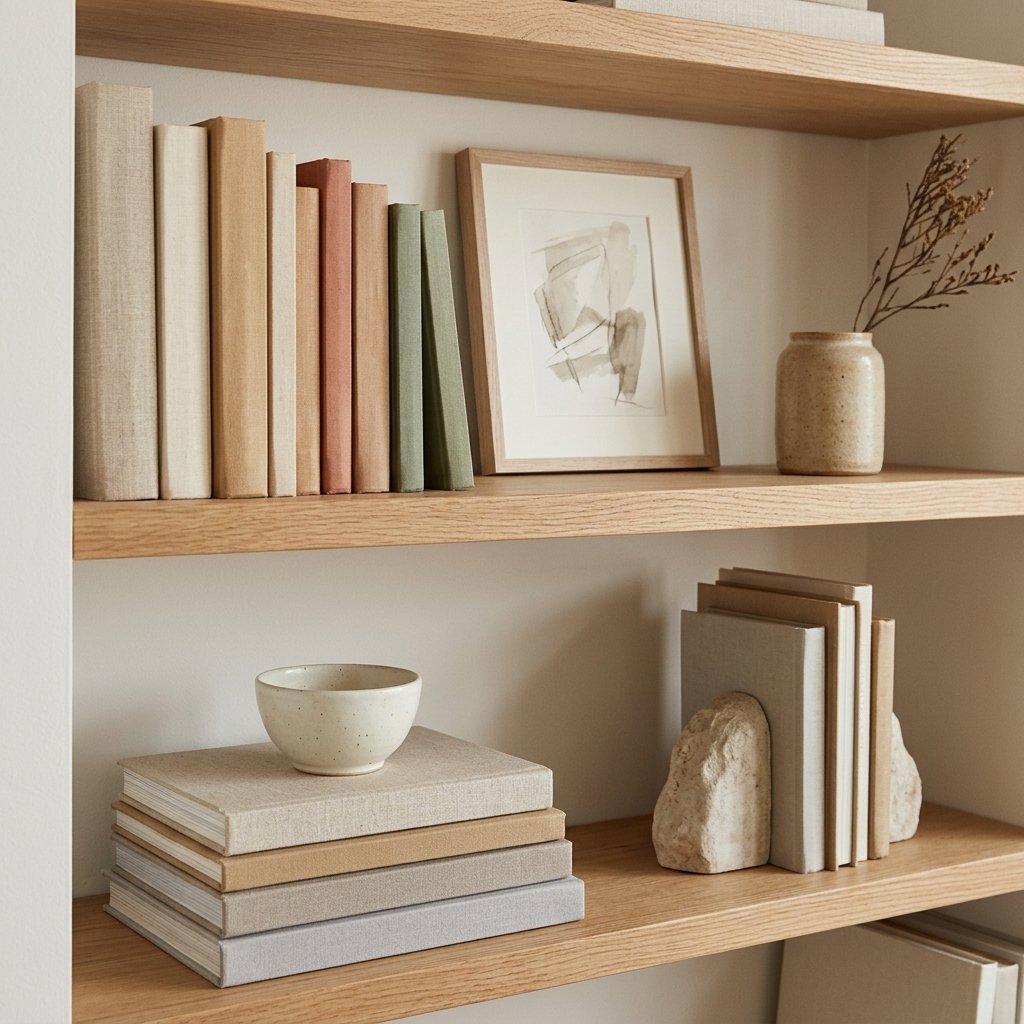
2. Mix Vertical and Horizontal Books
One of the easiest ways to create variety is to change book orientation.
Place some books vertically.
Stack others horizontally.
A horizontal stack can act as a pedestal for:
- Small bowl
- Decorative box
- Framed photo
- Sculptural object
Varying the direction prevents the shelves from becoming a repetitive row of vertical lines.
3. Use Larger Objects First
Tiny accessories are difficult to style when there are too many of them.
Begin with the largest pieces.
For example:
- Large vase
- Substantial bowl
- Framed artwork
- Sculptural object
- Basket
Spread these throughout the bookcase.
Large objects create visual anchors.
Once they’re in place, you can fill smaller areas with books and more modest accessories.
4. Vary the Height of Objects
If every object is roughly the same height, the shelves can look flat.
Create variation.
Pair:
- Tall vase + short stack of books
- Framed art + low bowl
- Vertical books + small object
Your eye should move up and down rather than following one straight horizontal line across each shelf.
5. Layer Artwork Behind Objects
Small framed artwork is one of my favorite ways to add depth to a bookcase.
Instead of treating every object independently, create layers.
Lean a small piece of art against the back of the shelf.
Then place a shorter object slightly in front.
For example:
Artwork + small bowl
or:
Framed photo + horizontal books
or:
Print + small sculptural object
Layering makes the arrangement feel more collected.

6. Create Small Groupings
Rather than spreading objects evenly across a shelf, create intentional groups.
A grouping might include:
Three books + small vase
or:
Artwork + bowl + decorative object
Then leave part of the shelf empty.
This creates stronger visual moments than placing one small item every few inches.
7. Remember the Rule of Three—But Don’t Follow It Everywhere
Groups of three often feel balanced.
Try combining three objects with different:
- Heights
- Shapes
- Textures
For example:
Tall vase + medium frame + low bowl
But don’t create a group of three on every shelf.
That becomes predictable.
Some shelves may need:
- One object
- Two objects
- Three objects
- A larger collection of books
Variation keeps the arrangement natural.
8. Leave Empty Space
Empty space is part of the design.
You don’t need to fill every inch.
Leaving open areas allows important objects to stand out and prevents the bookcase from feeling cluttered.
This is especially useful when you’re styling shelves primarily for decoration rather than maximizing book storage.
If something feels wrong, try removing an item before adding another.
That one habit can solve a surprising number of styling problems.
9. Repeat Colors Throughout the Bookcase
Repetition helps separate shelves feel connected.
Choose a few colors and distribute them throughout.
For a warm neutral bookcase, you might repeat:
- Cream
- Black
- Brown
- Warm wood
- Muted green
A black frame on the upper shelf can relate to a black decorative object lower down.
A cream vase can connect visually with pale books on another shelf.
You don’t need perfect matching.
You’re creating rhythm.
10. Repeat Materials Too
Color isn’t the only thing you can repeat.
Try repeating:
- Ceramic
- Wood
- Brass
- Glass
- Woven texture
If you use one wood object, consider adding another wood element somewhere else.
If you use brass, repeat it subtly.
This helps the styling feel intentional rather than random.

11. Mix Old and New
Shelves become more interesting when everything doesn’t look like it was purchased at the same store on the same afternoon.
Mix:
- New books
- Vintage books
- New pottery
- Antique or secondhand pieces
- Family photographs
- Travel finds
- Meaningful objects
This creates personality.
Secondhand stores, flea markets, antique shops, and your own cabinets can be useful places to find shelf decor.
You don’t need everything to be valuable.
Interesting shape and texture matter more than price.
12. Add Something Sculptural
Bookcases contain lots of rectangles.
The shelves are rectangular.
Books are rectangular.
Frames are rectangular.
Break up all those straight lines with something curved or irregular.
Try:
- Round bowl
- Ceramic vessel
- Small sculpture
- Decorative knot
- Organic object
Curves create contrast against the geometry of the shelving.
13. Add Natural Texture
Natural materials help shelves feel warmer.
Try:
- Wood
- Woven basket
- Stone
- Ceramic
- Small natural object
Be selective with organic materials gathered outdoors. Avoid bringing in unknown plants, insects, deteriorating materials, or objects that may be unsafe for children or pets.
A small amount of texture is enough.
14. Use Baskets or Boxes for Hidden Storage
Not everything needs to be displayed.
If your bookcase also serves a practical purpose, use attractive storage containers.
They can hide:
- Chargers
- Remote controls
- Office supplies
- Games
- Small toys
- Paperwork
Choose baskets or boxes that fit comfortably on the shelf without being wedged tightly into the opening.
This is particularly helpful on lower shelves.

15. Add Personal Items
The difference between a beautiful bookcase and a generic display often comes down to personality.
Add things that actually mean something.
Consider:
- Family photos
- Travel souvenirs
- Favorite books
- Collected pottery
- Heirlooms
- Children’s artwork in a frame
You don’t need to display everything sentimental you own.
Choose a few meaningful pieces and give them room.
How to Style a Bookcase Step by Step
If you’re staring at empty shelves and don’t know where to begin, use this order.
Step 1: Add the Books
Distribute books vertically and horizontally.
Step 2: Add the Largest Accessories
Place vases, bowls, baskets, and artwork.
Step 3: Create Height Variation
Check that objects aren’t all sitting at the same visual level.
Step 4: Add Smaller Objects
Use them to finish groupings rather than filling every gap.
Step 5: Repeat Colors and Materials
Look across the entire bookcase rather than at individual shelves.
Step 6: Add Personal Pieces
Include photographs, collections, or meaningful objects.
Step 7: Remove Something
If a shelf feels cluttered, take one item away.
Step 8: Step Back
View the bookcase from across the room.
Shelf styling often looks completely different from a distance.
How to Balance a Bookcase
Balance doesn’t mean symmetry.
Instead, think about visual weight.
A large dark vase has more visual weight than a small cream bowl.
A group of dark books has more weight than one pale frame.
Distribute heavier elements throughout the bookcase rather than concentrating all of them on one side.
If the upper right corner has a large dark object, you might balance it with another darker element somewhere toward the lower left.
They don’t need to match.
They simply need to feel visually connected.
How to Style Two Bookcases Beside a Fireplace
Built-ins around a fireplace create a larger composition.
You can use some symmetry without making both sides identical.
For example, repeat:
- Similar color palette
- Similar amount of books
- Related pottery
- Comparable visual weight
But vary the individual objects.
Two matching vases in the same position on each side can feel formal.
Related but different arrangements usually feel more relaxed.
How to Style Built-In Shelves
Built-ins can handle larger accessories than many people expect.
Tiny decor often disappears on deep, substantial shelving.
Use:
- Larger vases
- Bigger artwork
- Substantial bowls
- Groups of books
Then leave space around them.
If the built-ins include lower cabinets, keep the open shelving more decorative and use the closed storage for less attractive necessities.
How to Style a Bookcase With Lots of Books
If you actually own a lot of books, don’t hide them just to create decorative shelves.
Organize them in a way that works for you.
Options include:
- By subject
- By author
- Alphabetically
- By size where practical
Then add a few decorative moments where space allows.
You might place a small piece of artwork in front of a row of books or add a bowl to a horizontal stack.
Function comes first in a working library.
Should You Organize Books by Color?
You can if you enjoy the look and don’t need another organizational system.
But you don’t have to.
Color-organized books can create a strong visual effect, while mixed book spines often make a shelf feel more natural and collected.
If the book colors feel overwhelming, you can create visual calm by grouping similar tones loosely rather than arranging a perfect rainbow.
Should You Turn Books Backward?
Books are meant to be read.
Turning every spine backward creates a neutral look but makes finding a particular book difficult.
If you’re styling a purely decorative display, that’s a personal choice.
For functional shelves, keeping titles visible makes far more sense.
How to Style a Bookcase in a Living Room
Living room shelves can combine decorative and personal objects.
Try:
- Books
- Pottery
- Family photos
- Small art
- Bowls
- Collected objects
Use the colors already present in the living room.
If your sofa has muted green pillows, repeat a small amount of green in artwork or a book spine.
If the room contains black lighting, use a few black frames on the shelves.

How to Style Office Bookshelves
Office shelving can be more functional.
Prioritize:
- Reference books
- Files
- Storage boxes
- Supplies
Then soften them with a few decorative objects.
Use attractive boxes to conceal loose paperwork and small office supplies.
Keep frequently used items within easy reach.
How to Style a Small Bookcase
A small bookcase needs restraint.
Don’t use miniature accessories simply because the bookcase is small.
Instead, try:
- One group of books
- One medium vase
- One framed photo
- One bowl
- One basket
You may not need more than that.
How to Style a Bookcase on a Budget
Start with what you own.
Books are already decor.
Then look around your home for:
- Bowls
- Vases
- Frames
- Boxes
- Small artwork
Secondhand shopping can also be useful for pottery, frames, books, and interesting objects.
Avoid buying a large collection of matching shelf accessories.
A mixture collected over time often looks more interesting.
How to Make Cheap Bookcase Decor Look Expensive
Price matters less than scale, composition, and restraint.
Try these strategies:
Use Fewer Accessories
Don’t fill every gap.
Choose Larger Pieces
A substantial vase can look more intentional than five tiny objects.
Limit the Color Palette
Repeat a handful of colors.
Mix Materials
Combine books, ceramic, wood, glass, and metal.
Include Personal Items
Collected objects add authenticity.
Avoid Perfect Matching
A room can feel more sophisticated when everything isn’t part of one coordinated set.
How to Style Deep Bookshelves
Deep shelves can make objects disappear against the back.
Use layering.
Place artwork toward the rear.
Then add:
- Books
- Bowl
- Small vase
in front.
Larger accessories also help fill the depth.
Avoid lining every object along the front edge.
Use the full shelf.
How to Style Tall Shelves
Tall bookcases can feel top-heavy if the largest objects are all at eye level.
Distribute visual weight vertically.
Upper shelves can hold:
- Lighter pottery
- Books
- Artwork
Lower shelves can handle:
- Baskets
- Larger books
- Substantial objects
Very heavy items are generally safer and more practical on lower shelves.
Bookcase Styling Safety
Bookcase styling isn’t only about appearance.
Freestanding bookcases and tall shelving can tip, particularly if children may climb them or if heavy objects are stored high.
Secure furniture to the wall when appropriate using anchoring methods suitable for the furniture, wall construction, and manufacturer instructions.
Also:
- Keep very heavy objects lower.
- Don’t overload shelves beyond their rated capacity.
- Keep fragile items away from edges.
- Consider children and pets when displaying breakable objects.
- Use appropriate hardware for artwork attached to shelving or walls.
- Keep candles and open flames away from books and other combustible materials.
Common Bookcase Styling Mistakes
Using Too Many Tiny Objects
Small accessories quickly create visual clutter.
Filling Every Inch
Empty space makes the arrangement stronger.
Styling Every Shelf the Same Way
Variation creates rhythm.
Ignoring Scale
Large shelving usually needs substantial accessories.
Putting All the Books in One Area
Distribute them if the bookcase is primarily decorative.
Using Only Decorative Objects
Books make a bookcase feel natural.
Buying Everything at Once
Collected shelves usually feel more personal.
Forgetting the Rest of the Room
Bookcase colors should connect with the surrounding decor.
Styling Only From Up Close
Always step back and evaluate the entire wall.
An Easy Bookcase Styling Formula
If you’re stuck, try rotating these simple arrangements.
Shelf Formula 1
Vertical books + decorative object
Shelf Formula 2
Horizontal books + small bowl
Shelf Formula 3
Artwork + small object
Shelf Formula 4
One substantial vase
Shelf Formula 5
Books + framed photo + pottery
Shelf Formula 6
Basket or decorative box
Don’t use every formula on every shelf.
Mix them throughout the bookcase.

FAQ About Styling a Bookcase
How do you style a bookcase without making it look cluttered?
Use fewer, larger objects, group accessories together instead of spreading them evenly, and intentionally leave some open space.
What should I put on a bookcase besides books?
Try pottery, bowls, artwork, framed photos, sculptural objects, boxes, baskets, and meaningful collected pieces.
How many items should go on each shelf?
There isn’t a fixed number. Some shelves may need one large object while others can hold several books and accessories. Focus on balance rather than counting.
Should every shelf be decorated differently?
The arrangements can vary, but repeating colors and materials helps the entire bookcase feel connected.
How do I make a bookshelf look expensive?
Use substantial accessories, limit clutter, repeat a restrained palette, mix materials, and include a few personal or collected pieces rather than filling shelves with matching decor.
Should books be vertical or horizontal?
Use both. Mixing vertical rows with horizontal stacks creates variety and provides platforms for smaller objects.
How do you balance two bookcases?
Repeat similar colors, materials, and visual weight across both bookcases without making every shelf perfectly symmetrical.
Should I decorate the top of a bookcase?
It depends on the bookcase and ceiling height. Some freestanding bookcases look better with the top left empty, while others may support one appropriately scaled object. Avoid placing unstable or very heavy items overhead.
How do you style shelves with lots of books?
Prioritize a practical organization system, then add small decorative moments where space allows. You don’t need to remove useful books just to make the shelves decorative.
How do I style bookshelves with family photos?
Use a limited number of framed photos and mix them with books, artwork, and pottery. Vary frame sizes while repeating one or two frame finishes for cohesion.
Final Thoughts
Learning how to style a bookcase becomes much easier when you stop trying to decorate every individual shelf perfectly.
Think about the bookcase as one large composition.
Start with books.
Add your largest objects.
Layer in artwork, pottery, bowls, baskets, and a few personal pieces.
Vary heights and shapes.
Repeat colors and materials.
Then leave some empty space.
Most importantly, step back.
If one section feels heavy, move something. If a shelf feels cluttered, remove something. If everything feels too symmetrical, change the arrangement on one side.
The goal isn’t to create shelves that look like a furniture showroom.
A great bookcase should tell you something about the people who live in the home.
Fill it with books you enjoy, objects you’ve collected, family photographs, favorite artwork, and enough breathing room to let those pieces stand out.
That’s what makes styled shelves feel finished, personal, and collected rather than simply decorated.