

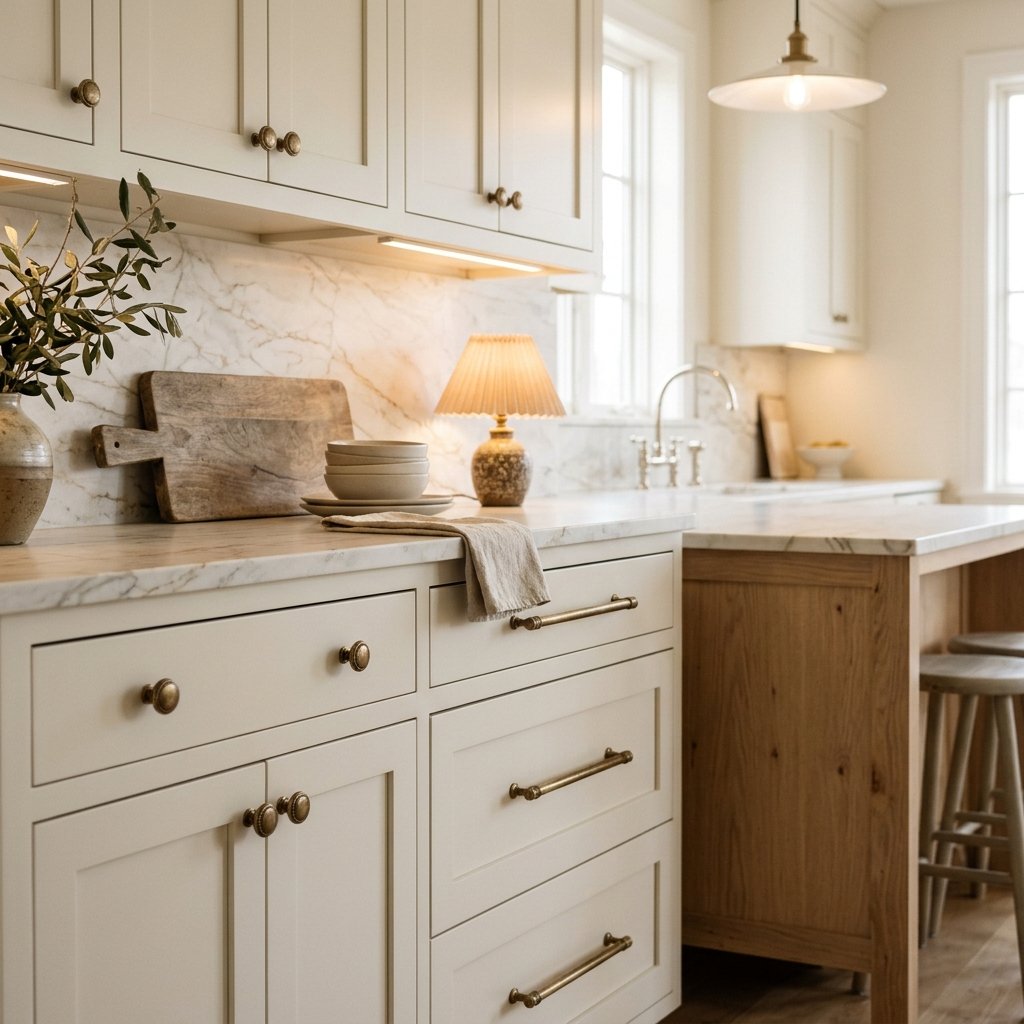
Kitchen hardware may be one of the smallest details in a kitchen, but it can have an outsized effect on how the entire room looks.
Cabinet knobs and pulls can make simple cabinetry feel more custom, bring warmth to a white kitchen, add contrast to wood cabinets, or give an older kitchen a relatively easy refresh without replacing the cabinets.
And in 2026, kitchen hardware trends are becoming noticeably more interesting.
The biggest shift is away from hardware that feels perfectly uniform or purely functional. Current designer predictions emphasize warmer aged finishes, tactile surfaces, sculptural shapes, mixed metals, decorative backplates, and vintage-inspired details.
That doesn’t mean you should choose unusual hardware simply because it’s trending.
Kitchen hardware gets touched constantly, and changing the hole spacing on existing cabinets can turn a simple update into a much larger project. Comfort, durability, proportion, and how the hardware relates to the cabinetry matter just as much as appearance.
If you’re planning a kitchen remodel or simply replacing outdated knobs and pulls, here are the kitchen hardware trends for 2026 worth knowing—and how to use them without making your kitchen feel dated in a few years.
What’s Trending in Kitchen Hardware?
Current kitchen hardware is becoming warmer, more detailed, and more individual.
Designers are moving toward finishes and shapes that bring character rather than disappearing completely into the cabinetry.
Some of the strongest directions include:
- Aged and antique brass
- Bronze
- Unlacquered finishes
- Mixed metals
- Decorative backplates
- Textured and reeded hardware
- Sculptural pulls
- Longer, slimmer handles
- Vintage-style cabinet catches
- Knobs mixed with pulls
- Furniture-inspired details
The common theme is character.
Rather than making every element in the kitchen match perfectly, hardware is increasingly being treated like jewelry for the cabinetry.
1. Aged Brass Hardware
Brass isn’t disappearing.
What’s changing is the type of brass.
Rather than very bright, perfectly polished finishes, designers are gravitating toward brass with greater depth and character. Aged brass remains a particularly prominent choice in current kitchen hardware forecasts.
Aged brass works beautifully with:
- Warm white cabinets
- Cream cabinets
- Green cabinets
- Blue cabinets
- Natural wood
- Black
- Burgundy
It’s especially effective if you want a new kitchen to feel less pristine and more collected.
Aged brass can also bridge traditional and contemporary styles.
On detailed Shaker cabinetry, it can look classic.
On simpler cabinet fronts, the same warm metal can soften a modern kitchen.
2. Unlacquered Brass
Unlacquered brass is another important direction.
Unlike a protected finish designed to remain relatively consistent, unlacquered brass is chosen specifically because it can develop a patina over time. Current designers are embracing this kind of changing, imperfect finish as part of a broader preference for kitchens that feel lived-in rather than pristine.
This isn’t the right choice for everyone.
If you want every knob to maintain a perfectly consistent finish, choose something designed for that purpose instead.
If you like materials that develop character with use, unlacquered brass may be worth considering.
Before buying, check the manufacturer’s care instructions and understand how the finish is expected to change.

3. Bronze Kitchen Hardware
Bronze is becoming another strong alternative to conventional brass and black.
Designers cited in current 2026 trend coverage are pointing toward deeper bronze and brass-adjacent tones with warmth, texture, and softened finishes.
Bronze can be particularly attractive if brass feels too golden for your kitchen.
Depending on the specific finish, bronze can work with:
- Warm white
- Taupe
- Mushroom
- Olive
- Natural oak
- Walnut
- Black
It’s dark enough to create definition but can feel softer than stark matte black.
4. Mixed Metals
One of the most practical kitchen hardware trends is the continued move away from matching every metal finish perfectly.
Your faucet, cabinet hardware, lighting, and appliances don’t necessarily have to be identical.
Designers are intentionally layering different metals for a more collected look.
For example:
Aged brass cabinet hardware + polished nickel faucet
or:
Bronze cabinet hardware + stainless steel appliances
can work beautifully.
The trick is repetition.
If you’re introducing a second metal, repeat it somewhere else so it feels intentional.
For example, polished nickel might appear on both the faucet and a pot filler, while aged brass repeats through cabinet hardware and lighting.
You don’t need four or five different finishes.
Two carefully repeated metals are usually much easier to coordinate.
5. Decorative Backplates
One of the more distinctive kitchen hardware trends for 2026 is the return of backplates.
A backplate is the decorative piece that sits behind a cabinet knob or pull.
It can instantly make simple hardware look more substantial.
Current designers are using backplates to introduce character and make cabinetry feel more customized without completely changing the cabinet style.
They work especially well in:
- Traditional kitchens
- English-inspired kitchens
- Transitional kitchens
- Vintage-inspired kitchens
You don’t necessarily need them on every cabinet.
Backplates could be reserved for a hutch, pantry, glass-front cabinets, or another special section of cabinetry.

6. Textured and Tactile Hardware
Perfectly smooth hardware is no longer the only option.
Texture is becoming much more important.
Current designs include details such as:
- Knurling
- Reeded surfaces
- Subtle hammering
- Etched patterns
- Pitted finishes
Designers are highlighting tactile hardware as a way to add craftsmanship and personality to otherwise simple cabinetry.
This works especially well on minimal cabinet doors.
If the cabinetry is simple, a textured handle can become the detail that keeps the kitchen from feeling flat.
Just remember practicality.
Intricate textures may require more effort to clean than smooth hardware, particularly near cooking areas.
7. Sculptural Cabinet Pulls
Hardware is increasingly being treated as a decorative feature rather than something that should disappear.
That means more:
- Curves
- Organic shapes
- Rounded forms
- Cast-metal pieces
- Unusual silhouettes
Current designers are moving away from some of the generic square bars and standard T-bar shapes toward hardware with more personality.
Sculptural hardware can be especially effective on a simple cabinet door.
You don’t need decorative cabinetry and highly decorative hardware.
Let one of those elements take the lead.
8. Long, Slim Cabinet Pulls
Not every current trend is ornate.
At the other end of the spectrum, long, streamlined pulls continue to work beautifully in modern kitchens.
Slim elongated pulls are being used particularly on slab-front cabinetry, where the hardware can provide a clean architectural accent without interrupting the overall simplicity.
Try them on:
- Tall pantry cabinets
- Large drawers
- Appliance panels
- Slab cabinets
Proportion matters.
An undersized pull on a very large drawer can look visually weak, while an oversized pull on a narrow cabinet may dominate the door.
Consider the entire elevation rather than choosing one handle size automatically for every cabinet.

9. Mixing Knobs and Pulls
Using one identical pull on every cabinet isn’t your only option.
Mixing knobs and pulls can make a kitchen look more considered.
A common approach is:
Knobs on doors + pulls on drawers
But that isn’t a rule.
You might also use:
- Knobs on upper cabinets
- Pulls on lower drawers
- Larger pulls on pantry cabinets
- Special hardware on a hutch
This variation can make cabinetry feel more furniture-like.
It also gives you an opportunity to respond to function.
A wide, heavy drawer may be easier to use with a substantial pull than a tiny knob.
10. Vintage-Inspired Cabinet Catches
Kitchen design is continuing to borrow details from older cabinetry and furniture.
That includes cabinet catches, latches, and other hardware that feels more architectural.
Current 2026 forecasts specifically point to details such as cupboard catches and cremone bolts as part of the shift toward cabinetry that feels custom and furniture-like.
These details work particularly well on:
- Glass-front cabinets
- Built-in hutches
- Pantry cabinets
- Freestanding-style cabinetry
The key is restraint.
You don’t necessarily need specialty hardware on every cabinet.
One beautifully detailed section can create more impact.
11. Hardware That Looks Like Jewelry
Small decorative knobs are becoming an opportunity to add personality.
Think beyond a basic metal circle.
Depending on the kitchen style, that might mean:
- Detailed cast metal
- Fluted designs
- Stone accents
- Unusual shapes
- Decorative motifs
This trend works particularly well when most of the kitchen is relatively restrained.
A small decorative knob can provide interest without committing to a bold backsplash or colorful countertop.
Current trend reporting reflects this broader move toward craftsmanship, decorative detail, and statement hardware.
12. Colorful Kitchen Hardware
One of the more unexpected kitchen hardware trends is hardware that isn’t metallic at all.
Colorful knobs and pulls are appearing as designers look for more personal alternatives to standard metal finishes.
This could include:
- Burgundy
- Green
- Cream
- Black
- Blue
- Cabinet-matched colors
Colorful hardware is naturally a bolder choice.
If you’re hesitant, use it in a smaller area such as:
- Pantry
- Bar
- Butler’s pantry
- Freestanding cabinet
That lets you experiment without committing the entire kitchen.

Is Matte Black Kitchen Hardware Going Out of Style?
Matte black isn’t suddenly unusable.
It’s a simple, high-contrast finish that can still work beautifully in the right kitchen.
However, current designer commentary suggests it is no longer the automatic default it became during the previous wave of modern farmhouse and high-contrast kitchens. Some designers are specifically moving toward warmer, more nuanced finishes instead.
If you already have black hardware that works with your kitchen, there’s no reason to replace it simply because trends have changed.
If you’re choosing hardware for a new kitchen, consider whether:
- Black relates to other finishes in the room
- You want strong contrast
- A warmer bronze might work better
- The cabinet color needs softer hardware
Choose based on the room rather than trend status alone.
Is Chrome Kitchen Hardware Still in Style?
Polished chrome can still work, particularly in crisp or modern spaces.
But current kitchen hardware coverage is showing increased interest in brushed nickel and more nuanced finishes rather than relying exclusively on highly reflective chrome.
If you like silver-toned hardware, don’t assume you need to switch to brass.
Consider:
- Polished nickel
- Brushed nickel
- Chrome
- Stainless finishes
The right choice depends on the kitchen.
Polished Nickel Kitchen Hardware
Polished nickel can provide the brightness of a silver-toned metal while feeling warmer and softer than some chrome finishes.
It can work beautifully with:
- White
- Cream
- Blue
- Gray
- Natural wood
It also mixes particularly well with brass.
A polished nickel faucet paired with aged brass cabinet hardware can create a sophisticated mixed-metal kitchen.
Brass vs. Nickel Kitchen Hardware
Both can be timeless choices.
Choose brass when you want:
- More warmth
- Golden tones
- Contrast with cool cabinetry
- Traditional character
Choose nickel when you want:
- Silver tones
- Subtle brightness
- A cooler overall palette
- A classic alternative to brass
Or use both.
Mixed metals can create a more layered kitchen when the finishes are repeated intentionally.
What Hardware Looks Good on White Kitchen Cabinets?
White cabinets are extremely flexible.
Try:
Aged Brass
Warm and classic.
Bronze
Rich but understated.
Polished Nickel
Clean and timeless.
Black
High contrast.
Unlacquered Brass
Warm and evolving.
The undertone of the white matters.
Warm cream-white cabinets may naturally relate to aged brass and bronze, while cleaner whites can pair beautifully with nickel.

What Hardware Looks Good on Wood Cabinets?
Wood cabinetry is becoming increasingly important in kitchen design, and the hardware should complement rather than compete with the grain.
For light oak, consider:
- Aged brass
- Bronze
- Black
- Polished nickel
For darker walnut, brass can create beautiful contrast while dark bronze can create a more tonal look.
If the wood already has a lot of movement, simpler hardware may be the better choice.
What Hardware Looks Good on Green Cabinets?
Green cabinets pair naturally with warm metals.
Try:
- Aged brass
- Unlacquered brass
- Bronze
For stronger contrast, polished nickel can also work.
Dark green cabinets with aged brass hardware can create a particularly rich traditional look.
What Hardware Looks Good on Black Cabinets?
Black cabinetry can handle several directions.
Try:
- Aged brass for warmth
- Bronze for a subtle tonal look
- Polished nickel for contrast
Black hardware on black cabinetry can create a very minimal effect, but make sure there is enough variation in texture or sheen that the hardware doesn’t completely disappear.
What Hardware Looks Good on Blue Cabinets?
Blue cabinetry works beautifully with both warm and cool metals.
Brass creates a warm complementary contrast.
Polished nickel feels cooler and more classic.
Bronze can create a deeper, moodier palette.
Should Kitchen Hardware Match the Faucet?
No.
It certainly can, but it doesn’t have to.
Thoughtfully mixed metals are an established design approach and continue to appear in current kitchen trend coverage.
The easiest strategy is to choose one dominant finish and one secondary finish.
For example:
Dominant
Aged brass cabinet hardware and lighting
Secondary
Polished nickel faucet and pot filler
Repeating each finish makes the combination feel intentional.
Should Kitchen Hardware Match the Light Fixtures?
Again, it can, but exact matching isn’t necessary.
Think about the entire room.
If the hardware is brass and the faucet is nickel, you might repeat brass in the pendants.
That creates continuity.
The goal isn’t matching.
It’s balance.
Knobs or Pulls: Which Is Better?
Neither is universally better.
Knobs are compact and can work beautifully on cabinet doors.
Pulls provide a larger gripping surface and often work particularly well on drawers.
Mixing both can provide visual interest and function.
Before ordering, physically test the hardware.
A beautiful knob isn’t useful if it’s uncomfortable every time you open the cabinet.
What Size Cabinet Pulls Should You Choose?
There isn’t one universal pull size that works for every kitchen.
Consider:
- Cabinet dimensions
- Drawer width
- Door proportions
- Appliance panels
- Existing hole spacing
Larger drawers can often visually support longer pulls.
Smaller cabinet doors may look better with a knob or shorter pull.
For an existing kitchen, measure the center-to-center distance between current screw holes before buying replacement pulls.
Matching that measurement can save you from filling old holes and drilling new ones.
How to Mix Kitchen Hardware
If you want a collected look without chaos, use a simple system.
For example:
Knobs on cabinet doors
Pulls on drawers
Long pulls on tall pantry doors
Decorative catches on one glass cabinet
Then keep the finish consistent.
Or reverse the strategy:
Use simple hardware shapes throughout but introduce two carefully coordinated metals.
Changing either shape or finish creates variety.
Changing everything at once can make the kitchen feel disconnected.
How Many Metal Finishes Should You Mix?
Two is usually the easiest starting point.
Three can work in a large kitchen, particularly when stainless appliances already function as one of the metals.
For example:
- Aged brass hardware
- Polished nickel plumbing
- Stainless appliances
You don’t have to make the stainless appliances dictate every other metal choice.
How to Choose Kitchen Hardware That Won’t Date Quickly
Trends can provide inspiration, but hardware should still make sense with the cabinetry.
If longevity is your priority, focus on:
- Comfortable shapes
- Good proportions
- Quality construction
- Finishes that relate to the kitchen
- Simple but distinctive forms
Warm metals such as brass and bronze have long histories in interiors, and current designers continue to favor these character-rich finishes for their ability to work across styles.
Use the bolder trends—such as colorful knobs or highly decorative shapes—in places where they’re relatively easy to change.
How to Update Kitchen Hardware Without Remodeling
Changing hardware can make an older kitchen feel noticeably different.
Before ordering anything:
- Remove one existing pull.
- Measure the distance between the screw holes.
- Measure the drawer and door sizes.
- Order samples of several options.
- Test them against the actual cabinetry.
- Check how each piece feels in your hand.
- Look at the finish during the day and at night.
Don’t buy an entire kitchen’s worth of hardware based on an online photo.
Metal finishes can look very different in person.

Common Kitchen Hardware Mistakes
Choosing Hardware That’s Too Small
Tiny hardware can look out of proportion on large drawers.
Choosing Only by Appearance
You touch kitchen hardware constantly. It needs to feel comfortable.
Ignoring Existing Hole Spacing
This can turn an easy hardware update into a cabinet repair project.
Matching Every Metal Automatically
Exact matching isn’t required for a cohesive kitchen.
Mixing Too Many Styles
Decorative hardware needs room to stand out.
Forgetting About Appliances
Stainless appliances are already contributing a metal finish to the room.
Using Highly Detailed Hardware Everywhere
A little decorative hardware can go a long way.
Ignoring Maintenance
Textured surfaces and living finishes may require different care than smooth protected finishes.
Always check manufacturer instructions before using cleaning products.
The Kitchen Hardware Trends Most Likely to Last
The most useful current hardware trends aren’t necessarily the most unusual ones.
The broader movement toward warmth, craftsmanship, texture, and thoughtful variation has the potential to work beyond a single trend cycle because those ideas aren’t tied to one exact knob or finish.
Current designer predictions repeatedly emphasize aged metals, bronze, tactile details, mixed finishes, and furniture-inspired hardware.
If you’re nervous about trends, choose a classic shape in a character-rich finish.
For example:
Simple pull + aged brass
or:
Classic knob + bronze
Then introduce more decorative pieces selectively.

FAQ About Kitchen Hardware Trends
What kitchen hardware is trending in 2026?
Major 2026 kitchen hardware trends include aged brass, unlacquered finishes, bronze, mixed metals, decorative backplates, textured hardware, sculptural shapes, elongated pulls, and vintage-inspired cabinet catches.
Is brass kitchen hardware still in style?
Yes. Current trend coverage continues to identify brass as a major kitchen hardware finish, particularly aged and unlacquered versions that have more character than highly uniform finishes.
Is matte black kitchen hardware going out of style?
Matte black can still work, but some designers are moving away from using it as the automatic default and toward warmer finishes such as aged brass and bronze.
Is bronze kitchen hardware in style?
Yes. Bronze is gaining attention as a warmer, deeper alternative to brass and black, particularly in textured and softly aged finishes.
Should cabinet hardware match the faucet?
Not necessarily. Mixed metals can create a layered look when each finish is repeated intentionally.
Can you mix brass and nickel in a kitchen?
Yes. Brass cabinet hardware with a polished or brushed nickel faucet can create a sophisticated mixed-metal palette.
Should I use knobs or pulls on kitchen cabinets?
Both can work. Knobs are often useful on doors, while pulls provide a larger grip for drawers. Mixing the two can add interest and function.
Are decorative backplates trending?
Yes. Decorative backplates are appearing prominently in 2026 hardware forecasts as an easy way to add character and make cabinetry feel more custom.
What kitchen hardware is most timeless?
Simple, well-proportioned knobs and pulls in finishes that coordinate with the cabinetry tend to have the greatest longevity. Brass, bronze, and nickel can all work across many kitchen styles.
Final Thoughts
The biggest kitchen hardware trends aren’t really about finding one perfect finish.
They’re about making kitchens feel more personal.
Instead of defaulting automatically to identical bar pulls throughout the kitchen, designers are experimenting with aged brass, bronze, mixed metals, decorative backplates, tactile textures, sculptural shapes, and vintage-inspired details.
But you don’t need to use every trend.
For a kitchen that feels current without becoming overly trendy, start with the cabinetry.
Consider its color, style, scale, and surrounding materials.
Then choose hardware that complements those elements.
Aged brass can warm up white cabinetry.
Bronze can add depth to natural wood.
Polished nickel can provide a classic cooler contrast.
A decorative backplate or cabinet catch can turn one special section of cabinetry into a focal point.
And mixed metals can make the entire room feel collected rather than perfectly matched.
Most importantly, test the hardware before ordering dozens of pieces.
Hold it against the actual cabinet.
Open a drawer with it.
Look at the finish beside the faucet, lighting, countertop, backsplash, and appliances.
Because while hardware may be called the jewelry of the kitchen, it still has a job to do every single day.
Choose pieces that feel as good to use as they look, and your kitchen hardware can outlast the trend that inspired it.