

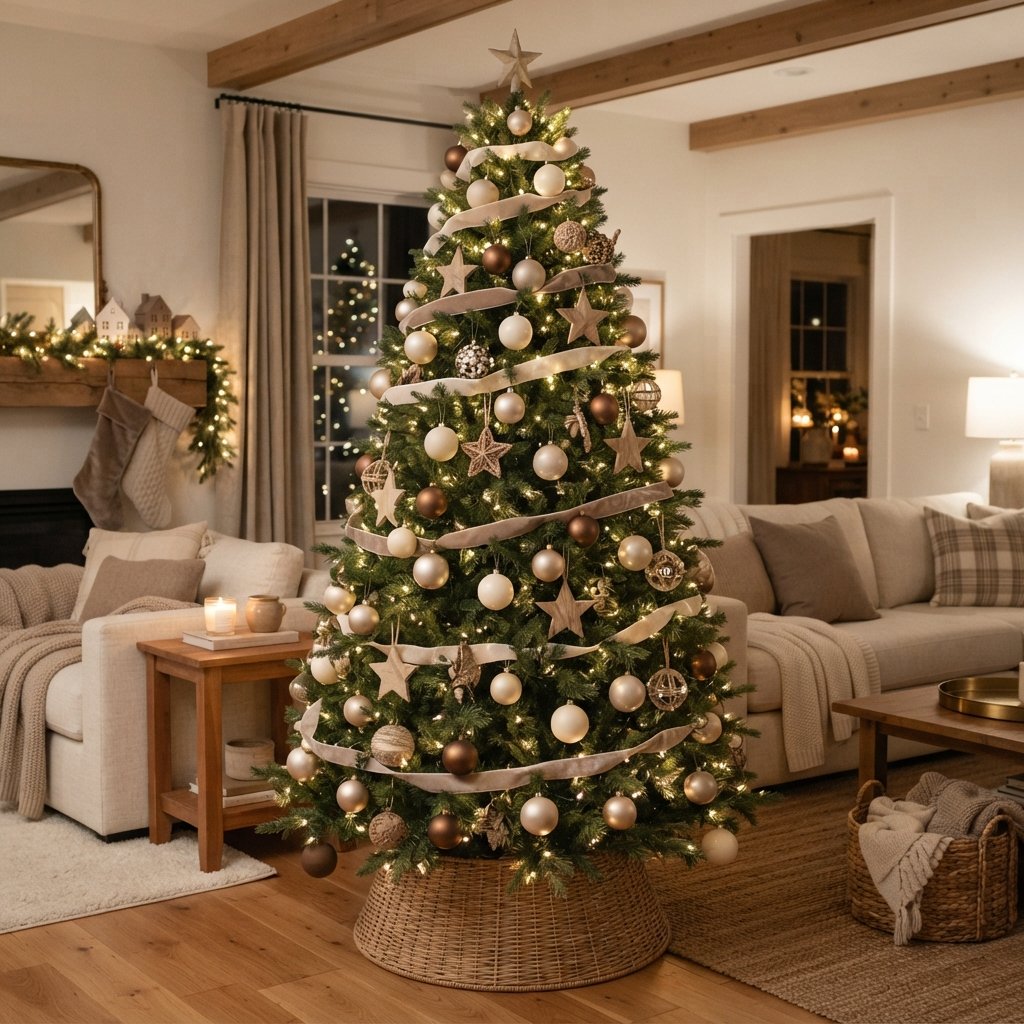
Christmas decorating doesn’t have to mean filling the house with bright red and green. If your home leans toward warm whites, natural wood, soft browns, creams, and earthy textures, neutral Christmas tree decor can create a festive look that feels right at home with the rest of your space.
And neutral doesn’t have to mean boring.
The key is layering.
When you’re working with a limited color palette, texture, scale, shape, and finish become much more important. Velvet ribbon looks different beside linen. Matte ornaments create contrast against shiny glass. Wood and woven decorations bring warmth, while brass-toned or champagne accents can add just enough sparkle.
You can also take neutral Christmas decor in several directions. Keep everything cream and white for a light, elegant tree. Add brown and wood for an organic look. Mix in champagne for something dressier. Or bring in muted green if you want a little color without moving too far from the neutral palette.
Whether you’re starting with a new Christmas tree or simply want to give your existing ornaments a calmer look this year, these ideas will help you create a neutral Christmas tree that feels cozy, layered, and festive.
What Is Neutral Christmas Tree Decor?
Neutral Christmas decorating uses a restrained palette rather than relying primarily on traditional red and bright green.
Common colors include:
- Warm white
- Ivory
- Cream
- Beige
- Taupe
- Camel
- Brown
- Champagne
- Soft gold tones
- Natural wood
- Muted green
- Black in small amounts
You don’t need to use all of these.
Three or four main colors are usually enough.
The goal isn’t to remove color completely. It’s to create a tree where the colors work quietly together rather than competing for attention.
Choose Your Neutral Christmas Color Palette
Before decorating, decide which direction you want to take.
This will prevent you from buying beautiful ornaments individually that don’t necessarily work together on the tree.
Cream + Champagne + Warm White
Elegant and light.
Cream + Brown + Wood
Warm and organic.
White + Taupe + Champagne
Soft and sophisticated.
Cream + Sage + Wood
Natural with subtle color.
Brown + Burgundy + Cream
A richer interpretation of neutral Christmas decor.
Cream + Black + Wood
Higher contrast and more modern.
Taupe + Brass Tones + Deep Green
Warm and traditional without relying on bright red.
Once you’ve chosen the palette, repeat those colors throughout the tree.
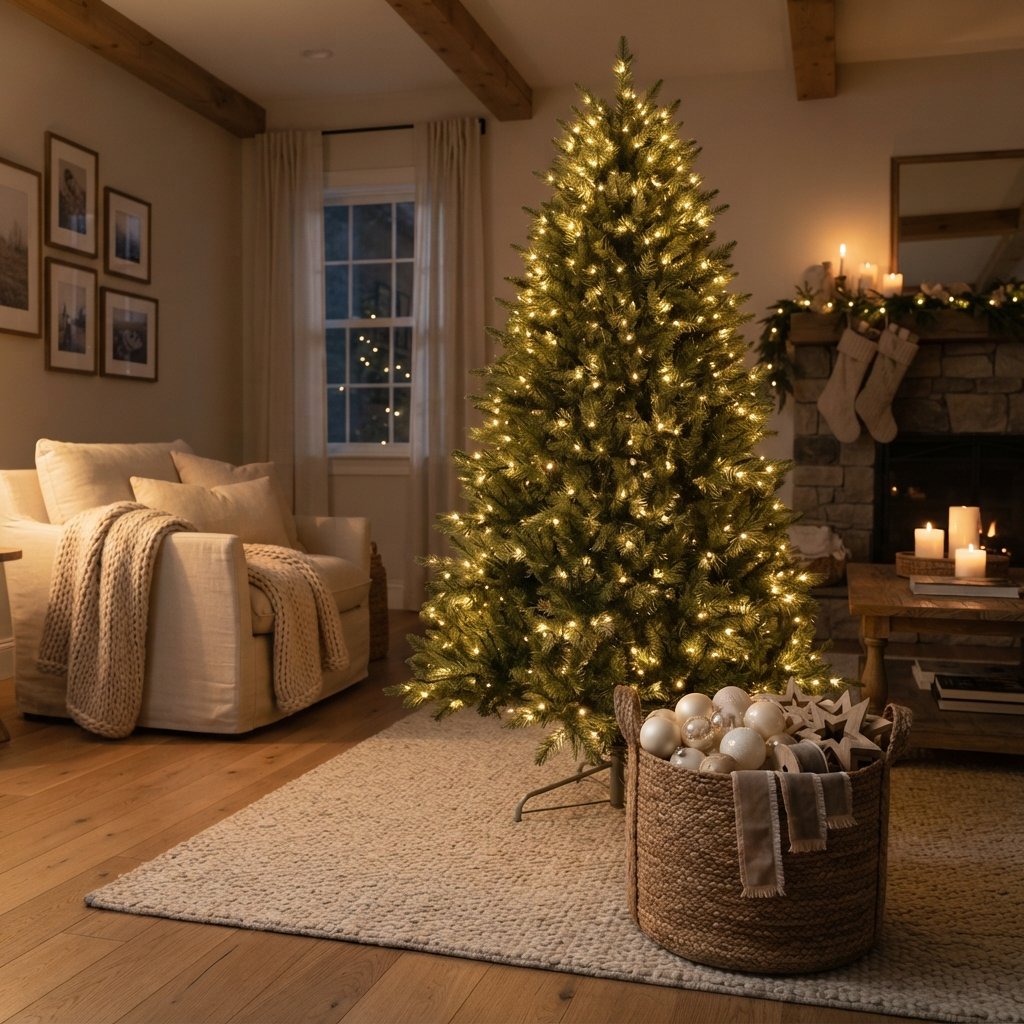
1. Start With Warm White Christmas Lights
Lighting establishes the mood before any ornaments go on.
For a warm neutral tree, warm white lights generally complement cream, brown, wood, and champagne decorations beautifully.
Before decorating, test all lights.
If you’re adding separate light strands, follow the tree and light manufacturers’ instructions for electrical capacity, connection limits, indoor/outdoor use, and placement.
Don’t overload outlets or daisy-chain electrical products beyond their rated limits.
2. Choose Two or Three Main Ornament Colors
A neutral tree becomes much easier to decorate when you establish dominant colors.
For example:
- Cream
- Taupe
- Champagne
Then use wood and brown as secondary accents.
You don’t need every ornament to match exactly.
In fact, several shades of cream and taupe can give the tree more depth.
3. Mix Matte and Shiny Ornaments
When the colors are similar, changing the finish creates contrast.
Use a combination of:
- Matte
- Shiny
- Frosted
- Ribbed
- Textured
A matte cream ornament next to a glossy champagne ornament creates dimension even though the colors are close.
Avoid using only one ornament finish across the entire tree unless you intentionally want a very minimal look.
4. Use Different Ornament Sizes
One of the easiest ways to make a Christmas tree look fuller is to vary ornament scale.
Use:
- Large ornaments
- Medium ornaments
- Small ornaments
Place some larger ornaments slightly deeper into the branches.
Then use medium and small ornaments closer to the tips.
This creates visual depth rather than making every decoration sit on the outside edge.
5. Add Velvet Ribbon
Velvet is perfect for a neutral Christmas tree because it introduces texture without requiring another pattern.
Try:
- Cream
- Taupe
- Camel
- Chocolate brown
- Muted olive
- Burgundy
You can use ribbon in several ways.
Create loose vertical sections, tuck short pieces between branches, or make simple bows.
There’s no rule saying ribbon has to spiral perfectly around the tree.
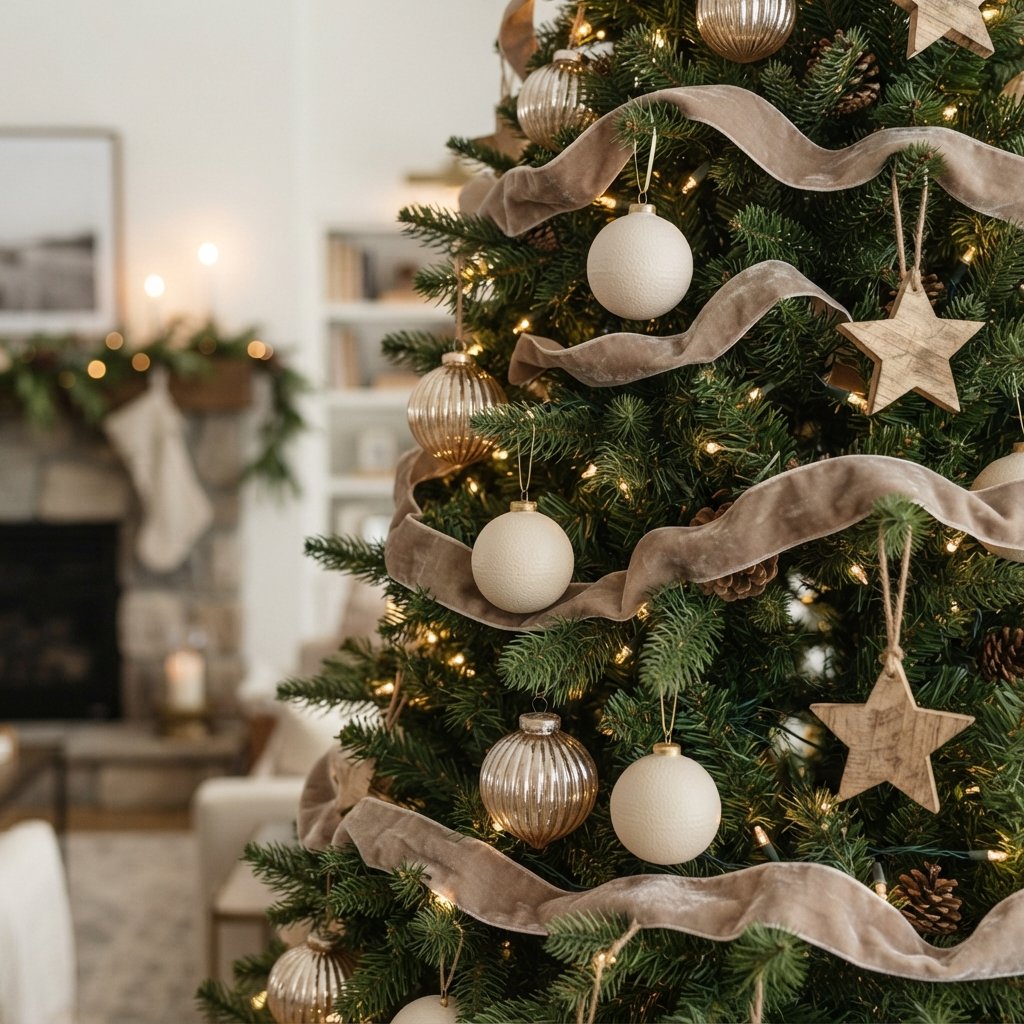
6. Try Cream Ribbon
Cream ribbon creates a soft contrast against dark green branches.
It works particularly well with:
- Champagne ornaments
- Wood ornaments
- Brown accents
- Warm white lights
Choose ribbon with texture so it doesn’t disappear into the rest of the neutral decorations.
Velvet, woven, or linen-look finishes can all work.
7. Decorate With Brown Velvet Ribbon
Brown has become a beautiful alternative to black or traditional red for Christmas decorating.
Chocolate or warm brown velvet ribbon looks especially good with:
- Cream
- Champagne
- Natural wood
- Deep green
Because brown is darker than most neutral ornaments, it helps visually ground the tree.
8. Add Wood Ornaments
Wood is one of the easiest ways to keep neutral Christmas decor from feeling too formal.
Try:
- Wood stars
- Simple trees
- Snowflakes
- Beads
- Bells with wood details
You can use both light and medium wood tones.
They don’t need to match your furniture exactly.
9. Use Paper Christmas Ornaments
Paper ornaments bring texture without adding much visual weight.
Try:
- Honeycomb ornaments
- Paper stars
- Folded paper trees
- Paper snowflakes
Cream, kraft brown, and warm white work especially well.
Because paper is combustible, keep it away from open flames, fireplaces, candles, and other heat sources.
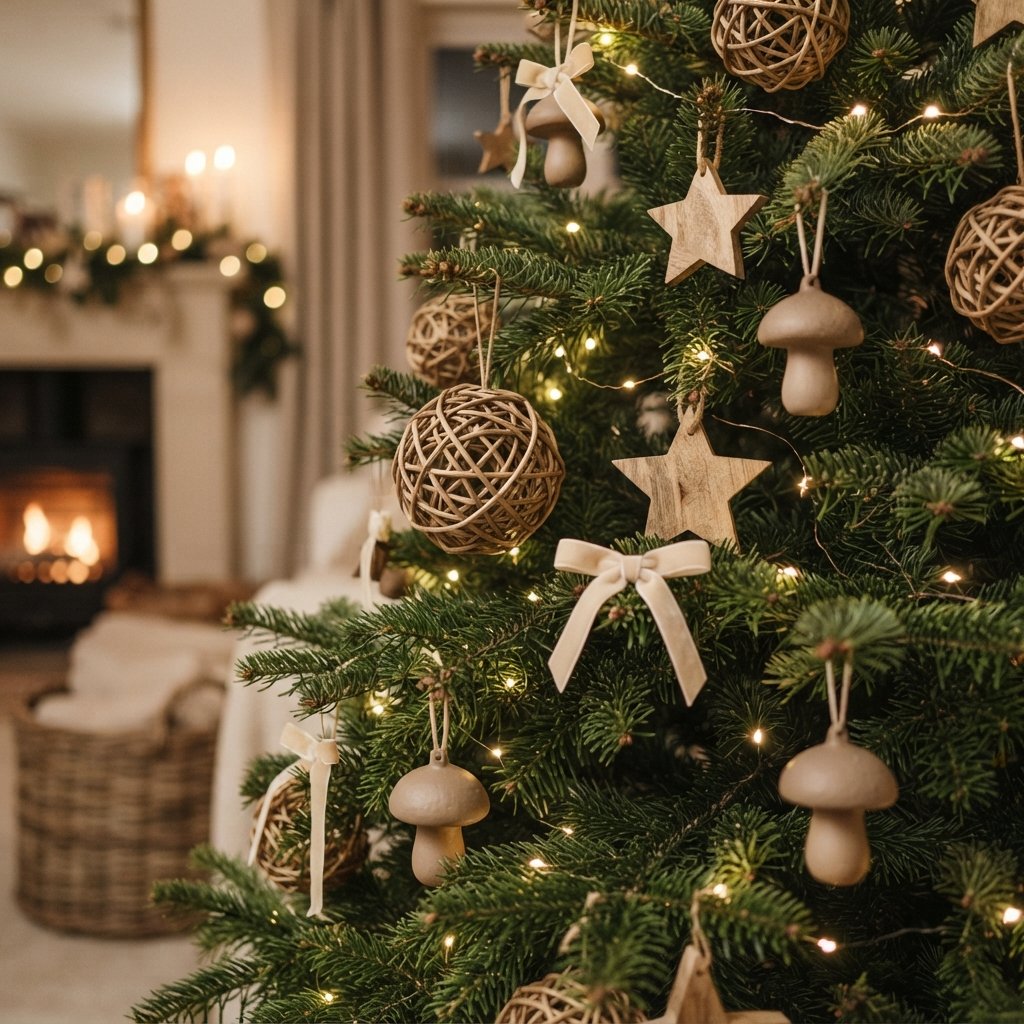
10. Add Woven Ornaments
Rattan-style, wicker, or woven decorations can give a neutral tree an organic look.
They pair beautifully with:
- Linen
- Wood
- Cream
- Brown
- Muted green
Don’t use too many.
A handful scattered around the tree is enough to introduce the texture.
11. Use Bells as Christmas Tree Decorations
Decorative bells add shape and a subtle traditional element.
Warm brass-toned bells look beautiful with cream and brown.
You could hang:
- Individual bells
- Small bell clusters
- Bells tied with velvet ribbon
Make sure heavier ornaments are attached to branches capable of supporting their weight.
12. Add Neutral Floral Picks
Floral picks help fill gaps in the tree.
Look for colors that support your palette, such as:
- Cream
- Champagne
- Brown
- Soft green
Use them sparingly.
Place them at slightly different angles so they look integrated into the tree rather than forming a ring around it.
13. Use Natural-Looking Greenery Picks
If your artificial tree needs more fullness, additional greenery can help.
Try mixing in foliage with a slightly different shape or tone.
For example, cedar-style or pine-style picks can add variation to a standard artificial tree.
Keep the greens relatively compatible so the result still looks cohesive.
14. Add Pinecones
Pinecones work naturally with a neutral palette.
You can leave them natural-looking or use decorative versions with a subtle finish.
Place them deeper among the branches to add texture.
If using natural pinecones, make sure they’re clean, dry, and appropriate for indoor decorating.
Keep them away from open flames and high heat.
15. Add Dried-Looking Florals
Dried-look florals can give a neutral tree a softer organic feel.
Use decorative faux versions or appropriately dried materials.
Try:
- Beige grasses
- Brown seed heads
- Cream florals
- Muted foliage
Keep combustible natural materials away from fireplaces, candles, and heat sources.
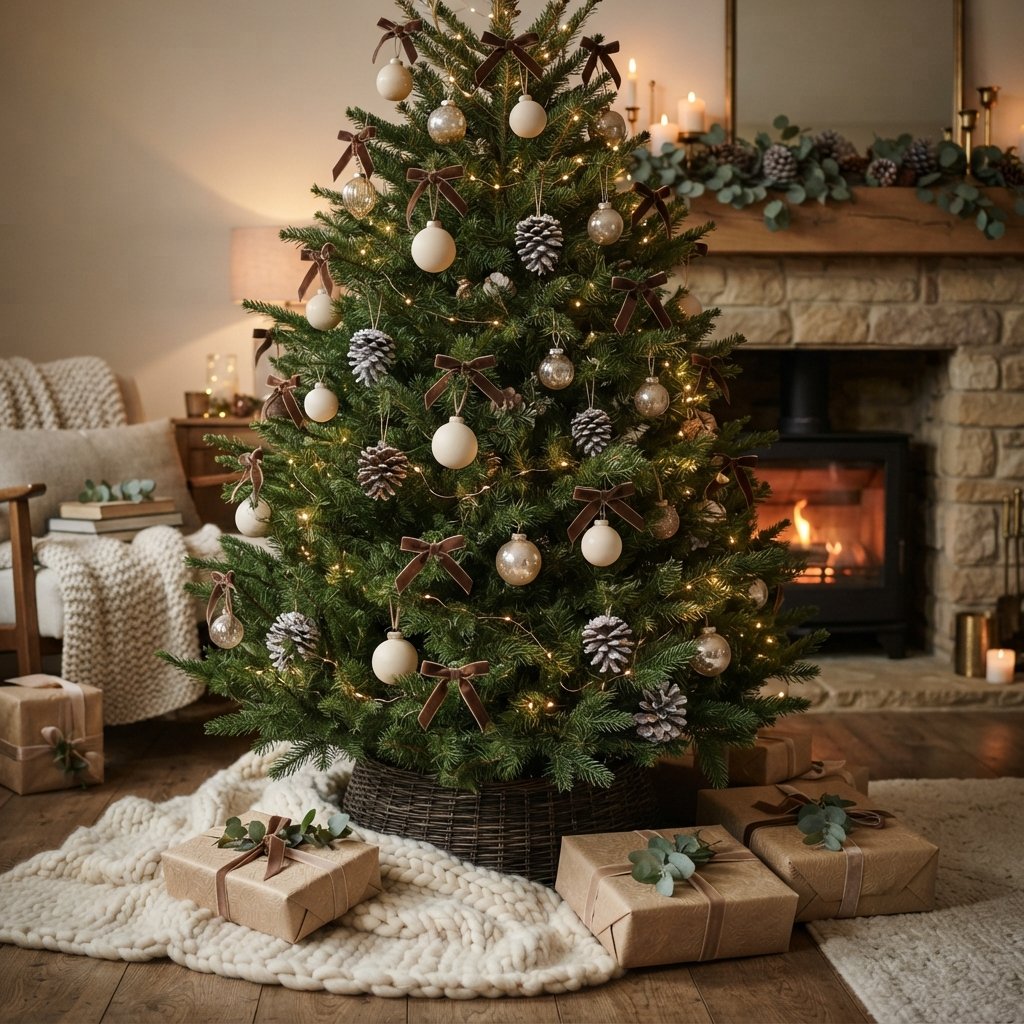
16. Create Small Velvet Bows
Small bows are an inexpensive way to repeat a color throughout the tree.
Tie them from:
- Brown velvet
- Cream velvet
- Taupe ribbon
- Muted olive ribbon
Space them around the tree rather than concentrating them all in one area.
The slightly handmade appearance can soften a tree filled with shiny ornaments.
17. Add a Few Vintage-Inspired Ornaments
Neutral doesn’t need to mean modern.
A few vintage-inspired ornaments can make the tree feel collected.
Look for shapes such as:
- Bells
- Stars
- Finials
- Houses
- Traditional baubles
Keep them within the overall color palette so they blend with newer decorations.
18. Use Black as a Small Accent
If your neutral tree feels too soft, a little black can create definition.
Try:
- Thin black ribbon
- Small black ornaments
- Black bells
- Several dark decorative details
Use it sparingly.
Black should provide punctuation rather than becoming the dominant color unless you’re intentionally creating a black-and-neutral Christmas tree.
19. Bring in Muted Green
Your tree itself is already green, but repeating green in several ornaments or ribbons can make the palette feel more layered.
Try:
- Sage
- Olive
- Moss
- Deep forest green
These colors work particularly well with cream and brown.
20. Add Burgundy for a Richer Neutral Tree
Burgundy isn’t technically neutral, but in small amounts it works beautifully with earthy Christmas palettes.
Pair it with:
- Cream
- Brown
- Deep green
- Warm brass tones
Use burgundy in ribbon or a handful of ornaments.
This gives the tree a more traditional Christmas feeling without introducing bright red.
21. Use Champagne Instead of Bright Gold
Champagne can provide sparkle while staying soft.
Mix champagne ornaments with:
- Cream
- Taupe
- Wood
- Brown
You don’t need every metallic element to be exactly the same shade.
Slight variation makes the tree feel more collected.
How to Decorate a Neutral Christmas Tree Step by Step
If you’re starting from scratch, decorate in layers.
Step 1: Fluff the Tree
If you’re using an artificial tree, take time to separate and shape the branches according to its instructions.
This makes a major difference.
Step 2: Add Lights
If the tree isn’t pre-lit, add lights before ornaments.
Test them first.
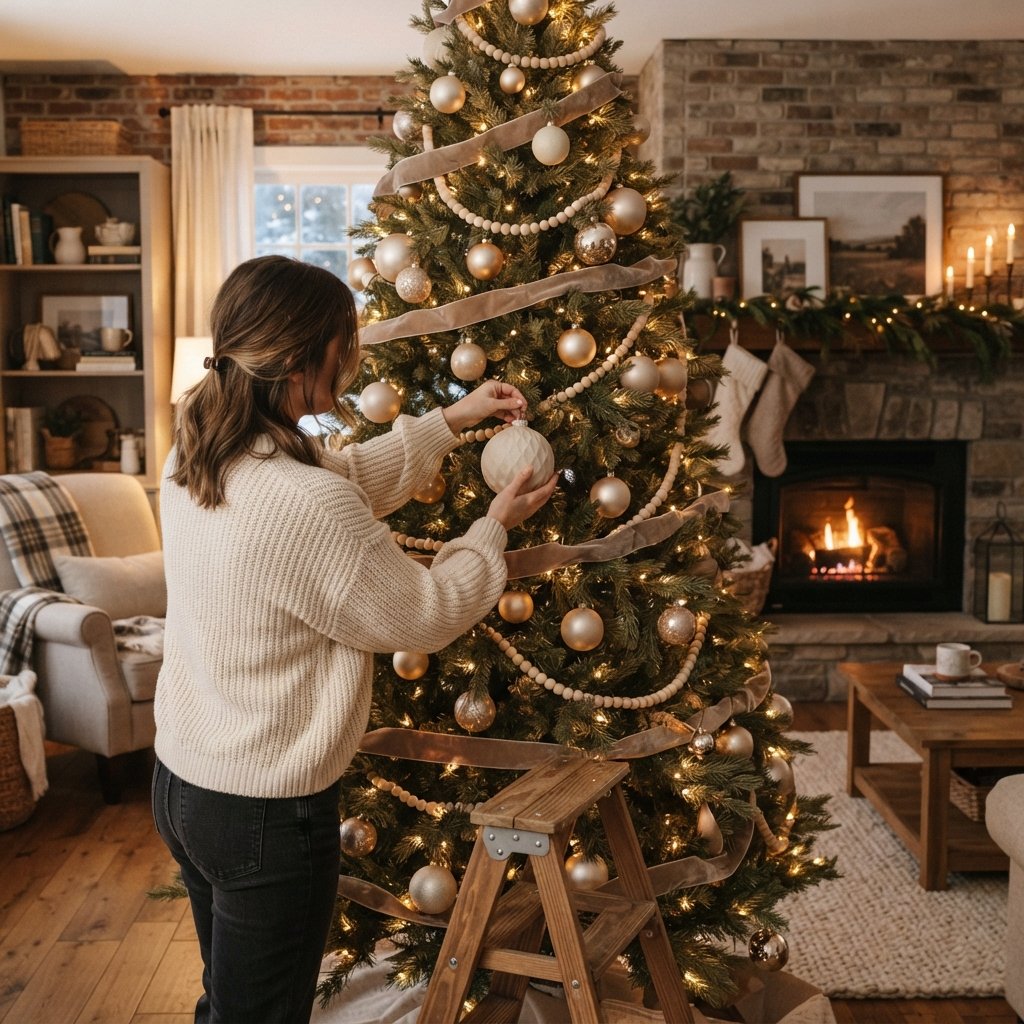
Step 3: Add Ribbon
Ribbon is easier to position before the tree is covered in ornaments.
Step 4: Add the Largest Ornaments
Distribute them throughout the tree.
Don’t place all the large ornaments at the bottom.
Step 5: Add Medium Ornaments
Fill in the main body of the tree.
Step 6: Add Small Ornaments
Use these toward branch tips and to fill smaller gaps.
Step 7: Add Special Ornaments
Now add wood pieces, bells, paper ornaments, bows, and sentimental decorations.
Step 8: Add Picks
Fill remaining gaps with greenery or floral picks.
Step 9: Step Back
Look at the entire tree from across the room.
Move anything that looks overly concentrated.
How to Make a Neutral Christmas Tree Look Full
A full-looking tree doesn’t necessarily require hundreds of ornaments.
Focus on layering.
Decorate Into the Tree
Don’t place everything on the outer tips.
Vary Ornament Size
Large ornaments fill visual space quickly.
Add Ribbon
Ribbon covers larger areas than small ornaments.
Use Picks
Greenery and floral picks can disguise sparse spots.
Mix Shapes
Round ornaments alone can become repetitive.
Add stars, bells, bows, and elongated ornaments.
How to Keep a Neutral Christmas Tree From Looking Boring
The biggest challenge with a neutral palette is creating enough contrast.
The solution is texture.
Mix:
- Velvet
- Glass
- Matte finishes
- Wood
- Paper
- Metal
- Woven textures
Then vary the value of the colors.
Instead of using only pale cream, introduce medium taupe and dark brown.
Those darker accents give the lighter ornaments definition.
Neutral Christmas Tree With a Minimal Look
If you prefer simple Christmas decor, skip the ribbon and floral picks.
Use:
- Warm white lights
- Cream ornaments
- Wood ornaments
- Several paper stars
Leave plenty of visible greenery.
A minimal tree should look intentionally restrained rather than unfinished.
Neutral Christmas Tree With a Cozy Look
For something warmer, layer:
- Brown velvet ribbon
- Cream ornaments
- Wood
- Pinecones
- Woven accents
- Warm white lights
Use a soft tree skirt or woven tree collar at the base.
Add a basket of folded blankets nearby if it works with your living room.
Neutral Christmas Tree With an Elegant Look
For a dressier tree, use:
- Champagne
- Ivory
- Taupe
- Velvet
- Glass ornaments
- Warm metallic details
Keep rustic elements to a minimum.
Use larger ribbon and elegant ornament shapes to create more visual impact.
Neutral Christmas Tree With Natural Decor
For an organic look, emphasize:
- Wood
- Paper
- Pinecones
- Woven ornaments
- Muted green
- Cream
Avoid making every natural element brown.
Cream ornaments and warm lights will provide contrast.
Neutral Christmas Tree for a Small Space
A smaller tree doesn’t need tiny decorations exclusively.
A few medium or slightly oversized ornaments can actually make it feel more intentional.
Keep the palette tight.
Try:
- Cream
- Brown
- Wood
Skip heavy garland and use small velvet bows instead.
This gives the tree detail without making it feel crowded.
Choosing a Tree Skirt or Tree Collar
The base of the tree is part of the overall design.
For a neutral tree, try:
- Woven tree collar
- Warm wood-style collar
- Cream fabric skirt
- Chunky knit-style skirt
- Simple brown or beige textile
Choose something that relates to another texture already in the room.
A woven collar, for example, works especially well if you already have woven baskets or natural wood nearby.
Neutral Christmas Gift Wrapping
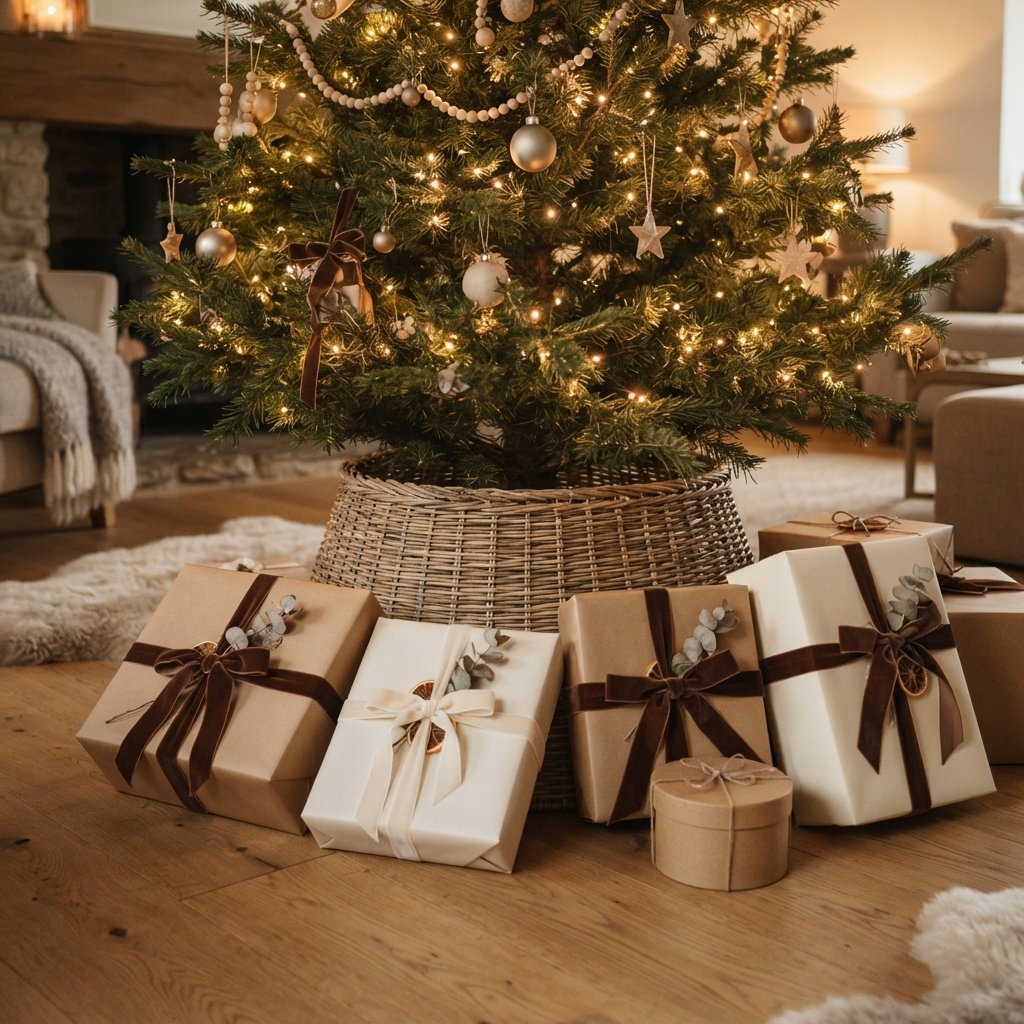
The presents under the tree can become part of the decor.
Use:
- Kraft paper
- Cream paper
- White paper
- Simple striped paper
Then add:
- Brown ribbon
- Cream ribbon
- Velvet
- Twine
You don’t need every package to match.
Keeping them within the same general palette is enough.
What Tree Topper Works With Neutral Christmas Decor?
Choose something that complements the tree rather than competing with it.
Ideas include:
- Simple star
- Woven star
- Wood star
- Large velvet bow
- Neutral floral arrangement
If the tree is already heavily decorated, keep the topper simple.
Make sure the top branch can safely support its weight and secure the topper so it cannot easily fall.
Neutral Christmas Tree Decorating on a Budget
You don’t have to replace your entire ornament collection.
Start with what you already own.
Remove ornaments that strongly clash with the new palette and keep anything that works.
Then add inexpensive neutral elements such as:
- Ribbon
- Bows
- Pinecones
- Paper ornaments
- Simple wood decorations
You can also place existing colorful ornaments deeper inside the tree where they add fullness without becoming focal points.
Another option is to update suitable old ornaments with craft materials, provided the coating or adhesive is appropriate for the ornament material.
How Many Ornament Styles Should You Use?
There isn’t a perfect number.
Instead, think in categories.
For example:
Base ornaments: cream and taupe baubles
Texture: wood and woven ornaments
Sparkle: champagne ornaments
Accent: brown velvet bows
Special pieces: sentimental ornaments
This creates variety without making the tree look random.
Neutral Christmas Tree Safety Tips
Christmas trees combine electrical lights, cords, delicate decorations, and sometimes combustible materials, so decorate with safety in mind.
- Follow the tree and light manufacturers’ instructions.
- Inspect electrical cords and lights for damage before use.
- Don’t overload outlets or extension cords.
- Don’t exceed stated limits for connected light strands.
- Use lights rated for the intended indoor or outdoor location.
- Keep cords where they won’t create trip hazards.
- Keep paper, dried materials, ribbon, and other combustible decorations away from fireplaces, candles, and heat sources.
- Use flameless candles near the tree rather than open flames.
- Secure heavy ornaments to sturdy branches.
- Secure the tree appropriately, especially in homes with young children or pets.
- Keep small or breakable ornaments out of reach where necessary.
- Never use real candles on a Christmas tree.
- If using a real tree, follow appropriate care and fire-safety recommendations and prevent it from becoming excessively dry.
Common Neutral Christmas Tree Decorating Mistakes
Using Only One Shade
Add cream, taupe, brown, and champagne for depth.
Using Only Round Ornaments
Mix in bells, bows, stars, and other shapes.
Putting Everything on Branch Tips
Decorate deeper into the tree.
Using Too Many Ornament Styles
Repeat several key elements.
Forgetting Darker Accents
Brown, deep green, or a little black can provide needed contrast.
Buying Everything New
Work existing ornaments into the palette.
Using Too Much Ribbon
Leave some greenery visible.
Making Everything Match Perfectly
A little variation keeps the tree interesting.
Ignoring the Base of the Tree
Choose a tree skirt or collar that supports the overall look.
FAQ About Neutral Christmas Tree Decor
What colors are good for a neutral Christmas tree?
Cream, warm white, ivory, beige, taupe, brown, champagne, natural wood, muted green, and small amounts of black or burgundy can all work well.
How do you decorate a neutral Christmas tree?
Start with warm lights, choose two or three main ornament colors, add ribbon, vary ornament sizes and finishes, and introduce texture through wood, velvet, woven ornaments, bells, or paper decorations.
How do you keep a neutral Christmas tree from looking boring?
Use plenty of texture and contrast. Mix matte and shiny ornaments, add wood and velvet, and include medium or dark accents such as taupe, brown, deep green, or black.
What ribbon looks good on a neutral Christmas tree?
Cream, taupe, camel, chocolate brown, muted olive, and even deep burgundy ribbon can work beautifully.
Does gold work with neutral Christmas decor?
Yes. Champagne and softer warm metallic tones are particularly easy to mix with cream, taupe, brown, and wood.
Can you mix wood ornaments with elegant ornaments?
Absolutely. Keeping the colors coordinated allows rustic wood and more polished glass or metallic ornaments to work together.
What color lights are best for a neutral Christmas tree?
Warm white lights often complement warm neutral palettes particularly well, although the best choice depends on the overall look you’re creating.
How can I decorate a neutral Christmas tree cheaply?
Reuse existing ornaments, add inexpensive ribbon or handmade bows, make paper decorations, use pinecones where appropriate, and buy only a few larger ornaments in your chosen neutral palette.
Final Thoughts
The best neutral Christmas tree decor isn’t about removing personality or color from Christmas.
It’s about creating interest in different ways.
Instead of relying on bright colors, use layers of texture.
Mix cream ornaments with taupe.
Add warm wood.
Bring in velvet ribbon.
Use champagne for a little sparkle and brown or deep green for contrast.
Then include the ornaments that actually mean something to you.
A neutral tree doesn’t have to look like it came straight from a showroom. Sentimental ornaments, handmade decorations, and pieces collected over time can still fit beautifully into the overall design.
Start with a simple palette, repeat several key elements around the tree, vary the ornament sizes, and leave enough greenery visible that every decoration has room to stand out.
Whether your style is minimal, organic, cozy, or elegant, a neutral Christmas tree can feel festive without overwhelming the rest of your home.
And because so many neutral decorations work with different colors, it’s an easy foundation to update from year to year.
Add burgundy one Christmas.
Bring in olive the next.
Or keep everything cream, wood, and champagne.
The result can change while the basics stay the same—which makes neutral Christmas decor both beautiful and practical.