

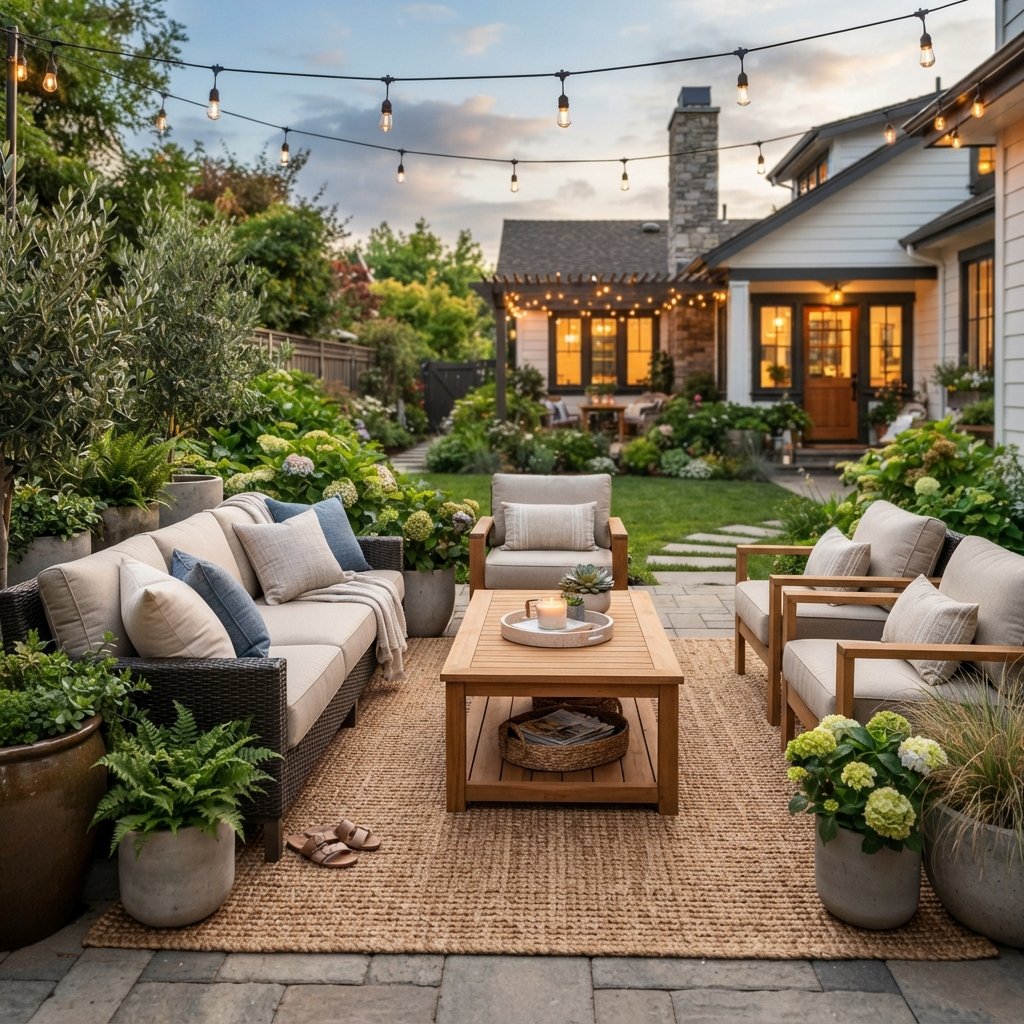
A patio doesn’t need to be large, expensive, or professionally designed to become one of the most enjoyable spaces in your home.
Sometimes the simplest changes make the biggest difference.
A comfortable place to sit, an outdoor rug, a few planters, soft lighting, and some weather-appropriate textiles can turn a bare concrete slab or basic deck into a space that actually feels like an outdoor room.
The trick is decorating your patio with the same thought you’d give an indoor space—while remembering that everything outside needs to handle a much tougher environment.
Sun, rain, wind, humidity, temperature changes, and everyday dirt all affect outdoor furniture and decor. Your climate and whether the patio is covered will determine which materials make sense.
Whether you’re decorating a small apartment patio, a covered porch, or a larger backyard entertaining area, these patio decorating ideas will help you create a comfortable, inviting outdoor space without making it feel cluttered or overdone.
1. Decide How You Want to Use the Patio
Before buying furniture, decide what you actually want to do outside.
Do you want a place for:
- Morning coffee?
- Family dinners?
- Entertaining?
- Reading?
- Lounging?
- Grilling?
- Kids to play?
A patio designed primarily for dining needs a different layout from one designed for lounging.
If you have enough room, you may be able to create several zones.
But don’t force every possible function into a small space.
One comfortable seating area is better than several cramped ones.
2. Start With Comfortable Outdoor Seating
Furniture is usually the largest visual element on a patio, so start there.
Depending on your space, you might choose:
- Outdoor sofa
- Loveseat
- Lounge chairs
- Dining chairs
- Adirondack-style chairs
- Small bistro set
Before purchasing anything, measure the patio.
Then mark the furniture footprint on the ground with painter’s tape or another temporary method.
Make sure there’s enough room to walk comfortably around the furniture and access doors, steps, grills, and other areas.
3. Add an Outdoor Rug
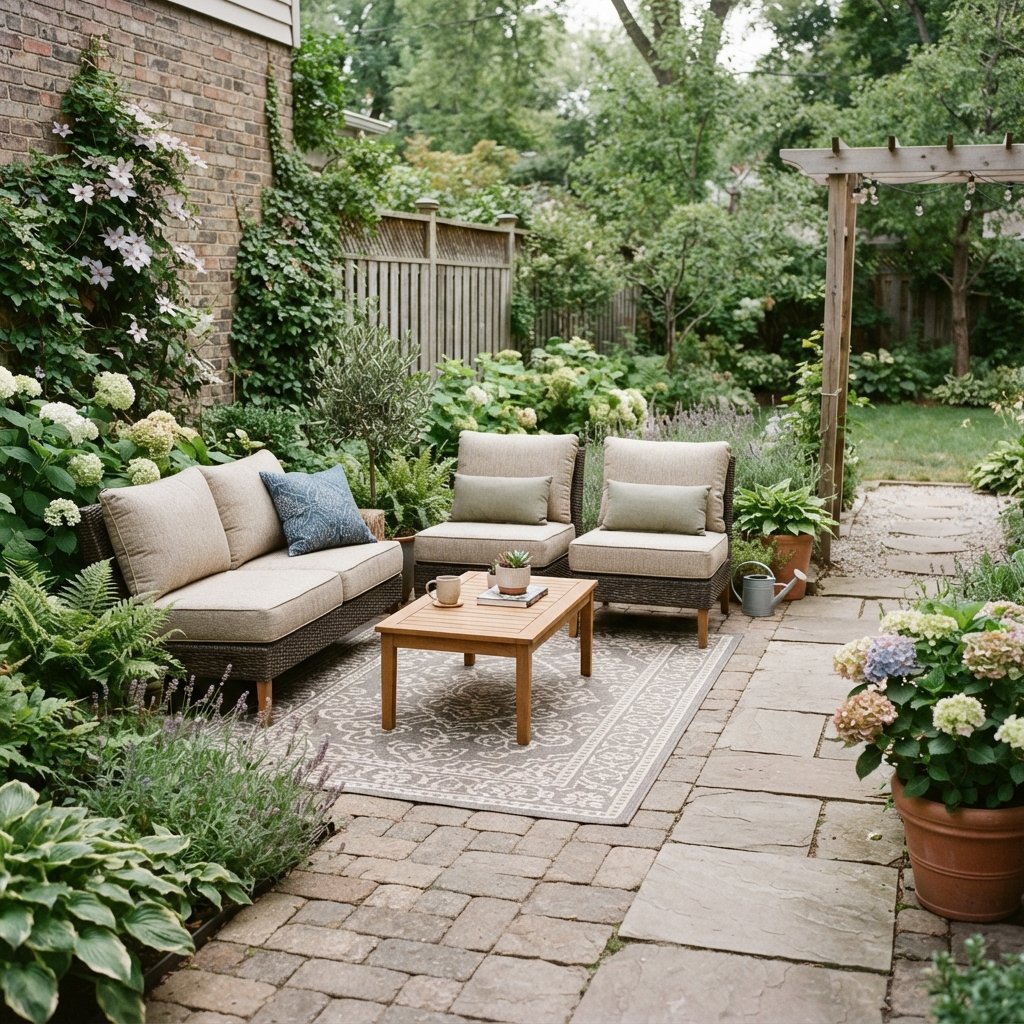
An outdoor rug can immediately make a patio feel more like a finished room.
It visually connects the furniture and adds:
- Color
- Pattern
- Texture
- Softness
Scale matters.
A tiny rug floating beneath a large seating arrangement can make the furniture feel disconnected.
Choose a size that relates appropriately to the furniture arrangement and available patio area.
Use a rug designed for outdoor conditions and suitable for your specific surface and exposure.
Also consider drainage and drying. A rug that remains wet against certain surfaces can create maintenance problems.
4. Use Outdoor Throw Pillows
Pillows are one of the easiest ways to change your patio from season to season.
Start with your furniture color.
Then choose a simple palette.
For example:
Cream + blue + green
or:
Beige + terracotta + olive
or:
Black + cream + warm brown
Mix a few patterns with solids rather than making every pillow a statement.
Most importantly, choose materials intended for outdoor use when pillows will be exposed to the elements.
5. Add an Outdoor Throw
A throw blanket can make a covered patio feel especially inviting during cooler evenings.
Keep one in a weather-protected storage area and bring it out when needed.
Avoid leaving indoor textiles exposed to moisture or harsh weather.
A simple throw draped over a chair can also introduce another layer of texture.
6. Decorate With Large Planters
Plants are one of the best ways to soften a patio filled with hard surfaces.
Instead of covering the space with dozens of tiny pots, try a few larger planters.
Place them:
- Beside seating
- Near stairs
- At patio corners
- Beside a doorway
Choose plants appropriate for your climate, sun exposure, container size, and maintenance preferences.
If you have children or pets, also check whether plants are suitable for your household.

7. Group Planters Together
If you enjoy container gardening, group pots rather than scattering them randomly around the patio.
Try combining three planters of different heights.
Vary:
- Pot size
- Plant height
- Foliage texture
You can keep the planter materials similar to make the arrangement feel cohesive.
Grouping creates more impact and reduces visual clutter.
8. Add a Coffee Table
If your patio is primarily for lounging, give people somewhere to set a drink.
An outdoor coffee table helps anchor a seating arrangement just as it does indoors.
Look for materials appropriate for your climate and exposure.
Keep styling simple.
You may only need:
- Small planter
- Outdoor-safe lantern
- Decorative bowl or tray when in use
Avoid leaving lightweight decor outside when wind could turn it into a hazard.
9. Use Side Tables
Side tables can be more useful than additional decorative furniture.
Place one beside a lounge chair for:
- Drink
- Book
- Small lamp designed for outdoor use
On a small patio, a side table can even replace a coffee table.
10. Hang String Lights
Few patio decorating ideas change the atmosphere as quickly as outdoor string lights.
They can create soft ambient light for evening use.
But installation matters.
Use lighting specifically rated for the intended outdoor location and follow the manufacturer’s instructions.
Don’t rely on decorative light cords to support themselves across long spans unless the product is designed for that installation.
Keep electrical connections protected as required, use appropriate outdoor-rated power sources and equipment, and avoid creating trip hazards.
If permanent electrical work is needed, use a qualified professional.

11. Layer Your Outdoor Lighting
String lights aren’t your only option.
A well-lit patio can use several types of light.
Consider:
- Wall sconces
- Outdoor-rated pendants in appropriate covered locations
- Path lighting
- Landscape lighting
- Portable outdoor-rated lamps
- Lantern-style lighting
Think about function first.
Steps and walking areas need adequate visibility.
Decorative lighting should supplement—not compromise—safe illumination.
12. Add an Umbrella for Shade
Shade can dramatically improve how often you use a sunny patio.
An umbrella also adds color and height to the design.
Choose one that’s appropriately sized and designed for your setup.
Follow the manufacturer’s requirements for the base and installation.
Close or secure umbrellas as directed during windy conditions and severe weather.
For larger shade structures or permanent installations, consider local requirements and professional installation where appropriate.
13. Create Shade With a Pergola
A pergola can help define a larger patio and create the feeling of an outdoor room.
It can also provide a framework for appropriate shade solutions and lighting.
Because pergolas are structures, installation can involve:
- Foundations
- Structural loads
- Wind
- Attachment to buildings
- Local requirements
If you’re considering building one, verify the structural and permitting requirements for your location and use qualified help where necessary.
14. Use Outdoor Curtains Carefully
Outdoor curtains can soften a covered patio or pergola.
They may also provide some privacy or limited shade depending on the setup.
Choose fabric designed for outdoor use.
Consider how the curtains will behave in wind and how they’re secured.
Avoid hanging loose fabric where it can interfere with flames, cooking equipment, heaters, or other heat sources.
15. Create Privacy With Plants
Plants can provide softer privacy than a solid screen.
Depending on your climate and space, consider tall container plants or appropriately maintained shrubs.
This can be especially useful along:
- Patio edges
- Neighbor-facing sides
- Seating areas
Make sure mature plant size works for the location.
Don’t block required walkways, vents, equipment, or sightlines.

16. Add a Privacy Screen
For more defined privacy, a screen or trellis can help.
It can also provide an architectural backdrop for furniture.
Before attaching or installing a permanent screen, consider:
- Wind exposure
- Structural support
- Property boundaries
- Local rules
- Attachment method
A large screen can catch significant wind, so it needs to be appropriately designed and secured.
17. Bring in Warm Wood Tones
Outdoor spaces often contain lots of gray:
- Concrete
- Pavers
- Metal
- Siding
Wood can warm up the palette.
Introduce it through appropriately rated outdoor:
- Furniture
- Tables
- Planters
- Decorative details
Choose materials and finishes suitable for outdoor exposure and maintain them according to manufacturer recommendations.
18. Mix Materials
Your patio doesn’t need to be a matching furniture set.
Mixing materials can make the space feel collected.
For example:
Woven chairs + wood table + metal planters
or:
Metal sofa frame + stone table + woven rug
Repeat each material or color somewhere else so the combination feels intentional.
19. Decorate an Outdoor Dining Table Simply
If you have a patio dining table, you don’t need a permanent elaborate centerpiece.
Try:
- Potted plant
- Outdoor-safe lantern
- Bowl used when entertaining
Then add more decorative pieces for meals.
Keeping everyday styling simple makes outdoor maintenance easier.
20. Add a Fire Feature Only Where Appropriate
A fire feature can create a wonderful gathering area, but placement and product requirements matter.
Follow the fire feature manufacturer’s instructions regarding:
- Clearances
- Surface
- Ventilation
- Fuel
- Operation
- Weather
- Storage
Keep combustible materials away as directed.
Never place a fire feature beneath or near structures, curtains, furniture, or other materials unless the specific product and installation are approved for that situation.
Local fire restrictions and rules can also apply.
When in doubt, get professional guidance.
21. Keep the Final Styling Simple
Outdoor spaces become dirty faster than indoor rooms.
Everything you put outside eventually needs to be:
- Cleaned
- Moved
- Stored
- Maintained
Don’t make the patio harder to use by filling every surface.
A few substantial decorative elements often work better than dozens of small accessories.
Let the plants, furniture, lighting, and surrounding landscape do most of the decorating.

Patio Decorating Ideas on a Budget
You don’t have to replace your furniture to refresh a patio.
Focus on high-impact changes.
Try:
- Cleaning the patio thoroughly
- Rearranging furniture
- Adding a few outdoor pillows
- Moving existing planters
- Updating an outdoor rug
- Adding lighting
- Painting or refinishing suitable outdoor furniture according to material and product instructions
Start by cleaning.
It’s surprising how different a patio can look after removing dirt, leaves, pollen, and clutter.
Small Patio Decorating Ideas
Small patios need editing.
Choose furniture based on how you actually use the space.
If you mostly have coffee outside with one other person, you may not need a six-person dining table.
Consider:
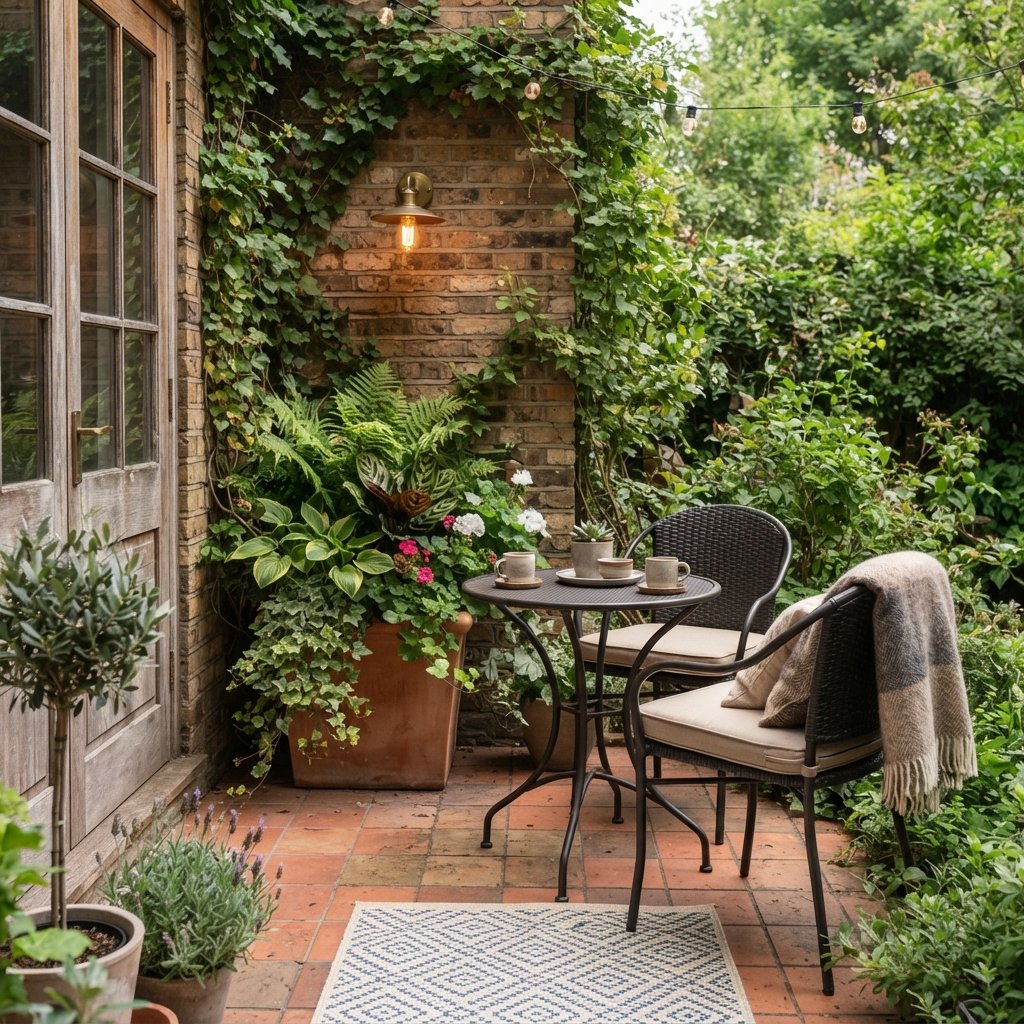
- Bistro table
- Two comfortable chairs
- Compact loveseat
- Small side table
- Vertical planting
- One substantial planter
Avoid filling every edge with furniture.
Negative space makes a small patio easier to use.
Covered Patio Decorating Ideas
A covered patio often feels more like an outdoor room.
You can emphasize that with:
- Rug
- Seating arrangement
- Lighting
- Coffee table
- Curtains where appropriate
- Plants
But “covered” doesn’t automatically mean weatherproof.
Wind-driven rain, humidity, temperature changes, and sunlight can still affect furniture and textiles.
Use materials suited to the actual conditions.
How to Choose a Patio Color Palette
Start with the colors that aren’t changing.
That might include:
- House exterior
- Patio material
- Decking
- Outdoor furniture
Then add two or three colors.
For example:
Warm Neutral Patio
Cream + tan + warm wood + green plants.
Coastal-Inspired Patio
White + blue + natural woven texture.
Earthy Patio
Beige + terracotta + olive.
High-Contrast Patio
Black + cream + natural wood.
Plants naturally add green, so you don’t necessarily need to count greenery as an accent color.
How to Make a Patio Feel Cozy
Coziness comes from layers.
Indoors, you use:
- Rugs
- Pillows
- Curtains
- Lamps
- Plants
Use the same general concept outside—with outdoor-appropriate materials.
Add softness through textiles.
Create pools of light.
Bring plants close to seating.
Use furniture arranged for conversation rather than lining every chair against the perimeter.
How to Arrange Patio Furniture
Start with the focal point.
That could be:
- View
- Fireplace or appropriate fire feature
- Coffee table
- Garden
- Dining table
Arrange seating around that feature.
Then check traffic flow.
Can someone comfortably walk:
- From the house to the yard?
- Around the table?
- To the grill?
- Up and down steps?
Don’t sacrifice function for symmetry.
How to Make a Patio Look Expensive on a Budget
You don’t necessarily need expensive furniture.
Focus on scale and restraint.
Try:
- One appropriately sized rug
- Larger planters
- Cohesive pillow palette
- Simple lighting
- Repeated materials
- Fewer decorative accessories
Matching isn’t required.
Cohesion is.
A limited palette can make inexpensive pieces look more intentional.
Patio Decorating Ideas With Plants
Plants should feel integrated into the design rather than added as an afterthought.
Use them to:
- Frame seating
- Fill an awkward corner
- Create privacy
- Add height
- Soften hard edges
Vary height but repeat planter materials or colors.
Always choose plants appropriate for your actual growing conditions.
Patio Decorating Ideas for Summer
For a summer refresh, you may only need a few changes.
Try:
- Fresh outdoor pillows
- Flowering planters appropriate to your climate
- Clean rug
- Lightweight table linens for entertaining
- Improved shade
- Evening lighting
Keep maintenance realistic.
A patio you can easily clean and reset will probably get used more often.
Common Patio Decorating Mistakes
Buying Furniture Before Measuring
Measure first and account for circulation.
Choosing a Rug That’s Too Small
The rug should relate to the furniture grouping.
Using Indoor Decor Outside
Use materials designed for the environment.
Adding Too Many Small Accessories
Outdoor clutter becomes outdoor maintenance.
Ignoring Shade
A beautiful patio isn’t useful if it’s uncomfortable for much of the day.
Forgetting Evening Lighting
Plan for how you’ll use the patio after sunset.
Ignoring Wind
Secure or store lightweight items as conditions require.
Blocking Traffic Paths
Maintain comfortable access between the house, patio, and yard.
Choosing Plants Only for Appearance
Match plants to sun, climate, containers, and care requirements.
Ignoring Safety Around Fire
Follow product instructions, clearance requirements, and local restrictions.
Treating a Covered Patio Like an Indoor Room
Covered outdoor spaces can still experience moisture, sun, wind, and temperature extremes.

FAQ About Patio Decorating
How can I make my patio look nice on a budget?
Start by cleaning and rearranging what you already own. Then focus on a few high-impact additions such as outdoor pillows, planters, lighting, or an appropriately sized outdoor rug.
How do I make my patio feel cozy?
Use comfortable furniture, outdoor textiles, plants, warm ambient lighting, and an arrangement that encourages conversation.
What should I put on an empty patio?
Start with the function. A small patio may only need two comfortable chairs and a table, while a larger patio could include separate dining and lounging zones.
How do I decorate a small patio?
Use appropriately scaled furniture, limit unnecessary accessories, use vertical space where suitable, and prioritize the activity you use the patio for most.
What colors look good on a patio?
Neutral colors such as cream, beige, black, brown, and natural wood are versatile foundations. Add blue, green, terracotta, or another accent color that complements your home’s exterior.
Can I use regular pillows outside?
Indoor pillows generally aren’t designed for prolonged outdoor exposure. For furniture exposed to outdoor conditions, use textiles intended for the environment and follow their care instructions.
How can I add privacy to a patio?
Depending on the space, you can use container plants, landscaping, screens, trellises, or appropriately installed outdoor curtains. Permanent structures may need additional structural or local-rule considerations.
How can I decorate a patio without making it cluttered?
Use fewer, larger pieces. Let your furniture, rug, planters, and lighting provide most of the visual interest, then add only a small number of decorative accessories.
Final Thoughts
The best patio decorating ideas aren’t necessarily the most elaborate ones.
Start by deciding what you want to do outside.
If you love having coffee on the patio, create a comfortable little seating area.
If your family eats outside all summer, prioritize a functional dining space.
If you entertain, arrange furniture so people can comfortably talk and move around.
Once the function is right, decorate in layers.
Add an appropriately sized outdoor rug to define the space.
Bring in pillows for softness and color.
Use large planters to connect the patio to the surrounding landscape.
Add lighting so the space remains inviting after sunset.
And consider shade if strong sun keeps you from actually using the patio.
Most importantly, don’t feel like you need to fill every corner.
Outdoor spaces already have plenty happening visually between landscaping, architecture, furniture, and the natural surroundings.
A few well-chosen elements will often create a more polished patio than a large collection of small decorations.
Keep the palette cohesive.
Choose materials designed for the actual outdoor conditions.
Prioritize comfort.
And create a space that’s easy enough to maintain that you’ll actually want to use it.
Because ultimately, the best patio isn’t the one with the most decor.
It’s the one that makes you want to stay outside a little longer.

