

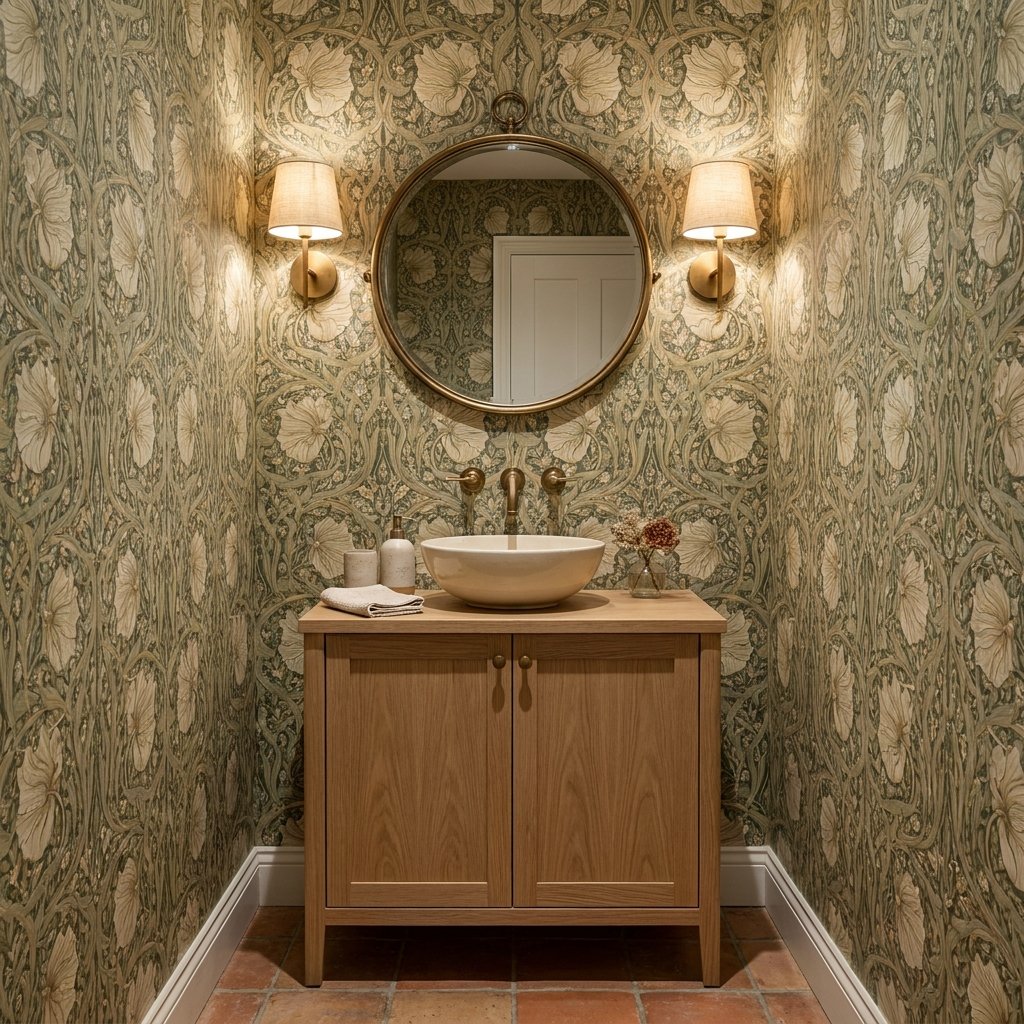
A powder room may be one of the smallest spaces in a home, but that doesn’t mean it has to be an afterthought.
In fact, its small footprint can make it the perfect room for trying decorating ideas you might hesitate to use in a larger space. A richer paint color, statement wallpaper, dramatic mirror, beautiful lighting, or contrasting vanity can completely transform a basic half bathroom.
For this powder room reveal, the goal is to create a space that feels finished, intentional, and welcoming without filling every available inch with decor.
The most successful small powder rooms balance style with function. You need comfortable clearance around the toilet and sink, flattering lighting, practical surfaces, and enough room for everyday necessities. Once those basics are handled, the decorative details can give the room personality.
Whether you’re planning a complete powder room makeover or simply looking for ideas to update a builder-grade half bath, these design strategies can help you create a small bathroom that feels much more special.
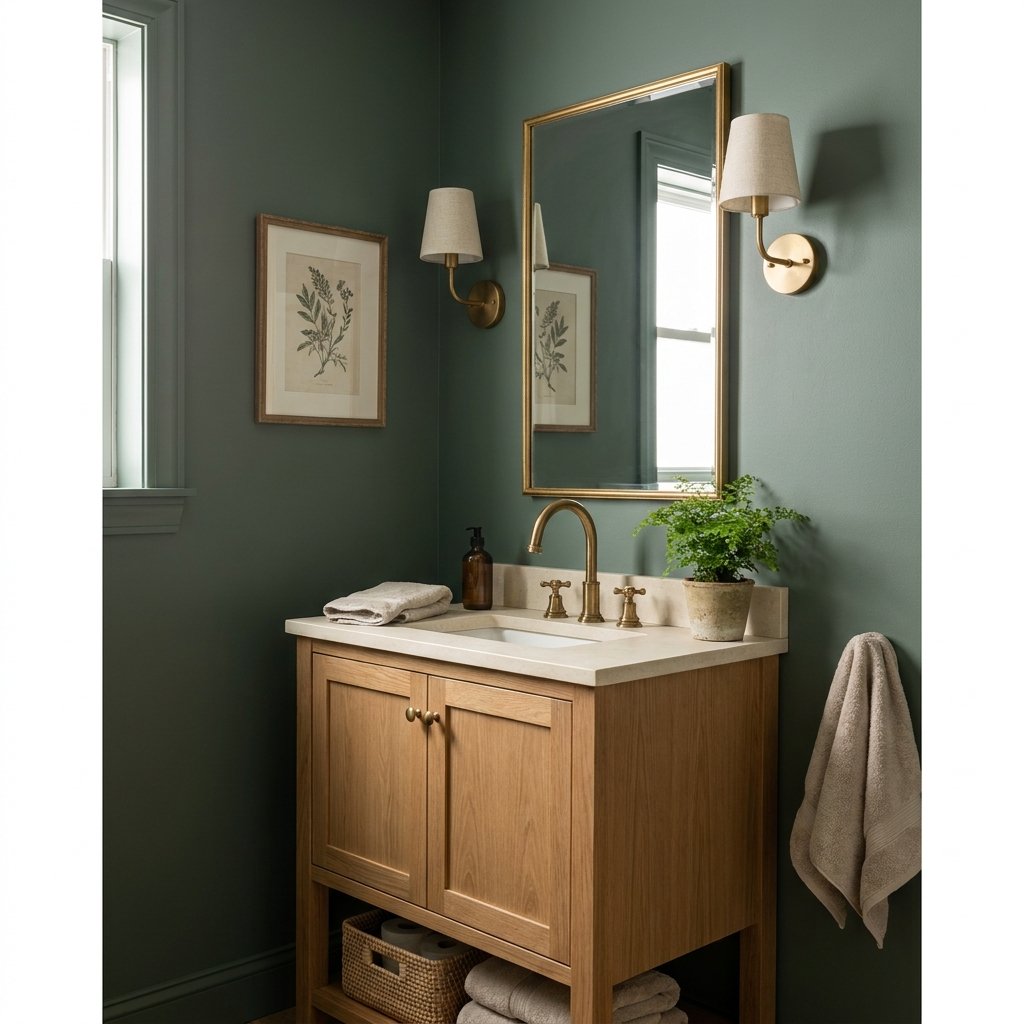
Why the Powder Room Is a Great Place to Take a Design Risk
Large rooms often require a significant investment to make a dramatic change.
A bold wallpaper in a living room might cover hundreds of square feet. A deep wall color could affect an entire open floor plan.
A powder room gives you a much smaller canvas.
That makes it a great place to experiment with:
- Dark paint
- Wallpaper
- Pattern
- Bold artwork
- Unusual mirrors
- Decorative lighting
- Rich cabinet colors
- Mixed materials
Because powder rooms are generally used for shorter periods, they can also handle a little more visual drama than spaces where you spend hours every day.
Start With a Powder Room Design Plan
Small doesn’t necessarily mean simple.
In fact, small rooms can be surprisingly difficult to design because everything sits close together.
Before choosing individual pieces, establish a basic palette.
For example:
Muted green + warm wood + cream + brass
or:
Deep blue + warm white + walnut + black
or:
Wallpaper + painted vanity + warm metal + natural wood
Having a palette prevents the room from becoming a collection of unrelated decorative ideas.
Create One Main Focal Point
A small powder room doesn’t need five competing statement pieces.
Choose one element to lead the room.
That might be:
- Wallpaper
- Vanity
- Mirror
- Wall color
- Tile
Then let the other elements support it.
If the wallpaper is highly patterned, you might choose a simple mirror.
If the vanity is a dramatic color, quieter walls may provide balance.
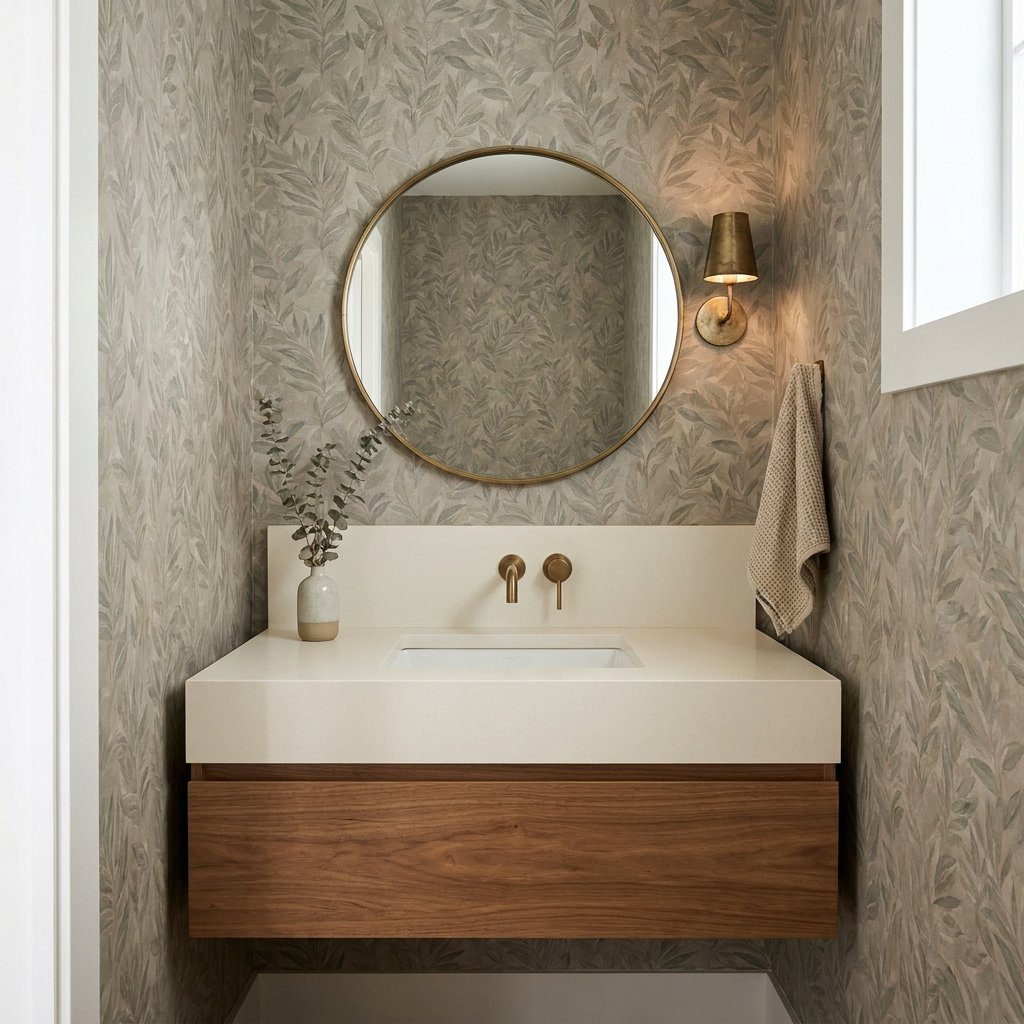
Choose a Wall Color With Personality
A powder room is an excellent place to move beyond safe neutrals.
Consider:
- Sage
- Olive
- Forest green
- Navy
- Burgundy
- Charcoal
- Mushroom
- Taupe
- Dusty blue
You can still use white or cream, of course.
But if the rest of your home is light and neutral, the powder room can be a fun opportunity to introduce contrast.
Don’t Be Afraid of Dark Paint
One of the most common decorating concerns is that dark paint will make a small bathroom look smaller.
It can make the boundaries of the room feel more pronounced, but that isn’t necessarily a problem.
A powder room doesn’t have to look enormous.
Sometimes embracing its small size creates a more interesting result.
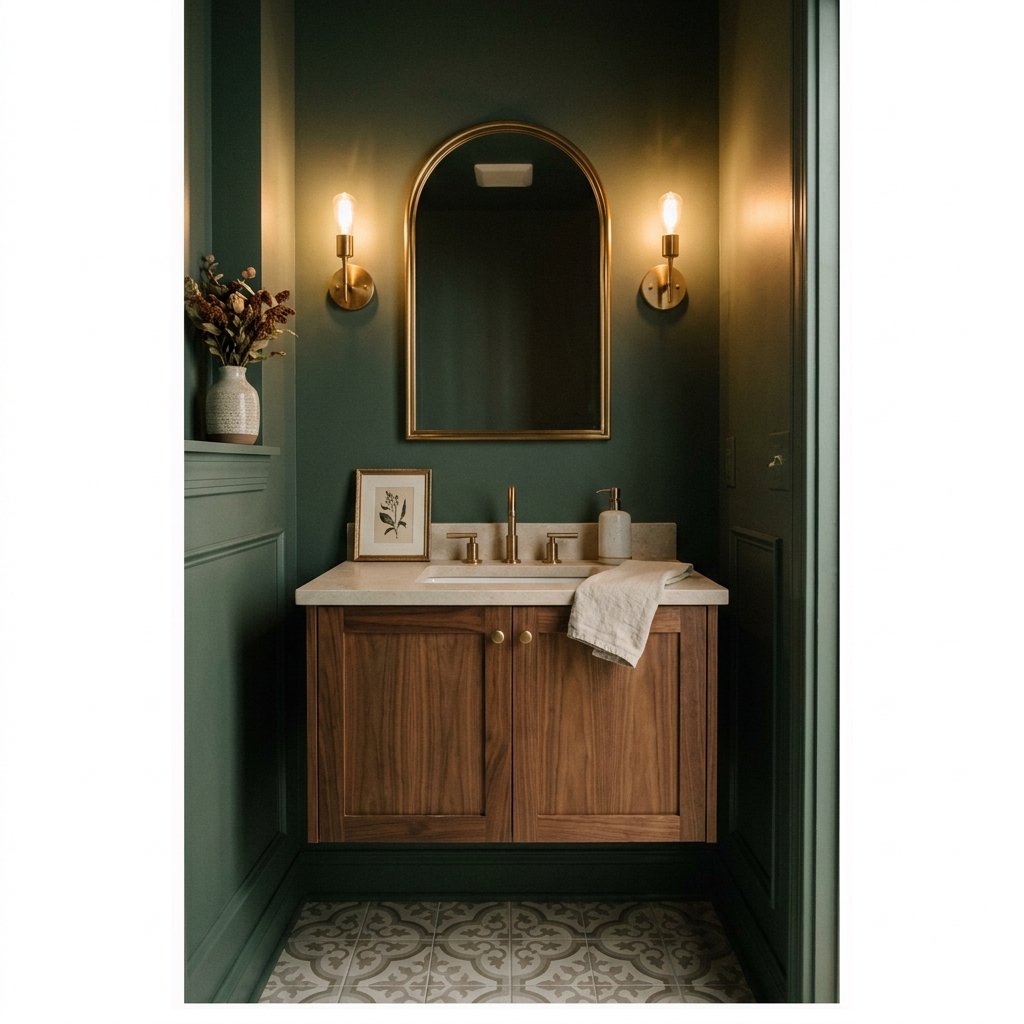
Deep green, charcoal, navy, or brown can make the room feel cozy and sophisticated.
Balance darker walls with:
- Good lighting
- Reflective mirror
- Light countertop
- Warm metal
- Lighter flooring where appropriate
Use Wallpaper for a Big Transformation
Wallpaper can turn an ordinary powder room into one of the most memorable rooms in the house.
Consider patterns such as:
- Botanical
- Floral
- Geometric
- Small-scale traditional
- Abstract
- Subtle texture
Scale matters.
A large pattern can be dramatic in a tiny room, while a smaller repeating pattern can create a more detailed, enveloping effect.
Neither is automatically better.
Order a sample and look at it on multiple walls before committing.
Wallpaper All Four Walls
You don’t necessarily need a single wallpaper accent wall.
Wrapping all four walls can make a small powder room feel intentional and immersive.
This works particularly well when the wallpaper is the main design feature.
Keep some of the other elements quieter so the pattern has room to breathe.
Consider Wallpaper Above Wall Molding
If full-wall wallpaper feels overwhelming, divide the room.
Use wallpaper above and a painted wall treatment below.
Possible lower-wall treatments include:
- Board and batten
- Beadboard
- Picture-frame molding
- Simple panel molding
This gives you pattern and architectural detail without covering every surface.
Make sure the wall treatment is appropriate for bathroom conditions and install it according to material and coating requirements.
Add Board and Batten
Board and batten can give a builder-grade powder room much more character.
It can also create a natural visual division for paint or wallpaper.
For example:
Wallpaper above + warm white board and batten below
or:
Cream walls above + deep green board and batten below
Before nailing or drilling into walls, identify potential plumbing and electrical lines and use installation methods appropriate for your wall construction.
Try Beadboard for a Classic Look
Beadboard is another beautiful option.
It can work in:
- Cottage bathrooms
- Coastal homes
- Traditional interiors
- Farmhouse spaces
Pair it with wallpaper or simple painted walls.
Choose materials and coatings appropriate for the bathroom environment and follow manufacturer installation instructions.
Upgrade the Vanity
The vanity is often the largest piece of furniture in a powder room.
That makes it an obvious place to create impact.
Options include:
- Painted vanity
- Natural wood vanity
- Floating vanity
- Furniture-style vanity
If you’re replacing the vanity, don’t choose based only on appearance.
Confirm:
- Width
- Depth
- Door clearance
- Plumbing location
- Sink configuration
- Faucet compatibility
A vanity that’s slightly too deep can make a tiny room uncomfortable.
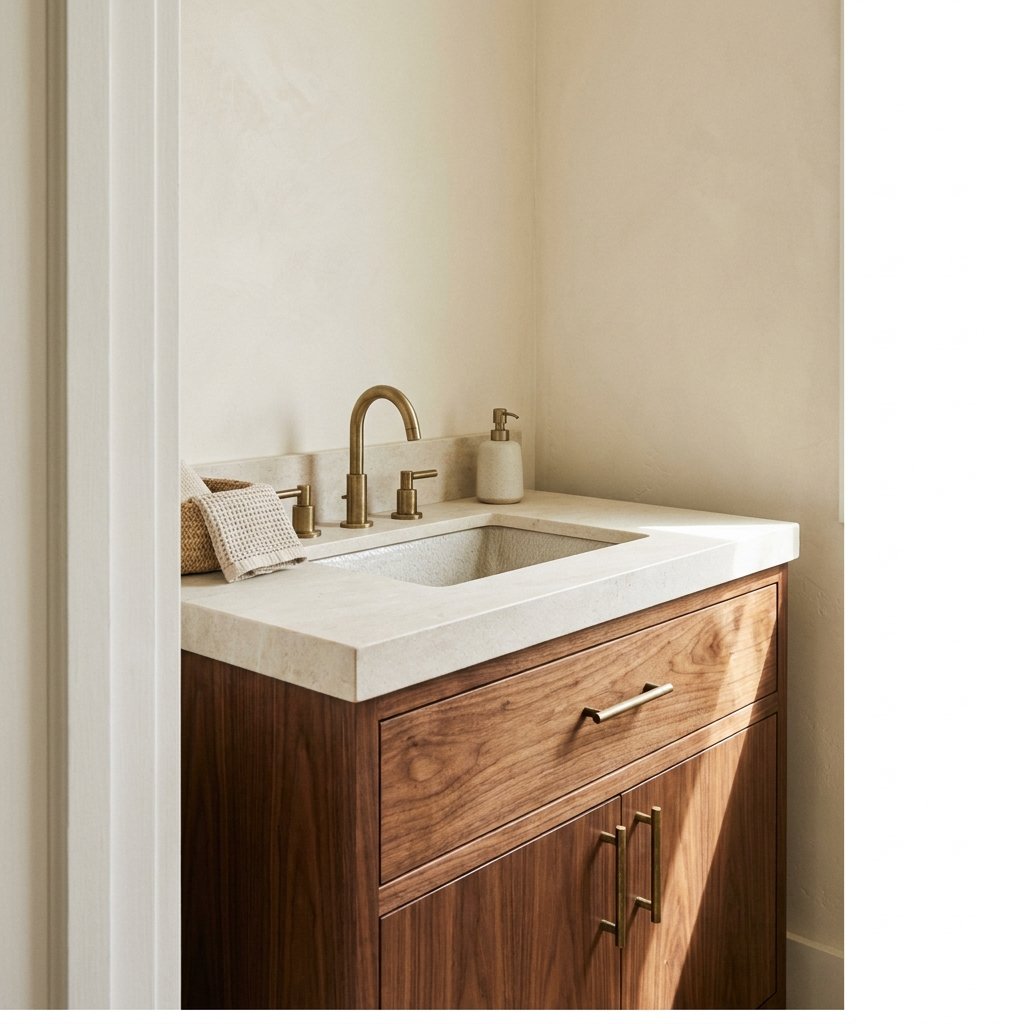
Paint an Existing Vanity
If the vanity is functional but dated, paint may be enough to transform it.
Possible colors include:
- Deep green
- Sage
- Navy
- Black
- Taupe
- Mushroom
- Burgundy
Proper preparation matters.
The exact process depends on the cabinet material and existing finish, but it may involve cleaning, degreasing, sanding or deglossing where appropriate, priming, and applying a cabinet-suitable coating.
Follow the coating manufacturer’s preparation, ventilation, application, drying, and curing instructions.
Add a Natural Wood Vanity
Wood brings warmth into a small bathroom filled with hard surfaces.
A wood vanity can balance:
- Painted walls
- Wallpaper
- Tile
- Stone
- Metal
It doesn’t need to match other wood in the home exactly.
Coordinating wood tones can look more layered than trying to create a perfect match.
Consider a Floating Vanity
A floating vanity exposes more flooring, which can create a visually lighter appearance.
It also brings a clean, modern feel.
But floating vanities need proper structural support.
Follow the manufacturer’s mounting instructions and make sure the wall structure can support the vanity and expected load.
Professional installation may be appropriate.
Choose a Statement Mirror
The mirror is another opportunity to give the powder room personality.
Consider:
- Round mirror
- Arched mirror
- Rectangular mirror
- Curved decorative shape
- Vintage-inspired mirror
Finish options might include:
- Brass
- Black
- Wood
- Bronze
Choose a mirror scaled to the vanity and available wall space.
An undersized mirror can make the entire vanity area feel unfinished.
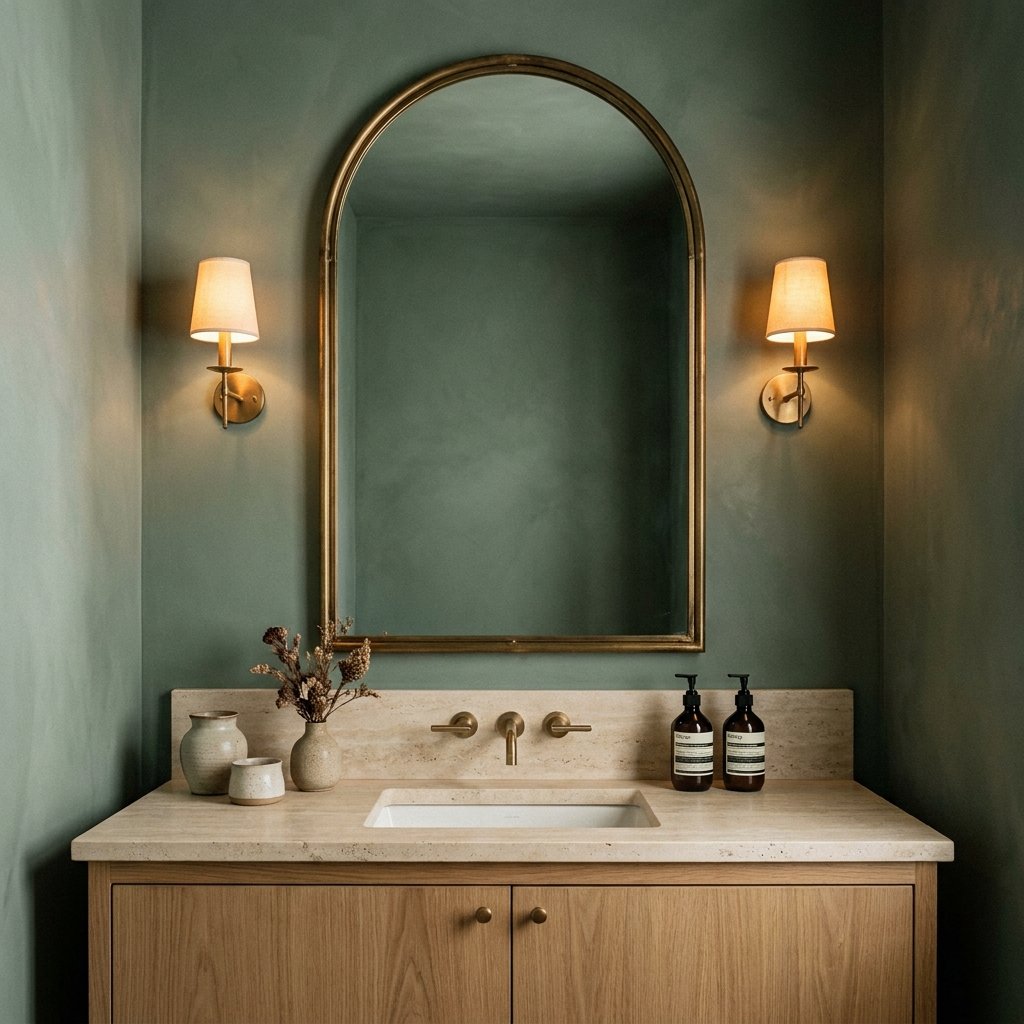
Use an Arched Mirror
An arched mirror is particularly useful when the bathroom contains many straight lines.
The curve softens:
- Rectangular vanity
- Door
- Tile
- Wall molding
Pair it with simple sconces for a clean focal point.
Upgrade the Lighting
Builder-grade lighting can make an otherwise beautiful powder room feel unfinished.
Consider:
- Single decorative sconce
- Pair of sconces
- Vanity light
- Pendant where appropriate
- Ceiling fixture combined with vanity lighting
Think about both appearance and function.
The mirror area needs useful light.
Electrical fixtures must be installed according to applicable requirements and manufacturer instructions. Use a qualified electrician when appropriate.
Put Sconces Beside the Mirror
Sconces on both sides of a mirror can create attractive symmetry and provide light from more than one direction.
However, not every powder room has enough wall space.
If space is tight, a fixture above the mirror may be more practical.
Plan the mirror and lighting together rather than buying each independently.
Upgrade the Faucet
A faucet can act almost like jewelry for the vanity.
Possible finishes include:
- Brass
- Polished nickel
- Chrome
- Black
- Bronze
Make sure the faucet is compatible with the sink and countertop configuration.
If plumbing modifications are necessary, follow local requirements and use qualified help where appropriate.
Replace Basic Cabinet Hardware
Hardware is one of the easiest details to change.
A basic vanity can look much more intentional with new:
- Knobs
- Pulls
- Handles
If you’re replacing existing hardware, measuring the current hole spacing may allow you to avoid drilling new holes.
Repeat the hardware finish somewhere else in the room for cohesion.
Mix Metals Carefully
You don’t need every finish to match exactly.
For example, a powder room might combine:
Brass faucet + brass mirror + black light fixture
or:
Polished nickel faucet + brass mirror + brass hardware
The easiest way to make mixed metals feel deliberate is to repeat the primary finish.
Avoid introducing a different metal on every single item.
Add an Interesting Floor
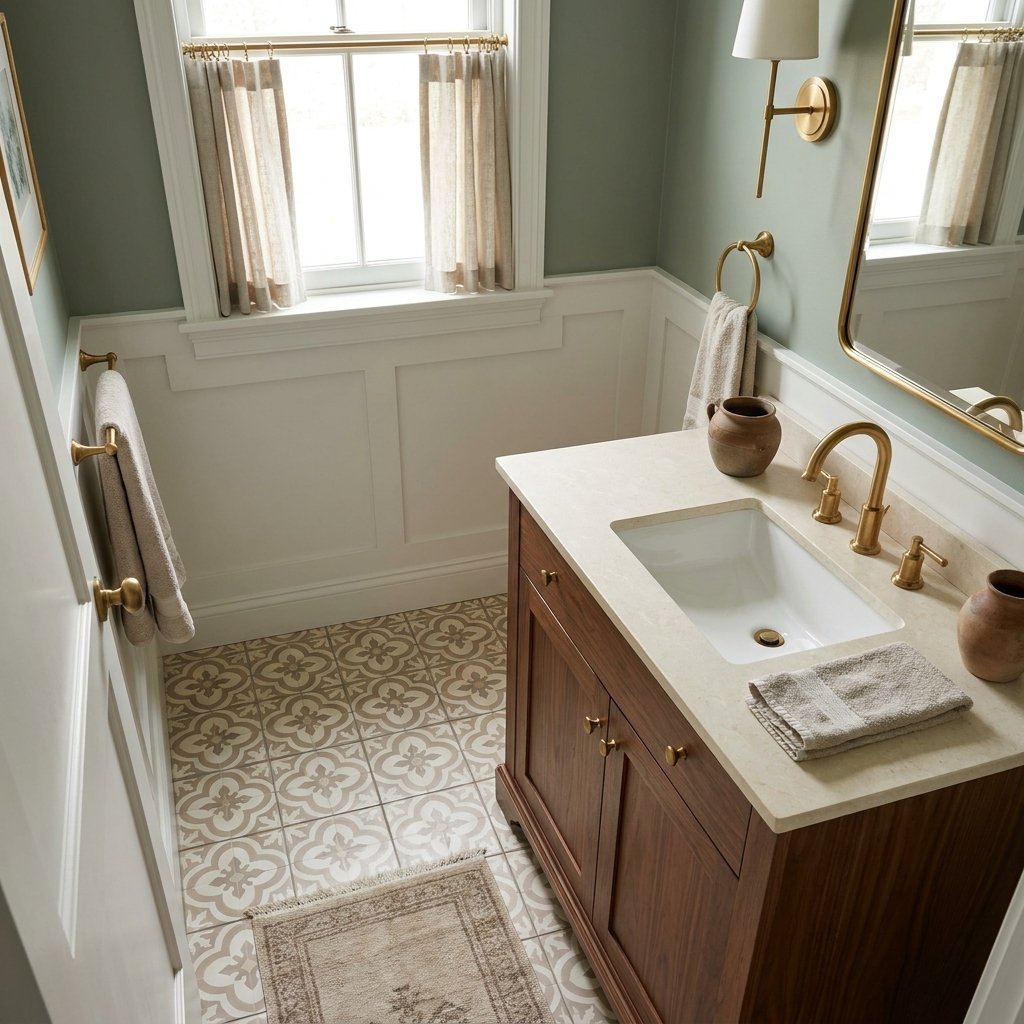
Because a powder room has a small footprint, the floor can become an important design feature.
Consider:
- Patterned tile
- Checkerboard
- Stone-look tile
- Wood-look tile
- Simple neutral tile
Flooring needs to be appropriate for the room and installed according to product and substrate requirements.
If you’re changing flooring around a toilet or vanity, plan removal and reinstallation carefully.
Keep the Countertop Simple
A small vanity doesn’t need a highly dramatic countertop.
A quieter surface can allow the walls, mirror, or vanity color to lead.
Consider materials with:
- Subtle veining
- Warm neutral color
- Minimal pattern
The exact countertop should be appropriate for bathroom use and compatible with the sink and faucet.
Add a Small Piece of Art
Artwork can make a powder room feel like a decorated room rather than simply a utility space.
Try:
- Vintage landscape
- Botanical print
- Abstract artwork
- Small framed photograph
One appropriately scaled piece may be enough.
If you have wallpaper, choose artwork that doesn’t compete heavily with the pattern.
Add a Vintage Detail
One vintage-inspired element can keep a new bathroom from feeling overly showroom-like.
Try:
- Small framed art
- Antique-style mirror
- Brass accessory
- Vintage rug
- Decorative dish
You don’t need to turn the entire powder room into a period room.
One old or old-looking piece can provide contrast with newer fixtures.
Use a Small Rug
A small rug adds softness and color.
Look for a size that doesn’t interfere with:
- Door swing
- Toilet
- Vanity
- Floor vent
In a high-use bathroom, choose something practical to clean.
Avoid creating a tripping hazard with a thick or poorly secured rug.
Add a Pretty Hand Towel
This is one of the easiest finishing details.
Choose a hand towel that connects to the room’s palette.
Try:
- Cream
- Sage
- Taupe
- Muted stripe
- Small pattern
Keep a practical backup nearby if the powder room receives frequent guests.
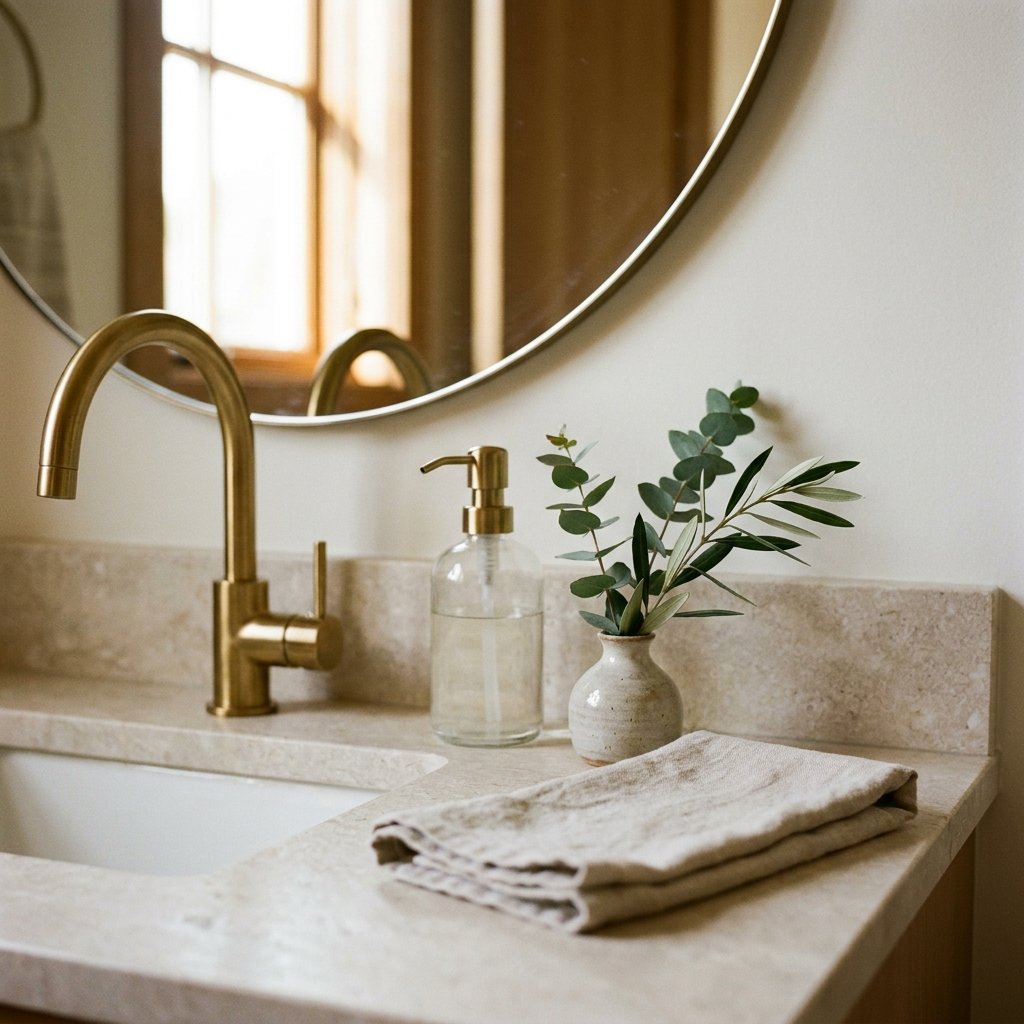
Keep Countertop Decor Minimal
Tiny powder room counters fill up quickly.
You usually don’t need much more than:
- Hand soap
- Small tray
- Tiny vase or decorative object
Leave enough clear space for guests to actually use the sink.
Add Greenery
A small plant or simple branch can soften all the hard surfaces.
If the room receives little or no natural light, choose a plant appropriate for those conditions or use a realistic faux stem.
A small vase beside the sink may be all you need.
Don’t Forget Practical Storage
Even a beautiful powder room needs somewhere to keep necessities.
Possible storage areas include:
- Vanity drawers
- Vanity cabinet
- Basket
- Small wall cabinet
- Decorative box
Store extra toilet paper where guests can easily find it.
There’s nothing luxurious about making someone search through your house for another roll.
Use a Basket for Extra Toilet Paper
If the vanity doesn’t have storage, a small basket can be both decorative and practical.
Choose a size that fits comfortably without crowding the floor.
Natural woven texture works particularly well in rooms with painted walls and metal fixtures.
Create Contrast
Contrast keeps a small room from feeling flat.
That could mean:
- Dark walls + light vanity
- Light walls + dark vanity
- Wallpaper + simple wood
- Green walls + brass
- White walls + black mirror
You don’t need extreme contrast.
Even subtle differences in color, material, and texture can create depth.
Repeat Each Important Element
A cohesive powder room usually repeats key details.
If you use brass on the faucet, repeat it in the mirror or hardware.
If the walls are sage, repeat green subtly in artwork or a hand towel.
If you use natural wood on the vanity, add a small wood frame or woven basket.
Repetition connects the room.
How to Make a Powder Room Look Expensive
You don’t need the most expensive materials.
Focus on the things people notice most:
- Wall treatment
- Vanity
- Mirror
- Lighting
- Faucet
- Hardware
Then keep the styling simple.
A powder room with a beautiful wall color, correctly scaled mirror, attractive light, and clean vanity often looks more polished than one filled with decorative accessories.
Budget Powder Room Makeover Ideas
If a complete remodel isn’t possible, prioritize cosmetic changes.
Try:
- Paint walls
- Paint vanity
- Replace mirror
- Replace hardware
- Add new light fixture
- Add artwork
- Upgrade hand towels
Even completing three of those changes can significantly alter the room.
Powder Room Ideas Without Remodeling
You can create a dramatic update without changing plumbing or flooring.
For example:
Before: light neutral walls + basic vanity + plain mirror
After: deep green walls + painted vanity + arched mirror + new hardware + artwork
The room can look completely different even though the sink, toilet, and floor remain in their original locations.
Common Powder Room Decorating Mistakes
Buying an Oversized Vanity
Small differences in depth matter in a tiny room.
Using a Mirror That’s Too Small
Scale it appropriately to the vanity and wall.
Making Everything a Statement
Choose a focal point.
Assuming Small Rooms Must Be White
Dark and colorful walls can be beautiful.
Ignoring Lighting
A powder room needs both atmosphere and functional light.
Overdecorating the Counter
Leave usable space.
Forgetting Storage
Guests need easy access to essentials.
Choosing Materials Only for Appearance
Bathroom surfaces and finishes need to suit the environment.
Drilling Without Checking the Wall
Plumbing and electrical lines may be hidden behind bathroom walls.
Rushing Paint or Cabinet Finishes
Follow recommended preparation, drying, and curing times.
FAQ About Powder Room Makeovers
What is a powder room?
A powder room is generally a small bathroom containing a toilet and sink without a bathtub or shower. It’s also commonly called a half bath.
What colors are best for a powder room?
Warm white, taupe, mushroom, sage, olive, navy, forest green, burgundy, charcoal, and many other colors can work. The best choice depends on the room’s lighting and fixed finishes.
Should a small powder room be painted a light color?
Not necessarily. Light colors can create an airy look, but deep colors can make a powder room feel dramatic and intentionally cozy.
Is wallpaper good for a powder room?
Wallpaper can create a strong focal point in a small bathroom. Choose a product appropriate for the room’s conditions and follow the manufacturer’s preparation and installation guidance.
Should I wallpaper all the powder room walls?
You can. Wrapping all four walls can create a cohesive, immersive look. Another option is wallpaper above beadboard or wall molding.
How do you make a powder room look expensive?
Focus on wall treatment, mirror scale, lighting, vanity, faucet, and hardware. A few carefully selected finishes generally have more impact than lots of small accessories.
What kind of mirror should I use in a powder room?
Round, arched, rectangular, and decorative mirrors can all work. Choose a shape and size that coordinate with the vanity and available wall space.
How can I update a powder room cheaply?
Paint the walls or vanity, replace the mirror and hardware, add artwork, update towels, and simplify the countertop. You don’t necessarily need to change plumbing or flooring.
Can you use dark colors in a tiny powder room?
Yes. Dark green, navy, charcoal, brown, and other deep colors can create a dramatic, sophisticated effect when paired thoughtfully with lighting and other finishes.
Final Thoughts
A powder room reveal doesn’t need to involve a massive renovation to be dramatic.
Because the room is small, a few thoughtful changes can completely transform it.
Start with one focal point.
That might be a rich wall color, beautiful wallpaper, warm wood vanity, patterned floor, or statement mirror.
Then build around it.
Repeat finishes, create contrast, improve the lighting, and keep the countertop styling simple.
Most importantly, don’t feel like a small bathroom has to play it safe.
The powder room is one of the best places in your home to experiment with color, pattern, and personality.
A deep green wall, botanical wallpaper, arched brass mirror, painted vanity, or unexpected floor might feel like too much for a large room—but in a powder room, it can be exactly what makes the space special.
Give the practical details as much attention as the decorative ones, and you’ll end up with a powder room that doesn’t just photograph beautifully.
It will actually work beautifully too.