

The laundry room floor has to work harder than flooring in many other areas of the home.
It deals with dirty shoes, laundry baskets, detergent spills, water drips, pet traffic in some homes, and the weight and vibration of a washer and dryer. If a hose leaks or a washing machine overflows, the floor may also be one of the first surfaces affected.
But practical does not have to mean boring.
The laundry room floor can add color, pattern, warmth, and character to a room that is often overlooked when decorating. A beautiful floor can even become the design feature that turns a basic utility space into a room you actually enjoy seeing.
The key is choosing a flooring product that works for your specific space.
A main-floor laundry room may have different needs from a basement laundry area. A room with a floor drain requires different planning than one without one. Existing subfloor conditions, appliance installation, moisture exposure, transitions, maintenance, and budget all matter.
Below are 15 laundry room flooring ideas, along with practical tips for choosing a material, coordinating it with cabinets, and avoiding common flooring mistakes.
1. Choose Classic Porcelain Tile
Porcelain tile is a popular choice for laundry rooms because many products are suitable for floors and moisture-prone spaces.
It also gives you plenty of design options.
You can find porcelain tile that resembles:
- Natural stone
- Marble
- Concrete
- Wood
- Handmade tile
For a laundry room, check the specifications for the exact tile rather than assuming every porcelain product is equally suitable.
Pay attention to floor suitability, slip characteristics, maintenance requirements, and installation recommendations.
2. Try Black-and-White Flooring
Black and white can turn the floor into the room’s main feature.
Consider:
- Checkerboard
- Geometric tile
- Small mosaic
- Patterned tile
Black-and-white flooring pairs especially well with white, cream, gray, wood, blue, or green cabinetry.
If the floor is bold, keep some of the other surfaces simple.
You probably do not need a busy backsplash, dramatic wallpaper, and statement flooring competing in the same small laundry room.
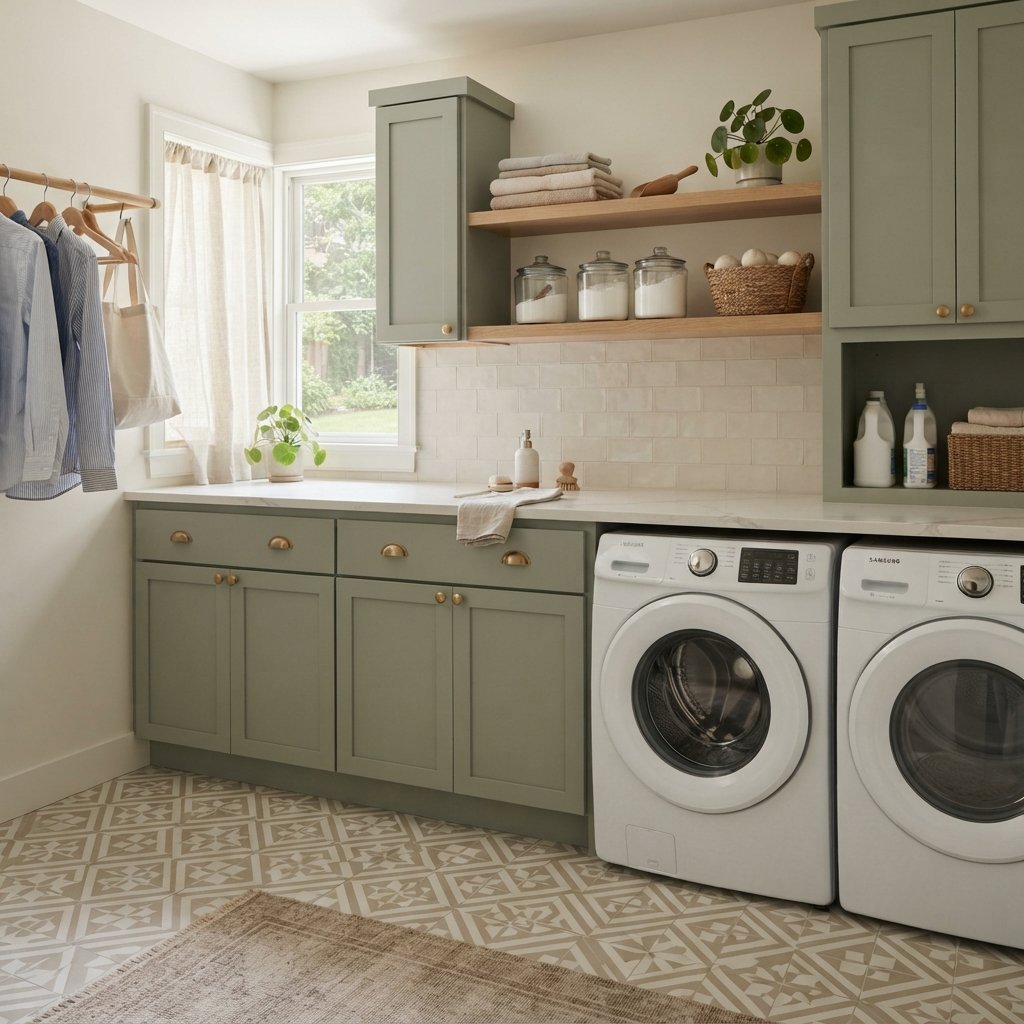
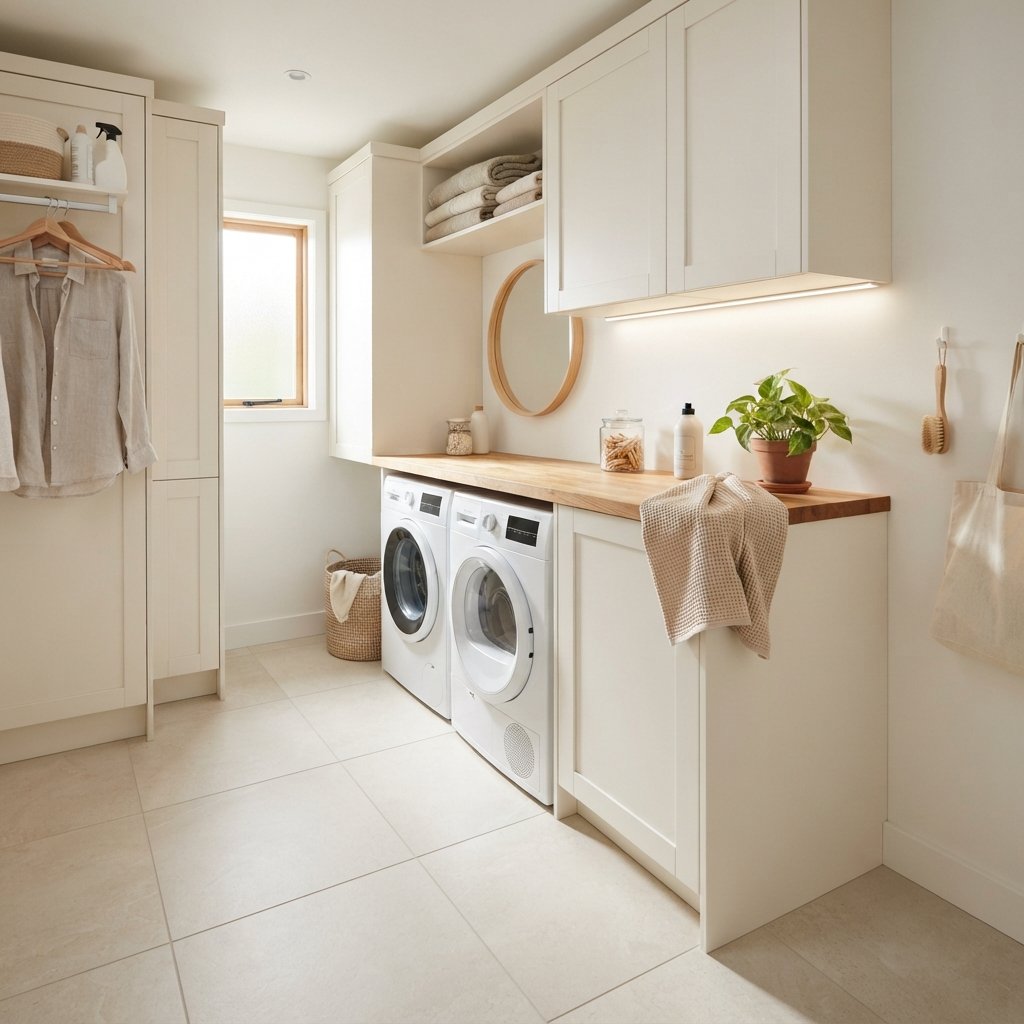
3. Warm Up the Room With Beige Tile
A laundry room does not have to be cool gray and white.
Warm beige or limestone-look tile can create a softer appearance.
Pair it with:
- Cream cabinets
- Warm white walls
- Natural oak
- Brass
- Black accents
A quiet beige floor is also a useful choice when you want cabinetry, wallpaper, or a backsplash to be the room’s focal point.
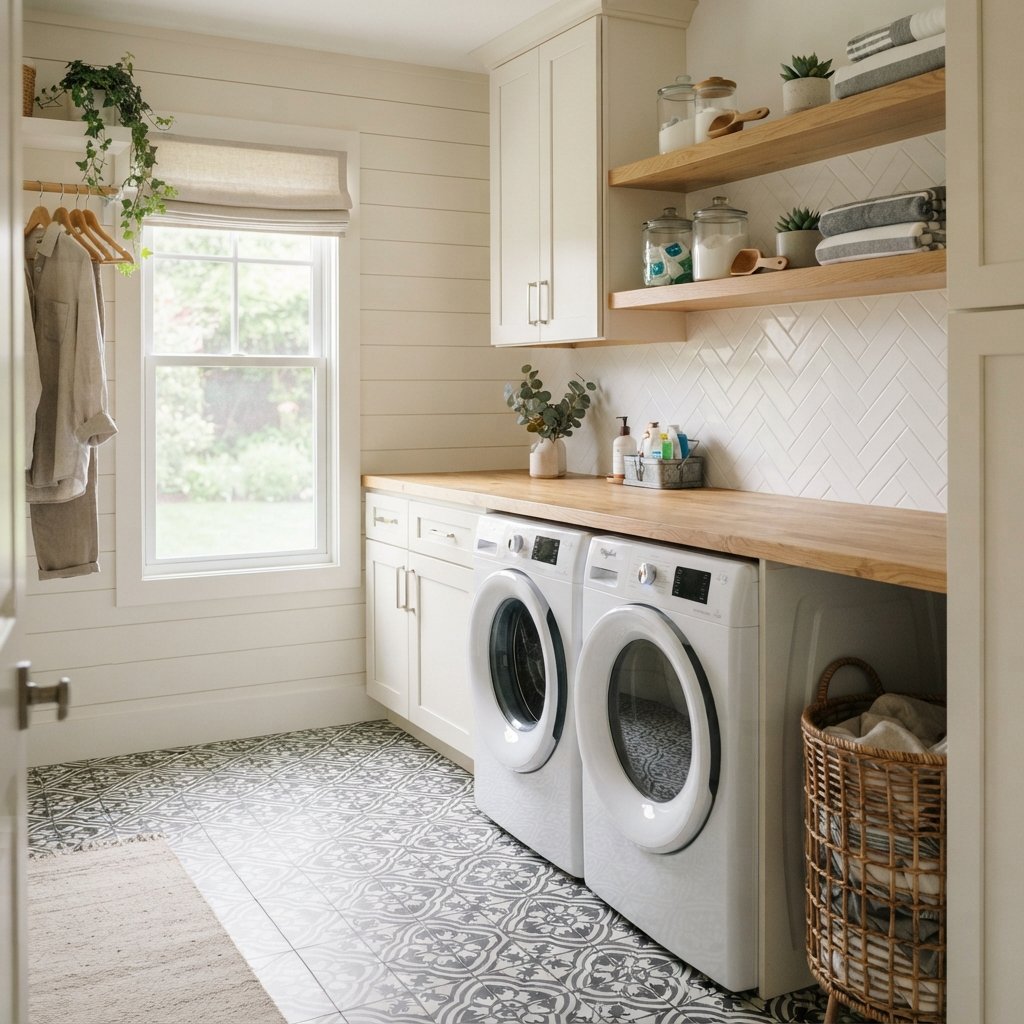
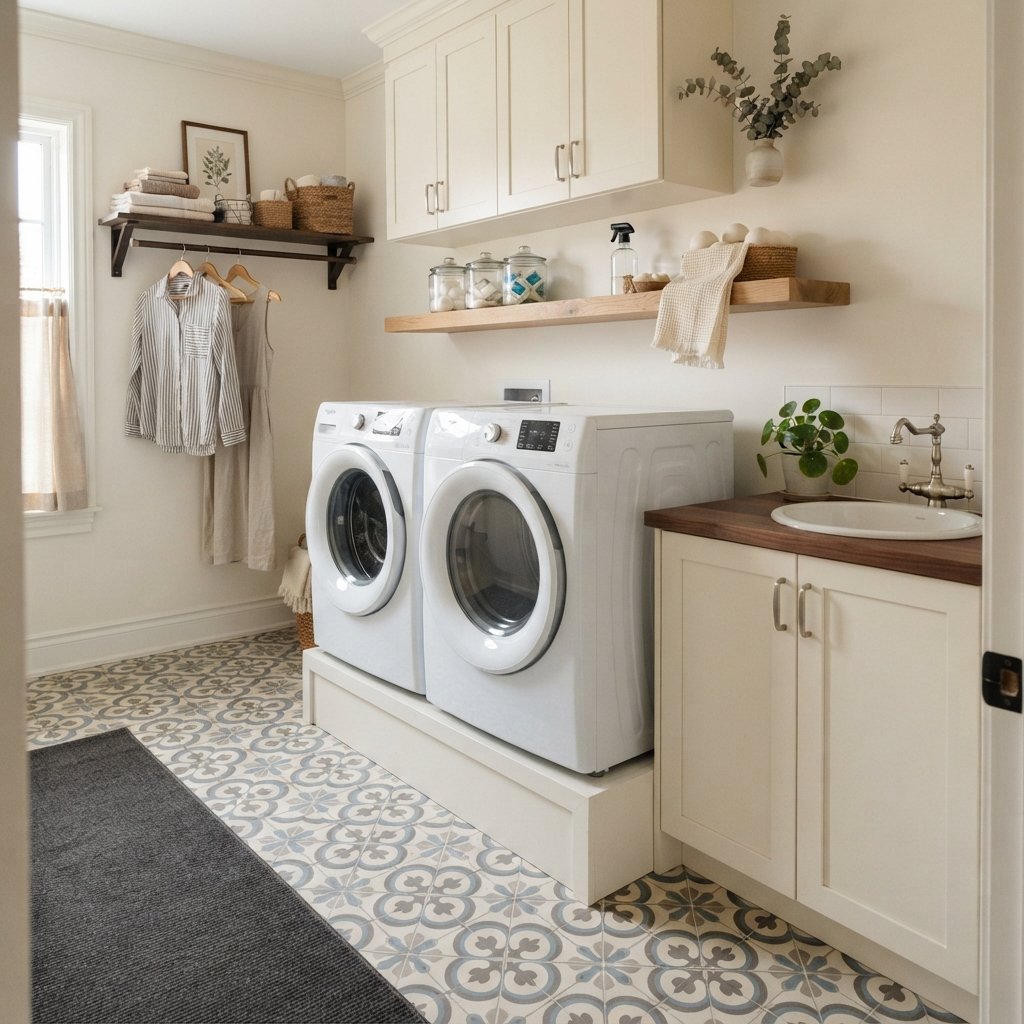
4. Add Character With Patterned Tile
A laundry room is a great place to experiment with pattern.
Because the room is often smaller than a kitchen or living area, a patterned floor can make a strong impact without covering a huge area.
Look at:
- Geometric patterns
- Vintage-inspired designs
- Floral motifs
- Mediterranean-inspired patterns
Before committing, lay out several tiles together.
A single tile sample does not always reveal how busy the repeated pattern will feel across the entire floor.
5. Use a Low-Contrast Pattern
Pattern does not have to mean bold black and white.
For a softer look, try:
- Cream + beige
- White + greige
- Pale gray + white
- Taupe + cream
Low-contrast patterned floors can add movement while keeping the laundry room calm.
This is especially useful if you already have colorful cabinets.
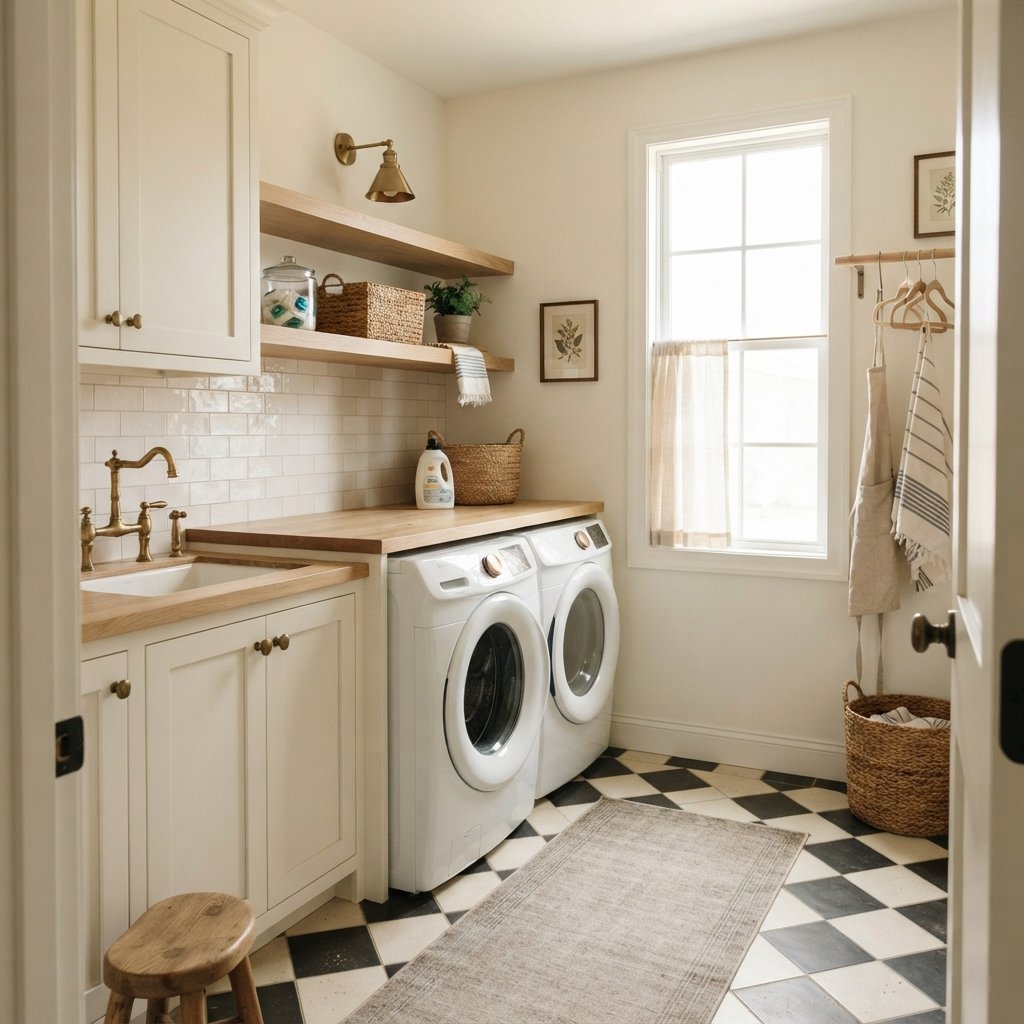
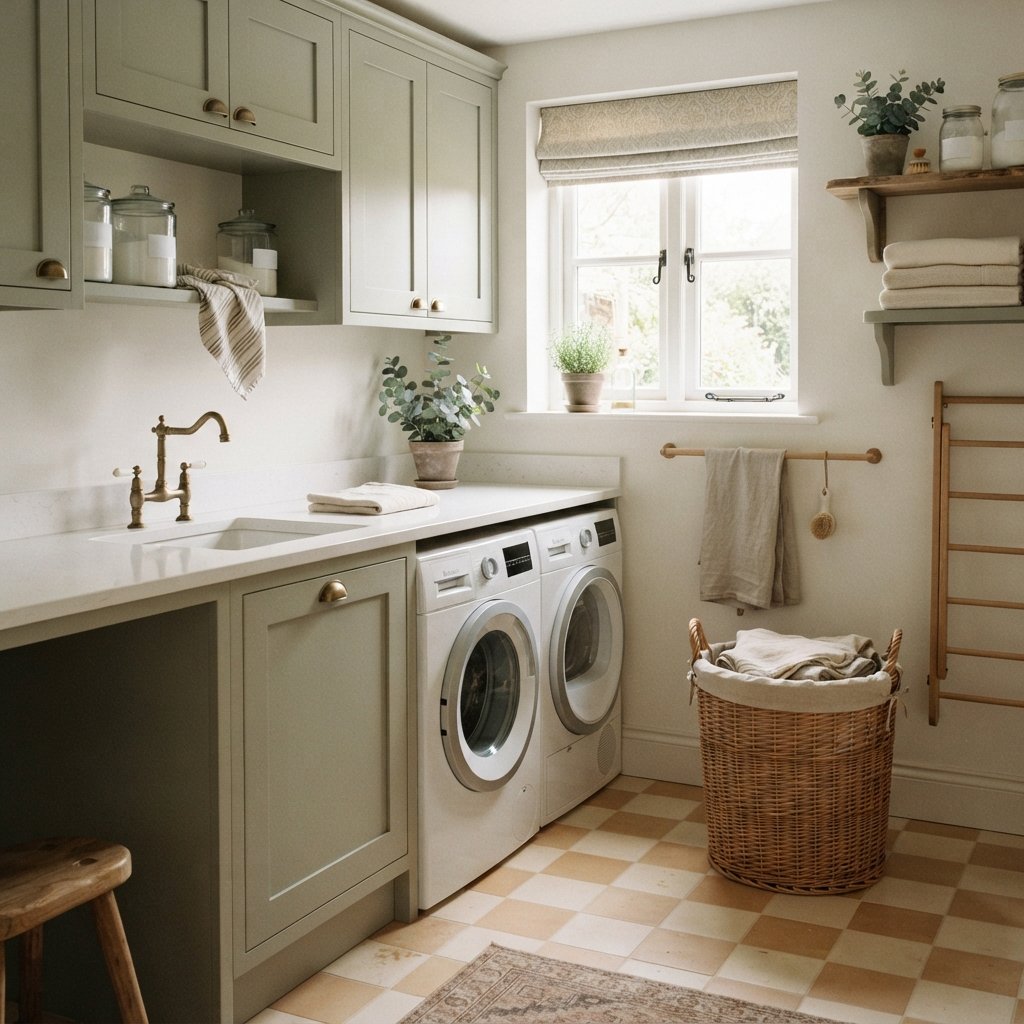
6. Consider a Checkerboard Floor
Checkerboard flooring can work in traditional, farmhouse-inspired, cottage, vintage, and modern laundry rooms.
You are not limited to black and white.
Try:
- Cream + taupe
- Beige + white
- Charcoal + gray
- Terracotta + cream
- Muted green + ivory
Tile size changes the look dramatically.
Large checks feel graphic and bold, while smaller checks can feel more traditional.
Mock up the scale before installation.
7. Try Slate-Look Flooring
Dark slate-look flooring can ground a light laundry room.
It works especially well with:
- White cabinets
- Natural wood
- Cream walls
- Black hardware
A darker floor may also be visually forgiving of certain everyday marks, although maintenance varies by material and finish.
If you like natural slate, research its specific sealing and maintenance requirements.
A porcelain slate-look product may provide a similar appearance with different maintenance characteristics.
8. Use Wood-Look Tile
Wood tones can make a laundry room feel warmer and more connected to surrounding living spaces.
Wood-look porcelain tile is one way to get the appearance of planks using a tile product designed for appropriate flooring applications.
Choose a tone that coordinates with nearby wood floors rather than trying to match them poorly.
For example, a medium warm oak floor in the hallway may coordinate nicely with a slightly lighter oak-look tile in the laundry room.
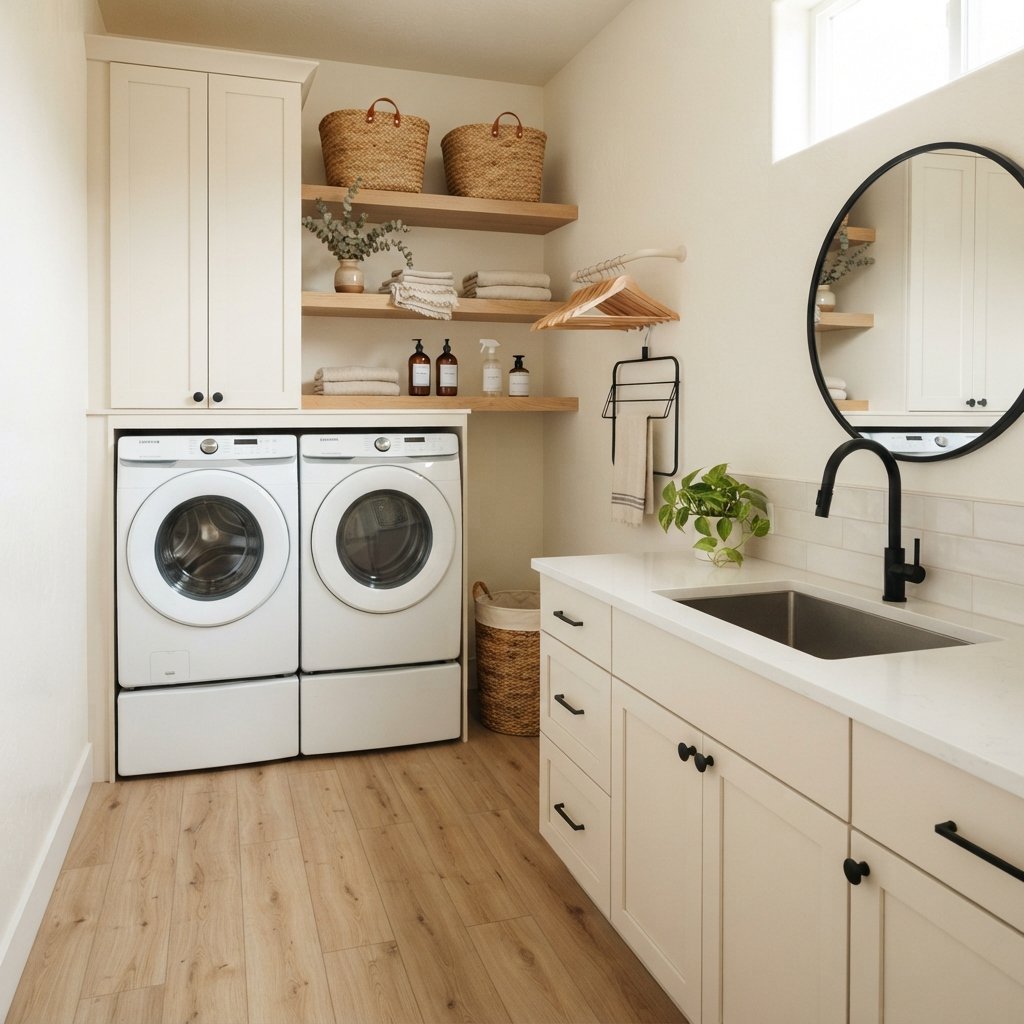
9. Consider Luxury Vinyl Flooring
Certain luxury vinyl flooring products can be practical options for laundry spaces.
They can offer:
- Wood-look designs
- Stone-look designs
- Comfortable feel underfoot
- Relatively straightforward maintenance
However, terms such as “waterproof” can be misleading if interpreted to mean the entire room is protected from water damage.
Water can still travel around edges, underneath flooring, into the subfloor, or into adjacent walls.
Use a product approved by its manufacturer for your particular laundry-room installation and follow all requirements for the substrate, perimeter, transitions, appliances, and moisture conditions.
10. Try Sheet Vinyl for a Practical Floor
Sheet vinyl can be worth considering, particularly when practicality and budget are priorities.
Because it can have fewer seams than some other resilient flooring installations, it may provide a relatively continuous surface.
Modern options are available in designs that resemble:
- Stone
- Tile
- Geometric patterns
- Wood
Installation requirements vary, and subfloor imperfections may telegraph through some products.
Follow the flooring manufacturer’s requirements carefully.
11. Use Simple Large-Format Tile
Not every laundry room needs a statement floor.
Large-format tile in a quiet neutral can create a clean, uncluttered appearance.
Try:
- Pale greige
- Warm gray
- Cream
- Beige
- Concrete look
Fewer grout joints can create a calmer visual surface.
However, large-format tile requires suitable substrate preparation and a carefully planned layout.
The room may be small, but installation quality still matters.
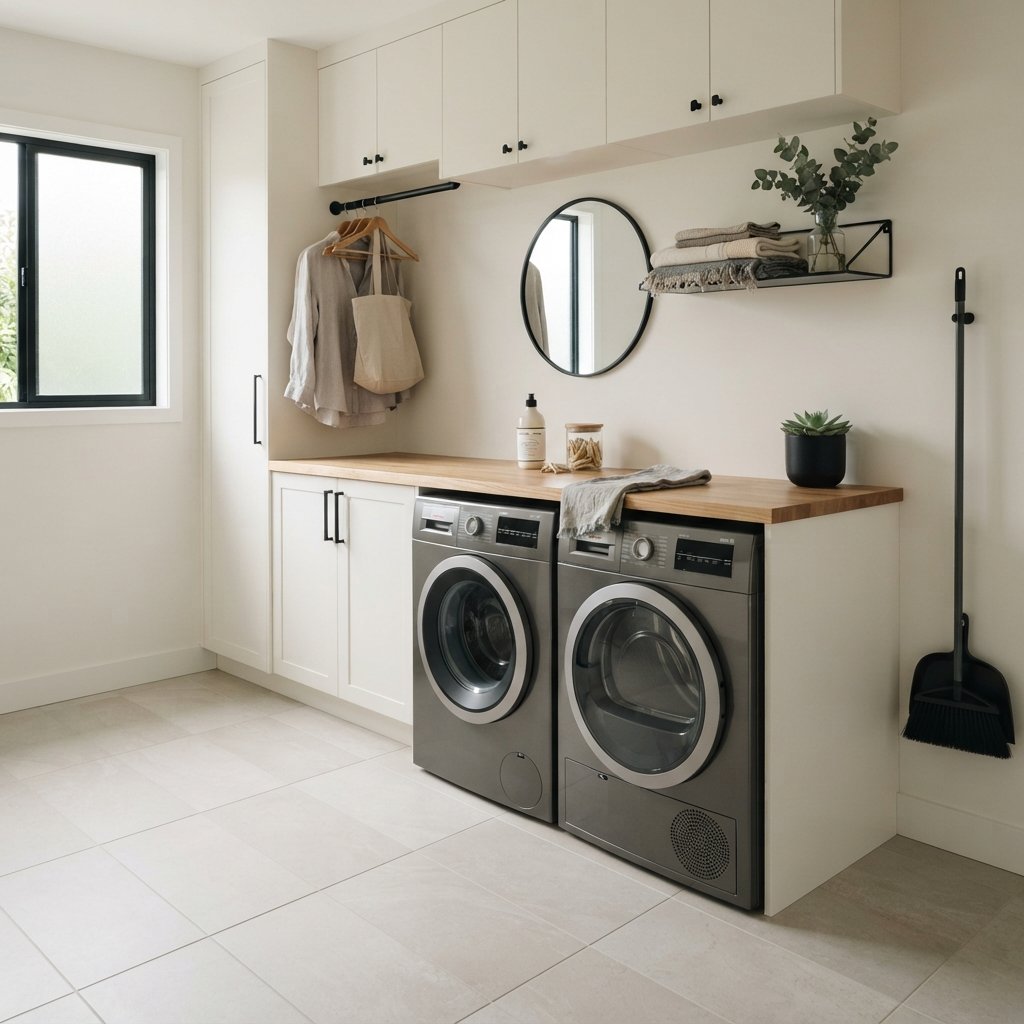
12. Go Dark With Charcoal Flooring
Dark flooring can look sophisticated in a laundry room.
Charcoal works beautifully with:
- White cabinets
- Sage cabinets
- Light wood
- Cream walls
The contrast can make lighter cabinetry stand out.
If the laundry room has little natural light, make sure the walls, lighting, and other finishes prevent the space from feeling unnecessarily gloomy.
13. Try Small Mosaic Tile
Small mosaic tile can add texture and vintage character.
Hexagons and other geometric mosaics work particularly well in older-home-inspired designs.
Keep in mind that smaller tiles mean more grout.
That can influence:
- Appearance
- Cleaning
- Maintenance
- Installation time
Choose grout and tile suitable for a floor application and follow the manufacturer’s care recommendations.
14. Coordinate the Laundry Floor With Adjacent Rooms
The laundry room does not exist in isolation.
If it opens from a:
- Kitchen
- Mudroom
- Hallway
- Bathroom
- Garage entry
look at the flooring transition from both sides.
The floors do not have to match.
But coordinating undertones can help the rooms feel connected.
For example, warm oak flooring outside the laundry room can transition naturally to beige, cream, warm gray, or oak-look tile inside.
15. Let the Floor Be the Room’s Focal Point
If you love a bold tile, build the rest of the room around it.
Start with the floor.
Then pull one or two colors from it for the:
- Cabinets
- Walls
- Hardware
- Accessories
Keep the remaining surfaces relatively quiet.
This makes the patterned flooring look intentional instead of overwhelming.
What Is a Good Flooring Material for a Laundry Room?
There is no single flooring material that is right for every laundry room.
Options may include appropriately selected:
- Porcelain tile
- Ceramic tile
- Luxury vinyl
- Sheet vinyl
- Natural stone
- Other flooring systems approved for the location
The right choice depends on the room’s construction, moisture exposure, existing subfloor, appliance setup, budget, and desired maintenance.
Check the exact product specifications rather than choosing based only on the material category.
Tile for a Laundry Room Floor
Tile can be a strong option when installed correctly.
It is available in countless colors and styles and can create a durable surface.
But tile installation depends on the substrate.
Excessive movement, poor preparation, or unsuitable underlayment can lead to cracked tile or grout.
The floor needs to meet the requirements of the chosen tile and installation system.
Laundry rooms may also be exposed to water, so waterproofing and water-management details should be considered based on the room and local requirements.
Vinyl for a Laundry Room Floor
Vinyl flooring is often attractive for laundry rooms because it can be affordable and available in many designs.
However, not all vinyl products have identical installation or moisture requirements.
Read the manufacturer’s instructions regarding:
- Subfloor preparation
- Moisture
- Perimeter gaps
- Seams
- Transitions
- Appliance installation
Do not assume a “waterproof” plank floor creates a waterproof room.
Can You Use Laminate in a Laundry Room?
Some laminate products may be approved for certain moisture-prone spaces, while others may not be suitable.
This is a product-specific decision.
If considering laminate, check the manufacturer’s documentation for laundry-room installation, water exposure, edge treatment, and warranty requirements.
If the product is not approved for the conditions in your laundry room, choose another material.
Can You Use Hardwood in a Laundry Room?
Real wood can be more sensitive to moisture than some alternatives.
Whether it is appropriate depends on the product, installation, environmental conditions, and manufacturer requirements.
If you want the warmth of wood without using hardwood, a bathroom- or laundry-room-suitable wood-look tile or resilient product may be worth considering.
Best Laundry Room Flooring for a Basement
Basements can introduce additional moisture concerns.
Before selecting flooring, investigate:
- Existing dampness
- Water intrusion
- Slab moisture
- Drainage
- Previous flooding
Do not cover an active moisture problem with new flooring.
The flooring system needs to be appropriate for the specific concrete slab and moisture conditions.
Some products may require moisture testing or particular underlayments, adhesives, or vapor-management systems.
Follow manufacturer instructions and seek professional assessment if the basement has persistent moisture.
Best Laundry Room Flooring With a Floor Drain
A floor drain changes the installation requirements.
The floor may need to accommodate drainage slope, and some floating flooring systems may not be suitable for that configuration.
Do not block, cover, or make a required drain inaccessible.
If the laundry room is designed to manage significant water through a floor drain, use an appropriate flooring and waterproofing assembly for that purpose.
Professional installation may be worthwhile when drainage and waterproofing are involved.
Laundry Room Flooring With White Cabinets
White cabinetry works with almost anything.
For contrast, try:
- Black-and-white pattern
- Charcoal
- Slate look
- Medium wood look
For a softer room, try:
- Beige
- Cream
- Pale greige
- Light oak look
A patterned floor can keep an all-white laundry room from feeling too plain.
Laundry Room Flooring With Green Cabinets
Green cabinets pair beautifully with warm neutrals.
Try:
- Cream tile
- Beige stone look
- Warm checkerboard
- Light oak look
- Soft black-and-white pattern
Pay attention to the green’s undertone.
A yellow-based olive green may pair differently with flooring than a cool blue-green.
Always compare samples in the room.
Laundry Room Flooring With Blue Cabinets
Blue cabinets can work with:
- Warm white
- Gray
- Black and white
- Pale wood tones
- Beige
A navy cabinet with a warm white floor can feel crisp and classic.
A dusty blue cabinet with beige or cream flooring feels softer and more relaxed.
Laundry Room Flooring With Wood Cabinets
Wood cabinetry already adds warmth, so the floor can either reinforce that warmth or create contrast.
Try:
- Cream stone look
- Charcoal
- Black-and-white pattern
- Pale greige
- Muted geometric tile
Compare the floor directly with the wood.
Undertones become much more obvious when two large surfaces sit beside each other.
How to Choose a Laundry Room Floor Color
Start with the fixed elements.
Look at:
- Cabinets
- Countertop
- Backsplash
- Adjacent flooring
- Wall color
Then decide whether the floor should blend or contrast.
For a quiet laundry room, choose a floor related to the surrounding neutrals.
For a more decorative room, choose a pattern or darker color that stands apart.
Bring physical samples into the room whenever possible.
Flooring colors can change dramatically under artificial lighting.
Should the Laundry Room Floor Match the Kitchen?
It does not have to.
If the laundry room opens directly from the kitchen, you can either continue the same suitable flooring or create an intentional transition.
If using different materials, coordinate their:
- Undertones
- Visual weight
- Transition height
Two floors can complement each other without being identical.
How to Make a Small Laundry Room Look Bigger With Flooring
Use a Quieter Pattern
Less visual interruption can make the floor feel more continuous.
Consider Larger Tile
Fewer grout lines can create a calmer surface.
Coordinate Grout
Lower-contrast grout can reduce the grid effect.
Connect It to Adjacent Spaces
Related colors help the transition feel less abrupt.
Keep Other Patterns Under Control
If the floor is busy, simplify walls and cabinetry.
Improve Lighting
Bright, even lighting makes the entire room feel more open.
How to Make a Laundry Room Floor Look More Expensive
Plan the Layout
Avoid awkward slivers of tile where possible.
Choose the Grout Carefully
Grout changes the appearance of the entire floor.
Keep Transitions Clean
Pay attention to doorways.
Coordinate the Palette
The floor should relate to the cabinets and countertop.
Use Pattern With Restraint
One strong design element can be enough.
Prepare the Subfloor Properly
A polished result starts underneath the flooring.
Finish Baseboards and Trim
New flooring beside damaged or poorly finished trim can make the entire project feel incomplete.
Laundry Room Floor Protection Under a Washing Machine
A washing machine is heavy and can vibrate during operation.
The floor needs to be appropriate for the appliance and installation.
Make sure the machine is properly leveled according to its manufacturer instructions.
Some homeowners consider washer pans or other water-management measures. Whether a pan is appropriate, required, or compatible depends on the appliance, plumbing, floor, drainage setup, and local requirements.
Do not improvise a drainage arrangement.
If using a pan, select and install it appropriately for the machine and space.
Should You Install Flooring Under the Washer and Dryer?
In many installations, finished flooring extends beneath freestanding appliances so they can be moved for service.
However, the correct approach depends on:
- Flooring type
- Appliance type
- Cabinet layout
- Installation method
- Manufacturer requirements
Floating floors can have specific requirements about heavy fixed objects and clearances.
Follow the flooring and appliance manufacturers’ instructions.
Think about future service access before trapping an appliance behind a flooring-height transition.
Preparing a Laundry Room Floor for New Flooring
Preparation may be the least exciting part of the project, but it is one of the most important.
Before installing new flooring:
- Remove appropriate old flooring
- Inspect the substrate
- Check for water damage
- Repair leaks
- Address rot or deterioration
- Correct significant unevenness as required
- Follow flooring manufacturer requirements
Do not install a new floor over a damaged substrate simply because the damage will be hidden.
What About an Uneven Laundry Room Floor?
Different flooring products have different flatness and substrate requirements.
Do not assume new flooring will hide an uneven floor.
Tile may require substrate preparation.
Floating flooring may have specific flatness tolerances.
Sheet flooring may show imperfections underneath.
Determine why the floor is uneven before deciding how to correct it.
Significant movement, settlement, or structural problems may require professional evaluation.
Common Laundry Room Flooring Mistakes
Choosing Flooring Based Only on Appearance
Laundry rooms have practical demands.
Assuming “Waterproof” Means the Whole Room Is Waterproof
Water can travel underneath flooring and into walls.
Ignoring the Subfloor
Damage underneath will not fix itself.
Forgetting Appliance Weight and Movement
Follow both flooring and appliance requirements.
Creating a Trip Hazard at the Doorway
Plan transitions and finished floor height.
Choosing Too Many Patterns
Let one element lead.
Ignoring a Floor Drain
Do not cover or compromise required drainage.
Installing Over an Existing Moisture Problem
Solve the source first.
Forgetting Future Appliance Replacement
Make sure machines can still be removed.
Skipping Layout Planning
A little planning can prevent awkward cuts.
Laundry Room Flooring Safety Tips
Turn off and disconnect appliances according to manufacturer instructions before moving them.
Washing machines and dryers are heavy. Use appropriate moving equipment and assistance rather than attempting to move them unsafely.
For gas dryers, gas connections require particular care. If disconnection or reconnection is outside your experience or local requirements call for it, use a qualified professional.
Before demolition, consider the age and composition of existing flooring, adhesives, underlayments, and other materials.
Some older flooring systems and adhesives can contain hazardous materials. Do not sand, grind, scrape aggressively, or otherwise disturb unknown materials until they have been appropriately assessed.
Use suitable eye, hearing, hand, and respiratory protection for demolition, cutting, mixing, and installation.
Follow all flooring, adhesive, mortar, grout, underlayment, waterproofing, and sealant manufacturer instructions.
Repair active leaks before installing new flooring.
If you discover substantial water damage, rot, mold, structural movement, or persistent slab moisture, address the underlying problem before proceeding.
FAQ About the Laundry Room Floor
What type of floor is good for a laundry room?
Appropriately rated porcelain or ceramic tile, certain vinyl products, and other flooring systems approved for laundry-room conditions can all be options. The best material depends on moisture exposure, substrate, appliances, maintenance, and budget.
Is tile good for a laundry room?
Tile can be an excellent option when the specific tile and installation system are suitable for the room and the substrate is properly prepared.
Is vinyl flooring good for a laundry room?
Certain vinyl flooring products can work well. Check the exact manufacturer’s requirements for moisture, appliances, subfloor preparation, and installation.
What color floor is best for a small laundry room?
Light beige, cream, pale greige, and light wood looks can create an airy feeling, but darker or patterned floors can also work beautifully when balanced with lighter cabinetry and good lighting.
Can I use patterned flooring in a small laundry room?
Yes. A small laundry room is an excellent place for pattern. Keep some of the other major surfaces simple so the room remains balanced.
Should the laundry room floor match the rest of the house?
It does not need to match exactly. Coordinating undertones and creating a clean transition can make different flooring materials feel intentional.
Is a washer pan necessary?
Requirements and usefulness vary by location, plumbing configuration, appliance, and local rules. Follow applicable requirements and appliance or pan manufacturer instructions.
Can I put new flooring under my washing machine?
Often yes, but the appropriate method depends on the flooring system and appliance. Follow both manufacturers’ requirements and plan for future service access.
Final Thoughts
The laundry room floor deserves just as much design consideration as the floors in more visible rooms.
It is a hardworking surface, so durability, moisture exposure, cleaning, appliance requirements, and proper installation need to come first.
But once those practical needs are covered, there is plenty of room to have fun.
Choose a bold checkerboard or patterned tile to give a basic laundry room personality. Use warm beige or stone-look flooring for something quieter. Bring in wood-look flooring for warmth, or create contrast with charcoal beneath light cabinetry.
And always look beyond the floor itself.
The most successful laundry rooms coordinate the flooring with the cabinets, countertop, wall color, and adjacent spaces.
Bring samples home. Look at them under the room’s actual lighting. Think about maintenance as well as appearance, and plan the installation before moving the appliances.
A beautiful laundry room floor will not make the laundry disappear.
But it can turn an overlooked utility room into a space that feels intentional, finished, and much more enjoyable to use.