

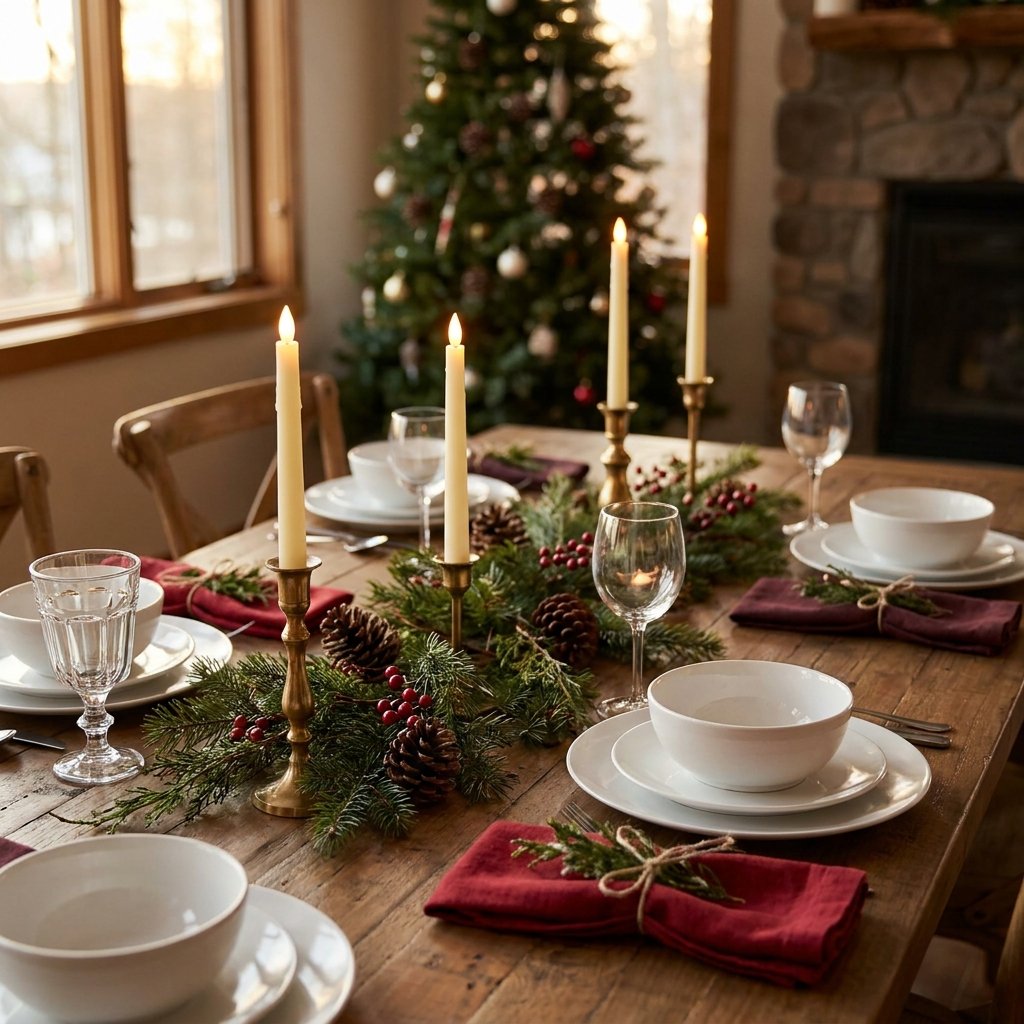
There is something especially inviting about a traditional Christmas table setting. Rich red and green, evergreen branches, warm candlelight, beautiful dishes, and a few classic holiday details can make Christmas dinner feel special before the food even reaches the table.
But traditional doesn’t have to mean formal, expensive, or complicated.
You can create a beautiful Christmas table with everyday white dishes, simple cloth napkins, greenery, ribbon, and decorations you already own. The key is using a recognizable Christmas color palette and repeating a few elements throughout the table.
Traditional Christmas decorating can also take several different directions. You might love classic red and green, prefer deeper burgundy with evergreen, or want an old-fashioned table filled with plaid, brass-toned candlesticks, pinecones, and warm wood.
Whatever version you choose, remember that this is still a dining table.
Guests need room for plates and glasses. Serving dishes need somewhere to go. And centerpieces should encourage conversation rather than creating a decorative wall down the middle of the table.
These traditional Christmas table setting ideas will help you create a festive table that feels warm, timeless, and practical enough for a real Christmas dinner.
Choose a Traditional Christmas Color Palette
Start with two or three main colors.
You don’t need every Christmas color on the table.
Classic Christmas
Red + green + white
Elegant Traditional
Burgundy + evergreen + cream
Old-Fashioned Christmas
Red + green + warm wood + brass tones
Traditional Neutral
Evergreen + cream + brown + gold tones
Tartan-Inspired
Deep red + forest green + cream + black
Using a limited palette keeps a traditional table from looking overly busy.
1. Start With White Dinnerware
You don’t need Christmas dishes to create a Christmas table.
Everyday white or cream dinnerware makes a versatile foundation.
Then add Christmas color through:
- Napkins
- Greenery
- Ribbon
- Centerpiece
- Glassware
- Place cards
Simple dishes are especially helpful when the table already contains plaid, greenery, berries, or other patterned and colorful elements.
2. Add Deep Red Napkins
Red cloth napkins immediately make white dinnerware feel festive.
For a traditional look, try:
- Cranberry
- Burgundy
- Brick red
- Classic Christmas red
If the rest of the table is colorful, choose a solid napkin.
Fold it simply on top of the plate or beside the flatware.
You don’t need an elaborate Christmas-tree napkin fold to make the table feel special.
3. Use Evergreen Down the Center
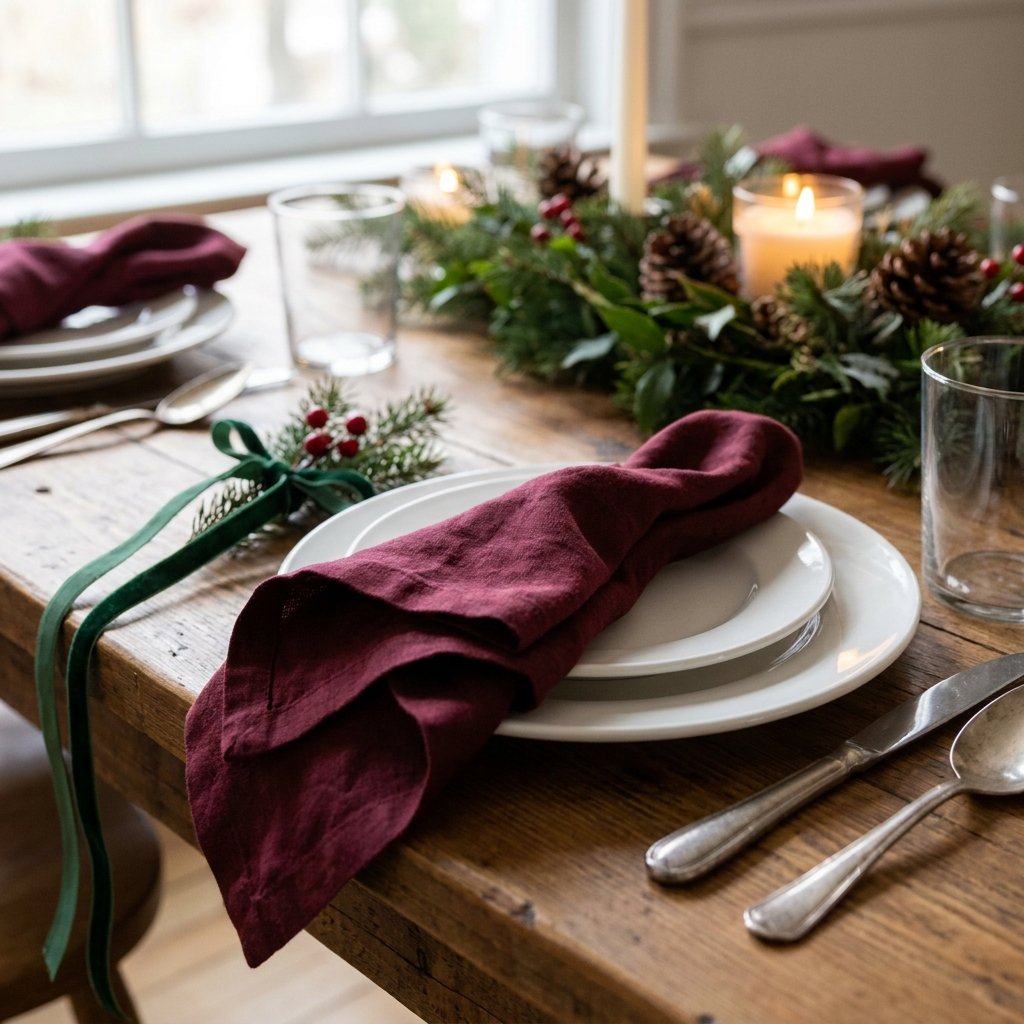
Greenery is one of the easiest ways to create a traditional Christmas centerpiece.
Use a loose arrangement of appropriate fresh greenery or realistic faux evergreen.
Keep it relatively narrow so guests still have room for:
- Glasses
- Plates
- Serving dishes
A thick garland can look beautiful in photos but may take up too much space during dinner.
If necessary, remove part of the centerpiece before serving the meal.
4. Add Pinecones
Pinecones bring natural brown tones and texture to red-and-green Christmas decor.
Place a few among the greenery rather than scattering them across every place setting.
If you’re bringing natural pinecones indoors, make sure they’re clean and dry before using them around your dining area.
Keep pinecones and other dried natural materials away from open flames.
5. Add Red Berries
A small amount of red berries can connect the greenery to red napkins or other accents.
Use realistic faux berries or appropriate decorative stems.
Tuck several small clusters into the centerpiece rather than creating a continuous line of bright red.
The berries should be an accent, not the entire centerpiece.
If decorative berries aren’t food-safe, keep them away from food and serving surfaces.
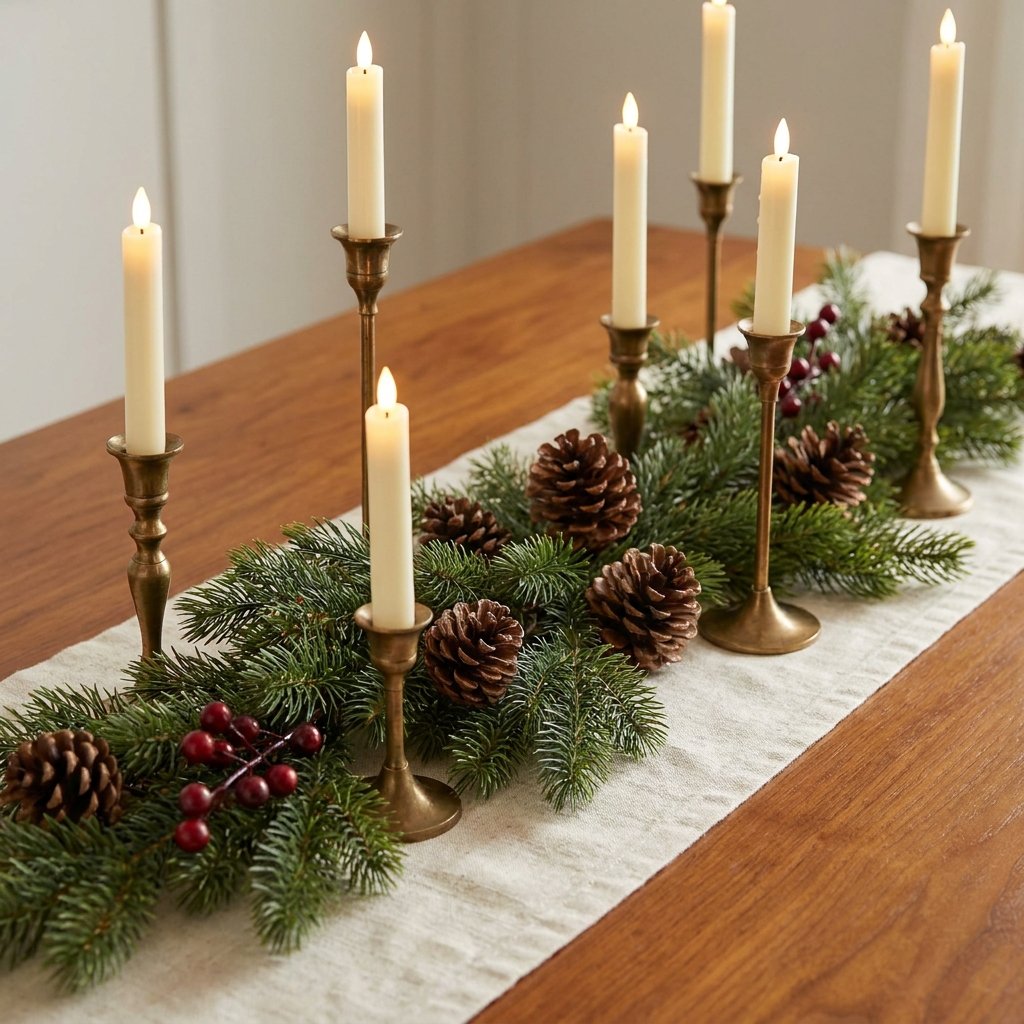
6. Use Candlesticks for Height
Candlesticks bring height to a low centerpiece without blocking the entire view across the table.
Try:
- Brass-toned metal
- Glass
- Wood
- Dark metal
Varying the heights creates more interest.
For a table filled with greenery, pinecones, ribbon, and other combustible materials, flameless tapers are the easiest choice.
7. Add Plaid
Plaid can instantly make a Christmas table feel traditional.
But you don’t need much.
Try plaid through:
- Napkins
- Table runner
- Ribbon
If you use a patterned runner, keep other textiles relatively simple.
For example:
Plaid runner + solid red napkins
or:
Neutral runner + plaid napkins
Using plaid everywhere can quickly make the table feel visually busy.
8. Tie Napkins With Velvet Ribbon
Velvet brings rich texture to a Christmas table.
Try ribbon in:
- Burgundy
- Forest green
- Deep red
- Brown
Fold the napkin loosely and tie the ribbon around the middle.
Add a small decorative evergreen sprig if desired.
Keep non-food-safe greenery away from direct food contact.
9. Add Simple Place Cards
Place cards make Christmas dinner feel thoughtful, even when the rest of the table is relaxed.
You don’t need an elaborate craft.
Write each guest’s name on a simple card and place it:
- Above the plate
- On the napkin
- Against a pinecone
- In a small card holder
Choose paper that coordinates with the table rather than adding another strong color.
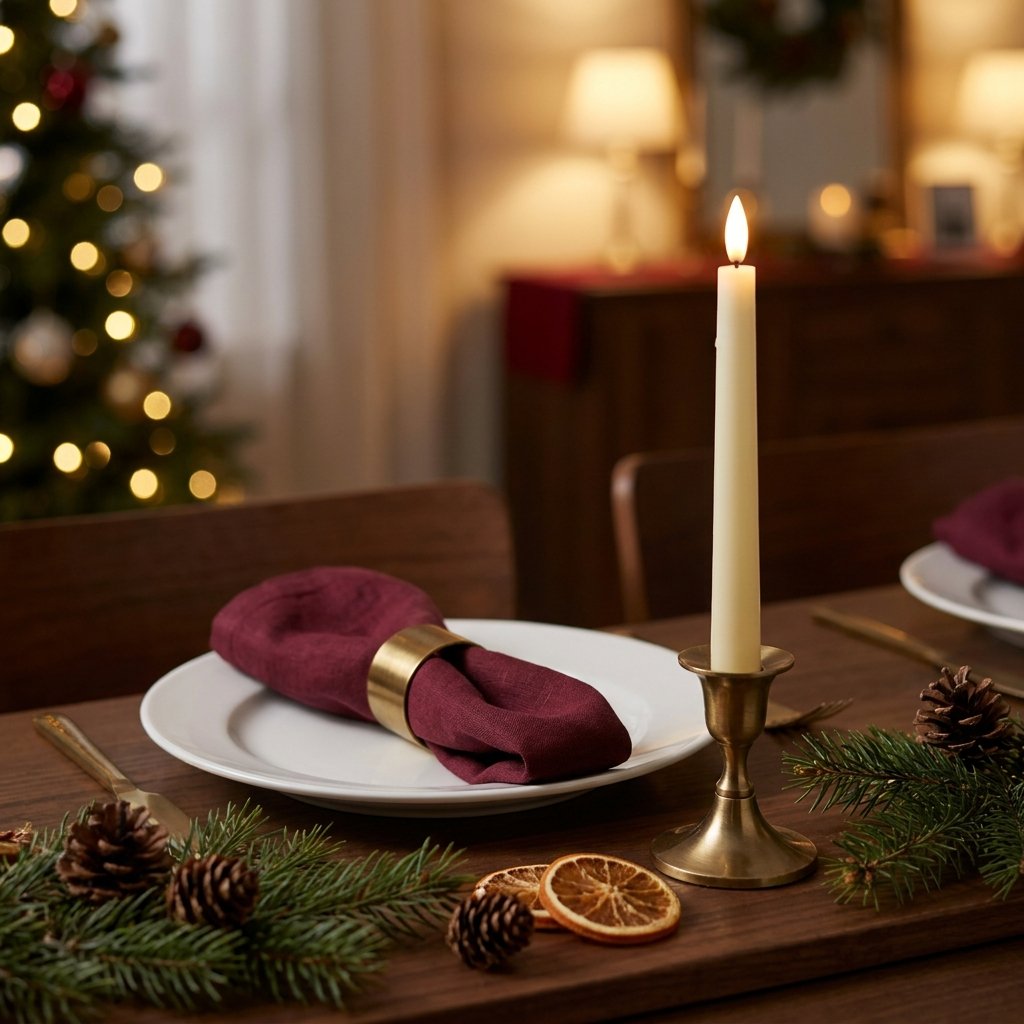
10. Use Brass-Toned Accents
Warm brass tones work beautifully with traditional red and green.
Bring them in through:
- Candlesticks
- Napkin rings
- Small bowls
- Serving pieces
You don’t need to replace all your flatware with gold-toned flatware.
A few warm metallic details are enough to add richness.
11. Add Vintage-Looking Glassware
Clear glassware is always appropriate, but vintage-inspired glasses can add another layer to a traditional table.
Try subtle:
- Etched glass
- Ribbed glass
- Goblet shapes
If you’re using colorful glassware, keep the rest of the place setting fairly restrained.
The table doesn’t need every element to become a focal point.
12. Use a Table Runner Instead of a Tablecloth
A runner lets you introduce color while leaving more of the table visible.
On a wood dining table, that can be particularly beautiful.
Try:
- Cream linen
- Deep red
- Plaid
- Forest green
Use a runner that lies flat and doesn’t interfere with place settings or serving dishes.
13. Use a White Tablecloth for a Formal Look
If you want Christmas dinner to feel a little more formal, start with a white or cream tablecloth.
Then layer:
- White dishes
- Red napkins
- Greenery
- Warm metal accents
The light background helps the traditional Christmas colors stand out.
Make sure table linens are positioned safely around candles and hot serving dishes.
14. Add Small Christmas Ornaments
Ornaments aren’t only for the tree.
A few simple ornaments can add sparkle to a table.
Use them:
- In a decorative bowl
- Among greenery
- In a small centerpiece
Choose one or two ornament colors rather than mixing every ornament in your collection.
For example:
Red + antique gold tones
or:
Burgundy + cream
Avoid placing fragile ornaments where they could easily roll from the table.
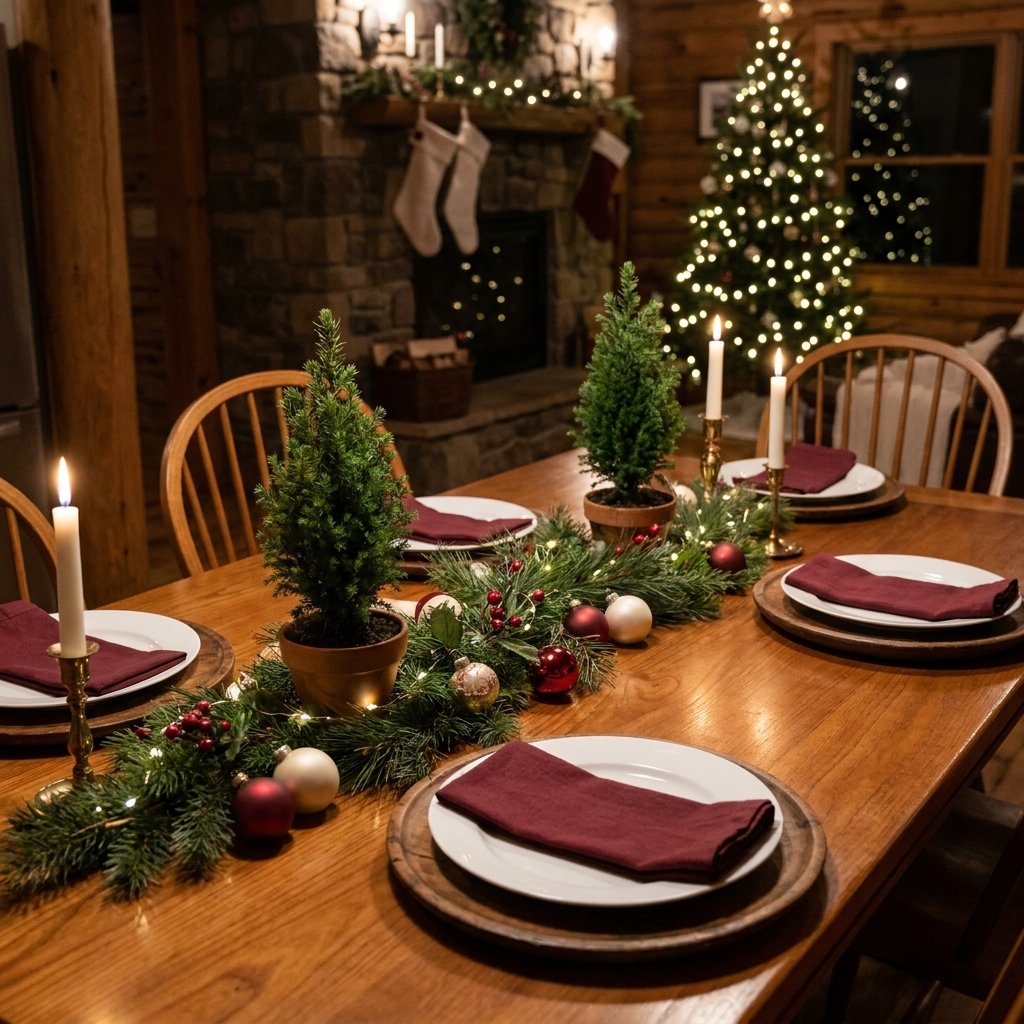
15. Decorate With Mini Christmas Trees
Small tabletop trees can make a fun centerpiece.
Choose trees that are:
- Narrow
- Stable
- Low enough for the table
Or place taller trees on a nearby sideboard instead.
A row of small bottle-brush-style trees can work well on a table, but don’t use so many that there’s no room left for dinner.
16. Add Warm Wood
Wood helps traditional red and green decor feel warmer and less formal.
Use:
- Dining table
- Serving board
- Wood candlesticks
- Small decorative bowl
Wood also connects beautifully with pinecones and greenery.
And because it’s useful throughout the year, you don’t have to store it with seasonal decorations afterward.
17. Add a Bowl of Ornaments to the Sideboard
The dining table doesn’t have to hold every Christmas decoration.
Place a decorative bowl of ornaments on the buffet or sideboard.
Add:
- Lamp
- Greenery
- Small Christmas tree
This spreads the Christmas color around the room while leaving more space on the dining table.
18. Decorate the Chandelier
If your dining room has a chandelier or pendant, a small amount of greenery or ribbon can help connect the upper half of the room to the table.
However, only decorate a fixture when it can be done safely.
Do not place combustible greenery, ribbon, or decorations against bulbs, hot surfaces, moving parts, electrical components, or areas where the fixture manufacturer requires clearance.
When in doubt, leave the fixture undecorated and use the table or sideboard instead.
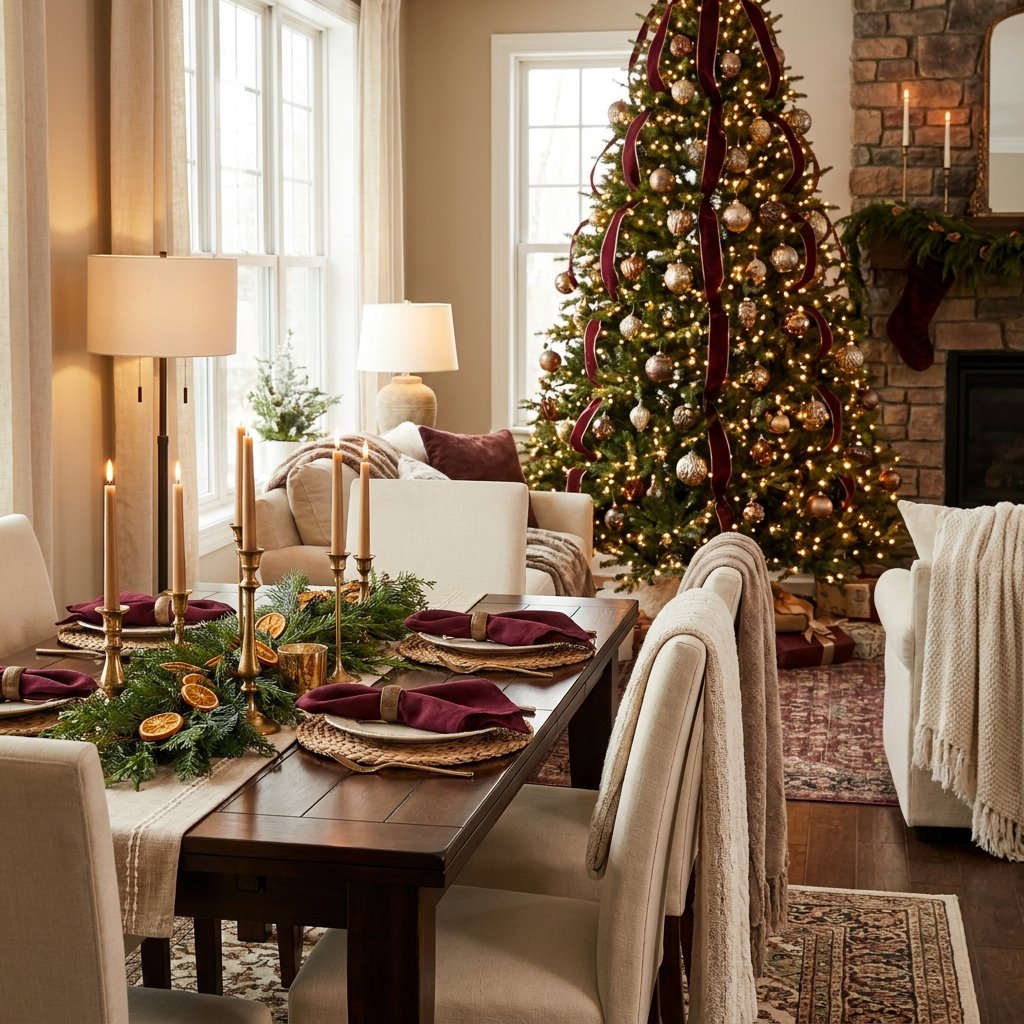
19. Let the Christmas Tree Become Part of the Dining Room
If the Christmas tree is visible from the dining table, use it as part of the room’s color palette.
You don’t need the table to compete with it.
If the tree has:
- Red ribbon
- Gold-toned ornaments
- Greenery
- Warm white lights
repeat just one or two of those details on the table.
This makes the entire dining room feel coordinated.
A Simple Traditional Christmas Table Formula
If you’re not sure where to begin, use this combination:
White dishes + red napkins + greenery + candles + one natural element
For example:
White dishes + burgundy napkins + evergreen + flameless brass-toned candlesticks + pinecones
That’s enough to create a traditional Christmas table.
How to Set a Traditional Christmas Table Step by Step
Step 1: Decide Where the Food Will Go
Will dinner be served:
- Family-style at the table?
- From a buffet?
- From a kitchen island?
This determines how much room you have for decorations.
Step 2: Add the Tablecloth or Runner
Or leave a beautiful wood table uncovered.
Step 3: Set the Dinner Plates
Position the largest necessary dinnerware first.
Step 4: Add Flatware
Only put out utensils that will actually be used.
Step 5: Add Glassware
Make sure glasses don’t compete with the centerpiece for space.
Step 6: Add Napkins
Place them on the plate or beside the setting.
Step 7: Build a Low Centerpiece
Start with greenery.
Then add pinecones or berries.
Step 8: Add Candlesticks
Keep them out of areas where guests need to reach frequently.
Step 9: Add Place Cards
Finish each place setting with a simple personal detail.
Step 10: Sit Down and Test the Table
Can you see the guest opposite you?
Can you reach your glass?
Is there enough space for food?
If not, remove something.
Traditional Red and Green Christmas Table
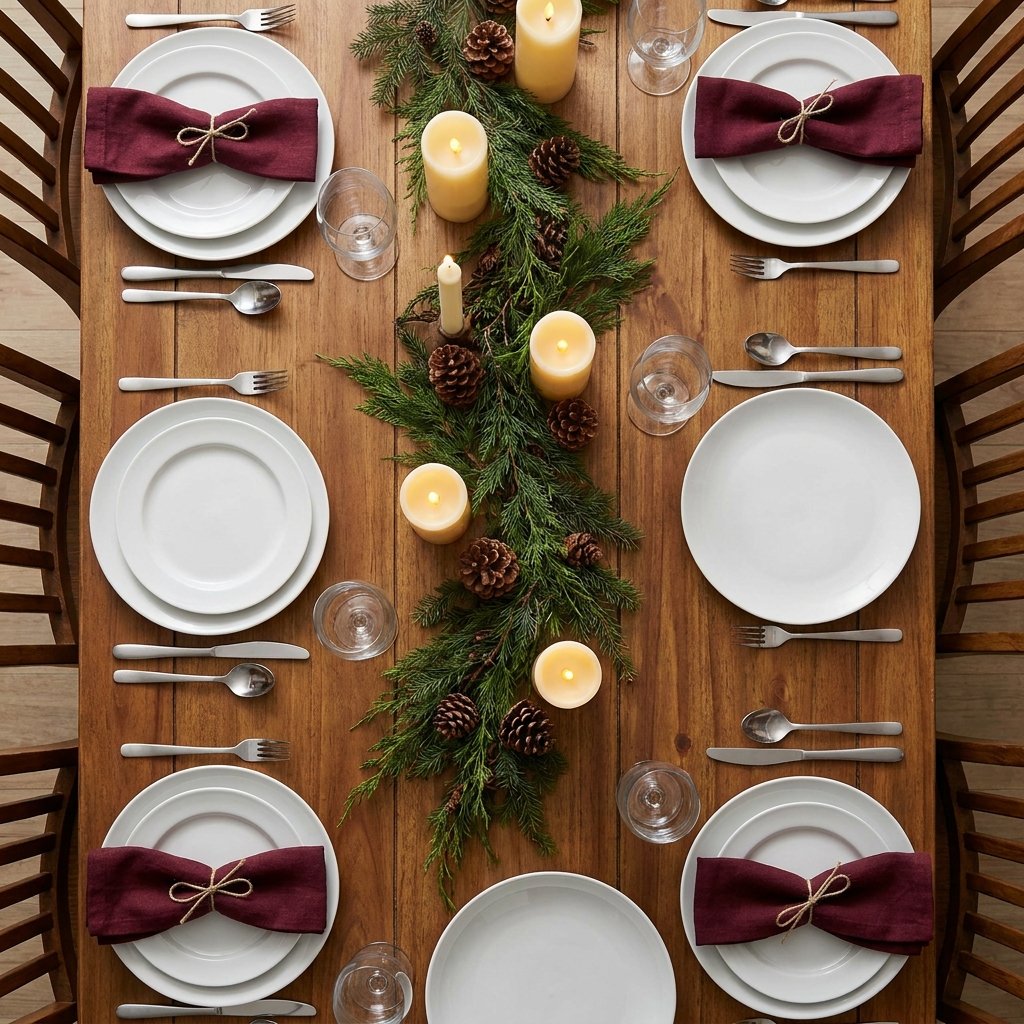
For the most classic version, use:
- White dishes
- Red napkins
- Greenery
- Red berries
- Brass-toned or wood candlesticks
Keep the background relatively neutral so the red and green don’t become overwhelming.
A wood table or white tablecloth works well.
Burgundy and Green Christmas Table
For a deeper, more sophisticated traditional palette, replace bright red with burgundy.
Combine:
- Burgundy napkins
- Evergreen
- Cream dishes
- Brown pinecones
- Brass-toned accents
This is still unmistakably Christmas but feels a little moodier.
Plaid Christmas Table Setting
Choose one plaid pattern and let it lead the color palette.
For example, if your plaid contains red, green, cream, and black, repeat only a few of those colors elsewhere.
Keep dishes simple.
Plaid already provides plenty of pattern.
Old-Fashioned Christmas Table Setting
For a nostalgic look, layer:
- Red
- Evergreen
- Warm wood
- Pinecones
- Brass tones
- Vintage-looking glassware
Add small traditional ornaments or old-fashioned-looking ribbon.
Avoid making every accessory look antique. Mixing older-inspired pieces with simple everyday dishes keeps the table approachable.
Traditional Christmas Table Without Red
You can create a traditional table without red.
Try:
Evergreen + cream + warm wood + brass tones
Use:
- White dishes
- Green napkins
- Evergreen centerpiece
- Pinecones
- Ivory candles
The greenery still gives the table a classic Christmas feeling.
Traditional Christmas Table for a Small Table
Small tables need fewer decorations.
Try:
- One short evergreen arrangement
- Two flameless candlesticks
- Several pinecones
Keep individual place settings simple.
Skip chargers and extra decorative plates if they take up valuable room.
Traditional Christmas Table for a Round Table
Use one compact centerpiece in the middle.
Try a low bowl filled with:
- Evergreen
- Pinecones
- Ornaments
Add three flameless pillar candles at varying heights if there’s enough room.
Keep everything contained so guests have adequate space around the perimeter.
Traditional Christmas Table for a Long Table
Rather than creating one huge centerpiece, repeat smaller groupings down the middle.
For example:
Candlestick + greenery + pinecones + candlestick + greenery
Repetition creates visual continuity without requiring a thick garland from end to end.
Christmas Table With a Centerpiece You Can Move
If dinner will be served family-style, make the centerpiece removable.
Build it on:
- Tray
- Long board
- Shallow container
Then move the entire arrangement to the sideboard when the food arrives.
This is much easier than relocating individual ornaments, candles, pinecones, and greenery.
How to Make a Traditional Christmas Table Look Expensive
You don’t necessarily need expensive dishes or linens.
Focus on presentation.
Limit the Palette
Use three or four main colors.
Repeat Materials
Use greenery in several places rather than adding many unrelated decorations.
Choose Fewer, Larger Decorations
Avoid dozens of tiny objects.
Use Cloth Napkins
They instantly make the table feel more finished.
Vary the Heights
Combine a low centerpiece with taller candlesticks.
Add Texture
Mix linen, greenery, wood, glass, ceramic, and metal.
Leave Empty Space
A little negative space makes each element more noticeable.
Budget-Friendly Traditional Christmas Table Ideas
Before shopping, look through your Christmas decorations.
You may already have:
- Ornaments
- Ribbon
- Greenery
- Pinecones
- Small trees
Then look through your everyday kitchen and dining pieces.
You may have:
- White dishes
- Clear glasses
- Serving boards
- Bowls
- Candlesticks
- Cloth napkins
Combine the two collections.
Instead of buying Christmas-specific dinnerware, spend your decorating budget on pieces that can be reused throughout the year.
Christmas Table Decorating Safety
Dining tables combine decorations, food, people, fabric, and sometimes flames, so safety matters.
- Flameless candles are the easiest option around greenery, ribbon, paper, pinecones, and fabric.
- If using real candles, use stable holders and never leave them unattended.
- Keep open flames well away from combustible decorations.
- Don’t place candles where guests must reach over flames.
- Keep hot serving dishes on suitable heat-resistant surfaces.
- Keep decorative greenery and ribbon away from hot serving equipment.
- Make sure runners and tablecloths don’t create hazards.
- Keep breakable ornaments stable and away from table edges.
- Keep small decorations away from young children and pets where appropriate.
- Use only electrical decorations appropriate for their intended location.
- Keep cords away from walking areas and liquids.
- Never decorate light fixtures in ways that interfere with heat dissipation, electrical components, bulbs, or manufacturer-required clearances.
Common Traditional Christmas Table Setting Mistakes
Adding Too Much Red and Green
Let neutral dishes and wood provide visual rest.
Making the Centerpiece Too Tall
Guests should be able to see one another.
Filling the Entire Table
Dinner still needs somewhere to go.
Using Too Many Patterns
If you’re using plaid, simplify other textiles.
Buying Christmas-Specific Everything
Everyday dishes can work beautifully.
Using Too Many Small Decorations
Group a few stronger pieces instead.
Forgetting About the Sideboard
Move some decor away from the dining table.
Making Every Place Setting Too Complicated
Guests shouldn’t need to dismantle decorations before they can eat.
Forgetting Candle Safety
Use flameless candles around combustible Christmas decorations whenever possible.
FAQ About Traditional Christmas Table Settings
How do you set a traditional Christmas table?
Start with simple dinnerware and cloth napkins. Add evergreen greenery, candles, pinecones, ribbon, and a few red, burgundy, or warm metallic accents.
What colors are traditional for a Christmas table?
Red, green, white, cream, burgundy, brown, and warm gold or brass tones all work well.
What can I use for a traditional Christmas centerpiece?
Try evergreen branches, pinecones, berries, ornaments, small Christmas trees, and flameless candles arranged in a low centerpiece.
Do I need Christmas dishes?
No. White or cream everyday dishes are one of the easiest foundations for a traditional Christmas table.
How can I make my Christmas table look elegant?
Limit the color palette, use cloth napkins, repeat materials, vary decorative heights, and leave enough open space around each place setting.
How can I create a traditional Christmas table on a budget?
Use your everyday dishes and glassware, then repurpose ornaments, ribbon, greenery, and pinecones from your existing Christmas decorations.
What can I use instead of a Christmas tablecloth?
Try a linen runner, plaid runner, woven placemats, or leave a wood dining table uncovered.
How do I decorate a Christmas table when serving food family-style?
Keep the centerpiece narrow or arrange it on a tray so you can quickly remove it when the serving dishes arrive.
Final Thoughts
A beautiful traditional Christmas table setting doesn’t require special Christmas dishes or an elaborate centerpiece.
Start with what you already have.
Use simple white dishes.
Add red or burgundy cloth napkins.
Bring evergreen down the center of the table.
Tuck in a few pinecones or berries.
Then add warm candlelight with flameless tapers in wood, glass, or brass-toned candlesticks.
If you love plaid, use it in one place. If you prefer a slightly more elegant traditional table, replace bright red with burgundy and add cream and warm metal accents.
Most importantly, leave room for Christmas dinner.
A festive table should still be comfortable enough for guests to eat, talk, pass dishes, and enjoy the meal.
By combining classic Christmas colors with greenery, natural textures, simple dinnerware, and a few carefully chosen details, you can create a table that feels timeless and festive without becoming complicated.